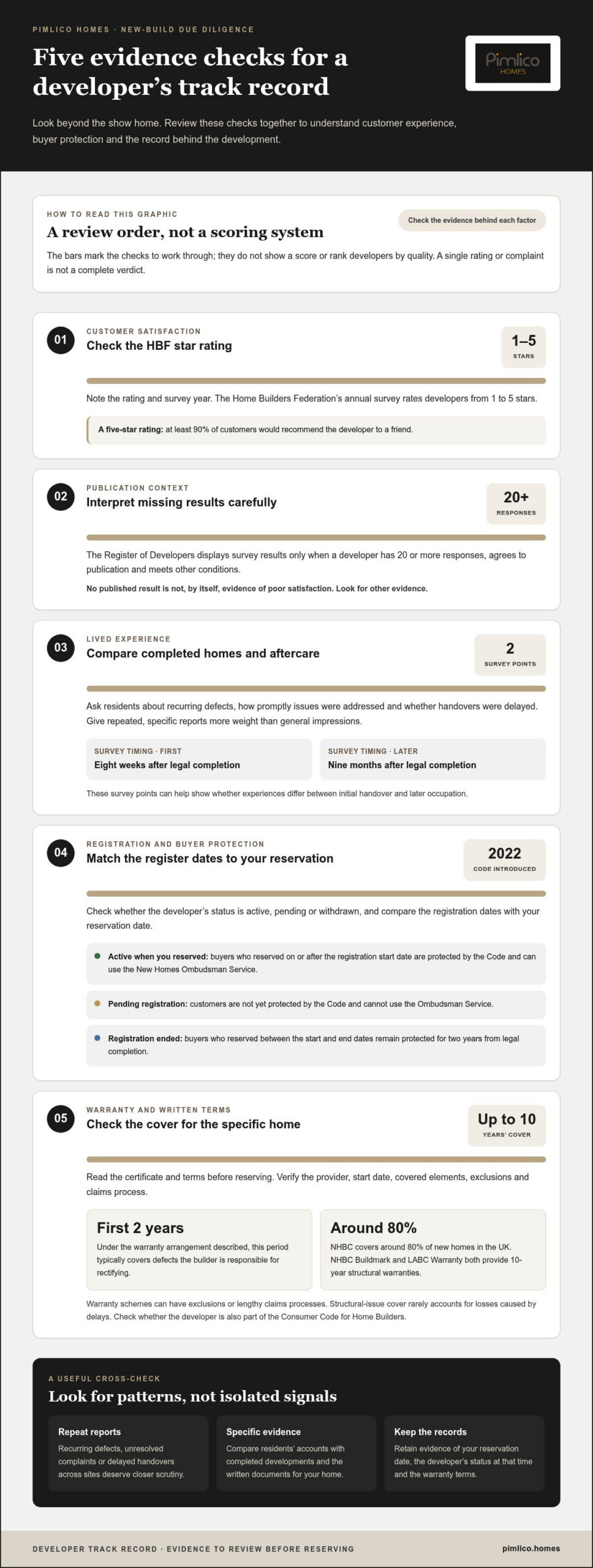
A polished show home is not a developer’s track record. To learn how to check a new-build developer’s track record, review its Home Builders Federation satisfaction rating, registration status, structural warranty and history of complaints before reserving. The Federation’s annual survey rates developers from 1 to 5 stars; a five-star rating means at least 90% of customers would recommend the developer to a friend.
Look beyond a property’s finish when assessing a new-build developer’s track record. Registration and warranty arrangements affect what protection may be available if problems arise, while a developer’s history can reveal recurring issues. If a project stalls or a developer becomes insolvent, buyers may face uncertainty about a home that is still under construction.
This guide explains how to assess satisfaction ratings, check registration and warranty status, and identify warning signs in a developer’s record. You’ll also learn how to investigate past developments and complaints, helping you make a considered decision before committing to a new-build home.
Key Takeaways
- Look beyond the show home: compare completed developments and speak with residents to understand how build quality and after-sales experience hold up.
- Check the developer’s registration and the warranty documents for the specific home, including who provides cover and what it applies to.
- Look for patterns in complaints, planning problems or abandoned projects; repeated issues deserve closer scrutiny than a single complaint.
- Review company accounts and ownership alongside site risks: according to the Environment Agency, Flood Zone 1 indicates an annual probability of flooding of less than 0.1%.
Home Builders Federation customer satisfaction ratings
Treat the Home Builders Federation (HBF) rating as one piece of evidence, not a complete verdict. Compare it with the timing of the survey, the developer’s completed homes and residents’ accounts.
Check HBF customer satisfaction ratings
- Find the developer’s HBF star rating and note its survey year before comparing builders. The HBF awards ratings from 1 to 5 stars through its annual customer satisfaction survey of recent new-build homeowners. A five-star rating means at least 90% of customers would recommend the developer to a friend. Record the score beside the developer’s name and the development you are considering.
- Read the result in context. The Register of Developers displays survey results only when a developer has 20 or more responses, has agreed to publication and meets other conditions. An absent result does not, by itself, establish poor satisfaction. Look for other evidence instead of treating missing results as a rating.
Compare defects, aftercare and completion records
- Compare accounts from residents of completed developments. Note recurring defects, how promptly the developer addressed them and whether handovers were delayed. You can ask estate agents and solicitors about complaints or handover problems they have encountered. Give repeated, specific reports more weight than general impressions.
- Check the survey timing when interpreting feedback: buyers receive the National New Homes Customer Satisfaction Survey eight weeks after legal completion and again nine months after legal completion. These points can show whether experiences differ between the initial handover and later occupation. For site context, according to the Environment Agency, Flood Zone 1 indicates an annual probability of flooding of less than 0.1%.
Checking developer registration and warranty status
- Search the developer’s status on the New Homes Quality Board’s Register of Developers. The New Homes Quality Code was introduced in 2022. Buyers who reserved while the developer was active on the register, on or after its registration start date, are protected by the Code and can use the New Homes Ombudsman Service. Check the registration dates against your reservation date, not simply the date you view the property.
- Check whether the developer’s registration is active, pending or withdrawn. Customers of a developer with pending registration are not yet protected by the Code and cannot use the Ombudsman Service. If registration has ended, buyers who reserved between its start and end dates remain protected for two years from legal completion. Keep evidence of your reservation date and the developer’s status at the time.
- Ask which structural warranty applies to the specific home, then read its certificate and terms before reserving. Structural warranties for most UK new-build homes provide cover for up to 10 years. Under the warranty arrangement described, the first two years typically cover defects the builder is responsible for rectifying. Check the provider, start date, covered elements, exclusions and claims process rather than relying on a verbal summary.
- Compare the written warranty with the completion documents and retain copies. NHBC covers around 80% of new homes in the UK; NHBC Buildmark and LABC Warranty both provide 10-year structural warranties. These schemes can offer reassurance, but they do not replace checks: protections may have exclusions or lengthy claims processes, and structural-issue cover rarely accounts for losses caused by delays. Also check whether the developer is part of the Consumer Code for Home Builders, which supports buyer protection and after-sales care.
Investigating disputes, planning permission and financial difficulties
Look for recurring problems across developments, not isolated comments. Review planning records, company information and project history together.
Investigate disputes and planning permission
- Search the developer’s name alongside terms such as “dispute”, “complaint” and “planning rejection”. Compare the reports with available planning records for the development you are considering. Note whether permission was rejected, revised or granted, and whether the completed project differs from earlier plans.
- Check whether the same concerns arise across separate sites. Repeated reports of leaks, faulty wiring or delayed handovers warrant more attention than a single complaint. A pattern of planning difficulties or unresolved disputes also deserves closer examination before you reserve.
Check company accounts and ownership
- Search Companies House using the developer’s exact legal name. Compare its filed accounts and ownership information with the trading name used in sales materials. A developer may use a separate company for each project, so identify the legal entity named in the reservation documents.
- Read accounts across several filing periods, noting changes in cash, borrowing, liabilities and reported trading activity. Compare the company’s directors and ownership over time. Frequent changes do not prove that a business is in difficulty, but they can help you understand whether the company behind the development has changed.
Review insolvency history and financial difficulties
- Search the developer’s legal name and connected project companies for insolvency notices and administration or liquidation records. Match names carefully, as similar trading names may refer to different legal entities. Record relevant dates and identify the developments involved.
- Look for broader patterns, such as repeated financial difficulties or abandoned developments. Insolvency can leave buyers’ money tied up in a partly built project without a clear resolution. Compare company records with site progress and the outcomes of past projects instead of relying on a single warning or reassuring sales statement.
How to check a UK developer’s company accounts, ownership and insolvency history?
- Start with the developer’s exact legal name and company number, using its reservation documents or sales paperwork. Search Companies House to distinguish the contracting company from its trading name. As developers may use separate companies for individual sites, match the relevant entity to the home you are considering.
- Read the latest filed accounts and compare them with earlier filings. Look for changes in cash, borrowing, liabilities and reported activity. A single figure rarely tells the whole story; consider whether the overall direction aligns with the developer’s project activity and delivery record.
- Review the directors and persons with significant control listed on the Companies House record. Compare current details with previous filings and note changes in ownership or leadership. Check how the company behind the development relates to the wider group named in sales materials.
- Search the legal entity and connected project companies for records of administration, liquidation or other insolvency events. Match each result by company number, not just by name. Note which company was involved and whether its history relates to the development you are considering.
- Compare those records with the developer’s portfolio and progress on site. A change in ownership alone does not establish financial trouble, but rising liabilities, reduced activity and unfinished projects together deserve attention. Look for repeated patterns rather than drawing conclusions from one filing.
- Keep a short record of company names, filing dates, ownership changes and project outcomes. This makes it easier to discuss specific evidence with your solicitor before reservation. If your research supports taking the next step, explore new-build homes as part of your decision.
Pimlico Homes: Luxury Detached Homes
Pimlico Homes offers Luxury Detached Homes for buyers considering a new-build home after reviewing a developer’s record. If your priorities include a more individual design, Bespoke Luxury Homes may also suit your brief; Executive Courtyard Homes and Luxury Barn Conversions provide other distinct options.
Use your research to clarify what matters most in your next home, from its setting and layout to its architectural character. These priorities offer a considered starting point for exploring available homes and deciding which direction suits your plans.
Explore the homes at pimlico.homes and contact Pimlico Homes to discuss your next step.
Choose a home that fits your future
Let your research shape a more considered brief. Think beyond the immediate purchase: how you want to live, the setting that feels right and the architectural character you hope to come home to. These priorities can turn a complex decision into a clearer sense of direction.
Pimlico Homes offers Luxury Detached Homes, Executive Courtyard Homes and Bespoke Luxury Homes. Each provides a different starting point for considering the form and feel of a new home. If you’re still deciding how to check a new-build developer’s track record, keep your own priorities beside the evidence, so the final choice reflects both confidence in the development and fit with your plans.
When you’re ready to explore those possibilities, contact Pimlico Homes to discuss your plans. A well-considered next step can bring your vision of home into sharper focus.
Frequently Asked Questions
What can go wrong without proper checks?
Without thorough checks, buyers may miss recurring defects, unresolved disputes or signs that a development could remain unfinished. Problems can include poor materials, faulty wiring and delayed handovers. If a developer becomes insolvent during construction, money may be tied up in an incomplete project. Reviewing documents and speaking with residents can reveal issues that a carefully presented show home may not show.
How to check a UK property developer’s track record?
Build your assessment from several kinds of evidence rather than relying on one rating or review. To check a new-build developer’s track record, match its legal identity to the specific development, then compare feedback, completed projects, planning history and published company information. Separate recurring concerns from isolated complaints. This makes it easier to raise specific questions with your solicitor before reserving.
Where to find reviews and complaints about a UK house builder?
Look for feedback from past buyers, residents and people familiar with completed developments. Search the developer’s legal and trading names alongside specific terms such as “leaks”, “faulty wiring” or “delayed handover”. Estate agents and solicitors may also have heard recurring concerns. Compare the dates, locations and details of reports: repeated, similar accounts carry more weight than an unsubstantiated comment.
How to check a developer’s previous new-build developments and build quality?
Visit a completed development by the same builder, ideally two to five years after completion, and arrange the visit in advance. Look at the condition of shared areas and visible external finishes, then speak with residents about their experience. An occupied development can offer a more useful view of lasting workmanship than a newly dressed show home.
Is the developer registered with the New Homes Quality Board or Consumer Code for Home Builders?
Check the New Homes Quality Board’s Register of Developers and compare the developer’s registration dates with your reservation date. Buyers who reserved while the developer was active on the register, on or after its registration start date, can use the New Homes Ombudsman Service under the New Homes Quality Code. Check Consumer Code for Home Builders membership separately as another buyer-protection consideration.
How to check NHBC or other warranty claims against a UK developer?
Start with the warranty certificate for the specific property, then request a written record of reported claims, their outcomes and any unresolved items. Compare this with the current owner’s account and any available inspection or repair documents. Make sure the warranty provider and the home covered match the paperwork. A developer’s general reputation cannot establish whether a specific defect was reported or remedied.