
A truly intelligent home is designed into the building, not added as an afterthought. Smart home automation in luxury new build homes works best when lighting, heating, shading, audio and security are coordinated through an integrated control platform. Personalised scenes, app or voice controls, and carefully planned connectivity can make everyday routines feel effortless.
Convenience is only part of the appeal. Thoughtful automation can help manage energy use and home security, while controls tailored to your routines keep technology intuitive rather than intrusive. If you are considering how to automate your home, this guide covers the foundations to plan during a new build, from connected systems and whole-home scenes to climate control and voice operation. The aim is to clarify how technology can complement both the architecture and the way you live.
Key Takeaways
- Plan cabling, network capacity and control points during the design stage so the home’s technology is integrated with its architecture.
- Choose compatible systems that bring lighting, shading, climate, audio and security together through a clear, unified control interface.
- Use tailored scenes and schedules to make everyday routines simpler, manage energy use and support privacy and security.
- Shape voice controls and automation around your household’s routines, entertaining habits and the way each space is used.
1. Matter and professionally integrated control platforms
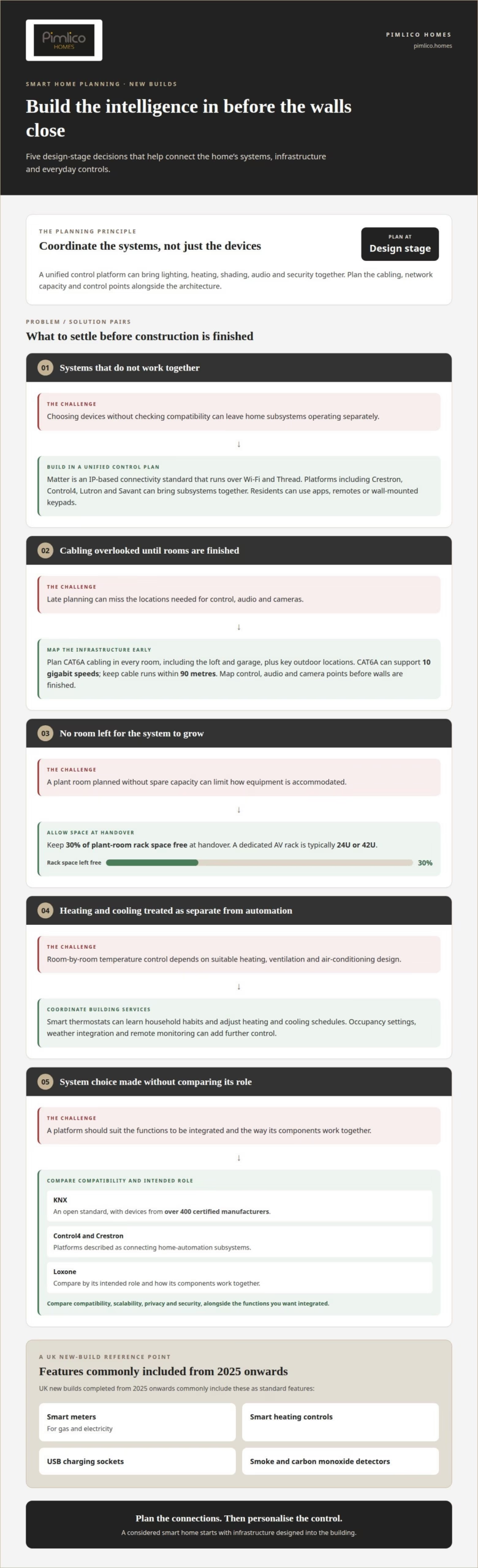
For smart home automation in luxury new build homes, begin with compatible devices and a unified control platform. Matter is an IP-based connectivity standard that runs over Wi-Fi and Thread. Platforms including Crestron, Control4, Lutron and Savant can bring home subsystems together. Apps, remotes and wall-mounted keypads give residents clear ways to control them.
Which systems are best for a UK luxury new build? The right choice depends on compatibility, scalability, privacy and security, as well as the functions you want integrated. KNX is an open standard with devices from over 400 certified manufacturers; Control4 and Crestron can connect home-automation subsystems. Compare those options with Loxone by the system’s intended role and how its components work together.
Which features are popular in UK luxury homes? Lighting control is a common starting point, alongside heating controls and smart meters. UK new builds completed from 2025 onwards commonly include smart meters for gas and electricity, smart heating controls, USB charging sockets, and smoke and carbon monoxide detectors as standard features.
At the design stage, plan CAT6A cabling in every room, including the loft and garage, plus key outdoor locations. It can support 10 gigabit speeds, and cable runs should stay within 90 metres. Allow 30% of plant-room rack space to remain free at handover; a dedicated AV rack is typically 24U or 42U. Map control, audio and camera points before walls are finished, and plan enterprise Wi-Fi with a segmented network.
How should heating, cooling and ventilation connect to the system? Room-by-room temperature control depends on suitable heating, ventilation and air-conditioning design. Smart thermostats can learn household habits and adjust heating and cooling schedules; occupancy settings, weather integration and remote monitoring can add further control. A successful smart home automation plan for a luxury new build coordinates these building services with the wider home system.
KNX offers an open standard with products from a broad range of certified manufacturers, while Control4 and Crestron are described as platforms for connecting home subsystems. Loxone should be compared by its intended role and how its components work together.
2. Whole-home scenes combining lighting, shades, audio, climate and security
A well-designed scene brings several devices together with one command. In the morning, bedroom lights can brighten gradually as shades open and the thermostat moves towards your preferred setting. Later, a cinema scene might lower the blinds, soften nearby lighting and prepare the selected audio zone. These settings make comfort feel considered, without requiring residents to adjust each system separately.
Architectural lighting works best when its controls reflect how each room is used. A kitchen might have brighter task lighting for food preparation and a softer setting for dining; a hallway may follow a different schedule from a living room. Plan lighting zones and control points alongside the room layout. Custom scenes can then adjust light levels across connected spaces, using wall keypads or an app.
Motorised shades add another layer of control. Schedule them by time of day, or link their position to lighting and climate settings to manage natural light and privacy. Fabrics with high UV blocking can help reduce fading to floors, upholstery and artwork. For entertaining, whole-home audio can play different music in individual rooms or connect indoor and outdoor zones as guests move around.
Scenes can also link security with everyday routines. A departure command could activate the home’s security mode, adjust lighting and set shades, while an arrival scene restores preferred settings. This makes control straightforward without requiring every device to behave identically. For a new build, considering these interactions alongside the architecture helps keep the installation discreet and the finished rooms visually coherent. Explore luxury new build homes as you plan how connected scenes could complement the spaces you want to create.
3. Convenience, energy optimisation and security benefits
Energy control can make everyday comfort more deliberate. Heating accounts for approximately 55% of energy use in the average UK home, so room-by-room settings can focus warmth where homeowners need it. Manufacturers estimate that smart thermostatic radiator valves can save 10 to 20% on energy. Actual savings depend on heating patterns and insulation, making the home’s construction and daily use important considerations.
Security systems can bring together high-resolution cameras, smart locks, video doorbells and access control. For example, cameras and motion sensors can trigger perimeter lighting when movement is detected at night. Separate credentials and permissions can be set for staff or guests, with entry times logged. This gives access management a clear structure instead of relying on shared keys.
A video intercom lets residents see a caller before granting access, while a smart lock can lock or unlock a door remotely and monitor entry. Footage can be recorded on a device inside the home rather than stored through a cloud subscription. This affects where recordings are kept and how privacy is managed. Position cameras to monitor entrances and boundaries without unnecessarily capturing private interior spaces.
Plan security infrastructure during construction, when wiring for cameras, access points and equipment can be installed before walls are finished. A battery-backed network rack can help keep internet access, cameras and remote access running through short power interruptions. To reduce the risk of technology becoming obsolete, consider compatibility, scalability, privacy and security when selecting devices. A system that can accommodate future equipment is easier to develop than one built around isolated products, helping homeowners maintain control as their needs change.
4. Voice-controlled systems and personalised automation
Voice control offers a direct way to operate connected spaces, alongside apps, remotes and wall-mounted keypads. A resident could ask for the living room lights to dim, music to play or the temperature to change. Set clear permissions and retain physical controls so everyone can use the system comfortably.
Start personalisation with a practical brief: how you live, entertain and use different spaces. Note preferred room temperatures, morning and evening routines, and which audio or video equipment should work together. Smart thermostats can learn household habits and adjust heating and cooling schedules. This helps automation respond to patterns rather than relying only on fixed timings.
Entertainment systems can bring audio and video controls into a single app, while smart appliances may support remote operation and monitoring. For example, an evening setting could prepare a living space for a film by coordinating selected audio and lighting controls. Platforms such as Lutron can form part of an integrated system when the selected devices are compatible.
Fire protection also belongs in the design conversation. The Viadux penthouse integrates fire detection and sprinkler systems discreetly, showing how safety equipment can be considered alongside interior design. In another home, the arrangement should reflect its layout and the building services selected.
System budgets vary according to specification. A focused installation may cover selected controls, while a full bespoke system involves broader platform hardware and programming across more spaces. Key factors include the rooms and devices involved, the chosen platform and the level of integration.
How should homeowners brief a UK smart home installer? Describe household routines, entertaining habits, room uses and long-term goals, then identify the controls and systems you want. This gives the design team a clear basis for developing a coherent specification.
Explore a home designed around your routines and consider how integrated controls could support the way you live.
Pimlico Homes: Luxury Detached Homes
Pimlico Homes offers luxury detached homes, executive courtyard homes, bespoke luxury homes and luxury barn conversions. If you are considering a new home, these provide a starting point for thinking about how its architecture, spaces and technology should work together.
Smart controls are most effective when decisions reflect the home’s layout and your routines from the design stage. Consider how lighting, temperature, entertainment and security should support daily life, then carry those priorities into conversations about your new home. A bespoke home can provide a particularly personal setting, with its design shaped around the way you intend to live.
To explore a home that reflects your aspirations, visit pimlico.homes.
Shape a Home Around the Way You Live
Treat technology as part of the home’s long-term character, not simply a catalogue of devices. Picture how you want the house to feel at different points in the day: welcoming on arrival, calm for rest and adaptable as routines change. That vision can guide decisions about the spaces, controls and infrastructure that matter to you. Consider which experiences should remain simple as equipment changes, and where technology should be discreet. Planning smart home automation in luxury new build homes is ultimately about creating a setting that remains intuitive as your life evolves.
Pimlico Homes offers Luxury Detached Homes, Executive Courtyard Homes and Bespoke Luxury Homes for those considering a home that reflects their priorities. Contact Pimlico Homes to discuss your plans. A considered home begins with a clear sense of how you want to live, and there is room to make that vision your own.
Frequently Asked Questions
How can I automate my house?
Start with one routine you would like to simplify, such as preparing the house for bedtime. List the actions involved, the rooms affected and who needs to control them. Choose compatible devices and create a scene that brings those actions together. Test the settings in daily use and refine them, rather than automating every room at once.
What are some things I can automate in my home?
You can automate lighting, heating, blinds, entertainment, security and some appliances. For example, a home system could switch off selected lights and appliances when you leave while keeping chosen devices available. Prioritise functions that remove a repeated task or make a room easier to use. A carefully chosen group of connected devices can be more useful than adding technology without a clear purpose.
How much does smart home automation cost in a UK new-build home?
There is no single cost for a UK new-build system. The price depends on the specification, including the rooms and devices involved, the level of integration, the control platform, cabling and programming. A focused specification and a whole-home design have different scopes, so compare what each includes rather than judging by device count alone.
How can smart lighting, heating and blinds be integrated in a new-build home?
Begin by deciding how each room should respond at different times, then group lighting, heating and blinds accordingly. For example, a study could have a work setting with task lighting and a comfortable temperature, while blinds adjust to daylight. Specify the intended behaviours and control points in the home’s plans, then test each setting in the finished rooms.
What are the energy-saving and security benefits of smart home automation?
Automation can reduce unnecessary lighting and heating by linking controls to schedules or room use. Remote access to locks and camera views can also help residents manage entry while away. These features are most useful when settings reflect normal routines: heating schedules should account for occupancy, while security permissions should match each person’s access needs.
What are the risks of proprietary systems, cybersecurity issues and vendor lock-in?
A proprietary system may limit future choices if replacement devices or support depend on one supplier. Connected devices can also expose personal data or create security weaknesses if accounts and network access are poorly managed. Before committing, map which functions depend on specific products, limit each person’s permissions to what they need, and consider how the system could be maintained as devices change.





