
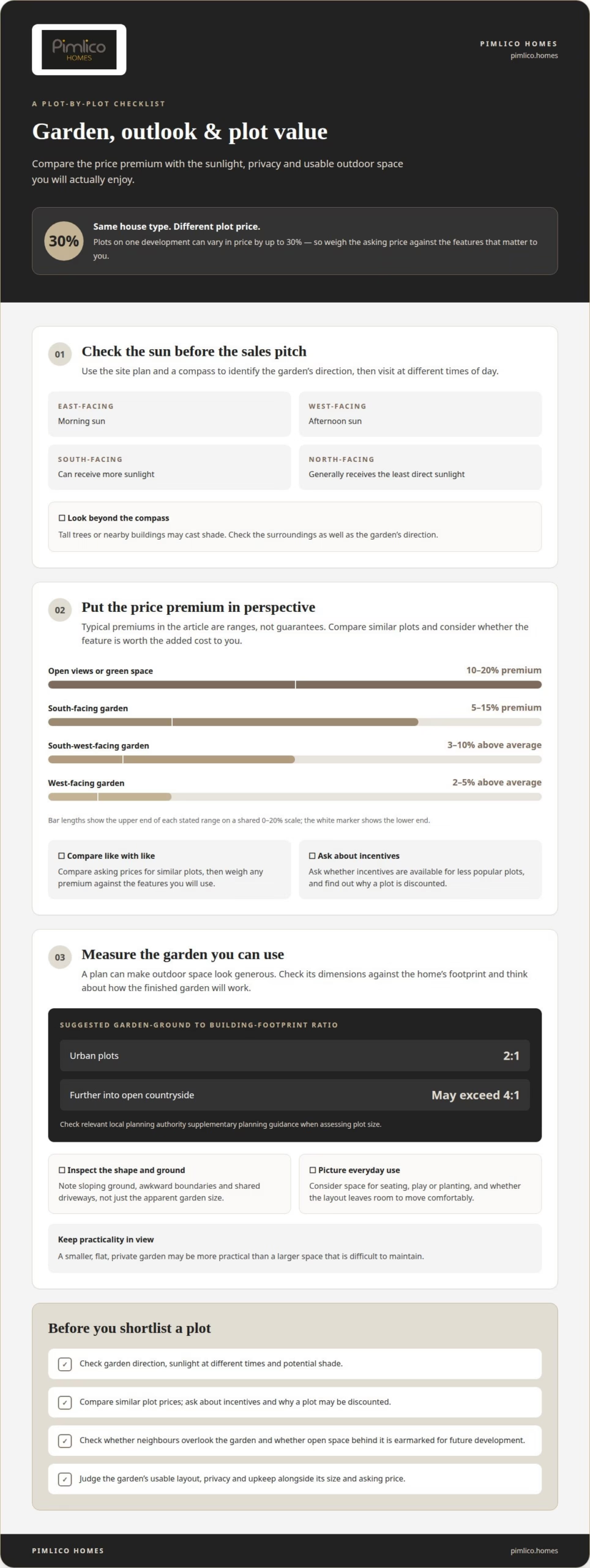
The best plot is not always the most expensive one. You can ask whether a specific plot’s price is negotiable and whether incentives are available for less popular plots; plots with the same house type can vary in price by up to 30%. Knowing how to choose the best plot on a new-build development means weighing its price against the garden, outlook, position and practical responsibilities that come with it.
It’s natural to focus on the house itself, but the plot shapes how you use your home and outdoor space every day. A sunny garden or quieter position may matter more than a corner plot or a particular view, so the right choice depends on your priorities.
This guide explains how to compare plot prices, assess garden orientation and privacy, understand shared access and maintenance responsibilities, and review planning status and the site plan. You’ll also find practical points to consider before negotiating, so you can make a considered decision about a home intended to feel right for years to come.
Key Takeaways
- Compare each plot’s price with its orientation, privacy and garden usability; plots with the same house type can vary in price by up to 30%.
- Clarify boundaries, shared access, maintenance duties and any restrictions before deciding what the plot includes.
- Distinguish planning potential from existing permission, and understand what approved drawings, conditions and outstanding approvals mean for your choice.
- Use the site plan to shortlist plots, then visit the area to assess traffic, noise, access and what may be built nearby.
Is a south-facing garden really worth paying more for?
The best plots for gardens, views and outdoor space combine useful sunlight, privacy and a layout you can enjoy. Prices vary across a development: south-facing gardens typically carry a 5-15% premium, while plots with open views or green space typically carry a 10-20% premium.
-
Check Garden Orientation and Sunlight
Use the site plan and a compass to identify the garden’s direction, then visit at different times of day. South-facing gardens can receive more sunlight; east-facing gardens get morning sun, while west-facing gardens get afternoon sun. North-facing gardens generally receive the least direct sunlight. Tall trees or nearby buildings may cast shade, so assess the surroundings as well as the compass direction.
-
Compare Garden Layouts, Views and Premiums
Compare the asking prices of similar plots, then weigh any premium against the features you will actually use. A south-west-facing garden typically costs 3-10% above average, and a west-facing garden 2-5% above average. Ask whether incentives are available for less popular plots, and find out why they are discounted. Check whether neighbouring homes overlook the garden, and whether an open space behind it is earmarked for future development.
- Measure usable space, not just the garden’s apparent size on a plan. Compare its dimensions with the home’s footprint, and note sloping ground, awkward boundaries or a shared driveway. For urban plots, a suggested garden-ground-to-building-footprint ratio is 2:1; plots further into open countryside may exceed 4:1. Check relevant local planning authority supplementary planning guidance when assessing plot size.
- Picture how the garden will work once the home is complete. A smaller, flat, private garden may be more practical than a larger space that is difficult to maintain. Consider where outdoor seating, play space or planting could fit, and whether the shape leaves enough room to move comfortably. These details help you assess the plot’s lasting value beyond its initial price.
Shared access, maintenance responsibilities and restrictions
Before purchasing, establish what access, upkeep duties and restrictions apply to the plot. Ask the sales office about boundaries, shared routes, service easements, construction access, incentives and expected completion timing.
Flood risk, ground conditions and nearby plans need separate attention. Review the planning history and development masterplan, while appropriate surveyors and engineers investigate physical risks, including ground conditions, contamination, level changes and utility connections.
- Clarify boundaries and shared responsibilities. Ask which driveways, paths or communal spaces serve multiple homes, who maintains them, and whether charges or obligations apply. Find out whether easements or service routes cross the plot, and ask a solicitor to review legal rights, title restrictions and boundary uncertainties before committing.
- Understand construction access and timing. Ask whether your plot will be used for site access during building work, as this could delay completion. Request the current completion estimate and ask how updates are communicated. Dates can change because of unforeseen events, including materials shortages or extreme weather; a plot may not be ready for nine months, while show-home or later-phase plots may take months or even years.
- Ask what incentives apply and why. If an incentive is offered, establish its terms and whether it relates to the plot’s position, construction sequence or another factor. Also ask whether nearby building work could affect access, noise or the time before the surrounding development is complete.
- Review access, services and planning conditions. Establish how residents and construction vehicles reach the plot, where utility connections run, and whether neighbouring foundations, trees or infrastructure affect the land. Obtain the planning decision notice, approved drawings, conditions and relevant planning history; distinguish existing permission from a claim of planning potential.
- Assess the wider location and investigate risks. Consider walking routes to schools, shops and public transport, then review local planning applications for proposed development nearby. Surveyors and engineers can investigate flood risk, ground conditions and drainage; a solicitor can assess legal access and restrictions. These findings help you judge the plot’s position, future use and potential resale appeal.
Understanding these practical constraints can help shape a home around its setting. Explore plot-led design choices as you weigh what matters most.
Comparing types of plots and planning status
Compare each plot’s position, planning status and purchase terms before reserving. A reservation can prevent another buyer from taking the plot, while exchanging contracts makes the purchase legally binding. A clear set of priorities helps you decide how to choose the best plot on a new build development without letting release-day pressure dictate your choice.
- Compare plot types by their setting. End-terraced homes can have more windows, while corner plots may offer more garden space but less privacy. Check whether roads, the development entrance or nearby industrial sites could bring noise, traffic or pollution. A corner position may suit buyers seeking space; a quieter plot may better suit those prioritising privacy.
- Assess planning status, not just potential. Obtain the planning decision notice, approved drawings, conditions and relevant history. Distinguish existing permission from a statement that a plot has planning potential. If permission is granted, determine whether it is outline or detailed, what remains to be approved, and whether conditions or time limits affect the proposed home.
- Score plots against your own priorities. Weigh road noise, privacy, outlook, access and garden usability consistently, then compare the results. One framework scores plots out of 105: above 80 is rated excellent, 60-80 represents good value with acceptable compromises, and below 60 warrants careful consideration. Treat a score as a decision aid, not a substitute for your own judgement.
- Prepare before plots are released. Some developments allocate plots on a first-come, first-served basis, and a mortgage agreement in principle can help you decide promptly. Discuss customisation before reserving, since options depend on the build stage. Ask what the reservation terms cover, including any deadline and deposit arrangements.
- For buyers considering how to choose the best plot on a new build development, understand deposit terms before committing. Outright purchasers typically pay a deposit of 10% to 30% of the property value at exchange; shared-ownership buyers typically pay 5% to 10% of the share they are buying. Review the contract and reservation terms carefully, as these govern your specific purchase.
A reservation may stop another buyer taking the plot, but exchanging contracts makes the purchase legally binding. Ask about reservation deadlines, deposit arrangements and plot customisation before committing, since options depend on the build stage; the contract and reservation terms govern your purchase. At exchange, outright buyers typically pay 10% to 30% of the property value, while shared-ownership buyers typically pay 5% to 10% of the share they are buying.
Reviewing the site plan and visiting the area
Before reserving, use the site plan to assess plot boundaries, orientation, parking and neighbouring properties. Then visit the estate to compare its drawn layout with the surrounding roads, amenities and planned development.
-
Review the Site and Master Plans
Start with the master plan to understand the development’s overall layout and what is planned around your preferred plot. Identify future phases, roads, communal areas and open space, then consider how construction or new homes could affect privacy and outlook. A green space shown behind a garden may not remain open if plans designate it for future development.
-
Read the Development Site Plan
Locate the plot and study its boundaries, street names, landscaping, parking bays and availability status. Check its orientation and proximity to neighbouring homes, communal areas and bin collection points, which can affect privacy or noise. Note nearby substations and pumping stations, too. Use the drawing to compare positions, but remember a sales-brochure plan does not prove a proposed scheme can be approved or built.
-
Visit the Area to Review the Plans
Walk or drive the surrounding roads and compare them with the plan, including routes outside the estate. Notice traffic, access, nearby amenities, schools and public transport, then consider how each journey would fit into daily life. Visit the plot’s surroundings at different times to understand activity and noise. Check whether a quiet cul-de-sac feels secluded or sits close to communal spaces or future construction.
Use these observations to refine your shortlist before making a decision. Explore new-build homes shaped by thoughtful design as you consider the setting and layout that suit you.
Pimlico Homes: New build homes
Pimlico Homes creates luxury new build homes for buyers considering how a carefully chosen setting can shape everyday living. Once you have weighed the plot’s outlook, access, planning position and surroundings, the next decision is the home that belongs there.
Explore the possibilities through Luxury Detached Homes, Executive Courtyard Homes and Bespoke Luxury Homes, alongside Luxury Barn Conversions. Each offers a distinct way to think about space, character and the relationship between a home and its setting. Your priorities, from a sense of privacy to a considered connection with the outdoors, can help guide that choice.
If you are considering a new home, contact Pimlico Homes to discuss your next step.
Make your next decision with clarity
Before negotiating, decide what would make the purchase feel right beyond the headline figure. Set out your priorities, the compromises you can accept and the terms that matter to you. This gives your discussion a clear purpose and helps you assess any response against your own plans, rather than making a decision under pressure.
Knowing how to choose the best plot on a new build development is also about imagining the life you want to lead there. Consider how the home and its setting should support your routines, now and as they change. That perspective can help you focus negotiations on meaningful value and make a choice you can feel confident about.
Pimlico Homes creates homes with a strong sense of place and individual character. Start a conversation with Pimlico Homes about your next home, and take the next step towards a setting that feels distinctly yours.
Frequently Asked Questions
Can I negotiate the price of a specific plot?
Yes, you can make an offer or ask whether the developer will consider an incentive. Build your case around comparable plots on the same development, identifying differences that matter to your decision, such as outlook, position or parking arrangements. Be clear whether you are proposing a lower purchase price or another incentive, and consider the complete terms rather than focusing on one figure alone.
How do I assess whether the plot is right for me?
Assess the plot against your household’s routines, not only its appearance. Picture arriving home, unloading shopping, accommodating visitors and spending time outdoors. For example, a household that regularly hosts guests may value convenient parking, while someone working from home may prioritise a quieter position. Write down your essential needs and acceptable compromises, then use them to compare shortlisted plots consistently.
Should I buy an early-phase plot or wait for later phases?
Choose an early-phase plot if securing a preferred position matters more than seeing the development take shape first. Waiting can give you a clearer view of completed streets and occupied homes, but later phases can involve a longer wait and ongoing building activity nearby. Compare the likely construction sequence with your moving plans, and weigh the benefit of choice against the value of seeing more of the finished estate.
What size of plot do I need?
The right size depends on the home’s footprint and how you plan to use the land. Sketch the outdoor features you want, such as seating, planting, play space or storage, then consider how they fit alongside access and maintenance. A plot with generous dimensions can still feel awkward if its shape limits usable space. Focus on practical layout, not area alone.
What should I avoid when choosing a plot?
Avoid deciding from a brochure image or show home alone. These can create an impression that differs from the exact plot, its boundaries and surrounding activity. Base your decision on the specific home and its position, and keep written records of the details discussed during the purchase. Take time to compare the plot with your priorities before committing, particularly if a deadline is influencing your choice.
What factors should you consider when choosing a plot on a new-build development?
Consider price, position, access, outlook, outdoor space, planning status and the obligations attached to the plot. Then rank them by importance to your household. For instance, a quiet setting might outweigh a larger garden, or straightforward access might matter more than a particular orientation. This ranking makes comparisons more useful and helps you explain clearly why one plot suits your plans better than another.





