
A new-build development will generally need planning permission from the relevant local planning authority. Planning permission and building regulations approval are separate matters, and both may be required for building work in the UK. To understand how to check planning permission for a new build development, start with the council responsible for the site and its planning records.
It’s natural to look at nearby developments for clues, but another project’s approval does not establish what your site needs. Planning applications and decisions are public records, so you can review a proposal and its supporting documents through the relevant local planning authority.
This guide explains how to find the planning records for a site, what to look for and how to follow up if the position is unclear. It also covers the details that can shape an application, helping you understand the planning context before decisions about a new build’s design and delivery.
Key Takeaways
- Use the local planning register to examine application documents, approved plans and decision notices for the site.
- Identify the local planning authority responsible for the land, then follow its application process and requirements.
- Consider the proposal’s scale, location and design when assessing whether planning permission may be needed.
- Check whether an approval is full, outline or subject to reserved matters to understand what has been agreed and what remains to be decided.
Need planning advice?
Start with the planning register for the site’s local authority. Read the application documents alongside the decision notice to establish what was approved, which conditions apply and whether later approvals or decisions affect the record.
-
Search for new-build applications
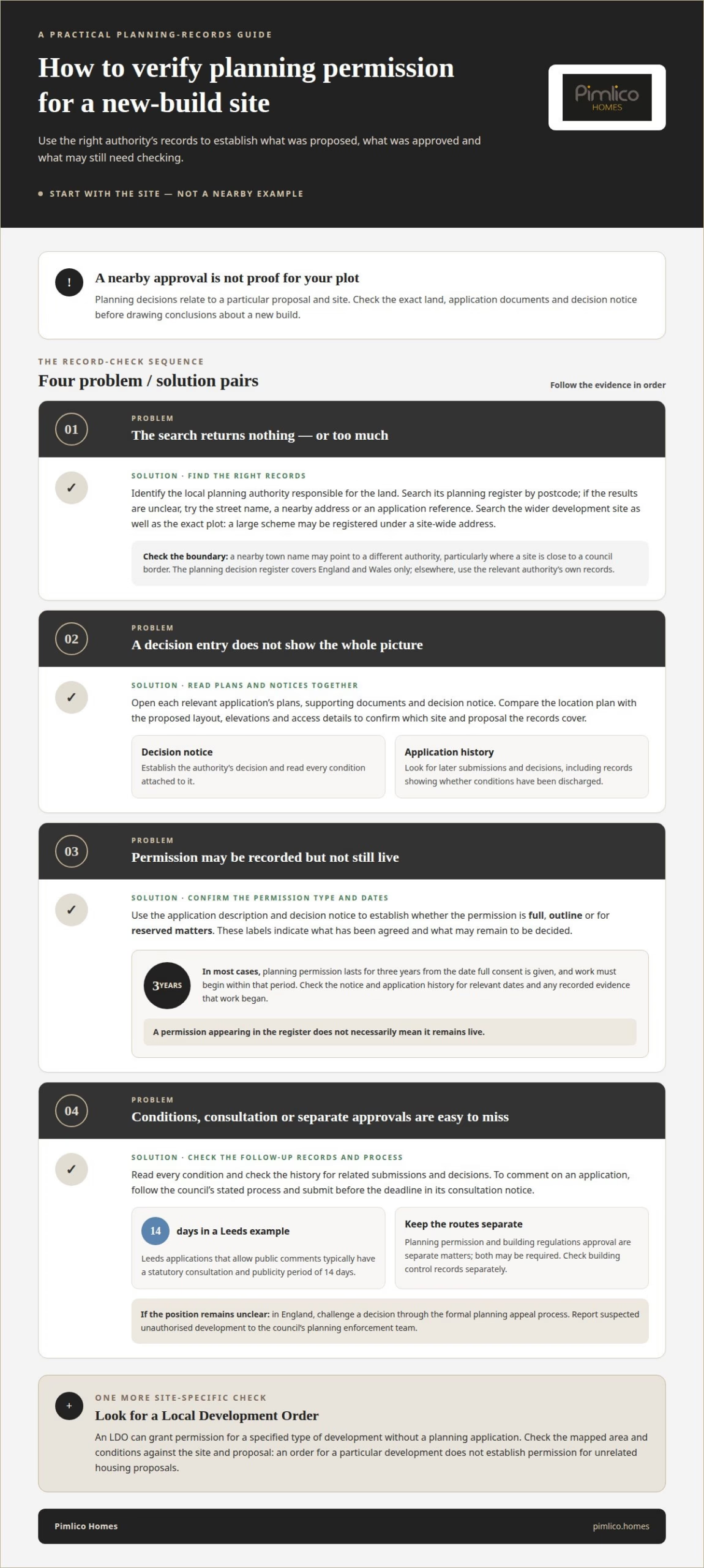
Search the relevant council’s planning portal by postcode. If the results are unclear, try the street name, a nearby address or an application reference. Search for applications covering the wider site as well as the exact plot: a large development may be registered under a site-wide address. The planning decision register covers England and Wales only.
-
Open plans, documents and decision notices
Open each relevant application and review its plans, supporting documents and decision notice. Compare the location plan with the proposed layout, elevations and access details to identify the site and proposal covered. Read the notice for the decision and conditions, then check the application history for later records showing whether conditions have been discharged.
-
Identify permission type and time limits
Check the application description and decision notice to establish whether permission is full, outline or reserved matters. In most cases, planning permission lasts for three years from the date full consent is given, and work must begin within that period. Use the notice and application history to check the relevant dates and any recorded evidence that work began. A permission appearing in the register does not necessarily mean it remains live.
-
Check conditions, comments and related approvals
Read every condition and search the application history for submissions and decisions relating to its discharge. To comment on an application, use the council’s stated process and submit before the deadline in its consultation notice. For example, Leeds applications that allow public comments typically have a statutory consultation and publicity period of 14 days. To challenge a decision in England, follow the formal planning appeal process; report suspected unauthorised development to the council’s planning enforcement team. Planning permission and building regulations approval may both be required, so check building control records separately.
Applying to the relevant local authority
Start with the authority responsible for the property, since planning applications are handled locally. In Scotland, Wales and Northern Ireland, search the relevant council or planning authority’s own records. The planning decision register covers England and Wales only.
-
Select the relevant local authority
Enter the site postcode into a council or government authority-finder to identify the correct planning area. Check the result against the property’s address and boundary, particularly where a site sits near a council border. A nearby town name may point to a different authority. Once identified, use the council’s planning contact page for its telephone, email or enquiry form, and direct questions to its planning service.
-
Search local planning records
Open the authority’s local planning application search and select filters for location, postcode or address. Search the development site itself, then try the wider street or settlement if no result appears. Review application descriptions for housing, new dwellings or site development, and note the reference number for relevant records. Leeds City Council cautions that its online planning history may be incomplete, so it should not be relied on for a property transaction.
-
Check Local Development Orders
Search the council’s planning policy pages for a Local Development Order, or LDO, covering the property. An LDO grants permission for a specified type of development without requiring a planning application, but its terms define what qualifies. Check the order’s mapped area and conditions against the site and proposal. An LDO for a particular development does not establish permission for unrelated housing proposals.
What planning permission is and when it is needed
Planning permission is the local authority’s approval for a development proposal. For a new house, check that the approval applies to the precise site and proposal, rather than relying on a nearby example.
- Read the application description and submitted plans to understand what the council considered. Planning permission is approval given by the local authority under powers provided by the Town and Country Planning Act 1948. It concerns the proposed development, while the decision notice records the authority’s outcome and any attached conditions. In England and Wales, councils make public plans for new developments that need permission. A neighbouring extension or a new school may also appear in local planning records, but its approval does not settle what your site requires.
- Check whether permitted development rights apply, and look for restrictions affecting the property. Local authorities can remove those rights in specific areas through Article 4 directions, requiring a full planning application for changes. Do not assume a proposal is exempt because it seems modest or similar to existing work. The site’s location, the proposal’s scale and any area-specific direction can alter the route. Search the council’s planning records for relevant directions before treating a new dwelling or change as permitted development.
- Compare the proposal with the council’s planning guidelines and recorded constraints. An extension exceeding 50% of the original house area is listed among the planning guidelines; the area is measured as built or as it existed on 1 July 1948. Demolition of a building under 115 cubic metres, measured externally, is also listed as a guideline consideration. These examples show why site details matter. A commercial proposal or residential scheme should be assessed against its own submitted plans, relevant local rules and decision records, not a broad assumption about development.
How to check whether planning permission is full, outline or reserved matters
- Open the council’s application record and find the application description. Look for the recorded permission type in the description, decision notice and any later application linked to the same site. Do not classify an approval from a project summary alone. Check that the reference relates to the correct plot or development phase, especially where a large site has several applications.
- Read the decision notice for the exact wording: full, outline or reserved matters. Use the recorded description as a starting point, then read the associated documents. Application titles may be abbreviated, while plans and supporting papers provide context. Note the reference number and decision date to distinguish the original decision from later submissions.
- Compare the decision notice with the approved plans and listed conditions. Note which drawings are named, whether further details are required and what action the conditions specify. For a reserved matters record, search the site history for related applications and decisions. Check each application’s description and site plan rather than assuming it covers the whole development.
- Build a clear sequence from the local planning register. Start with the original application, then follow linked references for later decisions, amended documents or reserved matters submissions. Compare each decision’s description and plans with the development phase you are assessing. This helps distinguish approval for one parcel or design detail from approval for every home on a wider site.
- When assessing a proposed new build, consider the permission type alongside the decision notice and documents. Keep the relevant plans and linked application references together. If the register’s wording appears inconsistent with its documents, contact the local planning authority with the reference number and ask which record clarifies the discrepancy. This makes your enquiry precise and site-specific.
Pimlico Homes
Pimlico Homes develops luxury new build homes, including Luxury Detached Homes, Executive Courtyard Homes and Bespoke Luxury Homes. Once you understand the planning position for a site, consider the home itself: its setting, design and suitability for the way you want to live. Planning decisions are specific to each proposal, so the local authority’s records remain essential when assessing a development.
If you are exploring a new-build home or a bespoke project, Pimlico Homes offers a considered route from initial interest towards a home shaped around its setting. For a different kind of project, its Luxury Barn Conversions bring another established property form into focus.
Contact Pimlico Homes to discuss your plans and the kind of home you are considering.
Take the next step with confidence
A well-considered home begins with a clear understanding of its setting and the decisions that shape it. Knowing how to check planning permission for a new build development helps you approach your next choices with greater confidence, while keeping the proposed home and its site in view.
Pimlico Homes creates Luxury Detached Homes, Executive Courtyard Homes and Bespoke Luxury Homes. If you are considering a new-build project, the design, site and planning context all form part of the wider vision. Bring your ideas into focus before deciding what kind of home feels right for you.
Contact Pimlico Homes to discuss your new-build plans and take a considered step towards a home shaped around your aspirations.
Frequently Asked Questions
Do you need permission?
Yes, a new dwelling will generally need planning permission from the local planning authority. A Local Development Order may grant permission for a specified type of development, but only within its stated scope. Check whether the order covers the actual site and proposal. Building regulations approval is separate, so planning permission alone does not settle every approval needed before construction.
Why might I be refused planning permission and what do I do about it?
An application may be refused if its design, access or effects conflict with planning considerations such as road safety, loss of light, noise, heritage or nature conservation. Read the decision notice for the authority’s specific reasons rather than relying on a general status label. You can consider revising the proposal to address those reasons or appealing the decision through the applicable process.
How to search a local council planning application portal for a new-build development
To understand how to check planning permission for a new build development, begin with the local council portal for the site. Search by postcode or address, then try the wider site name if a housing scheme has several phases. Open likely matches and compare their descriptions and location plans. An application title may refer to only one phase or part of the development.
What details are needed to find a planning application by address or postcode?
Start with the site’s full postcode or street address, and include the property name if it has one. For undeveloped land, use the nearest known address or development site name. An application reference is especially useful if you have one. If the first search produces no match, try a broader location description because the record may use a site name rather than an individual plot address.
How to check planning permission status and decision notices online
Knowing how to check planning permission for a new build development means looking beyond the portal’s summary status. Open the matching record and read the decision notice, which states the authority’s decision and identifies any conditions. Check the application history for later decisions that may affect the record. If the online status and notice appear inconsistent, contact the council’s planning team with the application reference.
How to view approved plans, conditions and supporting documents for a development
Open the document list within the relevant application and look for the decision notice, approved drawing schedule and supporting reports. Compare drawing references and revisions to distinguish approved plans from earlier submissions. Then read each condition alongside any later submission addressing it. A separate discharge decision can clarify whether a condition has been dealt with for that development.





