
A warranty is only meaningful if it is still in force and covers the fault in question. UK new-home warranties typically last 10 years, although the provider and policy terms determine the actual cover. To understand how to check if a property has a valid warranty, start with its certificate and policy documents, then confirm the dates, cover and claim process with the provider.
Look beyond the word “warranty” on a sales document. Cover may change over time, exclusions and claim limits matter, and a later owner may need the provider to update its records. The paperwork should explain what is covered, what is excluded and how to report a problem.
This guide explains how to verify the policy, find its claim instructions and review the seller’s TA6 property information form. With those details in hand, you can see what protection remains and what questions to raise during your purchase.
Key Takeaways
- Confirm the policy is active and matches the property, then establish what cover remains and which exclusions apply.
- Find the claim instructions in the warranty documents, including deadlines, required evidence and any costs you may need to meet.
- Use the TA6 form to identify disclosed guarantees and follow up on missing or unclear paperwork during conveyancing.
- For a new-build home, check the structural warranty certificate and ask how previous claims may affect the remaining cover.
Checking policy details with the provider
To check if a property has a valid warranty, start with the certificate and contact the named provider. Ask for written confirmation that the policy applies to the property and find out what cover remains in force.
Confirming structural warranty cover
For buyers asking how to check if a property has a valid warranty, the provider’s records are central. Give them the property address and certificate number, then ask them to confirm the policy dates, registered owner, remaining cover and recorded claims. A 10 year policy’s headline term does not establish how much protection remains. Ask the seller or conveyancer for the certificate and local authority building control completion certificate at completion. These documents serve different purposes.
For replacement windows and external doors installed after 1 April 2002, the UK Government says they must comply with Building Regulations Part L. Ask for the relevant compliance document when reviewing those installations.
Exclusions and conditions affecting cover
Exclusions describe faults or circumstances the policy does not cover; conditions set out requirements for maintaining protection. Major alterations may affect whether a warranty transfers to a later owner. Ask the provider how specific work affects the policy instead of assuming cover continues unchanged.
Check who can make a claim. An item’s warranty or guarantee may be limited to the original purchaser unless its terms include ‘third party rights’. Home warranty transfer rules can differ, so ask the provider to confirm the new buyer’s registration.
Responding to unconfirmed or absent cover
If the provider cannot find the policy, ask the seller for the certificate, schedule and transfer documents. Give these to your conveyancer and request written confirmation from the provider before relying on the cover. If there is no valid warranty, ask your conveyancer to explain the implications and assess the other property documents before you proceed.
A missing warranty does not remove every consumer right. According to the UK Government, consumers have legal rights for faulty goods for up to 6 years in England and 5 years in Scotland. Those rights differ from structural warranty cover, so discuss the relevant documents and possible claim route with your conveyancer.
Checking warranty paperwork and claim instructions
Read the policy alongside its certificate: the certificate identifies the scheme, while the policy explains which defects are covered and how claims work. Keep both documents accessible to the homeowner and conveyancer.
Evidence of validity and transferability
A certificate, policy schedule and written transfer record help establish whether cover applies to the property and its current owner. Check that the address, policy number, warranty period and named parties match across the documents. If the seller bought the home from a developer, request any transfer confirmation and ask the provider to update its records for the new buyer. A building control completion certificate is useful property paperwork, but it is not the warranty itself.
Warranty checks during a mortgage or conveyancing
Most UK mortgage lenders require structural warranty cover for properties less than 10 years old, and lenders are highly likely to require cover before completion of a new-build purchase. A warranty is not a universal legal requirement for every conveyance, but its terms can affect the buyer’s decision and lender’s requirements. Give the certificate and policy schedule to the conveyancer early, so they can establish whether the documents meet the mortgage conditions and whether the seller must provide anything further.
Warranty duration and cover periods
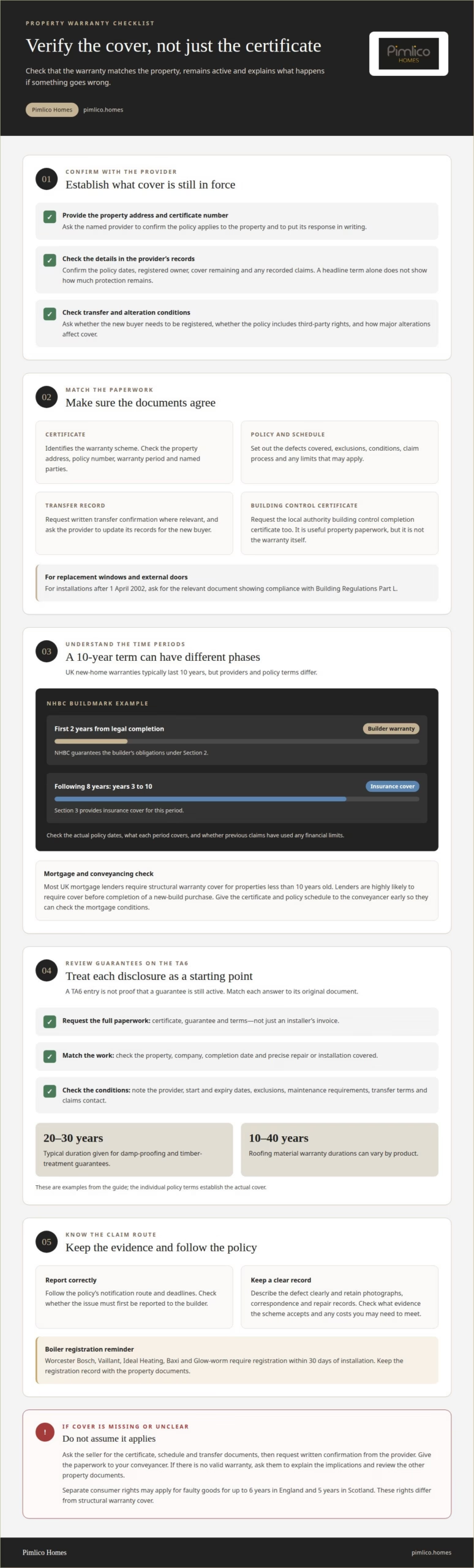
UK new-home warranties typically last 10 years, although providers may offer different terms. Under NHBC Buildmark, the first two years from legal completion form the builder warranty period, with NHBC guaranteeing the builder’s obligations under Section 2. Section 3 provides insurance cover for the following eight years, covering years 3 to 10. Check the policy dates: a later buyer needs to know how much time remains, what each period covers and whether previous claims have used any financial limits.
For a claim, follow the policy’s notification route and deadlines, describe the defect clearly, and retain photographs, correspondence and repair records. The paperwork should explain what evidence the scheme accepts and whether the homeowner must first report the issue to the builder. For boilers, Worcester Bosch, Vaillant, Ideal Heating, Baxi and Glow-worm require registration within 30 days of installation. Keep the registration record with the property documents. Buyers considering a newly built home can explore new-build homes as part of their search.
Disclosure of guarantees on the TA6 form
The TA6 gives a buyer a route to ask about guarantees and other property paperwork. Treat each answer as a starting point, not as proof that a guarantee remains active. A seller may refer to a roof repair, damp treatment or replacement installation; ask for the matching document and check that it identifies the work and property.
Match each disclosure to its original guarantee or insurance policy. Record the provider, work covered, start date, expiry date, exclusions and whether the protection can pass to a new owner. For example, damp-proofing and timber-treatment guarantees usually last 20 to 30 years, while roofing material warranties can run from 10 to 40 years, depending on the product. The policy terms, not the TA6 entry, establish the actual cover.
For each item listed, use this sequence:
- Ask the seller for the full certificate, guarantee and terms, not just an installer’s invoice.
- Check the named property, company, completion date and precise repair or installation covered.
- Look for transfer conditions, maintenance requirements, exclusions and a claims contact.
- Ask the provider whether the policy remains active and whether it accepts claims from a later owner.
A national warranty provider’s documents may differ from a contractor’s workmanship guarantee. Keep the records separate: one may insure specified defects, while another concerns the installer’s work. If an entry refers to a council or local authority inspection, request its completion or compliance record as supporting evidence. It does not replace a private guarantee or insurance policy.
Give unanswered or inconsistent TA6 entries to your solicitor before completion. For instance, a seller might disclose a roof repair but provide no transferable guarantee; your solicitor can advise what clarification or documents to seek before you proceed. A detailed inspection may also identify visible issues, but it cannot establish the legal status or claim terms of a guarantee. Keep the TA6, supporting documents and written provider responses together, so future buyers can follow the same record.
How can I check whether a new-build home has a valid structural warranty?
To check if a property has a valid warranty, start with the certificate and the home’s policy documents. The provider’s records should confirm that the policy applies to the property and remains in force. At completion, buyers are advised to obtain the seller’s warranty certificate and local authority building control completion certificate through their conveyancer. These documents serve different purposes: one records warranty cover, while the other records building control completion.
Contact the provider named on the certificate with the property address and policy reference. Ask it to confirm the current owner, cover dates, remaining protection and any previous claims. For an NHBC Buildmark home, a later owner can contact NHBC or their conveyancer to find out how much cover remains. Ask whether earlier claims have used any financial limits and whether shared parts, such as a communal staircase or shared wall, are covered.
To check if a property has a valid warranty, establish whether the policy transfers to you and what protection remains. Compare the address and policy details, then clarify any gaps:
- Confirm the certificate identifies the correct home and policy dates.
- Ask whether the current owner is recorded by the provider.
- Request information about previous claims and financial limits already used.
- Check which parts of the building the policy covers, especially in a flat or maisonette.
NHBC Buildmark provides 10-year warranty and insurance cover for newly built or newly converted homes. Its policy wording explains the cover and exclusions. A building control completion certificate alone does not establish that a structural warranty exists. If the seller cannot provide the warranty certificate, ask your conveyancer to seek it before completion.
For a property still under construction, NHBC Buildmark Section 1 covers loss of a deposit or increased completion costs if the builder becomes insolvent before completion. The policy stage matters as well as the final certificate. Buyers considering a new home can explore luxury new-build homes alongside their assessment of the purchase documents.
Pimlico Homes
Pimlico Homes is a natural next step if your warranty checks inform a wider decision about buying a home. Its Luxury Detached Homes, Executive Courtyard Homes, Bespoke Luxury Homes and Luxury Barn Conversions offer different approaches to a significant property purchase. For any home you are considering, weigh its design and setting alongside the warranty documents, including the certificate, policy terms and remaining cover.
Understanding warranty protection helps you assess the paperwork as part of your purchase, rather than as an afterthought. If you are exploring a new home, contact Pimlico Homes to discuss your requirements and the available property options.
Make your next property decision with confidence
Knowing how to check if a property has a valid warranty gives you a firmer basis for deciding what to do next. If the documents leave important questions unresolved, factor that uncertainty into your purchase plans rather than treating it as a minor detail. A home is a lasting commitment, and the quality of its design should sit alongside a clear understanding of its paperwork.
Pimlico Homes offers Luxury Detached Homes, Executive Courtyard Homes and Bespoke Luxury Homes. If you are considering your next property, explore the options with your requirements in mind, including the documentation you want to understand before moving forward.
Contact Pimlico Homes to discuss your next step. A considered decision can help you move towards a home that feels right for the years ahead.
Frequently Asked Questions
What’s covered?
A property warranty covers only the defects, components and circumstances specified in its policy. Structural policies may address defined defects in the home, while a boiler guarantee concerns that appliance and its stated terms. For example, a policy covering structural parts does not automatically cover every fault in fitted equipment. Read the exclusions and claim conditions alongside the cover description to understand how they apply to a specific problem.
What if I’m buying a new-build property, but I’m not the first owner?
A later owner may benefit from the remaining home warranty, as many schemes are designed to protect each owner during the policy’s lifespan. Ask the provider to update its records and transfer the policy into your name. Also ask whether major alterations affect the cover and whether earlier claims have used any financial limits. This helps clarify whether the policy continues with the home and what practical protection remains.
What is a home warranty scheme?
A home warranty scheme provides policy-based protection for a new-build or converted property, subject to its stated terms. It may combine obligations for the builder with insurance cover for defined defects or other specified events. The scheme’s certificate identifies the policy, while its wording explains eligibility, exclusions and claims. For a buyer, it offers a structured way to understand what protection accompanies the home, rather than relying solely on a seller’s description.
What types of property warranties are available in the UK?
Common forms include structural warranties for new-build homes, guarantees for individual installations or products, and insurance-backed guarantees for certain home-improvement work. An architect’s certificate is another form of supporting assurance, but it is not equivalent to a full structural warranty. The key distinction is what each document protects: a roof-material warranty, for instance, may cover the product rather than the workmanship or the building’s structure.
Which UK organisations provide new-build warranty cover, such as NHBC or LABC?
NHBC, LABC, Build-Zone and Premier Guarantee are organisations associated with new-home warranty cover in the UK. Their policies can differ in scope, conditions, claim limits and how responsibilities are divided between builder and insurer. The organisation’s name alone does not establish the protection attached to a particular home. Identify the provider shown on the certificate, then read the policy wording to understand its specific cover.
How do I verify a warranty with the warranty provider?
Contact the organisation named on the certificate and provide the property address and policy reference. Ask it to confirm that the record matches the home, who is registered as the current owner and what cover remains. For example, if the certificate lists a previous owner, request the transfer procedure and written confirmation once the records are updated. Keep that response with the conveyancing documents for future reference.





