
The more independent home is not always the better fit. Choosing between a gated residential enclave and a standalone country-house lifestyle depends on how you balance shared amenities and managed surroundings with privacy, outdoor space and freedom to shape your home. An apartment offers a different balance, often with less private outdoor space than a house and a distinct style of day-to-day living.
It is easy to focus on the property itself, but its setting and the responsibilities that come with it matter just as much. This comparison looks at outdoor space, privacy, shared facilities and customisation to help you identify which arrangement suits the way you want to live. It also explains the differences between a gated community, an apartment and an independent house, then offers a practical decision guide. The best choice should feel right not only on moving day, but in the everyday rhythms of home.
Key Takeaways
- Weigh shared facilities and managed communal spaces against the independence and responsibilities of a standalone home.
- Look beyond the size of a garden or terrace: consider how much privacy and outdoor upkeep suit your daily life.
- Understand how community rules can shape alterations, then decide how much freedom to personalise your home matters to you.
- Use the distinctions between a gated community, standalone apartment and independent house to narrow down the home style that fits your priorities.
Gated Community Vs Standalone Apartment Vs Independent House: Which Is A Better Choice?
In the UK, a gated community groups homes around controlled access and shared spaces. A standalone country house offers an individual home, while a standalone apartment provides private accommodation within a separate building. The best fit depends on how you value privacy, communal facilities and responsibility for upkeep.
Rural broadband, mobile coverage, transport links and access to services vary by address. Compare connectivity and everyday journeys for each property you consider. Resale demand and ongoing costs also depend on location, condition, land, maintenance and shared facilities. Purchase prices vary by region and property type, so compare similar homes in the same local market rather than relying on a single typical figure.
Gated residential enclaves
A gated enclave brings residents together around shared spaces and, in some developments, leisure facilities. Resort communities and urbanisations are planned residential settings that may include communal amenities, though facilities and access arrangements vary. Shared infrastructure can support community life, but residents may also have collective maintenance responsibilities.
In the UK, gated communities have been examined within the planning system, making development layout and access relevant parts of the comparison. Community facilities are not automatically public: access depends on the arrangements at each site. Check whether a facility is shared by residents, open to visitors or publicly accessible before counting on it as part of everyday life.
Standalone country houses
A standalone country house offers a more individual setting, usually with private outdoor space and no communal facilities built into the home arrangement. Owners take direct responsibility for the property and grounds. This can provide independence, but maintenance and access to services depend on the particular home and its location.
For buyers, the trade-off is between a managed shared setting and greater responsibility for a separate property. Broadband, mobile signal, transport and nearby services shape rural convenience; property condition and ongoing upkeep can influence future demand and costs. Purchase prices depend on local market conditions, size, setting and condition.
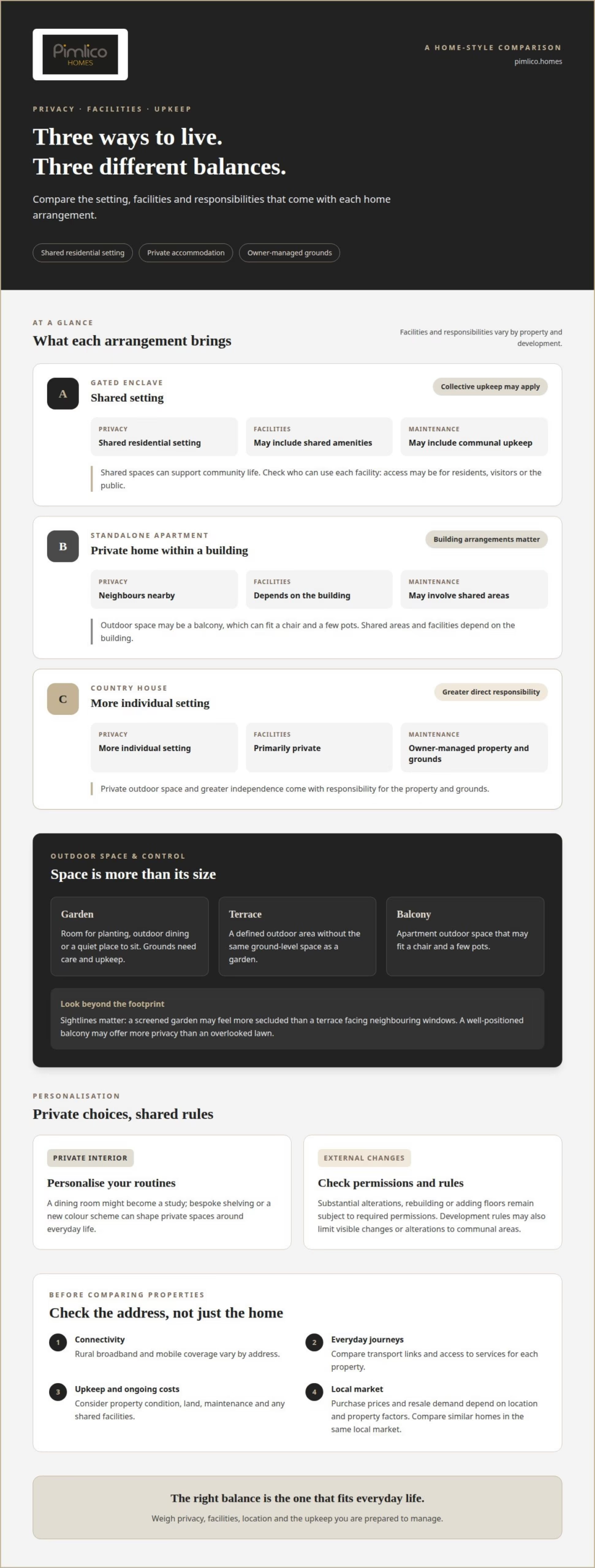
| Option | Privacy | Facilities | Maintenance |
|---|---|---|---|
| Gated enclave | Shared residential setting | May include shared amenities | May include communal upkeep |
| Standalone apartment | Neighbours nearby | Depends on the building | May involve shared areas |
| Country house | More individual setting | Primarily private | Owner-managed property and grounds |
Choose by weighing privacy, access to facilities, location and the upkeep you are prepared to manage.
Private gardens, backyards and terraces
A private garden changes how a home is used: it can provide space for planting, outdoor dining or a quiet place to sit. A terrace offers a defined outdoor area without the same ground-level space, while an apartment balcony may fit a chair and a few pots. In a gated community, gardens can still be private, but they sit within a shared residential setting.
When weighing privacy, consider sightlines as well as size. A country house with a garden screened by planting may feel more secluded than a terrace facing neighbouring windows; a well-positioned apartment balcony may offer more privacy than an overlooked lawn. Living among local people can mean closer everyday contact beyond the property, whereas a gated community places neighbours within a more defined estate. Neither setting guarantees quiet or connection: layout and daily habits matter.
Prestige and private control are personal priorities, not automatic features of an address. A landscaped garden, mature trees or a generous terrace may create a strong sense of arrival, but each requires care and upkeep. With an independent house, the grounds are part of the homeowner’s responsibilities: hedges need trimming, paths need attention, and a garden design should suit the time available. A gated community may offer managed shared landscaping, alongside limits on changes to communal areas.
Security also calls for practical thought. A standalone house may have separate access points, such as a side gate or rear door, and less day-to-day oversight from nearby residents. Owners remain responsible for their property and outdoor spaces, including keeping boundaries and access points in good order. A terrace or apartment entrance may involve fewer external areas, while a gated community adds shared access arrangements rather than removing the need for individual care. The right choice balances privacy with the upkeep and oversight you prefer.
Independent-house freedom and customisation
An independent house gives its owners more scope to shape private spaces around their routines. A dining room might become a study, or a garden could be arranged for planting and outdoor meals. These choices can make a home feel personal rather than standardised. The freedom is not unlimited, however: substantial alterations, rebuilding or adding floors remain subject to required permissions.
That distinction matters to buyers considering a home within a gated development. Shared settings can have rules governing how homes and communal areas are used, and those rules may restrict visible changes or alterations. A new boundary treatment, for example, might affect the appearance of the wider estate, not just one home. The association and development arrangements therefore influence how much control an owner has over external spaces.
Start by considering the change itself. A new colour scheme, bespoke shelving or a reconfigured furniture layout affects private interiors differently from extending a building or changing its exterior. For larger projects, the design, effect on the property and permissions required all shape what can proceed. Distinguish personal decoration from structural work before planning, as structural changes can involve more constraints.
Customisation also brings responsibility. An independent owner has greater control over decisions, but must also coordinate and maintain changes to the home and grounds. In a gated community, shared standards may help preserve a coherent appearance, yet they can narrow individual choices. Neither arrangement is automatically preferable: one suits buyers who value a tailored home and direct control, while the other may appeal to those comfortable with development-wide rules.
Consider two practical examples: one buyer wants to alter a garden layout, while another plans to extend the house. The first may have considerable freedom over private planting; the second must account for applicable permissions. In a community, rules may also affect external alterations. Match the home’s scope for personalisation with the changes you expect to make over time.
Definitions of standalone buildings and gated societies
For this comparison, a standalone building means a home on its own plot, detached from neighbouring properties. A gated community means a group of homes within a defined boundary, with access controlled through an entrance. These are useful descriptions of layout and access, but do not explain ownership, maintenance or residents’ responsibilities on their own.
A gate is only one feature. Homes in a gated development may also share roads, gardens or other facilities, with an association or management arrangement responsible for communal areas. The details affect daily life: residents might share responsibility for a landscaped entrance while maintaining their own gardens separately. Shared infrastructure distinguishes this arrangement from a wholly individual property.
Property descriptions can blur the categories. A detached house may sit within a larger development and share access roads, even though the home occupies its own plot. Conversely, an apartment building may stand separately without controlled entry or extensive communal facilities. In towns and cities, consider the site layout, entrance arrangements and shared spaces rather than relying solely on a listing’s label.
Planning is another consideration. Research has examined the regulation of gated communities within the British planning system, highlighting how access and development layout can matter alongside the homes themselves. For prospective buyers, the practical distinction is whether shared infrastructure or management arrangements shape the property’s use and upkeep. A gate alone does not tell the whole story.
To compare homes clearly, identify whether the property is detached, whether residents share facilities, and who manages communal spaces. Those distinctions reveal more about everyday responsibilities than the label alone. For a home centred on independent living, explore homes designed for individual lifestyles.
Pimlico Homes
Pimlico Homes offers homes for buyers weighing privacy, outdoor space and freedom to personalise. Its portfolio includes Luxury Detached Homes, Executive Courtyard Homes, Bespoke Luxury Homes and Luxury Barn Conversions, each suited to a different vision of home. The right choice depends on how you want to live: a detached setting may appeal if independence is central, while a courtyard home offers a distinct residential arrangement. For a more individual brief, bespoke homes make design choices part of the decision. Consider the spaces, setting and level of personalisation that matter most to your household, then explore the options that align with those priorities. For a considered conversation about your home search, contact Pimlico Homes.
Choose a home that fits the life ahead
The decision between a gated residential enclave and a standalone country-house lifestyle ultimately comes down to the kind of home you want to grow into. Look beyond first impressions and picture ordinary days: how you use your outdoor space, how much independence feels right, and whether you prefer a home shaped around shared surroundings or your own priorities. Taking that longer view can bring clarity to a significant decision.
Pimlico Homes offers Luxury Detached Homes, Executive Courtyard Homes and Bespoke Luxury Homes for different visions of home. Each gives you a way to explore what matters most in your next move, from a more independent setting to a considered design tailored to your needs.
Take the next step at your own pace. Contact Pimlico Homes to discuss your options and begin shaping a home choice around the life you want to lead.
Frequently Asked Questions
So, What Should You Choose?
Choose the home that best fits your daily routines and long-term priorities. The choice between a gated residential enclave vs standalone country house lifestyle depends on whether shared facilities or private outdoor space matters more to you. An apartment offers another balance. Picture a typical weekday and weekend, including travel, garden care and time outdoors, then use those routines to guide your shortlist.
How do privacy, security and access control compare in gated communities and country houses?
Gated communities organise access around shared entrances, while a country-house owner manages access to an individual property. A gate does not remove the need for personal security, and a standalone setting does not automatically mean greater risk. Consider practical details such as the number of entrances, visibility from nearby homes and how visitors reach the front door. Your preferred balance of oversight and seclusion matters as much as the property label.
How do council tax, service charges, maintenance and insurance costs compare?
Treat these costs as separate budget lines, as they depend on the property and its arrangements. Council tax relates to the home and its local authority; service charges, where applicable, relate to shared management or facilities. A house may bring more direct responsibility for its structure and grounds, while communal arrangements can add shared upkeep costs. Insurance also reflects the property and cover selected, not simply whether the home is gated.
What planning, building and renovation rules apply to homes in gated developments and rural areas?
Rules depend on the proposed work, the property and its setting. Structural changes, extensions or rebuilding may require permissions, and a development’s title or management documents may set additional conditions. A rural location alone does not determine what can be altered. Changing an internal room, for example, differs from extending a building or changing its exterior. Establish the scope of the work before making design decisions.
What are the pros and cons for families, pets and outdoor space in each type of home?
For a family with a dog, a private garden may make everyday outdoor access straightforward, while shared grounds can provide communal space with less private upkeep. An apartment may suit households that prioritise indoor living, though its outdoor area could be more limited. Think through routines such as play, walking a pet and storing outdoor equipment. The useful comparison is how each property’s actual layout supports those activities.
What restrictions can gated developments impose on residents, visitors, pets and property alterations?
Restrictions vary by development and its governing documents. Rules may cover visitor entry, pet behaviour in shared areas, use of communal facilities or changes visible from outside. For anyone weighing a gated residential enclave vs standalone country house lifestyle, these details can shape everyday independence. Distinguish rules for communal spaces from conditions attached to an individual home, then consider whether those arrangements suit your household’s routines.





