
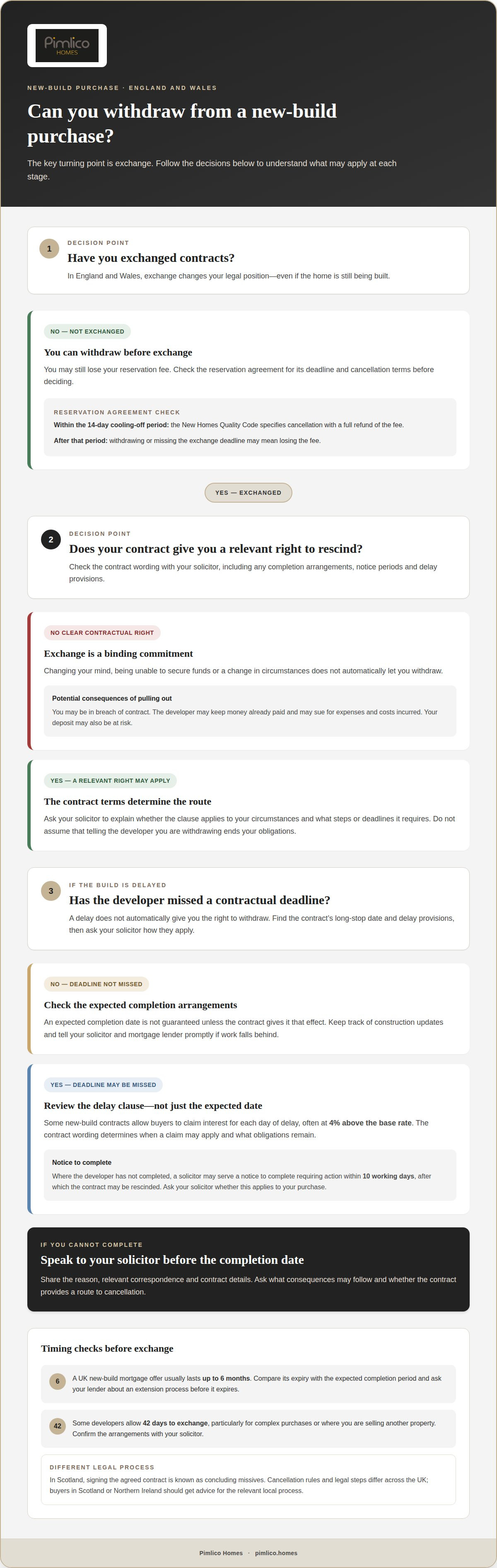
The decisive point is usually exchange, not completion. If you’re asking whether you can pull out of a new-build purchase before completion, in England and Wales you can withdraw before exchanging contracts, although you may lose your reservation fee. After exchange, the contract is legally binding. Pulling out may put you in breach and put your deposit at risk.
It’s understandable to feel uncertain when circumstances change or a home takes longer than expected. An off-plan purchase can involve a substantial gap between exchange and completion, so the consequences depend on where you are in the process and what the contract says.
This guide explains the stages from reservation to completion, what to consider if you can’t complete, and how a contractual long stop date may affect your options if the developer hasn’t finished the property. It also explains why a delay doesn’t automatically give you the right to withdraw, and which details to review before deciding how to proceed.
Key Takeaways
- Identify whether you are at reservation, exchange or completion before deciding what to do; the consequences can change at each stage.
- Review the reservation deadline and cancellation terms so you understand what may happen to the fee if you withdraw.
- For an off-plan home, consider whether your mortgage offer will remain valid through the expected completion date.
- Find the contract’s long-stop date and delay provisions to understand what options may apply if the property is not ready.
Buying a new-build- what if you can’t complete your purchase?
Your options depend on whether contracts have been exchanged and what the agreement says. In England and Wales, exchange changes your legal position, even when the home is still being built.
-
Understand the commitment at exchange
Before exchange, decide whether to proceed and ask your solicitor to explain any cancellation terms. You can legally withdraw before exchanging contracts, although you may lose a reservation fee. Once contracts are exchanged, the purchase becomes legally binding, even if the new-build home is unfinished and completion is still ahead.
Read the contract with your solicitor before exchange. Identify the completion arrangements, any notice period and the provisions covering delays. Do not treat an expected completion date as guaranteed unless the contract gives it that effect.
-
Assess the consequences of withdrawing
If you withdraw after exchange, you may be in breach of contract. The developer may keep money already paid and may sue for expenses and costs incurred. You may also lose your deposit, so consider the financial consequences before taking steps to stop completion.
Can a buyer withdraw after exchanging contracts on a new-build property? Not simply because they have changed their mind: exchange creates a binding commitment. Check whether the contract gives you a relevant right to rescind, including what applies if the developer misses a contractual deadline. Your solicitor can explain how those terms apply to your circumstances.
-
Contact a solicitor about cancellation
If you cannot complete, contact your solicitor promptly, before the completion date. Share the reason, relevant correspondence and contract details. Ask them to explain the consequences and whether the contract provides a route to cancellation. Do not assume that telling the developer you are withdrawing ends your obligations.
Where the developer has not completed, a solicitor may serve a notice to complete requiring action within 10 working days, after which the contract may be rescinded. According to HM Revenue & Customs, in England, a Stamp Duty Land Tax return must be filed within 14 days. Your solicitor can clarify the steps that apply to your purchase.
How off-plan purchases progress from reservation to completion
Use each stage to organise the next: secure the plot, complete legal checks, exchange contracts and prepare for completion when construction is finished.
- Before reserving, arrange your finances and understand the expected timeline. A mortgage offer for a UK new-build purchase usually lasts up to 6 months, so compare its expiry with the expected completion period. Ask your solicitor to review the reservation agreement and instruct them to begin searches and legal work promptly.
- Read the reservation agreement before paying to secure your chosen plot. The fee is generally deducted from the purchase price on completion. Some developers may extend the reservation period if you cannot exchange by its deadline.
- Understand the cancellation terms before you commit to the reservation. The New Homes Quality Code specifies a 14-day cooling-off period to cancel the reservation agreement and receive a full refund of the fee. Outside that period, withdrawing or missing the exchange deadline may mean losing it. Keep the deadline visible in your timeline.
- During the reservation period, progress the mortgage application, searches and contract review together. Some developers allow 42 days to exchange, particularly for complex purchases or where you are selling another property. Confirm the exchange arrangements with your solicitor, and do not treat the reservation as equivalent to an exchanged contract.
- In Scotland, signing the agreed contract is known as concluding missives. Cancellation rules and legal steps differ across the UK, so buyers in Scotland or Northern Ireland should get advice based on the relevant local process rather than assume England and Wales arrangements apply.
- After exchange, prepare for completion on notice. For an off-plan purchase, completion follows when the home is ready for occupation and has passed its final inspections; the date is not usually chosen at exchange. Keep your mortgage and funds arrangements aligned with construction progress and the developer’s completion notice.
Construction delays and other purchase considerations
Construction progress can shift the expected moving date and affect mortgage arrangements. Plan around the contract, lender conditions and updates from the developer.
- Compare the expected completion period with your mortgage offer. A UK new-build mortgage offer usually lasts up to 6 months, while an off-plan purchase can take longer. Ask your lender about an extension process before the offer expires, and note any conditions or updated financial information it requires.
- Track construction updates against the expected completion date. If work falls behind, tell your solicitor and mortgage lender promptly. A change to the build programme can affect the mortgage advance, your sale or tenancy arrangements, and the funds you need to transfer for completion.
- Ask your solicitor to explain the contract’s provisions for developer-side delays. Some new-build contracts allow buyers to claim interest for each day of delay, often at 4% above the base rate. The clause’s wording determines how the claim works, including when delay starts and which completion obligations apply.
- Can a buyer withdraw if their mortgage offer is withdrawn or their circumstances change? Not automatically after exchange. The contract remains binding, and being unable to secure funds or a change in circumstances can leave the buyer unable to complete, with potential breach consequences. Contact your solicitor promptly to understand the contract and your options.
- Distinguish a construction delay from a buyer-side delay. If the developer has not made the home ready, the contract’s completion and notice provisions matter. If the property is ready but your mortgage or funds are not, your solicitor can explain the consequences and any applicable completion deadline.
- Review the likely completion period with your solicitor, lender and anyone involved in your move. Keep funds, mortgage validity and moving arrangements aligned with formal updates, rather than relying only on an estimated date. Include Stamp Duty Land Tax in your purchase planning, as the amount depends on the property and the buyer’s circumstances.
What happens if the developer has not finished the property by the agreed completion date
A changed estimated date does not automatically let you cancel. The key question is whether the contractual long stop date has passed and what your agreement says.
- Find the long stop date in your contract and ask your solicitor to explain how it operates. This is the contractual deadline for the developer to finish the property and make it ready for legal completion. Developers typically set it 12 to 18 months after the anticipated completion date, so compare it with any revised construction timetable.
- Ask your solicitor to confirm whether the property is legally ready for completion. For an off-plan purchase, completion takes place once the home is ready for occupation and has passed its final inspections. A revised estimate or unfinished work does not, by itself, mean the long stop date has passed.
- If the long stop date passes without the developer completing, ask your solicitor about rescinding the contract. If the developer has failed to finish by that contractual deadline, the buyer can rescind and receive a full refund of the deposit. Follow the contract’s notice procedure rather than treating a delay alone as cancellation.
- Check the notice provisions separately. A developer’s Notice to Complete usually sets a completion date 10-14 days away. This is distinct from the long stop date: establish who served the notice, what action it requires and whether the home is ready. Keep notices and construction updates together as evidence of the timeline.
- Can a buyer cancel if the new-build property is delayed or the completion date changes? A delay or revised estimate alone does not automatically give the buyer a right to cancel. The contractual long stop date is the key deadline. If it passes without completion, the buyer can rescind under the stated terms and recover the deposit.
- Keep the financial and practical consequences in view. Check how delay affects your mortgage arrangements, moving plans and any inspection schedule. New-build homes commonly include a structural warranty providing 10 years of cover, but that warranty does not replace the contract’s delay provisions. For new-build homes, consider the completion timetable alongside the legal terms before making a purchase decision.
Pimlico Homes
Pimlico Homes develops and sells new-build homes for buyers considering a significant property decision. If a delay or change in circumstances has made you reconsider, separate the legal question of withdrawing from your decision about what kind of home suits your plans. Your solicitor can advise on the contract; Pimlico Homes can help you explore a future purchase, including Luxury Detached Homes, Executive Courtyard Homes, Bespoke Luxury Homes and Luxury Barn Conversions.
Turn to Pimlico Homes when you’re ready to consider your next move and the design, setting and form of home that matter to you. A considered choice begins with clarity about your circumstances and the home you want to make your own.
To discuss your next home, contact Pimlico Homes.
Make your next move with clarity
If you’re asking, “Can I pull out of a new-build purchase before completion?”, let the answer guide your next decision, not define your future plans. A difficult purchase can clarify what matters in your next home: its design, setting and suitability for the life you intend to build there.
Take time to set those priorities before committing again. A considered brief can help you focus on homes that genuinely fit, rather than making a decision under pressure. Keep legal advice about an existing contract separate from conversations about a future purchase; each calls for a different kind of guidance.
When you are ready to explore what could come next, begin a conversation with Pimlico Homes. A more assured move starts with a clear sense of the home you want.
Frequently Asked Questions
What does a new-build reservation agreement say about cancelling and losing the reservation fee?
The agreement records the plot being reserved, the reservation period, the fee and the cancellation terms. For a buyer asking, “can I pull out of a new build purchase before completion?”, the cancellation clauses are an important starting point. Check whether withdrawing before the deadline has a different consequence from failing to exchange by it, and how the fee is treated if the purchase completes.
What happens to the deposit if a buyer fails to complete a new-build purchase?
If a buyer fails to complete after exchange, the developer may keep the deposit and the buyer may be in breach of contract. The deposit is separate from the reservation fee paid earlier. Ask your solicitor to identify which payments have been made, how the contract treats them and what further liability could arise before deciding how to respond.
What financial losses or legal costs can a developer claim if a buyer pulls out before completion?
If a buyer cannot complete after exchange, the developer may keep money already paid and sue for expenses and costs incurred. Any claim depends on the contractual breach and the costs the developer has incurred; it is not necessarily limited to the deposit. Give your solicitor any notice or demand you receive so they can explain the amount claimed and the contract provisions relied upon.
What are the new-build contract long-stop date and notice-to-complete rules?
The long stop date is the contract’s final deadline for the developer to finish the property and make it ready for legal completion. If that deadline passes without completion, the contract may set out whether the buyer can rescind and how the deposit is treated. A Notice to Complete is a separate contractual notice; its deadline and effect depend on who serves it and the circumstances covered by the contract.
Does the buyer have a cooling-off period after reserving or exchanging contracts on a new-build home?
The New Homes Quality Code specifies a 14-day cooling-off period for cancelling a reservation agreement and receiving a full refund of its fee. If you are asking, “can I pull out of a new build purchase before completion?”, distinguish this reservation right from withdrawing after exchange. In England and Wales, exchange makes the purchase legally binding, so the reservation cooling-off period does not give you a later cancellation right.





