
What if the most imposing parcel box isn’t the most secure, or the right fit for your entrance? Choosing smart delivery drop boxes for secure executive properties calls for more than an impressive finish. The box must suit the parcels you receive, offer an access method that works with your delivery routine, and sit where it supports privacy without disrupting the approach to your home.
That balance matters. A carefully considered entrance should feel coherent, not crowded by a practical addition. This guide explains how to assess stated security features and smart functions without treating a product claim as a guarantee. It also covers placement, parcel retrieval and everyday access, so you can compare options against the way your property is used. Pimlico Homes’ focus on craftsmanship and timeless design offers a relevant perspective: practical choices can support a home’s character as well as its everyday use. The aim is a measured decision that suits both the entrance and the people who rely on it.
Key Takeaways
- Compare access methods, stated construction, parcel capacity and placement requirements using each product’s own information.
- Assess smart delivery drop boxes for secure executive properties by weighing documented features against everyday delivery needs.
- Map the delivery route, assess how visible the box would be, then check the product’s placement requirements.
- Balance convenience and discretion with the entrance’s appearance, so the solution feels at home in a carefully considered property.
Why smart delivery drop boxes matter at an executive property
A delivery drop box is a dedicated receptacle for parcels when nobody is available to receive them in person. At an executive property, its role goes beyond convenience. Security concerns who can access a parcel, privacy concerns how deliveries fit around household routines, and visual discretion concerns how the box sits within the entrance. These considerations overlap, but none can replace the others.
A product label alone cannot establish whether a box suits a particular property or its security needs. Compare the manufacturer’s stated features with the physical design, access arrangements and intended use. Background on automated parcel lockers and delivery boxes can help distinguish a parcel receptacle from the digital functions a particular model may provide.
What does “smart” mean on a delivery drop box?
“Smart” can refer to digital or access-related functions, but these vary by model. Read the manufacturer’s specifications to understand what the box actually does, how access is managed and what is needed to use those functions. Assess the receptacle separately: review its stated construction, opening and intended placement. A connected feature does not, by itself, explain the box’s physical security or suitability for your entrance.
Which delivery concerns should shape the decision?
Start with your household’s routine. Who is likely to receive parcels? How often do deliveries arrive, and are they usually small or varied in size? Then consider the approach to the entrance. Is it overlooked from the road, neighbouring properties or shared access? A visible position may make the box easier to find, while a more discreet location may better suit your preferences, provided it remains practical for delivery personnel.
Convenience is only one part of the decision. The right choice balances access and discretion with the entrance’s appearance, so a useful addition does not feel out of place. Assess smart delivery drop boxes for secure executive properties against your actual delivery routine and setting, rather than relying on a broad product label.
How to compare smart delivery drop boxes for security and discretion
A useful comparison begins with what a product’s documentation says, rather than what its marketing suggests. Record the details side by side, then weigh them against your household’s parcel habits and the character of the entrance. Suitability depends on the product’s stated specification and how deliveries work at your property.
| Consideration | What to compare |
|---|---|
| Access method | How the recipient or delivery person is stated to gain access, including any conditions or steps involved. |
| Construction | The materials and physical features specifically described by the manufacturer, rather than general terms such as “robust”. |
| Parcel capacity | Published dimensions and capacity, compared with the parcels your household commonly receives. |
| Mounting and placement | Stated installation requirements, suitable mounting positions and any limitations on where the unit can sit. |
Which specifications are worth comparing?
Compare the opening and internal capacity with the deliveries you typically receive. A box suited to small packages may not work for a household that often receives larger ones. Review the access process alongside the mounting requirements. A wall-mounted unit, for example, may need a different position from a freestanding box. Treat these as model-specific details, not standard features of every “smart” product.
Appearance matters too. Consider the finish, proportions and position in relation to the entrance’s materials and lines. A practical receptacle should look deliberate, rather than competing with carefully considered stonework, brickwork or joinery.
How can security claims be assessed carefully?
Separate precise, documented information from broad descriptions such as “secure” or “tamper-proof”. Look for clear explanations of construction and access, and note where the manufacturer provides little detail. No single feature guarantees that a parcel will be protected in every circumstance. Assessing the stated details alongside the intended position gives you a clearer basis for comparing products.
For a wider sense of how considered design shapes a home, explore Pimlico Homes’ design-led homes.
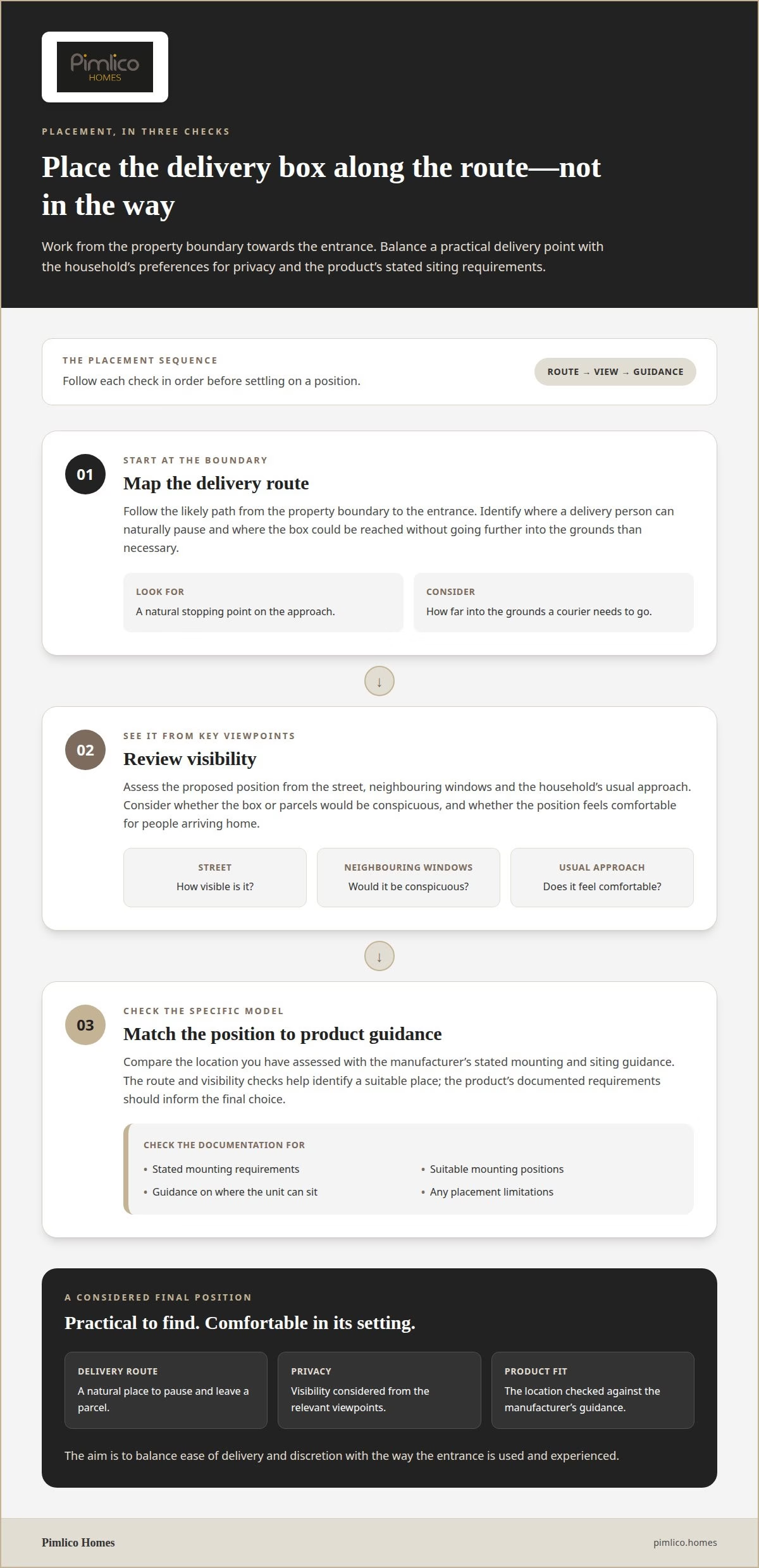
Where should a delivery drop box sit at an executive property?
Placement shapes both the arrival experience and the delivery routine. A discreet position is of little use if couriers cannot readily identify where to leave a parcel. A prominent position, however, may not suit a household that values privacy. Assess the approach in sequence before settling on a location.
- Map the delivery route. Follow the likely path from the property boundary to the entrance. Note where a delivery person can naturally pause and where a box could be reached without needing to go further into the grounds than necessary.
- Review visibility. Look at the proposed position from the street, neighbouring windows and the household’s usual approach. Consider whether the box or parcels would be conspicuous, and whether the position feels comfortable for people arriving home.
- Check the product’s placement requirements. Compare the intended position with the manufacturer’s stated mounting and siting guidance. Your route and visibility assessment can help identify a suitable location, but the product’s documented requirements should inform the final choice.
How do you assess the entrance before choosing a position?
Observe the entrance from the directions and at the times that matter to your household. A natural stopping point near the boundary may make delivery straightforward, while sightlines from neighbouring windows may favour a less exposed location. Balance these observations with clear access for delivery personnel. Concealment alone is not a practical measure of suitability.
How can the box complement the property’s appearance?
Consider the box’s stated finish, form and proportions beside the entrance’s existing materials and visual character. A finish that relates quietly to nearby surfaces may feel more integrated; an oversized or strongly contrasting unit could draw attention. Avoid assuming that a particular mounting method will suit the property. Let the manufacturer’s placement guidance and the actual setting shape your decision.
For a home where privacy and the arrival experience are part of considered design, explore executive courtyard homes and privacy. The same attention to proportion and setting can help you position a delivery box practically without disrupting the entrance.
Choosing a delivery solution that belongs in a considered home
The right choice is a measured balance. Convenient access matters, as do the product’s documented security features, its capacity for the parcels you receive and its appearance in the chosen position. No single quality should eclipse the rest. A discreet-looking solution that does not suit your delivery routine may prove impractical. A product with appealing claims but little specific information gives you less to assess.
What should the final shortlist prioritise?
Work through the essentials in order. First, consider whether the stated access process fits the way deliveries are received. Next, compare the published capacity with the parcels your household commonly expects. Then check whether the product’s placement requirements suit the proposed location, before judging its proportions and finish alongside the entrance. Remove options whose specifications conflict with your routine or intended position. This keeps your shortlist grounded in practical fit, rather than features that sound impressive but do not meet a real need.
How does a delivery detail fit into a wider home decision?
Parcel handling is one small but recurring part of living in a home. Its position and appearance can influence the arrival experience, just as other practical choices contribute to the way a property functions and feels. Pimlico Homes’ principles, “Exceptional Homes. Exceptional Standards.” and “Quality without compromise”, express a wider commitment to craftsmanship and timeless design. They reflect the consideration given to a home, rather than claims about delivery-box products.
For buyers weighing the wider qualities of a new home, a luxury new-build purchasing guide can sit naturally alongside decisions about daily use and design. The same care applies to choosing a parcel solution: prioritise documented suitability, a workable routine and a finish that respects the entrance. To discover a considered approach to exceptional homes, explore Pimlico Homes.
Make your next home choice with confidence
The way a home handles everyday arrivals is one detail within a larger question: how will the property support the life you want to lead? Apply the same care when considering smart delivery drop boxes for secure executive properties as you would when choosing a home. Look for thoughtful design, practical fit and clear information, without mistaking a product claim for a promise.
That considered outlook reflects Pimlico Homes’ principles of “Design-led innovation” and “Customer commitment”. With over 25 years of operation, the company supports buyers through The Pimlico Pledge, from reservation to key handover and beyond. These commitments speak to the importance of care throughout the home-buying experience and to the lasting value of considered craftsmanship.
Explore homes shaped by that approach and imagine the details that could make a property feel distinctly yours. Explore Pimlico Homes and discover exceptional homes defined by craftsmanship and timeless design. Take the next step towards a home of enduring character.
Frequently Asked Questions
Are smart delivery drop boxes secure?
They can offer a more controlled place for deliveries, but security depends on the particular box and how it is used. For smart delivery drop boxes for secure executive properties, examine whether the manufacturer explains how access works and what its construction claims mean. Consider a delivery left during a quiet period: visibility, household access and the box’s position all affect the practical picture. No feature guarantees that a parcel cannot be lost, accessed or stolen.
How does a smart delivery drop box work?
The process varies by model. In general, the box provides a designated place for a delivery, while the specific instructions explain how a courier deposits a parcel and how the recipient retrieves it. Before choosing one, read those instructions as if guiding someone unfamiliar with the property. Check whether the process depends on a particular access method, whether notifications are specified and what conditions or parcel limits apply.
Can a delivery drop box hold different parcel sizes?
Only within the capacity stated for that particular product. Compare its published dimensions with parcels your household receives, such as a small padded envelope and a larger boxed delivery. This makes limitations easier to judge than relying on a general capacity description. Also consider whether parcels can be placed inside without obstruction and whether the box remains accessible in its intended position.
Where should a delivery drop box be positioned?
Choose a position that suits both the product’s instructions and the way people approach the entrance. A location that is easy to spot from the delivery route may help avoid confusion, while the household may prefer to limit visibility from nearby windows. Consider the approach at different times of day and how parcel retrieval fits into the usual arrival routine. No single position suits every property.
Do smart delivery drop boxes need power or an internet connection?
Some models may require power or connectivity for particular functions, while others may not. The product specifications determine what is needed. Check the setup requirements and whether any access feature or notification depends on a connection. If the intended position is far from the home’s usual connection points, include that practical constraint in your decision. Do not assume that “smart” means either permanently connected or entirely self-contained.





