
You can make an offer on a new-build home. The developer may accept it, decline it or respond with different terms. Buying a luxury new build home is not always a take-it-or-leave-it decision, so understand what you are considering before you commit.
A prestigious finish matters, but so do the details that shape everyday life and long-term value. Learn how to assess a development, weigh its location and energy efficiency, understand what a warranty covers and make sense of build timelines.
You’ll also find out how offers fit into the process, including what to consider before reserving a home. From the wider setting to the workmanship and practicalities behind the front door, this guide will help you approach your decision with greater clarity and confidence.
Key Takeaways
- You can make an offer on a new-build home; understand the reservation and contract stages before committing.
- Assess a development by how its location, transport links, amenities and surroundings suit your daily life.
- Compare energy performance and warranty terms to understand a home’s efficiency and the protection available.
- Allow for build timelines to change, and understand how updates, snagging and completion fit into your plans.
Choosing a location and development
Start by matching the development’s setting and property type to your priorities. Urban, village and rural settings each offer different amenities, transport options and ways of life.
-
Compare development and property types
Compare locations and layouts before narrowing your shortlist. Urban developments may be close to shops, restaurants and transport, while village or rural settings can offer a quieter lifestyle and different access needs. Property types range from apartments to detached homes and courtyard developments. Consider commuting, schools, green spaces and the area’s future potential. When buying a luxury new build home, weigh these factors against the lifestyle you want, rather than choosing on finishes alone.
-
Visit show homes and developments
Visit the development and its show home to understand the setting beyond the brochure. Walk to nearby amenities, notice how the layout uses natural light and space, and consider whether the rooms suit your furniture and routines. A show home illustrates a possible finish, so compare its presentation with the plot and development plans. Look at access, surroundings and the character of neighbouring properties to decide whether the setting feels right.
- Clarify the purchase stages before committing. A reservation fee usually takes a new-build home off the market for a set period while mortgage and legal work progresses. The deposit is paid when contracts are exchanged to secure the purchase. Mortgage options depend on your finances and the property; an independent mortgage adviser can explain options and schemes that may suit a new-build purchase.
- Compare financial and resale considerations carefully. The price of a luxury new-build home varies with location, property type, plot and specification, so a UK-wide average will not reflect the home you are considering. Period properties and new builds can differ in condition, design and ongoing requirements. Resale appeal depends on factors such as location, demand and the home’s attributes. When buying a luxury new build home, assess these considerations together rather than assuming either property type will hold its value better.
Eco-friendly design and energy efficiency
Assess energy performance alongside the home’s design, running costs and suitability for everyday life. A measured comparison can show how well the property may work for your household.
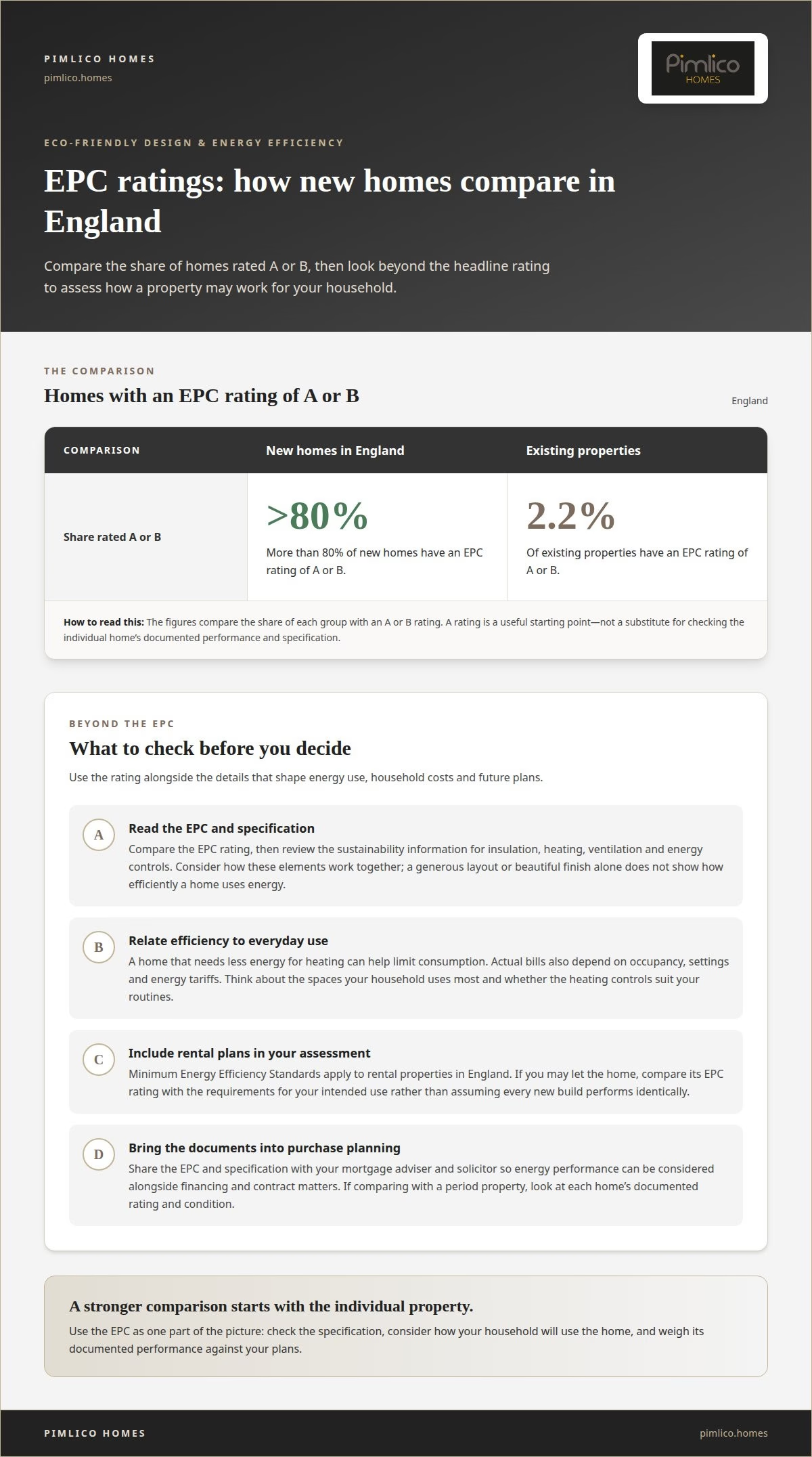
- Begin with the Energy Performance Certificate (EPC). More than 80% of new homes in England have an EPC rating of A or B, compared with 2.2% of existing properties. Use the rating to compare homes, then consider how the building’s energy performance fits your priorities. When buying a luxury new build home, look beyond the overall rating to understand what contributes to it.
- Review the sustainability information and specification for each property. Look for details about insulation, heating, ventilation and energy controls, then consider how they work together. A generous layout and beautifully finished living spaces do not, by themselves, show how efficiently a home uses energy.
- Consider how energy efficiency may affect household bills. A home that needs less energy for heating can help limit consumption, but actual bills also depend on occupancy, settings and energy tariffs. Think about which spaces your household uses most and whether the heating controls suit your routines.
- If you may let the property, include rental standards in your assessment. Minimum Energy Efficiency Standards apply to rental properties in England, so consider the EPC rating alongside your plans. Compare the property’s documented performance with the requirements for your intended use rather than assuming every new build performs identically.
- Bring your findings into your purchase planning. Share the EPC and specification with your mortgage adviser and solicitor, so energy performance can be considered alongside financing and contract matters. If you are also considering a period property, compare each home’s documented rating and condition. Buying a luxury new build home is more informed when its efficiency suits your household and longer-term plans.
New-build warranties
Review the warranty alongside the contract, plans and completion arrangements. A new-build home comes with a 10-year new home warranty, but the cover’s scope and process matter.
-
Review structural warranty and defect cover
Read the warranty documents and identify what protection applies during each stage of the 10-year term. Structural cover and defects cover may address different issues, so establish how the documents define each category, how to report a problem and what evidence is required. Check the exclusions and claim process, rather than assuming every snag or fault is treated alike.
-
Discuss contracts and warranties with a solicitor
Instruct a solicitor experienced in new-build purchases to review the contract, plans and warranty. Starting during reservation allows legal work to progress alongside the build. The usual sequence is reservation, legal review, exchange of contracts, construction or final preparations, then completion. At exchange, the purchase becomes legally binding and a completion date is agreed; the buyer pays the deposit to secure the home.
-
Assess buyer protections and off-plan risks
For an off-plan purchase, compare the contract plans and specification with the home you expect to receive. Construction takes time, and the finished property may differ in detail from a show-home presentation. Ask your solicitor to explain the contract’s provisions for changes, delays, deposit protection and remedies, so you understand what applies before exchange. A warranty provides protection, but does not replace understanding the contract.
- Keep the paperwork together and note key dates. Save the reservation documents, contract, plans, specification, warranty and written updates in one place. Before completion, arrange a snagging inspection to identify minor issues for the developer to resolve. Record each finding clearly and follow the applicable warranty or defects process.
Build updates and completion timelines
Plan for construction updates, inspection and handover as connected stages. A clear record can help you manage the final arrangements with less stress.
- Agree how you will receive progress updates during construction. Weather, supply chains and the demands of quality finishing work can affect build timelines, according to Campbell Buchanan. Use each update to track progress against the agreed stages and raise practical questions early, particularly if your moving arrangements depend on a specific completion date.
- Prepare for the exchange-to-completion period. In the UK, completion for a new-build purchase will usually be within 28 days of exchange of contracts. Exchange makes the purchase legally binding and a completion date is agreed, so coordinate your solicitor, mortgage arrangements and moving plans around that date.
- Arrange a snagging inspection before or shortly after completion. It can identify minor issues for the developer to resolve. Check finishes, doors, windows, fittings and visible damage; record each item clearly with its location, and keep the inspection notes for follow-up.
- Ask your solicitor to explain the transaction taxes that apply to your purchase. The relevant tax and amount depend on the property’s location, purchase price and your circumstances. Include this calculation in your completion planning, alongside legal and moving costs, rather than assuming one UK-wide figure applies.
- Prepare for handover by gathering the documents and details you will need for the home. Keep the warranty information and snagging record accessible, and note any instructions provided for appliances or household systems. England recorded 239,300 new homes completed in the 12 months to June 2023, the lowest since 2017 outside the pandemic period. For a considered next step, explore luxury new-build homes.
Pimlico Homes
Pimlico Homes offers a considered next step for buyers exploring luxury new builds across the UK. Its homes include luxury detached properties, executive courtyard homes, bespoke luxury homes and luxury barn conversions. Each offers a distinct approach to design, setting and the character of a home.
Turn to Pimlico Homes when you are ready to consider a new-build property that reflects your lifestyle and priorities. Whether you are drawn to a detached home, a courtyard setting or a bespoke design, begin with how you want to live.
For an initial conversation about your home search, contact Pimlico Homes.
Choose a home that feels right for the future
Buying a luxury new build home is a significant personal decision as well as a property purchase. Consider how the home will support your routines, priorities and plans for the years ahead. The right choice should feel considered beyond the first viewing, with a setting and design that continue to make sense as life changes.
Pimlico Homes offers Luxury Detached Homes, Executive Courtyard Homes and Bespoke Luxury Homes. These distinct options offer different ways to find a home that reflects your preferred balance of privacy, setting and design. A conversation can help you explore which direction suits your plans, without rushing a decision that deserves careful thought.
Take the next step at your own pace. Contact Pimlico Homes to discuss your plans and begin shaping a clearer picture of the home you want. A considered choice today can become a place to feel at home for years to come.
Frequently Asked Questions
Can you make an offer on a new build?
Yes, you can make an offer on a new-build home, and the developer can accept, decline or respond with different terms. Make your proposal before paying a reservation fee, and set out clearly what you are offering. If accepted, read the reservation agreement carefully: it explains how long the home is held and what happens next. The purchase becomes legally binding at exchange.
Are new build homes worth it for high-end investors?
They can suit investors seeking a newly built property, but their value depends on the investment strategy rather than the “new build” label. Assess local demand, likely rental income, ongoing costs and the property’s future appeal to buyers or tenants. Consider the home’s specification and location alongside your intended holding period. Comparing these factors is more useful than assuming a new home guarantees strong returns.
Do you need a survey on a new build?
A survey can provide an independent view of a new-build property, although the right inspection depends on the home and your concerns. A Level 1 Home Survey is described as the most basic type for a new build. A snagging inspection serves a different purpose: it identifies minor defects for the developer to resolve. Consider what each inspection covers before deciding what is useful for your purchase.
How long can you reserve a new build for?
A reservation usually takes the identified home off the market for a set period while you progress mortgage and legal work. The duration varies by development. Read the reservation agreement for its expiry date, the steps expected before then and what happens if the transaction does not proceed. This gives you a practical timetable for organising the purchase.
What is classed as a new build?
A new-build home is a property that has never been lived in. This includes a newly completed home and a property bought off-plan within a new residential development. An off-plan purchase means agreeing to buy before the home is complete. The term describes the home’s occupancy and purchase context; it does not, by itself, describe its design, finish or specification.
Which UK regions and cities offer the best luxury new-build homes?
There is no single best region for every buyer; the right setting depends on lifestyle, transport, amenities and investment aims. London offers luxury developments in an urban setting, while the North East has options around Newcastle and Durham. Compare the specific development and property type with your priorities, rather than treating a city’s reputation as a guarantee of suitability or future resale performance.





