
A self-build can appear less expensive than buying a finished home, but the headline figure may exclude professional fees, site costs and the time spent managing decisions. When comparing buying a luxury new build vs self build, weigh the full cost and responsibilities of creating a home against purchasing one that is complete.
It’s understandable to focus on the purchase price or build budget first. Yet the total depends on more: the plot and its planning status, design and professional fees, buying costs, contingency, and the value you place on choice and convenience. A typical self-build is estimated to save 20-30% compared with the value of an equivalent finished home, but that estimate is not a like-for-like promise for every luxury project.
This comparison breaks down the costs, planning considerations and potential resale risks of each route. It will help you judge whether building around a personal vision or choosing a completed new home better suits your budget, appetite for involvement and priorities.
Key Takeaways
- Assess the plot and its planning status alongside the build budget, as both can materially shape the overall outlay.
- Separate costs that apply to creating a home from those tied to purchasing a completed property.
- Compare the convenience of a finished home with the design choices and project responsibilities involved in building.
- Consider how your likely resale timing could affect the value of a new-build premium.
How much does self-build cost per square metre in the UK?
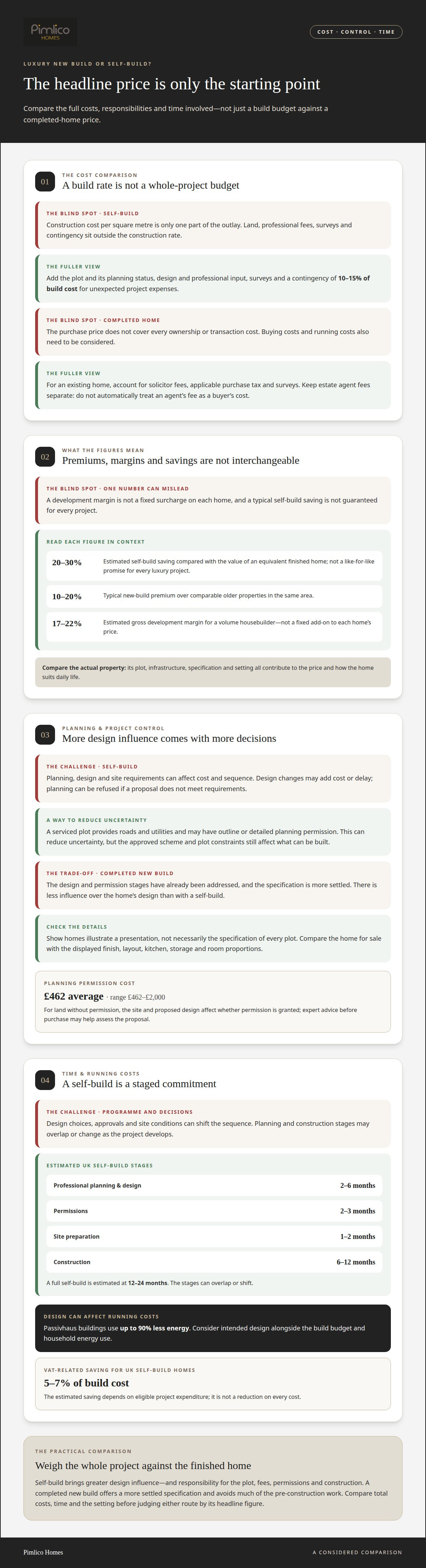
The choice between buying a luxury new build and self-building depends on more than the build rate. Include land, professional input, surveys and contingency to compare the full project with a completed home.
Land and construction costs
Land and construction make up the central self-build costs, but location and planning status influence the total. A contingency of 10-15% of build cost allows for unexpected project expenses.
Professional and pre-construction fees
Professional fees and surveys sit outside the construction rate.
Energy-efficient design and running costs
Design choices influence ongoing energy use as well as the build budget. Passivhaus buildings use up to 90% less energy. For anyone weighing buying a luxury new build against self-building, consider how the intended design may affect household running costs.
For UK self-build homes, the estimated VAT-related saving is 5-7% of build cost. The actual refund depends on eligible project expenditure, so do not treat it as a reduction on every cost.
| Option | Main cost basis | Other costs to consider |
|---|---|---|
| Self-build | Construction per square metre | Land, fees, surveys and contingency |
| Existing home | Purchase price | Solicitor fees, applicable purchase tax and surveys |
| Luxury new build | Completed-home purchase price | Buying costs and running costs |
Compare the complete project cost with the purchase and ownership costs of a finished home before choosing your route.
Developer markups and estate agent fees
A completed new build includes more than the cost of materials and construction. A volume housebuilder’s gross development margin is estimated at 17-22%; this is a measure of the development’s margin, not a fixed surcharge on each home. The purchase price also reflects the plot, infrastructure, specification and the finished property’s position within its development.
New-build homes typically cost 10-20% more than comparable older properties in the same area. That premium buys a completed home, but location and development character matter: a quiet courtyard, access routes and nearby services can shape how the setting suits your daily life. Compare the actual home and its surroundings, rather than treating the headline premium as a measure of quality.
Keep estate agent fees separate from the price of a home. Identify which sale or purchase costs apply and who is responsible for them; do not automatically add an agent’s fee to every buyer’s costs. A self-build avoids buying a developer’s finished home, but involves separate decisions about the plot, design and construction.
Show homes give you a useful sense of a developer’s finish, layout and available choices. During a visit, consider whether the displayed kitchen, storage and room proportions suit your needs, then compare them with the home for sale. A show home illustrates a presentation, but does not establish the specification of every plot.
Infrastructure also matters. A serviced development may provide roads and utilities, while a plot’s planning status and site requirements affect the work involved in building. The key difference is flexibility: a self-build gives you more influence over design, while a completed home has a more settled specification and setting.
For a practical comparison, separate the purchase price, development setting and included specification from any transaction costs. Then weigh the finished home’s convenience against the design control and site responsibilities of a build project.
Professional fees and planning permission
Planning affects a self-build’s design, costs and sequence, while buying a completed home avoids much of the pre-construction work. Key risks include cost increases when designs or site requirements change, delays during permissions and construction, and planning refusal if a proposal does not meet requirements.
Serviced plots and planning permission
A serviced plot is land within a larger site where roads and utilities are provided; it may have outline or detailed planning permission. This can reduce uncertainty compared with a plot without permission, but does not mean every design is possible. The approved scheme and plot constraints affect the layout, and changes such as a future renovation or extension may need further permission.
Planning permission costs an average of £462, with a range of £462-£2,000. A buyer considering land without permission should seek expert advice before purchase, since the proposed home’s design and the site affect whether permission is granted.
Plan for the home you need now and may need later. One self-build project began as a five-bedroom design, then changed to three bedrooms, with an intention to apply for permission to add two bedrooms above the house in future. It shows why future extensions belong in early design discussions, rather than being treated as an automatic right.
Planning and construction timescales
Professional planning and design for a UK self-build are estimated to take 2-6 months, while permissions are estimated at 2-3 months. Site preparation may take 1-2 months, followed by 6-12 months of construction. These stages can overlap or shift as the design, site conditions and build programme develop.
A full self-build is estimated to take 12-24 months. This is a substantial commitment compared with purchasing a completed home, where the design and permission stages have already been addressed. Allow time for decisions and approvals before construction begins; a revised layout can affect both the sequence and the overall programme.
If reducing planning uncertainty is a priority, choose a plot with permission that aligns with your intended design. A self-build offers more control over layout, but also means progressing design, permissions and construction in sequence.
Resale value and short-term investment risk
A new-build may lose value during its first 1-2 years as its new-build premium fades. The average cost of buying a luxury new-build varies with location, floor area, plot and specifications, so one figure would not describe every home.
Over-specification and resale value
Distinctive specifications can make a home exceptional for its first owner, but future buyers may not share the same preferences. Consider whether a particular kitchen, bespoke finish or specialist room will appeal beyond your household. A thoughtful design balances personal taste with practical, adaptable spaces that remain relevant if you sell.
Building your own gives you more influence over the design, but an unusually tailored layout may narrow the pool of interested buyers. A luxury finish can support a home’s appeal, while resale value also reflects location, condition and comparable properties. Do not treat the original build cost as a guaranteed resale price.
Purchase costs and resale value
Stamp Duty Land Tax may apply when buying a completed home; for a self-build, the stated tax treatment applies to the land, not the completed home. Council tax is a separate ongoing cost under either route. Keep these costs distinct from resale value, which depends on the property and the market when it is sold.
A new-build may lose value in its first 1-2 years as its premium fades, making short-term resale a particular consideration. If you may move soon, compare the purchase price and transaction costs with realistic resale expectations, rather than assuming the first asking price will be recovered.
Buying an existing home can be cheaper upfront, but condition affects the longer-term budget. For an older property, allow 1-2% of its value each year for maintenance. Repairs or a renovation can also influence presentation and saleability, while a self-build’s final value depends on how its design and finish meet local buyer demand.
Compare the total costs with how long you expect to own the home. A property tailored to your priorities may be right for you, while resale considerations favour durable specifications, flexible rooms and a design suited to its setting.
Pimlico Homes
Pimlico Homes offers a considered alternative for buyers who prefer a completed luxury home to managing a self-build. Its homes include luxury detached homes, executive courtyard homes, bespoke luxury homes and luxury barn conversions, offering different forms and settings to consider against your priorities.
If design choice matters but you would rather not coordinate a plot, planning and construction yourself, explore the homes available from Pimlico Homes. If full control over a bespoke build is your priority, self-build may be the better fit. Your decision depends on how you weigh personal involvement, design freedom and the appeal of a completed home.
To discuss your home priorities, contact Pimlico Homes.
Choose the home that fits your next chapter
Deciding between buying a luxury new build vs self build comes down to the ownership experience you want. Consider which responsibilities you are ready to take on, how much influence you want over the design and what would make the finished home feel unmistakably yours.
Before committing, define your non-negotiables. A clear brief covering space, setting and everyday use can help you assess each route. Be honest, too, about how closely you want to manage decisions throughout the process. The right choice should support your practical needs and the life you imagine in the property.
If a completed luxury home feels like the better fit, explore the homes available from Pimlico Homes against your priorities. If you prefer to build, use your brief to guide conversations about design, land and planning.
Discuss your plans with Pimlico Homes and take the next step towards a home that feels right for you.
Frequently Asked Questions
Self-Build vs Buying a House: Which Is Right for You?
A self-build suits buyers who value design control and are ready to take an active role in decisions. Buying a completed home is a more direct route if you want to choose a finished property rather than oversee its creation. Compare the time, responsibilities and full costs involved, then consider which option best supports your plans for the home.
Are self build mortgages more expensive?
Self-build mortgage rates are typically 0.5-1.5 percentage points above standard residential mortgage rates. The difference can affect borrowing costs over the loan term, so compare the rate alongside the amount borrowed and repayment period. Include the finance cost in your overall project calculation, rather than judging the route solely by construction expenses or the eventual value of the finished home.
Can self-building be an affordable option?
A self-build can cost less than an equivalent finished home: typical UK projects are estimated to save 20-30% compared with the finished home’s value. Treat this as a comparison, not a guaranteed saving. The result depends on the plot, design, construction choices and project costs. A useful assessment compares the complete project outlay with the price of a suitable finished property.
What about the value at the end?
A completed home’s value is not simply the sum spent creating it. Buyers and valuers consider the property, its condition and its appeal relative to comparable homes. A highly personal self-build layout may suit you perfectly but attract a narrower range of future buyers. Consider whether the rooms and design will adapt to someone with different needs.
How much does it cost per square metre to self-build a luxury home in the UK?
A high-end design’s final construction cost depends on the chosen materials, finishes and complexity. Land, professional fees, surveys and contingency also sit outside the build-rate estimate, so compare the full project cost.
What other costs should UK self-builders budget for, including land, planning, utilities and professional fees?
Allow for the plot, planning, architect and project management fees, surveys, utilities and contingency. Utility connection costs depend on the site and services required. Establish what the plot already provides, then include the remaining site-specific work in your total project estimate.





