
For buyers weighing estate management charges in luxury private developments, the amount depends on the shared spaces, facilities and maintenance the charge is intended to fund.
It’s reasonable to want a clear picture of a recurring cost before committing to a home. These charges are generally separate from council tax, and the obligation to pay is usually set out in the property transfer documents.
This guide explains what estate management charges can cover, why costs vary between developments and what the payment obligation may mean for freehold buyers. It also shows how to consider these costs alongside the quality and long-term care of a home’s setting.
Key Takeaways
- Look beyond the home itself: the upkeep of shared spaces and infrastructure can shape the ongoing cost of living on a private estate.
- Understand how the management company’s responsibilities, spending and accountability affect the services residents receive.
- Compare developments by the facilities and maintenance their charges fund, since these influence how costs can vary.
- According to UK Parliament, the Leasehold and Freehold Reform Act 2024 provides for freeholders in England to challenge unreasonable estate charges and the standard of work at a tribunal.
Shared areas and infrastructure maintained through estate charges
On a privately managed estate, homeowners may contribute towards maintaining spaces and facilities shared by residents. The property documents set out the payment obligation and the areas it covers.
Responsibility for shared amenities
Responsibility for shared amenities usually sits with the party named in the property documents, often a management company or residents’ company. This determines who organises upkeep and how costs are allocated. A landscaped green, private access road or communal play area may remain outside the local council’s maintenance responsibilities, even where residents pay council tax.
For a freehold house, the transfer document, often called a TP1 or Deed of Transfer, usually sets out the estate-charge obligation. Its terms define which spaces are shared and who must contribute. They also help clarify whether a planted area or private road is maintained for the whole development, rather than by individual homeowners.
Maintaining roads, grounds and facilities
Maintenance involves arranging the care, repair and renewal of shared infrastructure, from road surfaces and lighting to landscaped grounds. Clear responsibility matters: a well-kept entrance or accessible road depends on someone being accountable for its upkeep. The charge can fund routine work and repairs to facilities covered by the estate arrangements.
Road adoption can affect who maintains a development’s roads. Under a Section 38 agreement of the Highways Act 1980, a local highway authority may adopt roads on new developments. The process can take 3-7 years from the first residents moving in, including a maintenance period typically lasting 12 months before formal adoption.
Open spaces can remain privately managed even when the public can use them, leaving residents to fund upkeep alongside council tax. The Leasehold and Freehold Reform Act 2024 received Royal Assent on 24 May 2024, according to UK Parliament. According to UK Parliament, the Act provides for freeholders in England to challenge unreasonable estate charges and the standard of work at a tribunal. These rights make the quality of maintenance, and the responsibilities recorded in the property documents, especially relevant.
What Are Estate Management Fees?
Estate management charges fund the administration and upkeep of shared parts of a residential development. They are separate from council tax, which remains payable even where homeowners contribute towards maintaining open spaces.
Management company roles and accountability
A management company arranges the services and spending covered by the estate’s management arrangements. It may appoint a managing agent to organise contractors, maintain records and handle resident queries. The company holds responsibility under the estate arrangements, while the agent may carry out day-to-day tasks.
For leasehold and freehold homeowners, the legal basis and scope of the charge differ. A leasehold service charge relates to obligations in the lease; a freehold estate charge is usually set out in the transfer documents. These documents identify the responsible party and the costs residents must contribute towards.
A resident management company gives homeowners a formal role in managing the development. Its constitution and governing documents explain how residents participate in decisions. This can provide a route to influence priorities, such as landscaping or shared facilities, while requiring clear records of expenditure.
Allocating charges between homeowners
Charges are calculated and allocated according to the formula in the property documents. Costs may be divided equally or assigned in different proportions to homes. The formula determines each homeowner’s share of the development’s budget, so the amount due may differ even when residents use shared facilities in different ways.
The amount reflects the services included and the allocation terms, not council tax liability. During the purchase process, the transfer documents show how the charge is apportioned and which services it covers.
If a homeowner does not pay, the consequences depend on the legal arrangement securing the charge. Where an estate rentcharge applies, a homeowner may face loss of possession or a lease being imposed under the Law of Property Act 1925. The documents therefore matter as much as the amount: they set out the payment obligation and the remedies attached to arrears.
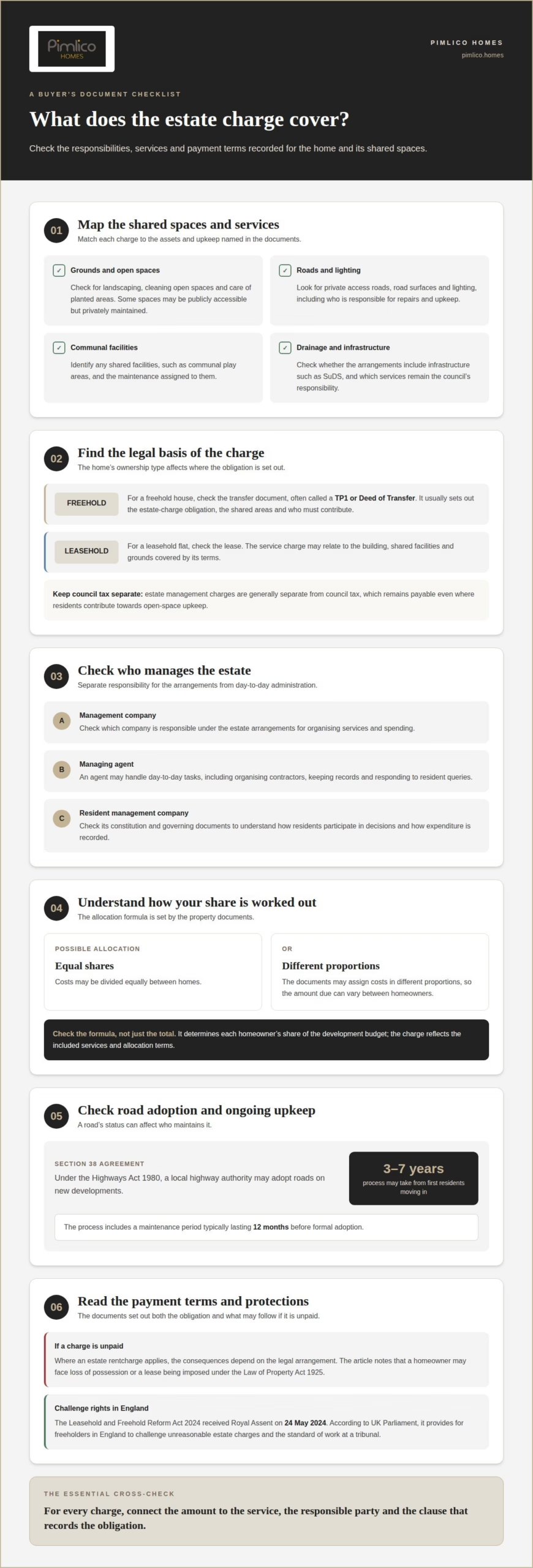
What estate management charges cover and how fleecehold works
Estate management charges in luxury private developments fund the services and upkeep described in the property documents. Their scope depends on whether the home is leasehold or freehold and which shared assets the management company maintains.
Services covered by estate charges
A charge funds services assigned to the management company in the property documents. On housing estates, these may include landscaping, cleaning open spaces, maintaining private roads and lighting, and caring for communal facilities. Larger developments can also have drainage systems such as SuDS. The documents clarify which upkeep is estate-funded and which services are arranged by the council.
Some grounds are publicly accessible but privately maintained, so residents may contribute while paying council tax. The charge follows the recorded responsibilities, not simply public access.
Charges for leasehold flats and freehold homes
Leasehold flat charges arise under the lease and may cover the building, shared facilities and grounds. Freehold houses on private estates may have a separate estate charge for communal spaces or infrastructure outside council maintenance. The lease or transfer document defines the services and obligations linked to each home.
Fleecehold describes freehold ownership combined with compulsory estate charges, often where homeowners have limited control over management. The Leasehold and Freehold Reform Act 2024 includes provisions intended to improve transparency and strengthen freeholders’ rights in England and Wales.
Checking charges before buying
Before buying, match the charge’s stated purpose against the transfer documents. Review the cost allocation, any cap or increase mechanism, and the services included. Check how responsibility for maintaining roads and shared spaces is addressed in the property documents.
When assessing estate management charges in luxury private developments, review how the obligations relate to the title and shared amenities. The scope varies according to the documented services and management responsibilities, so assess the full arrangement rather than focusing on the headline charge.
Estate management fee costs for UK new-build homes
The amount depends on the development’s location, shared infrastructure and amenities.
Regional differences in charges
There is no single regional rate: maintenance obligations and service costs shape the charge. Developments can differ in their shared facilities and upkeep needs, so location alone does not explain the amount. The specific budget and allocation arrangements provide more useful context.
Roads, landscaping and drainage all influence the work required. Where a development includes extensive grounds or private infrastructure, its management budget will reflect those responsibilities. Government policy has focused on greater transparency and protections for homeowners on private housing estates, including through the Leasehold and Freehold Reform Act 2024.
Charges in luxury developments
Premium amenities can increase annual costs. The difference lies in the services and facilities funded, not simply the home’s purchase price.
Treat any figure as context, not a forecast for an individual development: the service scope and allocation terms determine each household’s contribution. Some charges rise over time, so the initial figure alone does not show the longer-term cost.
For buyers, the clearest takeaway is to assess the annual charge against the actual amenities and maintenance provided. Consider whether the budget supports the development’s shared spaces and infrastructure, and how increases are handled. A carefully designed home remains part of a wider setting, so understanding its ongoing estate costs helps inform the purchase decision.
Pimlico Homes
Pimlico Homes offers luxury detached homes, executive courtyard homes, bespoke luxury homes and luxury barn conversions for buyers considering a significant property purchase. Once you understand the estate charge and the services it funds, consider whether the home and its setting suit your priorities.
Consider the property alongside its shared spaces, facilities and ongoing estate obligations. This broader view helps you weigh a home’s character against the responsibilities attached to its development, without treating the charge as the only measure of value.
If you are considering a home that fits your plans, contact Pimlico Homes to discuss your requirements.
Choose a home with the whole setting in view
A home is also a choice about the surroundings that shape everyday life. Estate management charges in luxury private developments belong in that wider consideration: weigh the shared setting, its maintenance and related obligations against the way you intend to live. A considered decision brings the property and its responsibilities into focus together.
As you consider your next move, define what matters most, from privacy and architectural character to the atmosphere of the surrounding spaces. Then weigh those priorities alongside the practical commitments attached to the development. This perspective keeps your decision grounded in long-term plans, rather than a single feature or headline figure. Consider the ownership structure alongside design and finish.
Pimlico Homes offers homes for buyers considering a distinctive next step. If you are ready to explore a home that reflects your priorities, discuss your next home with Pimlico Homes. A thoughtful decision can begin with a clear sense of what matters to you.
Frequently Asked Questions
What are estate management charges in UK luxury private developments?
Estate management charges are contributions towards the upkeep and administration of shared parts of a private residential development. For a freehold home, the payment obligation is generally attached to its transfer documents; for a leasehold flat, relevant payments arise under the lease. The “luxury” label does not create a separate charging system. The legal documents determine who pays and which costs are covered.
What is the average annual estate management charge for a luxury private development in the UK?
This is a general figure, not an average specifically for luxury developments. A premium estate may differ according to its amenities and maintenance obligations. Use the figure only as broad context, then consider the development’s actual budget and how costs are allocated between homes.
What services are typically included in private estate management charges?
Charges can fund work on shared grounds, roads and communal facilities, alongside the administration needed to arrange that work. The breakdown matters: managing-agent fees can account for 15-25% of the total management fee. Reviewing expenditure categories helps distinguish the cost of organising services from the cost of the maintenance itself, and shows how the estate’s budget is being used.
Can estate management charges increase, and what limits or protections apply?
Yes. Reported annual increases range from 5-15%, and some arrangements have no cap. The governing documents determine how charges are set and whether increases are restricted. In England, protections under the Leasehold and Freehold Reform Act 2024 provide for freeholders to challenge unreasonable estate charges and the standard of work at a tribunal. Leaseholders’ arrangements follow their lease terms.
Who manages private estate charges: residents, managing agents, or freeholders?
The management company is usually responsible for arranging services and administering the estate’s costs. It may appoint a managing agent for day-to-day organisation, such as coordinating contractors or handling resident enquiries. A resident management company can give homeowners a formal role in decisions. Freeholders are typically liable for charges set out in their property documents, but are not necessarily responsible for managing the estate.
What legal rights do UK homeowners have to challenge estate management charges?
Rights depend on whether the home is leasehold or freehold and on the relevant legal documents. According to UK Parliament, the Leasehold and Freehold Reform Act 2024 provides for freeholders in England to challenge unreasonable estate charges and the standard of work at a tribunal. This gives eligible freeholders a route to dispute a charge or raise concerns about maintenance quality.





