The most important protection for a heated stone floor may sit beneath the stone, not in the tile itself. Uncoupling membranes for underfloor heated stone tile flooring sit between the substrate and tiles, helping absorb movement as the heating warms and cools and reducing the risk of cracked tiles or grout.
It is reasonable to ask whether a membrane can support natural stone as well as ceramic tile. The answer depends on the complete floor build-up: the substrate, membrane, tile, flexible adhesive and grout must all be suitable for underfloor heating.
This article explains how an uncoupling membrane manages movement, what to consider when choosing stone or ceramic tiles, and why the substrate must be sound, level and fully dry. You will see where a membrane fits and when it can help create a more dependable tiled finish.
Key Takeaways
- A membrane sits between the substrate and tiles, helping manage movement as underfloor heating warms and cools.
- Stone and ceramic tiles can be considered for heated floors; the full build-up, including flexible adhesive and grout suitable for underfloor heating, matters.
- Large-format tiles need a sound, level base, so cracks and uneven areas should be addressed before tiling.
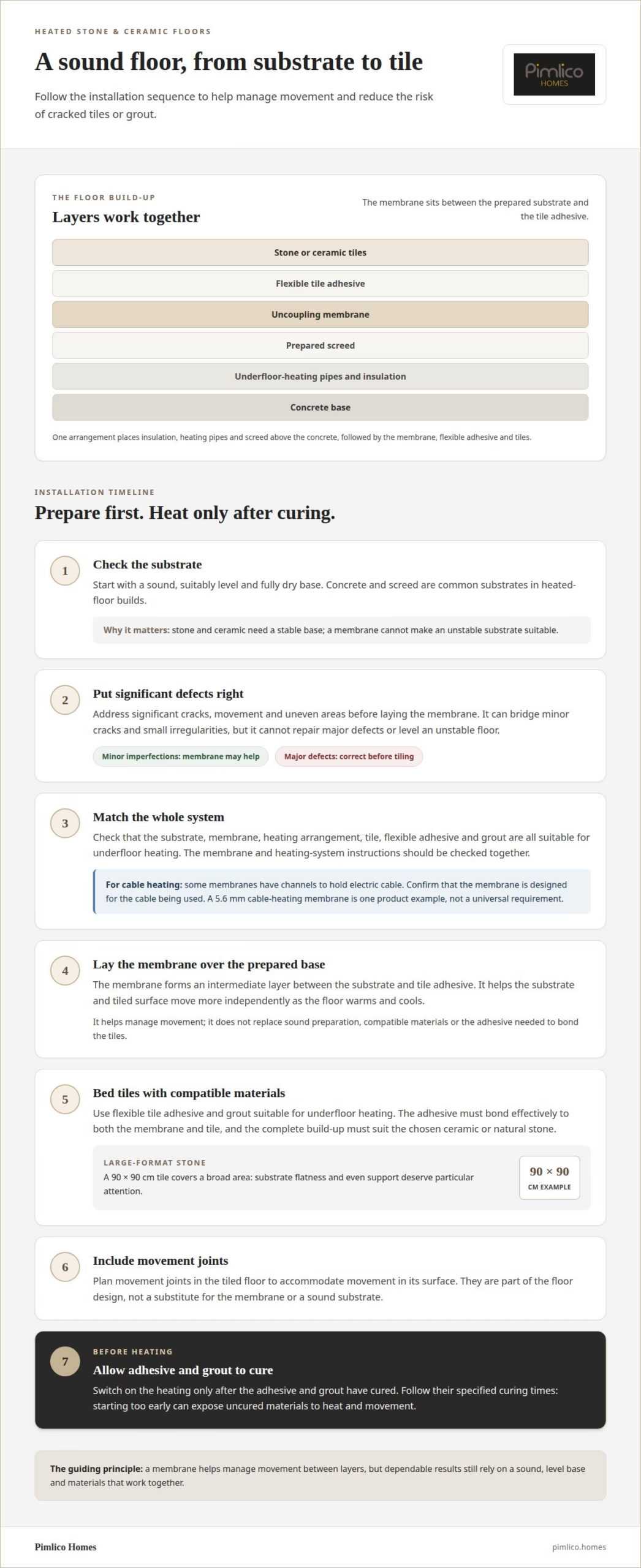
- Allow the screed to dry fully and the installation materials to cure before switching on the heating.
What is an uncoupling membrane?
An uncoupling membrane sits between the substrate and tile, helping the layers move independently. In a heated stone or ceramic floor, this separation helps manage movement rather than relying on the tile to absorb it.
Tile Separation from the Substrate
The membrane forms an intermediate layer between the floor base and tile adhesive. As underfloor heating warms and cools the floor, the substrate and tiles can respond differently. The membrane helps reduce the transfer of that movement to the tiled surface, lowering the risk of cracked tiles or grout. It does not replace sound preparation or suitable materials, and adhesive is still needed to bond the tiles to the membrane.
Bridging Cracks and Irregularities
An uncoupling membrane can bridge minor cracks and small irregularities in a substrate, creating a more stable surface for tiling. This can help where a concrete base or screed has slight imperfections. It cannot repair significant cracks, movement or an uneven floor: address those conditions before laying the membrane and tiles. This is particularly important beneath natural stone, which needs a stable base for a reliable finish.
Concrete and screed are common substrates in a heated-floor build-up. One arrangement places insulation, underfloor-heating pipes and screed above the concrete, followed by the membrane, flexible tile adhesive and tiles. The screed must provide a sound, suitably level base. A membrane can accommodate minor surface imperfections, but it cannot make an unstable substrate suitable for stone or ceramic tiles.
There is no single UK cost per square metre for membrane and installation. The price depends on the membrane specification, floor area and preparation required, and is provided after a quote request.
For stone tiles over a heated floor, use flexible tile adhesive and grout suitable for underfloor heating. Include movement joints in the floor design to accommodate movement in the tiled surface. They do not replace the membrane or a sound substrate.
Thermal expansion and tile cracking over underfloor heating
Heating and cooling cause movement in a tiled floor. An uncoupling membrane helps manage the difference between the substrate and tile layers, reducing the risk of cracked tiles or grout.
Membranes with Floor Heating
A membrane sits above the heated substrate and beneath the tile adhesive, separating the tiled finish from movement below. This arrangement helps limit stress passing into stone or ceramic tiles. Some membranes also provide channels to hold electric heating cable in place. Choose a membrane suited to the heating system and cable.
Some membranes are designed to accommodate heating cable, so check compatibility with the cable and membrane instructions. These measurements matter because the cable needs to fit the membrane’s retention features. A mismatch can make installation unsuitable. Check the membrane and heating system instructions together, rather than treating either product in isolation.
Requirements and Installation
Follow applicable UK building requirements and the installation instructions for the heating system, membrane, adhesive and grout. Lay the membrane over the prepared substrate, then bed the stone tiles with flexible adhesive suitable for underfloor heating. A 5.6 mm membrane designed for cable heating is one example of a product specification, not a universal requirement.
Switch on the heating only after the adhesive and grout have cured. Follow their specified curing times: starting the system too early can expose uncured materials to heat and movement. Natural stone can crack or lift if the substrate moves, the floor build-up is unsuitable or materials are incompatible. A membrane helps manage movement, but it cannot remove these risks or correct an unstable base.
For a large-format stone floor, such as 90 x 90 cm tiles, movement and substrate condition deserve particular attention. Flexible adhesive and grout suitable for underfloor heating are important parts of the build-up. The membrane, tile, cable and fixing materials must work as a compatible system.
Planning a heated stone floor as part of a new home? Explore Pimlico Homes’ new build homes as part of your wider design decisions.
Compatibility with ceramic and natural stone tiles
Uncoupling membranes can be used beneath ceramic and natural stone tiles over underfloor heating when the complete floor system suits the finish. Compatibility depends on the substrate, membrane, tile, heating arrangement and fixing materials working together. A membrane alone cannot make every tile suitable for every heated floor. Assess the whole build-up before choosing a material or format.
Ceramic tiles offer a manufactured finish, while natural stone varies by type, format and thickness. Those differences affect the support and fixing materials required beneath each tile. For example, 90 x 90 cm stone tiles cover a broad area, making substrate flatness and even bedding especially relevant. Uneven support can leave parts of a large tile more exposed to stress.
Choosing uncoupling membranes for underfloor heated stone tile flooring means matching the membrane to the floor application and pairing it with flexible adhesive and grout suitable for underfloor heating. The adhesive must bond effectively to both the membrane and tile. These materials work as a system: a suitable membrane cannot compensate for poor coverage, incompatible adhesive or an unsuitable substrate. Follow the product instructions for the specified materials.
Natural stone needs consideration in its own right. Its characteristics can affect adhesive selection and installation, while heating causes repeated temperature changes beneath the surface. A membrane helps manage movement between layers, but a stable, level base and correctly placed movement joints remain essential. Ceramic tiles also need compatible fixing materials and a properly prepared substrate.
For uncoupling membranes for underfloor heated stone tile flooring, assess the proposed combination rather than choosing tiles by appearance alone. A large-format stone floor, for example, needs a substrate, membrane and adhesive suited to its dimensions and heated setting. Confirm that the membrane is compatible with the tile and heating arrangement, then select the installation materials accordingly. This joined-up specification supports a considered finish in either ceramic or natural stone.
How should a subfloor be prepared before installing an uncoupling membrane over underfloor heating?
Preparation begins with the concrete or screed beneath the heated floor. A stable, level surface gives the membrane and tile build-up a sound foundation, particularly beneath large-format stone.
- Inspect the substrate. Look for cracks, movement and uneven areas in the concrete or screed. Cracks need assessment before the membrane is installed, rather than being concealed beneath it.
- Repair and prepare. Repair suitable cracks with an appropriate stitch repair resin, then prime and level the area as required. This creates a more consistent surface for the membrane.
- Allow the screed to dry. Make sure the screed is ready before tiling begins. Covering damp screed can compromise the floor build-up, so readiness matters as much as surface appearance.
- Respect curing times. After installation, leave the adhesive and grout to cure before switching on the heating. Heat should not be introduced while those materials are still curing.
In a concrete-floor build-up, insulation, underfloor-heating pipes and screed sit above the concrete. The uncoupling membrane is installed above the screed, followed by flexible tile adhesive and tiles. Each layer has a distinct role: the membrane does not replace insulation, sound screed or substrate repairs.
Levelling is especially relevant for large-format tiles, such as 90 x 90 cm stone. Uneven support can make it harder to achieve a consistent tiled surface. A membrane can bridge minor cracks and irregularities, but significant defects or an unstable base need attention first. Careful preparation helps the membrane perform its intended role within the complete floor system.
Once the screed is dry and the substrate prepared, the membrane can be installed according to its product instructions. The heating should remain off until the adhesive and grout have cured. For a considered floor build-up within a wider project, explore new-build home design.
Pimlico Homes
Pimlico Homes creates Luxury Detached Homes, Executive Courtyard Homes, Bespoke Luxury Homes and Luxury Barn Conversions. If you are planning a new home, consider choices such as natural stone, ceramic tiles and underfloor heating as part of the wider design, alongside the floor structure and intended finish.
The principles in this guide explain how a membrane fits into a heated tiled floor and why substrate preparation and compatible materials matter before installation. Where these details form part of a broader home-building vision, Pimlico Homes creates bespoke new homes shaped by craftsmanship, innovation and timeless design.
To discuss your plans, contact Pimlico Homes.
Shape the floor around the home
A heated stone floor is more than a surface choice. It shapes how a room feels underfoot, how its materials meet and how the wider interior is experienced. Treat the tile, heating and floor construction as one design decision, so the technical details support the atmosphere you want to create. The right specification depends on the complete floor design, not the membrane alone.
For uncoupling membranes for underfloor-heated stone tile flooring, bring the finish into the wider vision for your home. Consider how natural stone or ceramic will sit alongside the room’s proportions, light and other materials. This early clarity connects practical decisions with a lasting sense of place.
If you are planning a home where these choices matter, contact Pimlico Homes about your flooring. A considered conversation can help you move towards a home shaped around your aspirations.
Frequently Asked Questions
What uncoupling mats are available?
Uncoupling mats include general separation membranes and versions designed to retain electric underfloor-heating cable. One cable-heating membrane is described as a 10 x 1 m roll, with a 5.6 mm thickness and waterproof construction. Its studs are spaced 4 mm apart, and it is designed for heating cable measuring 3.6-4.2 mm in diameter. These specifications are product-specific, not universal.
When should you use a decoupling membrane?
Consider a decoupling membrane when tiles will sit above a substrate subject to movement, including a floor warmed by underfloor heating. It can help separate the tiled layer from movement below and reduce stress transfer. For example, a heated screed beneath stone tiles may benefit from a membrane designed for that floor build-up. It cannot correct significant cracks, movement or an unstable base.
What is an uncoupling membrane and how does it work under stone tile flooring?
An uncoupling membrane is an intermediate layer installed between the substrate and the tile covering. It allows the layers to respond more independently when the floor experiences movement, which can help protect stone tiles and grout from stress. Its purpose is not to make every substrate suitable: stone still needs a sound base and compatible fixing materials.
Which uncoupling membranes are suitable for underfloor heating in the UK?
Choose a membrane whose stated application matches the heating system and floor build-up. For electric cable, a cable-retention membrane is designed for cable measuring 3.6-4.2 mm, with studs spaced 4 mm apart. These details help identify whether that particular membrane suits the cable. They do not establish compatibility with every electric system or every tiled floor.
Can uncoupling membranes be used with electric and water underfloor heating?
Membranes are used with underfloor-heated tiled floors, but installation differs between systems. A cable-retention membrane is designed to hold compatible electric heating cable. With water heating, pipes can sit beneath the screed, with the membrane installed above it. The membrane must suit its position and the complete floor build-up; cable-specific dimensions do not apply to water pipes.
What stone tiles and tile sizes are compatible with uncoupling membranes over heated floors?
Ceramic and natural stone tiles can be used over underfloor heating when the complete system suits the chosen tile. Large-format stone, such as 90 x 90 cm tiles, calls for particular attention to substrate level and even support. Tile format alone does not establish compatibility. The membrane, substrate, adhesive and grout must all suit the tile and heated-floor application.