
A masterpiece isn’t truly finished until the final, invisible details are brought into the light. When you’re considering new build snagging what to expect, it’s vital to view the process not as a search for failure, but as the final stage of artistry that ensures your home is truly flawless. You’ve invested in a residence that reflects your achievements, and the worry that structural defects might be hidden behind a polished facade is a heavy weight to carry. It’s a natural concern for any homeowner who values longevity and meticulous care in equal measure.
This guide provides a sophisticated framework to help you navigate these final steps with quiet confidence and poise. We’ll demystify the 2026 NHBC standards and the protections offered by the New Homes Quality Code, ensuring you’re equipped to manage developer relationships without ever feeling like a difficult client. By exploring the nuances of pre-completion inspections and the two-year defect period, you’ll gain the peace of mind that your high-specification residence meets the exacting standards of modern prestige.
Key Takeaways
- Understand that the snagging process is the final stage of craftsmanship, ensuring your bespoke residence reflects the architectural perfection you expect.
- Discover exactly what to expect when navigating new build snagging, including your right to a Pre-Completion Inspection before the legal handover.
- Identify the critical high-specification details that require scrutiny, from the alignment of bespoke joinery to the integrity of external stonework.
- Learn why professional surveys using thermal imaging and drone technology are essential for uncovering hidden defects in executive homes.
- Master the art of professional communication to build a collaborative partnership with your developer, focusing on the long-term value of your asset.
Defining New Build Snagging: The Pursuit of Architectural Perfection
Luxury is defined by the absence of compromise. When you take possession of a high-end property, you aren’t merely buying a structure; you’re acquiring a legacy. This is why understanding new build snagging what to expect is paramount for the discerning homeowner. Snagging is often misunderstood as a combative search for errors. Instead, it should be viewed as the final, meticulous polish that transforms a high-specification build into a flawless sanctuary. Even the most prestigious developers recognise that perfection requires a final human touch.
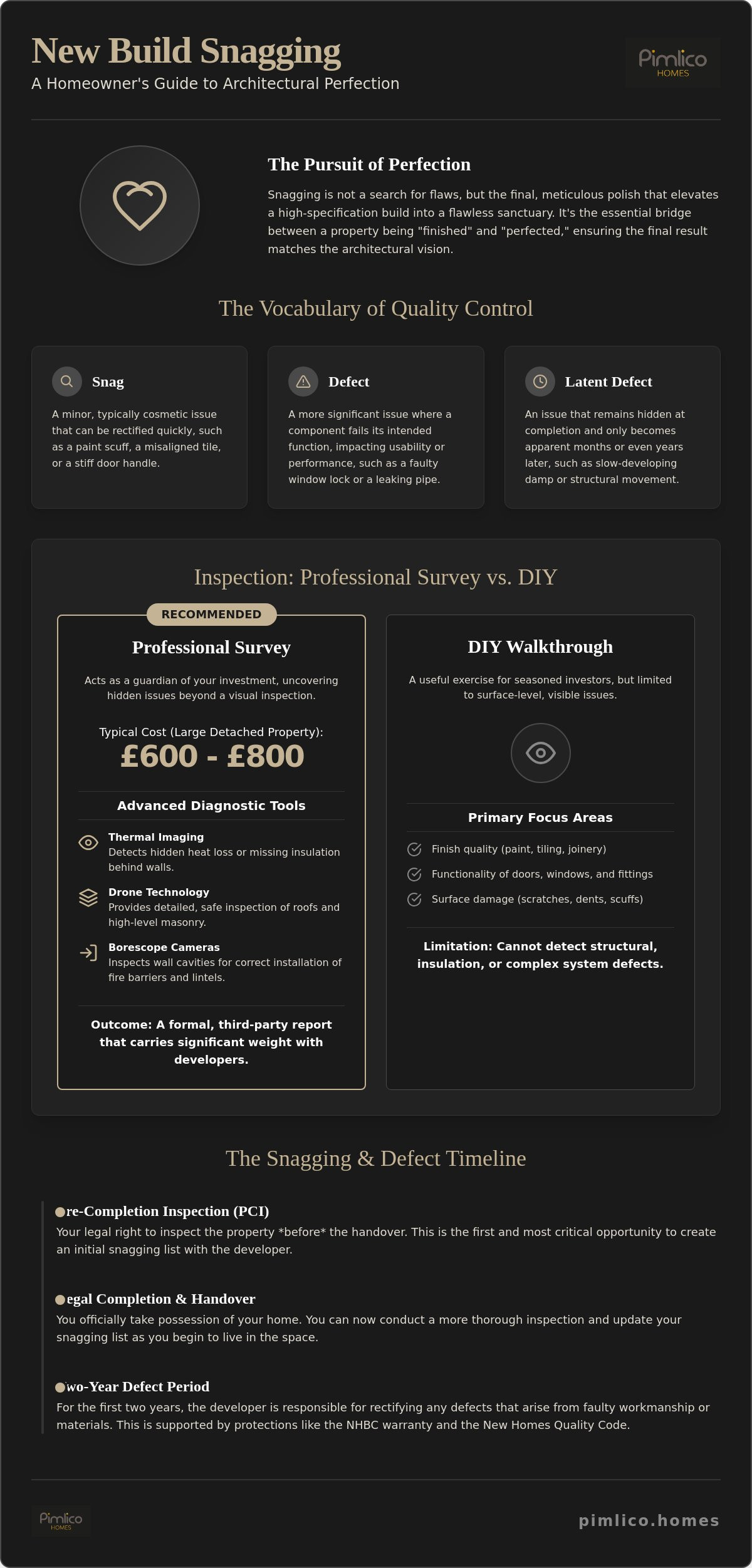
The industry often refers to this process as creating a What is a snagging or punch list? This document serves as the bridge between “finished” and “perfected”. It’s a record of items that don’t quite meet the exacting standards promised at the outset. For a luxury home, this list isn’t just about functionality; it’s about the aesthetic rhythm of the building. It’s the difference between a house that’s ready for move-in and a home that’s ready for your life.
The Vocabulary of Quality Control
Precision matters. A “snag” is typically a minor cosmetic issue, such as a paint scuff or a slightly misaligned tile, that can be rectified quickly. A “defect” is more significant, involving a failure of a component to perform its intended function. Beyond these lies the “latent defect”, an issue that remains hidden for months or even years. In 2026, the New Homes Quality Board (NHQB) has strengthened the framework for how these are handled, providing clear timescales for resolution. It’s also vital to distinguish these from “settling”. As materials like timber and plaster adjust to the internal climate, minor hairline cracks may appear. This is a natural evolution of a living building, not a sign of poor workmanship.
Why High-End Homes Demand Rigorous Inspection
The complexity of high specification new build homes necessitates a more sophisticated approach than standard residential properties. When you have integrated smart systems, bespoke joinery, and hand-finished masonry, the margin for error is razor-thin. A single inconsistent grout line or a millimetre of deviation in a bespoke kitchen cabinet can disrupt the visual harmony of a room. Rigorous inspection protects your investment. It ensures that the artistry of the craftsmen is preserved and that the property’s long-term prestige remains intact. When you know exactly what to expect from the snagging process, you can manage these final details with the authority of an owner who accepts nothing less than excellence. Before embarking on this process, it’s worth understanding what defines a luxury new build home beyond surface-level finishes, so you can evaluate whether every element of your residence truly meets the standard of modern prestige.
Professional Snagging Surveys vs. DIY: A Strategic Comparison
Deciding how to approach the final inspection is a pivotal moment in your journey. For an executive residence, the question isn’t just about finding scuffs. It’s about verifying the invisible integrity of the build. Whilst many investors have a keen eye for detail, the sheer complexity of modern luxury architecture often justifies a specialist’s intervention. Understanding new build snagging what to expect from a professional perspective involves looking past the surface to ensure the underlying craftsmanship matches the aesthetic brilliance.
The Professional Advantage: Beyond the Visible
A professional surveyor acts as a guardian of your investment. They utilise sophisticated equipment that the average homeowner doesn’t possess. Thermal imaging cameras detect heat loss or missing insulation behind perfectly plastered walls. Drones provide a detailed view of roof tiles and guttering that remain inaccessible from the ground. Borescope cameras can peer into cavities to ensure fire socks and lintels are correctly installed. These are the technical details that define the longevity of a property.
In 2026, the cost for a professional survey on a large detached property typically ranges between £600 and £800. This is a modest sum when compared to the emotional and financial weight of a luxury asset. A formal, third-party report carries significant weight when liaising with a site manager. It transforms a list of opinions into a technical mandate for excellence. This level of detail is a hallmark of the bespoke luxury homes that define the highest tier of the market. It provides a level of security that a simple visual walkthrough cannot match.
Conducting Your Own Walkthrough with Confidence
If you choose to conduct the inspection yourself, perhaps as a seasoned property investor, you must approach it with methodical precision. You’ll need more than just a notepad. A high-powered torch is essential for highlighting uneven plasterwork or paint finish issues. A spirit level checks the true verticality of door frames and the alignment of kitchen worktops. Even a simple marble ball can verify if floor levels are perfectly even across a vast open-plan space.
Your objective is to document findings that are clear and actionable. Avoid vague descriptions. Instead, note specific locations and the exact nature of the issue. Maintaining a calm, collaborative tone is vital. It reinforces your position as a partner in quality rather than an adversary. Familiarising yourself with the consumer rights for new home buyers ensures you’re protected by the latest industry regulations. This clarity of purpose allows the developer to address your concerns with the same meticulous care they used during the construction phase. For those who want a comprehensive understanding of the entire acquisition process, our buying a luxury new build guide provides an in-depth look at evaluating executive specifications and navigating the 2026 market with confidence.
The High-Specification Snagging Checklist: What to Inspect
A standard checklist often fails to capture the intricate details of a prestige property. When you are evaluating new build snagging what to expect, the focus must shift from basic functionality to the precision of high-end finishes. In a home designed for excellence, the alignment of a bespoke skirting board or the grain continuity of a hand-crafted oak door is just as critical as the structural integrity of the walls. It is about the seamless integration of every element. You aren’t just looking for mistakes; you’re verifying that the master craftsman’s vision has been fully realised in every corner of the residence. A clear understanding of what defines a luxury new build home in terms of materials, spatial design, and artisanal detail will sharpen your eye considerably during this stage.
Interior Finishes and Executive Details
Exacting standards require an exacting eye. Begin with the electrical layout. Every socket, USB port, and dimmer switch should be perfectly flush against the wall. Testing the multi-zone climate control is equally vital. Each room must respond independently and accurately to your desired settings. In the kitchen, inspect the mitred edges of natural stone worktops for smooth, invisible seams. Integrated appliances should sit perfectly square, with no gaps or vibrations when in use. In bathrooms, high-end brassware requires a pressure test to ensure consistent flow across all outlets, particularly in walk-in showers with multiple heads. Don’t overlook the internal joinery; skirting boards should meet at crisp, tight mitres without the need for excessive filler.
The External Shell and Landscaping
The exterior of a property speaks of its heritage and permanence. For those investing in executive new build homes, the courtyard and driveway are the first impressions of quality. Ensure that paving is level and that drainage systems are discreet yet highly effective. If your home is a barn conversion, pay close attention to the traditional slate or tile work on the roof. Look for uniform spacing and secure fixings. The transition between different materials, such as where timber cladding meets masonry, should be clean and weather-tight. This external review is a core part of new build snagging what to expect when you desire a home that is as beautiful on the outside as it is within. Landscape integrity is just as important. Verify that the planting, turfing, and fencing perfectly mirror the original architectural vision.
- Bespoke Joinery: Check for uniform gaps around internal doors and the smooth operation of soft-close cabinetry throughout the dressing rooms and kitchen.
- Masonry and Stonework: Inspect grout lines in natural stone flooring for colour consistency and depth; check external brickwork for clean mortar lines.
- Smart Integration: Verify that the central hub controls all lighting, security, and heating zones without lag or connectivity drops.
- External Grandeur: Ensure that all external lighting functions as intended and that all outdoor taps or power points are correctly sealed against the elements.
The Snagging Timeline: Managing the Process from PCI to Completion
Time is the ultimate arbiter of quality. In the context of new build snagging what to expect, the timeline is as critical as the inspection itself. It’s a structured journey that begins well before you receive the keys. By following a methodical schedule, you ensure that every detail is captured at the optimal moment, protecting both the aesthetic beauty and the long-term value of your investment. This process isn’t a race to the finish; it’s a deliberate progression toward excellence.
Navigating the Pre-Completion Inspection (PCI)
The Pre-Completion Inspection is a fundamental right introduced by the New Homes Quality Code. It typically occurs between five and fourteen days before legal completion. This is your opportunity to survey the property whilst it’s still under the developer’s care. You shouldn’t feel rushed. A thorough PCI usually requires at least an hour for a luxury detached home. It’s important to understand that whilst major issues can be flagged, the developer may focus on prioritising essential works before move-in day, with minor cosmetic refinements following shortly after.
Handover day is a moment of celebration, but it’s also a time for final vigilance. Once you take possession, the “First 7 Days” rule becomes paramount. Most developers require cosmetic issues, such as glass scratches or chips in sanitaryware, to be reported within this window. After this period, it becomes difficult to prove that damage didn’t occur during the moving process. This is why a second, rapid walkthrough immediately after you receive the keys is a wise investment of your time.
Post-Move-In: The Settling-In Period
Your home is a living structure that will evolve over its first year. As the building dries out, minor hairline cracks in plasterwork are common and usually addressed at the end of the first twelve months. However, you must distinguish these from structural movement. Maintaining a rolling log of any observations is a mark of a diligent homeowner. This record is invaluable for maintaining the resale value of luxury new build homes, proving that the property has been curated with professional care and technical oversight.
Beyond the initial honeymoon period, you’re protected by a two-tier warranty system. For the first two years, the developer remains responsible for rectifying defects that fail to meet the 2026 NHBC technical standards. From years three to ten, the focus shifts to structural insurance, covering major issues with the foundations, load-bearing walls, or roof. This decade-long safety net ensures your asset remains as structurally sound as it was on the day of its inception, providing the security that defines a true legacy home.
A Partnership for Excellence: Working with Your Developer
Excellence is never a solitary pursuit. In the upper echelons of residential development, the snagging phase is seen as a shared commitment to quality rather than a point of friction. When you understand new build snagging what to expect from a premier developer, you see a team that is as invested in the property’s perfection as you are. A builder who takes pride in their legacy welcomes your scrutiny. It is the final verification of their artistry. This collaborative spirit ensures that the transition from a construction site to a refined sanctuary is handled with the poise your investment deserves.
Effective communication is the foundation of this partnership. Being precise, polite, and persistent ensures that your expectations are met without compromising the professional relationship. Your primary point of contact is the Site Manager. They possess the technical authority to direct trades and ensure that rectifications are carried out with the same care as the original construction. Should a rare dispute arise, the New Homes Ombudsman Service (NHOS) provides a clear path for resolution. Established as a robust protector of consumer rights, it ensures that every standard is upheld and that your voice is heard if a developer’s response falls short of the required excellence.
The Pimlico Homes Approach to Quality Assurance
We draw upon 25 years of industry experience to ensure your journey is seamless. Long before your first walkthrough, our internal teams conduct rigorous multi-stage inspections. We aim to identify and resolve issues before they ever reach your sight. This proactive guardianship is a hallmark of bespoke luxury homes. We don’t just build; we curate. Throughout the handover phase, we remain by your side, providing the expert support needed to transition into your new residence with total confidence. Our history in luxury residential development means we understand the emotional and financial weight of your purchase.
The Final Sign-Off: Ensuring Your Vision is Met
The process concludes with a de-snagging visit. This is your opportunity to verify that every item on your list has been addressed to the required standard. It is a moment of quiet satisfaction. Knowing that your home is backed by a luxury new build warranty provides a final layer of reassurance. This isn’t just about insurance; it’s about the peace of mind that your investment is secure. As the last tradesman departs, you aren’t left with a house. You’re left with a perfected sanctuary, ready to hold the weight of your most significant life investments. It is the beginning of your story in a home that meets the exacting standards of modern prestige.
Perfecting the Vision of Your New Home
Achieving a truly flawless residence is a journey of collaboration and technical precision. By understanding the nuances of the pre-completion inspection and the protective framework of the 2026 NHBC standards, you ensure your investment is preserved for generations. Whether you choose the sophisticated depth of a professional survey or a meticulous self-guided walkthrough, the goal remains the same; it’s the realisation of a bespoke vision without compromise. Every detail, from the alignment of a skirting board to the integrity of the masonry, contributes to the property’s enduring prestige.
When you consider new build snagging what to expect, remember that the process is the final signature of a quality build. At Pimlico Homes, we bring over 25 years of specialist expertise to every project, redefining high-specification detached living through meticulous attention to detail. We view every home as a masterpiece that deserves a guardian’s care. It’s our belief that the path to perfection should be as refined as the destination itself.
Discover the Pimlico Homes commitment to excellence and see how we curate spaces of lasting legacy. Your future awaits in a home that’s as structurally sound as it is aesthetically sublime.
Frequently Asked Questions
When is the best time to do a snagging list for a new build?
The most effective time to compile a snagging list is during the Pre-Completion Inspection window, typically seven to fourteen days before you move in. Inspecting the property whilst it’s empty allows for a clearer view of the floors and walls. If you’ve already completed, aim to report cosmetic issues within the first seven days to ensure they are attributed to the construction rather than the moving process.
Can a developer refuse to fix snags on my list?
A developer cannot refuse to rectify items that fail to meet the technical standards set by your warranty provider or the New Homes Quality Code. If a snag is disputed, you should refer to the specific tolerance levels defined in the 2026 NHBC Standards. For unresolved disagreements, the New Homes Ombudsman Service provides an independent route to ensure your residence reaches the promised level of excellence.
Is it worth hiring a professional snagging company in 2026?
Hiring a professional is highly recommended for executive properties where the complexity of high-specification systems requires technical oversight. In 2026, surveyors use advanced tools like thermal imaging and drones to identify issues that are invisible to the naked eye. When considering new build snagging what to expect, a professional report provides the authoritative evidence needed to ensure your luxury asset is structurally and aesthetically perfect.
What are the most common snags found in high-end new builds?
High-end residences often face specific challenges related to the precision of bespoke finishes. Common issues include slight misalignments in hand-crafted joinery, inconsistent grout lines in natural stone tiling, and minor connectivity drops in integrated smart home systems. Because these properties use premium materials, the scrutiny must be higher; even a millimetre of deviation in a marble worktop is considered a snag in the context of luxury.
How long does a developer have to fix snags after I report them?
Under the current New Homes Quality Code, developers are expected to acknowledge your report within two days and provide a formal response within five. Most repairs should be completed within thirty days. Whilst complex bespoke parts may take longer to source, a premier builder will maintain transparent communication throughout the process to ensure your living experience remains undisturbed and refined.
Does snagging include structural issues or just cosmetic ones?
Snagging encompasses both structural integrity and cosmetic perfection during the initial two-year developer liability period. During this time, the builder is responsible for everything from paint scuffs to plumbing failures. After this window, your ten-year warranty typically pivots to cover major structural defects only. It’s vital to capture all aesthetic refinements early to ensure the home’s visual harmony is established from the outset.
What is a Pre-Completion Inspection (PCI) and is it mandatory?
The Pre-Completion Inspection is a formal right granted to buyers under the New Homes Quality Code, although it isn’t strictly mandatory for you to attend. We strongly advise participating, as it allows you to identify issues before legal handover. This process is central to new build snagging what to expect, as it sets the standard for the final finish and ensures any necessary refinements are planned before you move in.
Will my new build home settle and cause new snags later?
It is entirely natural for a new build to settle as the materials adjust to the internal climate and heating cycles. This drying out process often results in minor hairline cracks in the plaster or small gaps in the timber joinery. These are typically addressed during a final review at the end of the first twelve months, ensuring the property remains a pristine example of architectural excellence and meticulous care.


