
The true value of a prestige estate isn’t captured by its silhouette against the horizon, but by its resilience as a cornerstone of your financial legacy. You’ve likely found that as the scale of an investment grows, so too do the intricacies of its execution. Balancing the desire for a bespoke, high-specification build with the need for immediate liquidity is a challenge that demands more than just a healthy balance sheet. It requires a visionary approach to capital preservation.
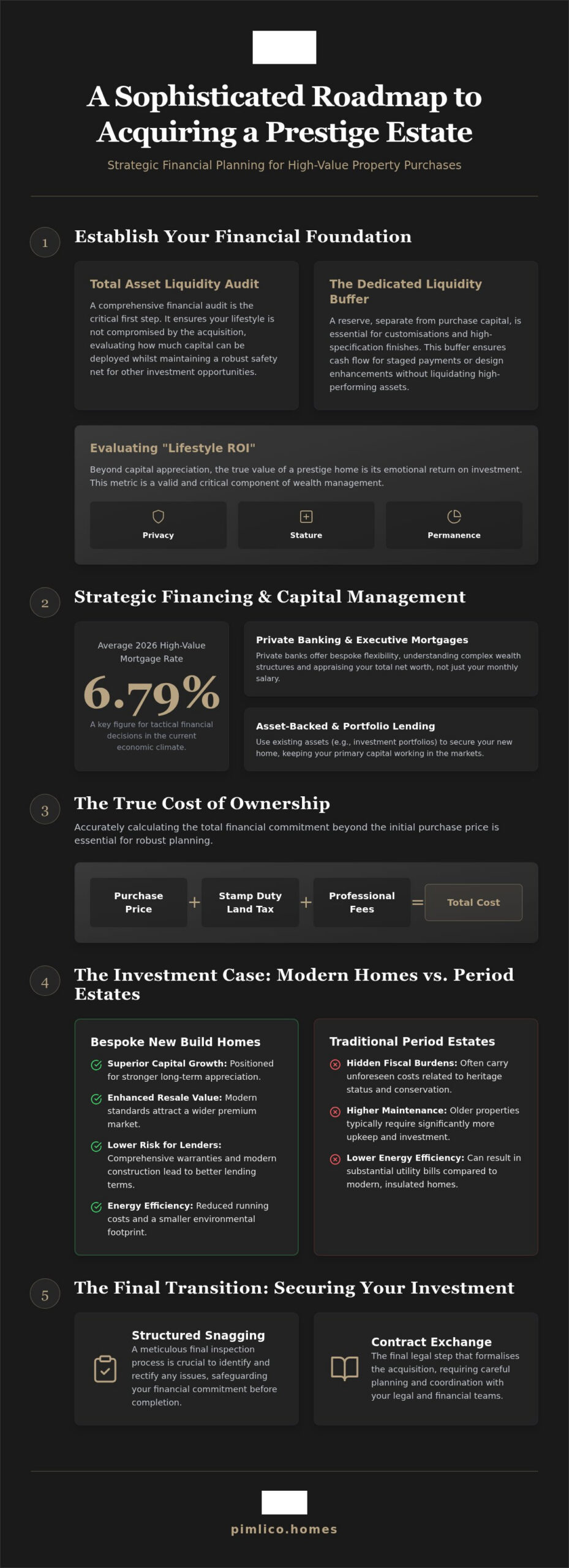
We understand that the path to a significant acquisition can feel clouded by the complexities of Stamp Duty Land Tax and the hidden fiscal burdens of heritage estates. This guide provides the clarity you need for financial planning for a luxury property purchase, offering a sophisticated roadmap that prioritises both your lifestyle aspirations and your capital’s longevity. We’ll explore how to optimise your tax position and why the efficiency of a modern, executive home represents a sounder investment in a 2026 market where high-value mortgage rates average 6.79 per cent. You’ll gain the confidence to ensure your next move is as rewarding for your portfolio as it is for your family.
Key Takeaways
- Learn how to conduct a comprehensive audit of total asset liquidity to ensure your financial planning for a luxury property purchase is robust and resilient.
- Discover how private banking and asset-backed lending can unlock capital without disrupting your broader investment strategy.
- Identify the true cost of ownership by accurately calculating Stamp Duty Land Tax and the essential professional fees required for high-value acquisitions.
- Understand why bespoke new build homes offer superior capital growth and long-term resale value compared to traditional period estates.
- Master the final transition with a structured approach to snagging and contract exchange to safeguard your financial commitment.
Establishing Your Financial Foundation for High-End Acquisition
Acquiring a prestige property is a deliberate act of wealth management. It’s about more than the initial deposit. True readiness means looking at total asset liquidity. For those considering financial planning for a luxury property purchase, the focus shifts from simple affordability to the preservation of long-term capital. A comprehensive financial audit is the first step. It ensures your lifestyle isn’t compromised by the acquisition of a high-value asset. You must evaluate how much capital can be deployed whilst maintaining a robust safety net for other investment opportunities.
The concept of “Lifestyle ROI” is a valid metric in this sector. A home is a sanctuary, not just a line item on a balance sheet. For clients of Pimlico Homes, the value of a bespoke luxury home lies in its ability to provide privacy, stature, and a sense of permanence. This emotional return on investment is just as critical as capital appreciation. Executive courtyard homes and bespoke builds require a unique liquidity strategy because they often involve longer lead times and higher levels of customisation than standard market offerings. Your financial foundation must be flexible enough to accommodate these nuances.
The Liquidity Buffer: Preparing for Bespoke Requirements
Customisations and high-spec interior finishes are the hallmarks of a prestige residence. These elements require a dedicated reserve that sits outside your primary purchase capital. When you choose a bespoke home, the building timeline can span several months. This impacts your cash flow management. You must balance liquid assets against illiquid investments during the acquisition phase to ensure funds are available for staged payments or unexpected design enhancements. A well-structured buffer prevents the need to liquidate high-performing stocks or other assets at an inopportune moment.
Debt-to-Income Ratios in the Executive Market
Standard mortgage ratios rarely apply to high-net-worth individuals. Lenders in the prestige market take a more nuanced view of your financial profile. They look at complex income streams, including annual bonuses, dividends, and carried interest. To secure the most competitive executive rates, you must present a transparent and optimised financial picture. Having a foundational understanding mortgage financing is helpful, but working with a specialist lender who understands the executive market is essential. They will assess your total net worth rather than just your monthly salary. This allows for greater flexibility in how debt is structured against your assets, ensuring your financial planning for a luxury property purchase remains both sophisticated and secure.
Financing Strategies: From Bespoke Mortgages to Asset-Backed Lending
Financing a prestige home is a sophisticated exercise in capital management. It’s rarely about a lack of funds. Instead, it’s about maintaining momentum. High-net-worth individuals often view debt as a strategic tool rather than a necessity. In the current 2026 economic climate, where national average jumbo mortgage rates hover around 6.79 per cent, the decision between fixed and variable structures is deeply tactical. A fixed rate offers the security of predictable outgoings. Conversely, a variable rate might suit those who anticipate significant liquidity events in the near term. This level of nuance is why comprehensive financial planning for real estate is vital before approaching a lender.
Lenders often view high-specification new builds with a degree of favour. These properties represent a lower risk due to modern construction standards and comprehensive warranties. For those considering bespoke luxury homes, the energy efficiency and reduced maintenance requirements of a new build can lead to more attractive lending margins. Portfolio lending also plays a significant role in this market. By using existing assets, such as a diversified investment portfolio or other real estate holdings, you can secure your new home whilst keeping your primary capital working in the markets. This approach is a cornerstone of effective financial planning for a luxury property purchase.
Private Banking and Executive Mortgages
Private banks provide the bespoke flexibility that high-street lenders cannot match. They understand that wealth is often tied up in complex structures. When appraising exclusive residential developments, these specialists look at the total value of the relationship, not just the property. This is particularly beneficial for non-standard acquisitions, such as luxury barn conversions or heritage-inspired new builds. These lenders possess the expertise to value the unique craftsmanship and architectural merit that define the prestige market, ensuring the loan reflects the true stature of the asset.
Bridging Loans and Strategic Leverage
Speed is often a currency in the luxury sector. Bridging finance allows you to secure a property immediately whilst awaiting the sale of a previous asset. It’s a short-term solution that requires a clear exit strategy. Leveraging your investment portfolio carries risks, but the rewards include maintaining your market position whilst expanding your real estate footprint. Asset-backed lending in the luxury sector is a strategic facility where high-value securities or physical collections serve as collateral to provide immediate liquidity without the need to divest. This ensures your acquisition doesn’t disrupt your broader wealth preservation goals.
The Total Cost of Ownership: Beyond the Initial Purchase Price
The purchase price of a high-value home is merely the threshold. True financial planning for a luxury property purchase accounts for the secondary layers of capital deployment that define the prestige market. For properties exceeding £2 million, Stamp Duty Land Tax (SDLT) represents a substantial fiscal commitment. At these levels, the standard 12 per cent rate applies to the portion of the price above £1.5 million. However, complexities often arise with surcharges. A 3 per cent surcharge for additional dwellings or the 2 per cent non-UK resident surcharge can significantly alter the acquisition cost. These figures demand early integration into your liquidity strategy to avoid late-stage capital friction.
Professional counsel is equally vital. Engaging a solicitor who understands the nuances of bespoke luxury contracts is a necessity. They manage the intricacies of high-value legal disbursements and ensure the contract reflects the artistry of the build. Specialist surveys and architectural consultations add further depth to the initial outlay. Whilst these fees are significant, they safeguard the investment against the structural uncertainties often found in older estates. Modern executive homes offer a distinct financial advantage here, as they are built to exacting modern standards that period properties simply cannot match.
Acquisition Taxes and Legal Disbursements
SDLT surcharges are a critical consideration for the discerning buyer. If you’re purchasing a second home or are a non-UK resident, the tax burden can escalate quickly. For luxury barn conversions, VAT implications require meticulous planning. Certain conversion works may qualify for reduced rates, but only with precise documentation and expert oversight. A solicitor experienced in the executive market will navigate these bespoke contracts, ensuring every detail of the acquisition is legally sound and tax-efficient. This professional layer provides the security needed when transferring significant sums across international borders or complex trust structures.
Operational Expenditure: Energy and Upkeep
High-specification energy efficiency isn’t just about environmental stewardship. It’s about reducing long-term operational costs. Period homes often hide vast maintenance requirements behind their stone walls, leading to unpredictable annual outgoings. In contrast, a new build by Pimlico Homes utilises advanced materials and insulation that require far less upkeep. Smart home technology also influences the bottom line. Integrated security and fire suppression systems often lead to more favourable insurance premiums for high-value assets. Budgeting for the meticulous upkeep of extensive landscaping and gated development security ensures the property retains its stature and exclusivity for decades to come.
Capital Growth and the Luxury New Build Investment Case
Capital appreciation in the prestige sector is increasingly defined by a flight to quality. In the current market, discerning investors prioritise assets that offer both aesthetic permanence and predictable performance. High-specification new builds achieve this by merging architectural artistry with advanced engineering. This focus on structural integrity is a vital component of financial planning for a luxury property purchase. Unlike heritage estates, which can suffer from capital leak due to unforeseen structural repairs, a new build protects your liquidity. The standard 10-year building warranty acts as a robust financial risk mitigation tool. It ensures your capital remains focused on growth rather than remediation.
Scarcity remains the ultimate driver of value. Exclusive courtyard enclaves offer a level of privacy and security that is increasingly rare in the modern market. These developments are curated environments that foster a sense of community whilst maintaining individual stature. This inherent uniqueness creates a price premium that persists through broader market fluctuations, making them a cornerstone of any sophisticated real estate portfolio.
Future-Proofing Your Investment
Sustainable design is no longer a secondary consideration; it’s a financial imperative. Buyers in 2026 seek homes that are both technologically advanced and ecologically responsible. High-specification bespoke luxury homes are meticulously designed to meet these evolving demands. Energy-efficient luxury is the primary driver of 2026 resale value because it minimises operational costs whilst enhancing the resident’s comfort. This forward-thinking approach ensures your asset remains relevant and desirable for decades.
Legacy Planning and Generational Wealth
A residence is often the centrepiece of a family’s legacy. Structuring property ownership for Inheritance Tax (IHT) efficiency is a critical part of financial planning for a luxury property purchase. By choosing an asset with a proven track record, you create a multi-generational hub that preserves wealth. The resale value of new build homes is historically more resilient due to their modern specifications and desirable locations. This stability provides deep reassurance for those looking to pass on a high-value estate to the next generation.
View our latest luxury detached homes to discover how we integrate long-term value into every architectural detail.
The Final Transition: Planning for a Seamless Property Acquisition
The threshold of ownership is a moment for meticulous focus. Before the exchange of contracts, a final financial review ensures that every facet of your strategy remains aligned with your long-term goals. This is the culmination of your financial planning for a luxury property purchase. It’s a time to verify that liquidity is positioned for the final transfer and that your tax structures are fully operational. Choosing a premier developer like Pimlico Homes simplifies this journey. Our 25 years of industry experience in the executive market means we understand the cadence of high-value transactions. We provide the steady hand and the quiet confidence required to move from vision to reality.
Organising your move-in fund is the final piece of the liquidity puzzle. Beyond the purchase price, you must account for immediate customisations, bespoke interior design, and high-end landscaping. These finishing touches transform a high-specification house into a personal sanctuary. By ring-fencing these funds early, you avoid the need to disrupt your broader investment portfolio during the move-in phase. This level of preparation ensures that the transition into your new residence is as smooth as the architecture is refined.
The Snagging Process as Financial Protection
A professional snagging survey is a non-negotiable safeguard for any luxury new build. It’s the final layer of quality control that protects your financial investment. Whilst our master craftsmen work to the highest standards, a formal inspection ensures every bespoke finish meets your agreed contractual expectations. This process isn’t merely about aesthetics. It’s about structural integrity and technical precision. The subsequent warranty period then serves as a long-term financial safety net. It provides deep reassurance that your capital is protected against the unforeseen, allowing you to settle into your new home with absolute peace of mind.
Your Acquisition Checklist
The transition from mortgage offer to key handover requires a structured approach. Precision is paramount. Managing the transfer of large sums with security ensures that the final exchange occurs without friction. Consider this final roadmap:
- Confirm the final mortgage offer and verify all conditions are satisfied.
- Coordinate with your private banker to manage the secure transfer of funds via CHAPS or Swift.
- Review the snagging report and confirm all remedial works are completed to a high standard.
- Verify that all warranties and legal disbursements are documented and filed.
Managing these final steps with precision ensures a sense of serenity. A well-planned acquisition allows you to focus on the emotional weight of your investment. It’s the start of a new chapter in a home built with meticulous care and visionary design. By following a clear roadmap, you ensure that your financial planning for a luxury property purchase concludes as successfully as it began. The result is a seamless entry into a residence that represents both a sound asset and a distinguished life choice.
Securing Your Legacy in the Prestige Market
Excellence is a deliberate choice. It’s the result of aligning a grand architectural vision with a disciplined approach to wealth preservation. We’ve explored how a sophisticated framework for liquidity management and a clear understanding of acquisition taxes can transform a complex process into a seamless transition. By prioritising high-specification new builds, you benefit from energy efficiency and structural warranties that period estates simply cannot match. Effective financial planning for a luxury property purchase ensures that your capital remains as resilient as the home you choose to build.
At Pimlico Homes, we bring 25 years of expertise to every project. We ensure that bespoke high-specification finishes and unrivalled privacy are woven into the very fabric of our exclusive executive enclaves. This commitment to quality provides the security you need when making a significant life investment. Explore our exclusive luxury developments to see how we create homes that stand as a testament to your success. Your next chapter deserves a foundation built on quality, artistry, and absolute fiscal confidence.
Frequently Asked Questions
How much deposit is typically required for a luxury property purchase in the UK?
Deposits for luxury acquisitions usually start at 20 per cent, though bespoke private banking arrangements can offer flexibility based on your total asset profile. These lenders prioritise the strength of your global portfolio rather than just the cash contribution. This flexibility is a key advantage of sophisticated financial planning for a luxury property purchase.
What are the Stamp Duty implications for properties over £2 million in 2026?
In 2026, properties exceeding £2 million attract the 12 per cent Stamp Duty Land Tax rate on the portion of the price above £1.5 million. You must also account for potential surcharges. For example, a 3 per cent additional dwelling surcharge or a 2 per cent non-UK resident surcharge can apply. These levies are substantial and should be factored into your initial liquidity calculations to ensure a smooth transaction.
Can I use my investment portfolio as collateral for a luxury home mortgage?
Yes, asset-backed lending allows you to use your investment portfolio as security without the need to divest. This strategy provides immediate liquidity whilst keeping your capital working in the markets. It’s a common tool for high-net-worth individuals who wish to expand their real estate footprint whilst maintaining their market positions. This approach allows you to leverage your wealth without disrupting your long-term investment strategy.
Are maintenance costs significantly lower for luxury new builds compared to period homes?
Maintenance outgoings for luxury new builds are typically significantly lower than those of period estates. High-specification modern homes utilise advanced materials and insulation that minimise repairs and energy consumption. Over a ten-year period, the savings on operational upkeep can be substantial. This represents a more efficient allocation of capital and provides greater predictability for your annual outgoings.
What is a “Jumbo Mortgage” and when should I consider one?
A Jumbo Mortgage refers to a high-value loan that exceeds standard lending limits, often requiring a more personalised underwriting process. In 2026, national average rates for these loans hover around 6.79 per cent. You should consider this path if your acquisition requires a loan-to-value ratio that standard products cannot accommodate. It allows for the acquisition of significant assets whilst preserving your liquid cash for other opportunities.
How does a building warranty affect the resale value of a luxury home?
A 10-year building warranty serves as a powerful risk-mitigation tool that bolsters the resale value of a luxury home. It provides future buyers with the reassurance that the property meets exacting structural standards. This flight to quality ensures your asset remains highly liquid and desirable in a competitive prestige market. It effectively transfers the risk of structural defects away from the owner, supporting a price premium at the point of sale.
Is it better to buy a luxury property through a limited company?
Purchasing through a limited company can offer Inheritance Tax benefits and flexibility for multi-generational wealth planning. However, you must weigh these against the Annual Tax on Enveloped Dwellings and the 3 per cent Stamp Duty surcharge. Consulting a specialist tax advisor is essential to determine if this structure aligns with your broader financial planning for a luxury property purchase. The decision depends entirely on your long-term objectives and total estate structure.
What additional insurance do I need for a high-value executive home?
High-value executive homes require specialist insurance that goes beyond standard buildings and contents cover. You may need specific protection for bespoke architectural features, integrated smart home technology, and extensive landscaping. Specialist brokers can also arrange cover for fine art collections and high-value liability. This ensures every facet of your estate is protected against unique risks that standard policies often exclude.


