
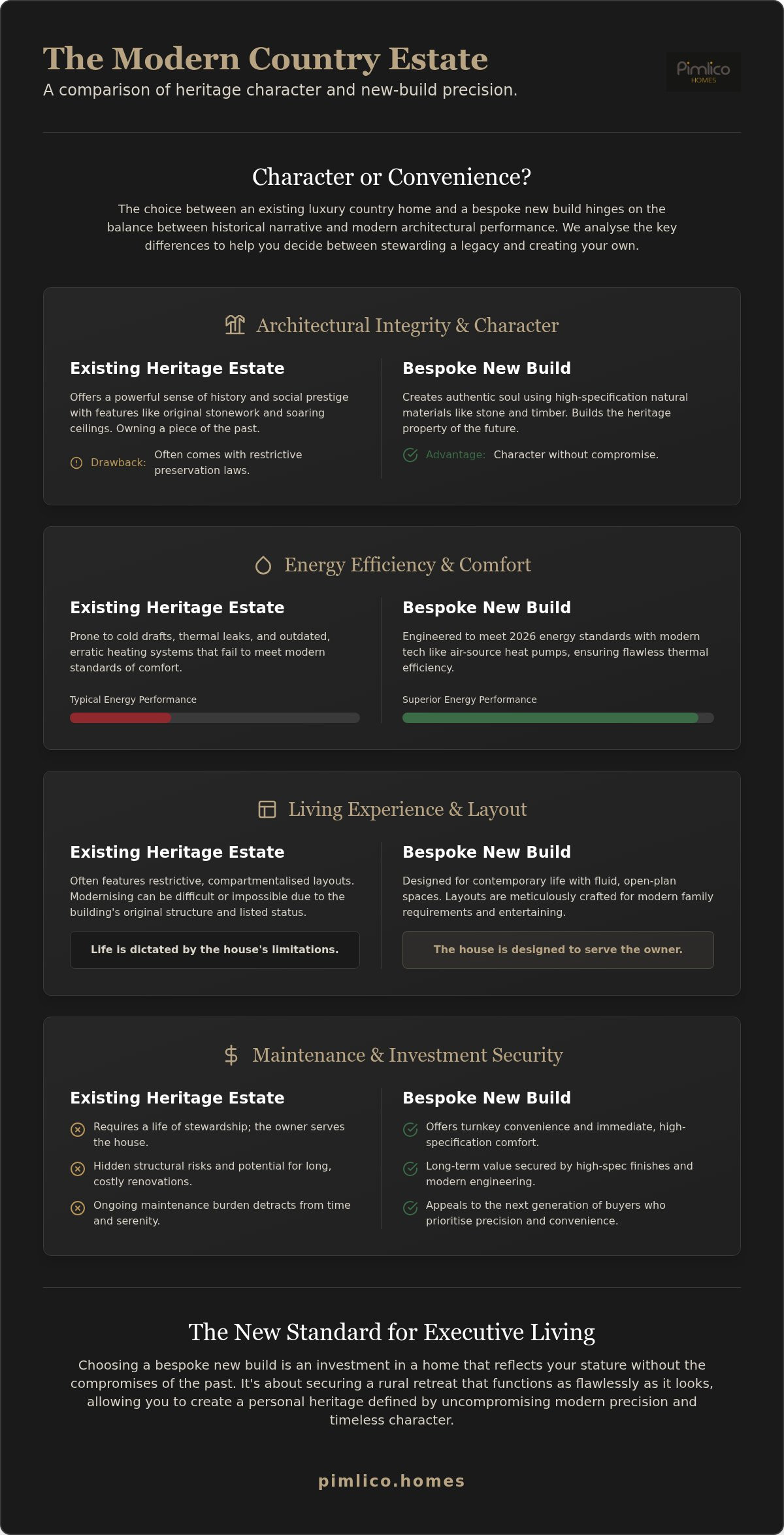
The true cost of a heritage estate isn’t found in the purchase price; it’s often hidden in the quiet compromise of living within someone else’s history. You’ve likely spent years admiring the weathered stone and grand proportions of a period manor, yet the reality of cold drafts and outdated layouts often creates a friction that detracts from the serenity of rural life. Deciding between a new build vs existing luxury country home requires more than a simple comparison of aesthetics. It’s a choice between the storied past and a future designed with your specific legacy in mind.
We understand that a home should be a reflection of your stature, offering a sanctuary that functions as flawlessly as it looks. You deserve the security of modern engineering without sacrificing the architectural soul that makes a country retreat so compelling. In this guide, we’ll explore these nuanced choices, from the long term investment security of high specification finishes to the unrivalled comfort of bespoke barn conversions. We’ll examine the structural realities of 2026 and how you can secure a residence that provides both timeless character and uncompromising modern precision.
Key Takeaways
- Discover why the choice between a new build vs existing luxury country home often hinges on the balance between historical narrative and modern architectural performance.
- Efficiency without compromise. Learn how 2026 energy standards and air-source technology eliminate the maintenance burdens and thermal leaks common in heritage estates.
- Fluid living. Explore the transition from restrictive period layouts to open-plan spaces that are meticulously crafted for the requirements of contemporary life.
- Bespoke character. Challenge the myth of soulless construction by exploring how natural stone and timber create homes with authentic soul and longevity.
- Investment security. Analyse the long-term value of high-specification finishes and why the next generation of buyers prioritises the turnkey convenience of executive developments.
The Dilemma of the Country Estate: Character or Convenience?
The British countryside is defined by the silhouettes of manor houses and honey-coloured stone farmsteads. These structures carry an undeniable romantic weight. They speak of a slower pace and a connection to the land that many high-net-worth individuals find deeply attractive. However, the decision between a new build vs existing luxury country home involves more than just a preference for aesthetics. It’s an evaluation of how you intend to spend your most precious resource: time. Traditional estates often demand a life of stewardship, where the owner serves the house. Modern luxury, by contrast, is designed to serve the owner.
There is a profound psychological shift occurring amongst today’s elite buyers. The narrative of “restoring a legacy” is being replaced by the desire to “create a personal heritage.” For the time-poor professional, the prospect of a five-year renovation project in a drafty period property has lost its lustre. They’re seeking a sanctuary that offers immediate, high-specification comfort without the hidden structural risks of the past. Balancing the desire for rural privacy with the need for modern precision is the new hallmark of a successful property search.
Evaluating the Allure of Period Property Heritage
Heritage properties offer a sense of social prestige that is difficult to replicate through standard construction. Soaring ceilings, original stonework, and gardens that have matured over centuries provide a backdrop of permanence. Owning a piece of history feels like a significant life investment. Yet, this emotional weight often carries a heavy price. The reality of “listed” status can turn a dream home into a museum where modern living is hindered by preservation laws. You might find yourself unable to install the energy-efficient glazing or the open-plan kitchen your lifestyle requires. The charm of a centuries-old fireplace is often tempered by the reality of erratic heating systems that fail to meet the expectations of 2026 living.
The Rising Demand for Executive Country Homes
Today’s discerning buyer prioritises architectural precision over historical repairs. There is an increasing preference for exclusive developments that offer curated privacy and high-level security. The modern standard for luxury detached homes focuses on the seamless integration of technology and craftsmanship. These residences aren’t just houses; they’re engineered environments designed for contemporary family life. They offer the quiet confidence of a master-built home, where every joint is perfect and every room is thermally efficient. By choosing a bespoke new build, you’re investing in a home that reflects your stature without the ongoing stress of renovation. It’s about securing a rural retreat that functions as flawlessly as it looks, allowing you to focus on the human experience of the home rather than its maintenance.
Architectural Integrity: Traditional Charm vs. Bespoke Craftsmanship
A common misconception persists that character is a quality only time can bestow. Many believe that choosing a new build vs existing luxury country home means sacrificing soul for efficiency. However, true architectural integrity isn’t found in the date on a cornerstone; it’s found in the meticulous selection of materials and the artistry of the build. Bespoke construction allows for the integration of natural stone, hand-cut timber, and Welsh slate into a high-specification frame. This approach creates a residence that feels grounded in its environment from the moment the keys are turned.
Executive courtyard homes provide a unique solution to the isolation often felt in sprawling heritage estates. These developments are designed to foster a sense of established community whilst maintaining absolute privacy for every resident. By using traditional aesthetics like dry-stone walling and timber-framed porches, visionary builders create a narrative of permanence. It’s about building for longevity, ensuring that the home you buy today becomes the heritage property of the future.
Preserving the Narrative in Luxury Barn Conversions
For those who refuse to choose between history and modernity, modern barn conversion interiors offer a masterclass in refined rural luxury. These projects preserve the original structural timber, allowing the history of the building to remain visible and respected. When combined with floor-to-ceiling glazing, the result is a light-filled space that feels both rustic and contemporary. Reclaiming heritage materials, such as weathered brick or flagstone flooring, ensures the home retains its architectural honesty whilst benefitting from 21st-century insulation. It’s a sophisticated hybrid that captures the best of both worlds.
Designing for the Future with Bespoke Luxury New Builds
The primary advantage of a bespoke build is the absolute freedom of a blank canvas. Period properties are often restricted by load-bearing walls and narrow windows that limit your vision. In a modern detached home, you can dictate the flow of light and the volume of space with total precision. You might choose a double-height entrance hall that commands attention or a kitchen designed specifically for large-scale entertaining. Every detail, from the hand-crafted joinery to the designer kitchen, is tailored to your unique lifestyle. This level of personalisation ensures that your home is a true reflection of your stature. If you’re ready to explore these possibilities, our range of bespoke luxury homes offers the perfect starting point for your journey.
The Engineering Gap: Energy Efficiency and Maintenance Realities
The true standard of a residence isn’t merely found in its facade; it’s found in the invisible engineering that sustains it. When weighing the choice between a new build vs existing luxury country home, the thermal efficiency gap is often the most significant differentiator. An 18th-century manor, whilst undeniably beautiful, was never designed for the climate expectations of 2026. These older structures frequently struggle to achieve even a modest ‘D’ or ‘E’ rating on the Energy Performance Certificate (EPC) scale. In contrast, a modern luxury build is engineered for ‘A’ ratings as standard, utilizing advanced air-source heat pumps and intricate insulation layers that ensure the house remains a sanctuary of consistent warmth.
Owning an existing country estate often involves an unspoken “maintenance tax.” This isn’t a government levy, but the constant financial drain required to keep a period property functional. Roofs require specialist slate repairs; damp courses fail in centuries-old stonework; and outdated wiring struggles to support modern smart-home technology. A new build eliminates these anxieties through comprehensive structural warranties and snagging guarantees. It’s the difference between being a custodian of a decaying asset and the owner of a precision-engineered investment.
The True Cost of Maintaining an Older Rural Property
The emotional burden of constant upkeep can quickly overshadow the romance of a period estate. Retrofitting sustainable technology into heritage structures is notoriously difficult and often requires invasive work that compromises the building’s aesthetic. You may find that installing modern heat recovery systems is impossible due to the thickness of the original walls or restrictive building regulations. Character in an older home often masks hidden structural vulnerabilities that don’t reveal themselves until you’ve already committed to the purchase. It’s a cycle of repair that can detract from the peace you sought in the countryside.
High Specification Standards in Modern Construction
Modern luxury is defined by a seamless marriage of comfort and sustainability. Exploring the technical superiority of high specification new build homes reveals a world of engineering that period properties simply cannot match. Zoned underfloor heating provides a gentle, pervasive warmth that eliminates the cold spots common in high-ceilinged manors. We’re seeing a decisive move towards Net Zero luxury, where solar integration and mechanical ventilation with heat recovery (MVHR) create a living environment that is as healthy as it is efficient. The longevity of modern, high-performance materials ensures your home remains pristine for decades, allowing you to enjoy the landscape rather than worrying about the infrastructure beneath your feet.
Curating the Living Experience: Layouts and Technology
The internal experience of a residence is defined by its spatial logic. When evaluating the merits of a new build vs existing luxury country home, the most immediate differentiator is often the fluidity of movement. Period properties, for all their external grandeur, frequently suffer from “rabbit warren” layouts. These fragmented floor plans reflect a bygone era of domestic service, where kitchens were hidden and rooms were strictly partitioned for formality. In 2026, luxury is synonymous with connection. Modern executive builds prioritise the expansive, light-filled volumes required for contemporary socialising, providing a seamless transition between cooking, dining, and relaxation.
Designing a home from the ground up allows for the integration of modern lifestyle requirements into the architectural DNA. Home offices and wellness suites are no longer afterthoughts or converted bedrooms; they are purpose-built spaces with dedicated acoustics and climate control. This level of intentionality ensures that your home functions as a high-performance environment for both work and restoration. It’s the invisible luxury of a home that understands how you live. To see how these principles are applied in practice, you can explore our bespoke luxury homes and discover the art of modern spatial design.
The Evolution of Open-Plan Living in Contemporary Estates
Successful open-plan design is an exercise in balance. It requires the intelligent use of architectural glazing and precise orientation to flood the home with natural light throughout the day. Whilst volume builders often struggle with proportion, executive detached homes use high ceilings and wide apertures to create a sense of grandeur that rivals any manor house. Zoning these large spaces is essential to maintain intimacy; we use structural elements and varied floor levels to define areas without the need for restrictive walls. In our executive courtyard homes, this approach ensures that every primary room enjoys framed views of the gardens, blurring the boundary between the interior and the landscape.
Future-Proofing with Smart Technology and Security
A modern luxury home is a sophisticated machine. Integrating AV, lighting, and climate control from day one avoids the clunky, visible retrofitting often seen in older properties. In the 2026 luxury market, high-speed connectivity and EV charging points are not optional extras; they are fundamental requirements for a future-proofed investment. This technological layer is supported by enhanced security features inherent in modern developments. Gated entrances and discreet, integrated surveillance provide a level of security and peace of mind that is difficult to achieve in an isolated heritage estate. It’s a comprehensive approach to safety that allows you to enjoy your retreat with absolute confidence.
Securing Your Investment: Why a Luxury New Build Prevails
The final consideration in the debate between a new build vs existing luxury country home is the legacy of the investment itself. Luxury is a long game. It requires a balance of immediate gratification and future security. Whilst some observers suggest that new properties face initial depreciation, this perspective rarely applies to the upper echelons of the executive market. In the premium sector, value is driven by scarcity, architectural uniqueness, and the uncompromising quality of the build. A bespoke residence is an individual masterpiece; it’s a tangible asset that stands apart from the mass-produced units of volume developers.
Turnkey convenience has become a primary currency for the next generation of luxury buyers. They seek a home that is ready for life on the day of completion, free from the shadow of impending renovations or structural surprises. A 10-year structural warranty provides a level of reassurance that a period survey simply cannot match. It offers a clear, documented promise of quality. This security allows you to focus on the pleasure of your retreat, confident that your capital is protected by modern engineering and professional guarantees.
Long-Term Resale Value and Structural Guarantees
Energy efficiency will dictate property value in the coming decade. As environmental regulations evolve and running costs remain a priority, the EPC ‘A’ rating of a 2026 build becomes a significant commercial advantage. We are already seeing a shift where the resale value of new build homes in the executive sector outpaces older properties that require expensive retrofitting. By eliminating the “renovation risk” for future purchasers, you ensure your home remains a highly liquid and desirable asset. The scarcity of high-specification executive homes in prime rural locations ensures that demand continues to outstrip supply, sustaining premium prices for years to come.
Embarking on Your Journey with Pimlico Homes
The Pimlico philosophy is rooted in the belief that a home should be a sanctuary of quiet confidence. We blend heritage aesthetics with visionary modern living to create residences that feel both timeless and innovative. Our commitment to high-quality craftsmanship ensures that every project meets the most exacting executive standards, from the initial architectural concept to the final, meticulous finish. If you’re ready to find a home that reflects your stature and secures your future, we invite you to explore our latest opportunities:
- Discover our latest collections of luxury detached homes in sought-after rural settings.
- Explore the refined community of our executive courtyard homes.
- Consult with us on bespoke luxury homes tailored to your specific vision.
- Experience the unique character of our luxury barn conversions.
Defining Your Rural Legacy for 2026
The choice between a new build vs existing luxury country home ultimately rests on where you wish to place your energy. You can choose to be a custodian of a fading past or the visionary creator of a vibrant future. True luxury in the coming years will be defined by residences that offer the architectural soul of a heritage estate without the thermal inefficiency and structural uncertainty that so often accompany it. By prioritising bespoke precision and high-specification engineering, you secure a sanctuary that respects the landscape whilst enhancing your daily experience.
With 25 years of luxury development expertise, we understand the emotional and financial weight of this significant life investment. We remain specialists in high-specification barn conversions and bespoke residential projects, driven by an uncompromising commitment to craftsmanship. Your home should be a reflection of your stature; it’s a vessel for your comfort and a secure foundation for your family. We invite you to discover the pinnacle of bespoke living with Pimlico Homes. Your ultimate rural retreat is waiting to be realised.
Frequently Asked Questions
Does a luxury new build hold its value as well as a period property?
Luxury new builds often sustain premium prices due to their scarcity and high-specification finishes. Unlike older properties that may require significant capital expenditure to remain functional, a modern home remains a liquid asset. This is particularly true when considering the new build vs existing luxury country home debate in the context of the 2026 market, where energy efficiency is a primary driver of resale value.
Can I customise the interior specification of a Pimlico Homes new build?
Customisation is a fundamental part of the journey with us. We invite our clients to influence the interior specification of their bespoke luxury homes, from the selection of hand-crafted joinery to the layout of designer kitchens. This ensures the final residence isn’t just a house; it’s a reflection of your unique stature and lifestyle requirements.
What are the main maintenance differences between old and new country homes?
The primary difference lies in the predictability of costs. Existing country homes often face ongoing structural repairs to roofs, damp courses, and outdated wiring. New builds eliminate this uncertainty through the use of high-performance materials and the protection of structural warranties. You’re buying peace of mind rather than a renovation project.
Are luxury barn conversions considered new builds or existing properties?
Luxury barn conversions occupy a unique position in the market. Whilst they utilise original structural timbers and heritage stonework, they are often classified as new builds for warranty and efficiency purposes. This provides the ultimate architectural compromise: the soul of a period property with the precision and comfort of modern engineering.
How does energy efficiency in a new build compare to a retrofitted older home?
New builds are engineered for peak thermal performance from the foundations up. Retrofitting an older home often reaches a plateau of efficiency due to the thickness of original walls or restrictive listed status. A modern executive build achieves an EPC ‘A’ rating as standard, utilising air-source technology that an older manor simply cannot support.
What structural warranties are included with an executive new build home?
Every executive new build home is backed by a comprehensive 10-year structural warranty. This provides a legal guarantee against major defects, offering a level of security that a standard survey on an older property cannot match. It’s a fundamental layer of protection that safeguards your long-term investment.
Is it possible to achieve a “character” look in a bespoke new build?
We achieve authentic character through the meticulous selection of natural materials. By using hand-cut stone, timber frames, and slate, we create homes that feel grounded in the landscape. This bespoke approach ensures that your residence possesses the architectural honesty of a traditional estate without the inherent structural vulnerabilities of age.
How do executive courtyard homes ensure privacy compared to older estates?
Privacy in executive courtyard homes is established through intelligent orientation and gated perimeters. Unlike older estates that may have public rights of way or overlooked gardens, these developments are designed with sightlines that protect every resident’s seclusion. You enjoy a sense of community whilst maintaining absolute control over your personal sanctuary.


