
What if the most prestigious address of 2026 isn’t defined by its square footage, but by its ability to generate more energy than it consumes? It’s a provocative thought for the discerning homeowner. You likely believe that a residence should be a masterpiece of design, yet there’s a lingering anxiety that “green” technology might feel utilitarian or look out of place in a high-specification development. You shouldn’t have to choose between architectural grandeur and ecological integrity. Many investors fear that eco-friendly luxury new build homes will lack the refined finish of a traditional executive property, or that upcoming 2026 building regulations will impose restrictive, unattractive constraints.
This guide demonstrates how to harmonise ultra-high-end aesthetics with cutting-edge environmental responsibility to create an enduring residential legacy. We’ll explore the invisible technologies that allow a home to cost nothing to run whilst looking like a work of art. You’ll discover how future-proofed engineering increases resale value, ensuring your investment remains a bold leader in the market. From the thermal efficiency of luxury barn conversions to the sophisticated systems of executive courtyard homes, we’ll show you how to build for tomorrow without sacrificing the luxury of today.
Key Takeaways
- Learn how the 2026 Future Homes Standard redefines prestige by shifting the focus from simple consumption to a legacy of conscientious, high-specification design.
- Understand why the most sophisticated eco-friendly luxury new build homes prioritise the building’s fabric to ensure silent, effortless thermal performance without relying on visible machinery.
- Discover how all-electric systems and intelligent automation manage your environment’s climate and energy needs whilst remaining entirely invisible to the eye.
- Gain a structured framework for evaluating developer heritage and defining your environmental non-negotiables well before the architectural design phase begins.
- Explore the unique methodology of marrying 25 years of traditional craftsmanship with modern efficiency to create sustainable residences that feel both permanent and innovative.
The Evolution of Sustainable Luxury: Defining the 2026 Standard
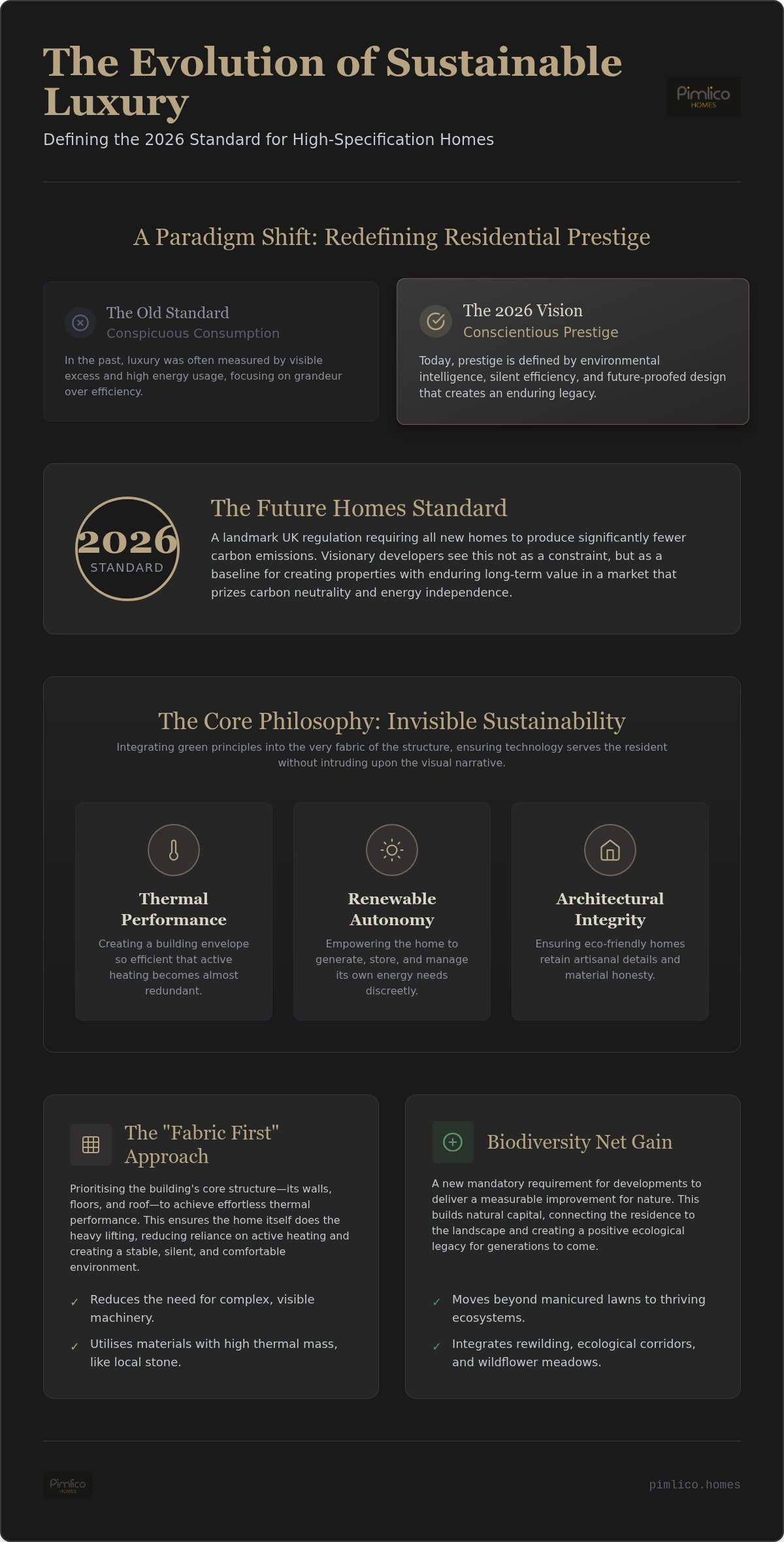
The definition of prestige is undergoing a quiet transformation. For decades, high-end residential design focused on conspicuous consumption, where grandeur was measured by visible excess. Today, a more sophisticated philosophy has emerged: conscientious prestige. This movement prioritises the environmental intelligence of a property as much as its aesthetic finish. It’s about a home that performs with silent efficiency whilst maintaining the uncompromising standards of a bespoke residence. The modern homeowner seeks a sanctuary that reflects their values, blending the weight of tradition with the agility of future-proofed technology.
Modern luxury demands that technology serves the resident without intruding upon the visual narrative. We call this “Invisible Sustainability.” By integrating green building principles into the very fabric of the structure, we ensure that solar arrays, heat pumps, and ventilation systems disappear into the architectural silhouette. The result is a home that feels timeless, not technical. This approach rests on three essential pillars:
- Thermal Performance: Creating a building envelope so efficient that active heating becomes almost redundant.
- Renewable Autonomy: Empowering the home to generate and manage its own energy through integrated storage.
- Architectural Integrity: Ensuring that eco-friendly luxury new build homes retain the artisanal details and material honesty that define high-specification living.
The Future Homes Standard and Beyond
The year 2026 marks a significant shift in the United Kingdom’s regulatory environment. The Future Homes Standard will require all new builds to produce significantly fewer carbon emissions than those built under previous codes. Whilst these mandates represent a challenge for some, they’re a baseline for the visionary developer. Sustainable Luxury is the intersection of artisanal craftsmanship and carbon-neutral technology. By exceeding these standards today, homeowners secure the long-term resale value of their property, ensuring it remains a desirable asset in a market that increasingly values carbon neutrality and energy independence.
Biodiversity Net Gain: The New Estate Requirement
Luxury is no longer confined to the interior. New regulations regarding Biodiversity Net Gain (BNG) require developments to deliver a measurable increase in local ecology. For executive courtyard homes and large detached estates, this means moving beyond simple manicured lawns. We’re seeing the integration of rewilding projects, ecological corridors, and wildflower meadows into the master plan. These elements don’t just meet a legal requirement; they build natural capital. A private estate that supports a thriving local ecosystem carries a unique sense of permanence and pride, connecting the resident to the landscape in a way that feels both ancient and innovative. This commitment to the land ensures that eco-friendly luxury new build homes serve as a positive legacy for generations to come.
Architectural Core: The “Fabric First” Approach to Eco-Friendly Luxury
True luxury is felt before it’s seen. It’s the weight of a solid door, the silence of a gallery hallway, and the steady, ambient temperature of a master suite. In the context of eco-friendly luxury new build homes, this tactile quality is achieved through a fabric-first philosophy. This approach ensures the building’s structure does the heavy lifting, reducing the need for complex, active heating systems. Whilst global benchmarks like the National Green Building Standard provide a framework for efficiency, true prestige lies in how these technical requirements are translated into a sensory experience.
Selecting materials that balance environmental credentials with aesthetic grandeur is a delicate art. Local stone provides a deep connection to the British landscape, offering high thermal mass that absorbs energy during the day and releases it at night. This creates a sense of “quiet luxury” where the home maintains its own equilibrium. Conversely, carbon-sequestering timber offers a lighter, contemporary feel whilst acting as a natural carbon store. This balance is particularly evident in luxury barn conversions, where heritage stone meets modern structural timber to create a residence of enduring character.
Airtightness is often misunderstood as a purely technical metric. In reality, it’s about resident comfort and health. A perfectly sealed envelope eliminates the subtle drafts that plague traditional builds. When paired with mechanical ventilation and heat recovery, it ensures the internal air is filtered, fresh, and consistently tempered. It’s a level of precision that protects both the building’s longevity and the well-being of those within it.
Advanced Construction Methods: ICF vs. Structural Timber
Insulated Concrete Formwork (ICF) has become a preferred choice for those seeking superior acoustic privacy and thermal stability. The solid core provides a level of soundproofing that traditional methods struggle to match, creating a sanctuary from the outside world. For those pursuing a more organic aesthetic, sustainable timber frames remain the premium carbon-neutral choice. They offer immense architectural flexibility, allowing for the sweeping, vaulted ceilings and open-plan spaces that define modern executive living.
High-Performance Glazing as a Design Feature
Glass is no longer a weak point in the building’s thermal armour. Modern triple glazing mimics the sleek, slimline profiles of traditional luxury windows whilst offering insulation values that rival solid walls. We use solar-control glass to maintain expansive, floor-to-ceiling views without the risk of overheating in the summer months. By carefully orienting window placement, we can harness passive solar gain during the winter, naturally warming the home’s interior through intelligent design rather than mechanical intervention.
Intelligent Systems: Comparing Sustainable Energy Solutions
The era of the fossil-fuelled estate is drawing to a close. In its place, a more refined, all-electric existence has emerged. This transition isn’t merely a response to shifting regulations; it’s a choice for a cleaner, quieter, and more autonomous lifestyle. The most sophisticated eco-friendly features for luxury homes today are those that operate with silent precision, removing the friction of manual management. By removing gas connections entirely, we eliminate combustion from the living environment, resulting in superior indoor air quality and a simplified infrastructure.
Intelligence is the hallmark of the 2026 residence. Modern smart systems act as a digital concierge, orchestrating the home’s energy consumption without the need for resident intervention. These systems learn your patterns. They might pre-cool a dressing room using surplus solar energy or divert power to the laundry suite when generation peaks. This level of automation ensures that eco-friendly luxury new build homes remain effortless to inhabit, maintaining perfect conditions whilst the technology remains entirely unobtrusive.
True energy independence requires a robust storage strategy. High-capacity battery systems now allow homeowners to bridge the gap between daytime generation and evening demand, ensuring the lights stay on and the climate remains controlled regardless of the grid’s status. Similarly, electric vehicle charging infrastructure is now a core architectural consideration. In executive courtyard designs, these points are integrated into the stonework or garaging, providing rapid, reliable power without compromising the property’s kerb appeal.
Heating the Modern Estate: Air Source vs. Ground Source
Heat pumps have become the standard for high-specification heating. Air Source Heat Pumps offer quiet efficiency and are easily sited within the grounds of detached luxury homes. For larger estates with significant land, Ground Source Heat Pumps provide a truly “invisible” solution, tapping into the constant temperature of the earth to provide reliable warmth. Both systems are designed to work perfectly with underfloor heating, which remains the gold standard for sustainable thermal comfort, particularly in homes with grand, vaulted ceilings where traditional radiators would be insufficient.
Solar Integration: From Panels to Solar Tiles
The aesthetic evolution of solar technology has been remarkable. Whilst traditional high-efficiency panels remain a powerful choice, many homeowners now opt for integrated solar roof tiles. These tiles mimic the appearance of slate or clay, allowing for significant energy generation on bespoke barn conversions without compromising their heritage charm. Modern solar arrays can power an entire executive home including pool and spa facilities, turning a luxury lifestyle into a self-sustaining reality.
A Step-by-Step Framework for Acquiring a Sustainable Luxury Home
Acquiring a home of this calibre requires a transition from passive observer to informed visionary. It’s about establishing a framework that ensures your environmental values are reflected in every stone and circuit. Before the first architectural drawing is commissioned, you must define your non-negotiables. Whether it’s achieving absolute carbon neutrality or ensuring a completely VOC-free interior, these priorities will guide the entire development process. Eco-friendly luxury new build homes are complex ecosystems; they require a level of foresight that goes beyond traditional aesthetics. You aren’t just buying a property; you’re commissioning a high-performance environment.
The “snagging” process takes on a new dimension in high-tech residences. In an airtight home, the precision of seals and the calibration of smart systems are paramount. It’s not just about a flawless paint finish; it’s about the invisible performance of the building’s envelope. As we look toward 2026, these eco-credentials have become the new “location, location, location.” A property’s environmental intelligence is now a primary driver of long-term resale value, protecting your investment against future regulatory shifts and energy volatility. When evaluating eco-friendly luxury new build homes, the focus should remain on the developer’s ability to integrate complex systems without compromising on the artisanal finish.
Evaluating the Specification: What to Look For
A high-specification eco-home should offer more than just solar panels. Look for Mechanical Ventilation with Heat Recovery (MVHR) systems. These are essential for maintaining optimal air health in airtight structures, ensuring the environment remains fresh without losing heat. You should also scrutinise the interior finishes. Ensure the developer uses non-toxic, sustainable paints and materials that don’t off-gas. In 2026, reading a SAP (Standard Assessment Procedure) rating is vital. A high score indicates a property that is fundamentally efficient, rather than one that relies on bolt-on gadgets to meet standards.
Choosing the Right Developer
The most critical decision is selecting the partner who’ll realise your vision. There’s immense value in a developer with a 25-year heritage in bespoke luxury builds. Heritage provides a steady hand and a proven eye for detail that volume builders simply can’t replicate. An executive courtyard specialist, for instance, understands the nuances of privacy and site orientation better than most. For a deeper understanding of this process, you can explore our advice on how to choose a luxury home developer. This choice is the foundation of your future home’s success. If you’re ready to begin your journey, explore our current range of bespoke luxury homes to see how we balance innovation with tradition.
The Pimlico Approach: Where Heritage Craft Meets Sustainable Innovation
At Pimlico Homes, we believe that the most advanced eco-friendly luxury new build homes should feel as though they’ve always belonged to the landscape. Our 25-year heritage in the North East has taught us that quality isn’t a fleeting trend; it’s a commitment to meticulous care and structural permanence. As we move toward 2026, we’re merging this traditional craftsmanship with the stringent requirements of the Future Homes Standard. This isn’t a compromise. It’s an evolution. We treat every project as a unique residential legacy, ensuring that the structural integrity and aesthetic grandeur of our homes remain unchanged even as the technology within them advances. Our role is that of a visionary creator and a reliable guardian of your investment.
Luxury barn conversions represent the pinnacle of this philosophy. These projects present unique challenges, requiring us to harmonise thick, traditional stonework with modern thermal efficiency. The reward is a residence that possesses the soul of a heritage building whilst performing with the efficiency of a zero-carbon development. Similarly, our executive courtyard homes provide a blueprint for a more considered way of living. By grouping high-specification residences, we can implement shared sustainable infrastructures that enhance privacy whilst reducing the collective environmental footprint. These homes are built to endure, serving as a lasting family legacy for generations.
Bespoke Excellence in Every Detail
Every client has a different vision for their environment. We don’t believe in a one-size-fits-all approach to sustainability. Instead, we customise the tech-stack—from specific heat pump configurations to integrated solar arrays—to fit the unique requirements of the private buyer. This ensures that high-specification finishes, such as hand-laid stone or bespoke joinery, are never compromised by the inclusion of eco-credentials. Investing in such precision is essential when considering the resale value of new build homes north east. A home that is both beautiful and future-proofed remains a superior asset in any market, offering a sense of security that only true quality can provide.
Your Vision, Our Expertise
The journey toward a bespoke luxury home is a collaborative one. Designing eco-friendly luxury new build homes requires a partner who understands that sustainability must be woven into the very soul of the architecture. We handle the complexities of 2026 planning and environmental regulations on your behalf, allowing you to focus on the emotional weight of your investment whilst we manage the technical delivery. Our process is methodical and deliberate, mirroring the careful construction of the homes themselves. We invite you to explore our current luxury residential developments to see how we’re turning the promise of sustainable luxury into a physical reality. It’s time to build a legacy that is as responsible as it is refined.
Building a Legacy for 2026 and Beyond
The transition toward conscientious prestige is no longer a distant vision; it’s the current standard for the discerning homeowner. By prioritising a fabric-first approach and invisible technology, you ensure your residence remains a masterpiece of both performance and design. The future of residential investment lies in eco-friendly luxury new build homes that refuse to compromise on artistry. These properties don’t just meet 2026 environmental standards. They redefine what it means to live with quiet confidence and enduring quality.
With 25 years of specialist luxury development experience, Pimlico Homes stands as a visionary guardian of this new architectural era. Whether you’re drawn to the heritage charm of bespoke barn conversions or the refined privacy of executive courtyard homes, our commitment to the highest specifications remains absolute. Your home should be more than a dwelling; it’s a testament to your values and a gift to future generations. We invite you to explore our bespoke portfolio of sustainable luxury homes and discover how we can help you realise your vision. The path to a sophisticated, sustainable future is ready for you to walk.
Frequently Asked Questions
Can an eco-friendly luxury home really have zero energy bills?
Achieving zero energy bills is entirely possible through the strategic integration of high-performance insulation, solar generation, and battery storage. When a residence generates more energy than it consumes over a year, it reaches a net-zero operational state. This requires meticulous precision during the design phase to ensure the technology perfectly matches the resident’s lifestyle, effectively insulating the homeowner from the volatility of global energy markets.
Do sustainable technologies like heat pumps require more maintenance than gas boilers?
Heat pumps generally require similar or even less maintenance than traditional gas boilers. Whilst a gas boiler necessitates annual safety checks and combustion services, an air source heat pump focuses on ensuring clear airflow and refrigerant stability. Because these systems don’t involve combustion, they’re inherently cleaner and often boast a longer operational lifespan when installed and commissioned by industry specialists.
Will a sustainable new build home hold its resale value better than a period property?
Modern buyers are increasingly prioritising eco-friendly luxury new build homes, leading these properties to outperform period homes in value retention. Traditional period properties often face escalating costs for retrofitting and maintenance to meet modern standards. A residence built to 2026 specifications is inherently future-proofed against upcoming regulations, making it a more secure and liquid asset in a discerning market.
How does a fabric-first approach improve the comfort of a luxury home?
A fabric-first approach creates a consistent, draft-free internal climate that active heating systems simply cannot replicate. By focusing on superior insulation and airtightness, the building itself maintains a steady ambient temperature. This results in a sense of quiet luxury where the home feels solid and comfortable without the mechanical noise of fans or the uneven heat of traditional radiators.
What is Biodiversity Net Gain and why does it matter for my new home?
Biodiversity Net Gain is a regulatory requirement ensuring that new developments leave the local environment in a measurably better state than before. For a luxury estate, this translates into professionally designed landscapes featuring rewilding zones and wildlife corridors. It enhances the prestige of your property by creating a private, thriving ecosystem that offers a deeper, more permanent connection to the natural British landscape.
Are luxury barn conversions as energy-efficient as modern new builds?
Modern luxury barn conversions can match the efficiency of new builds through advanced internal retrofitting and high-specification materials. We utilise sophisticated thermal linings and insulated flooring to bring heritage stone structures up to 2026 standards. The result is a residence that successfully marries the soul of a historic building with the exceptional thermal performance expected of a contemporary executive development.
Can I include high-energy features like a heated pool in a sustainable luxury home?
You can certainly enjoy luxury amenities like heated pools by integrating dedicated renewable energy loops. Solar thermal arrays or high-capacity heat pumps can manage the significant energy demands of a spa or pool without relying on fossil fuels. This allows for an uncompromising high-specification lifestyle whilst maintaining a conscientious and carbon-neutral footprint that you can take pride in.
What warranties are available for the sustainable technologies in a new build?
Sustainable technologies in eco-friendly luxury new build homes typically carry robust manufacturer warranties, often spanning seven to ten years for heat pumps. Additionally, our homes are covered by standard structural warranties that provide long-term peace of mind. We ensure every system is commissioned to the highest standard, providing a comprehensive handover that gives you absolute security in the longevity of your investment.


