
In the refined world of high-end property, a tax calculation is never just a calculation. It’s a strategic pillar of a legacy investment. You likely feel that the recent shifts in thresholds have added an unwelcome layer of complexity to your acquisition plans, especially following the 2025 reversals. Understanding the nuances of stamp duty on new build luxury homes 2026 is no longer a matter of administrative routine but a necessity for the discerning buyer who values precision and long-term security.
We recognise the anxiety that comes with navigating surcharges for second homes or the uncertainty of how bespoke architectural extras might influence your final liability. This guide promises to clarify these complexities, offering a methodical breakdown of current SDLT rates for properties exceeding the £1.5 million threshold. We’ll examine how to manage acquisition costs without compromising on the artistry of your home. You’ll gain a clear view of the 2026 tax landscape, from the impact of premium kitchen upgrades to the specific implications for non-UK residents, ensuring your next investment is as seamless as the craftsmanship within it.
Key Takeaways
- Understand the updated SDLT thresholds to ensure your financial strategy accounts for the 2025 reversals affecting high-value acquisitions.
- Learn how to calculate the stamp duty on new build luxury homes 2026, specifically the 12% rate applicable to property values over £1.5 million.
- Identify the implications of the 5% additional property surcharge and the procedural steps for reclaiming costs when transitioning between primary residences.
- Clarify how bespoke interior specifications and architectural extras are valued within your total tax liability to avoid unforeseen completion costs.
- Assess the long-term investment benefits of modern, energy-efficient estates that provide a compelling counter-balance to initial acquisition taxes.
Navigating the Stamp Duty Landscape for Luxury New Builds in 2026
Stamp Duty Land Tax (SDLT) is a progressive acquisition tax that scales with the ambition of your property purchase. For those seeking bespoke excellence, the fiscal environment surrounding stamp duty on new build luxury homes 2026 demands a sophisticated understanding of how value and liability intertwine. Every decision, from the choice of site to the specification of the finishes, carries a weight that extends beyond the aesthetic. We view this tax not merely as a cost, but as a critical component of a significant life investment. It’s a statement of commitment to a permanent legacy.
Luxury new builds require a more nuanced approach than standard residences. This is because the total consideration often includes bespoke additions that can shift a property into a higher bracket. This is especially true whilst considering the total acquisition cost, where precision in planning ensures that the financial structure of the deal remains as robust as the home’s foundations. We recognise that for our clients, clarity is the ultimate luxury.
Current SDLT Thresholds for High-Value Residences
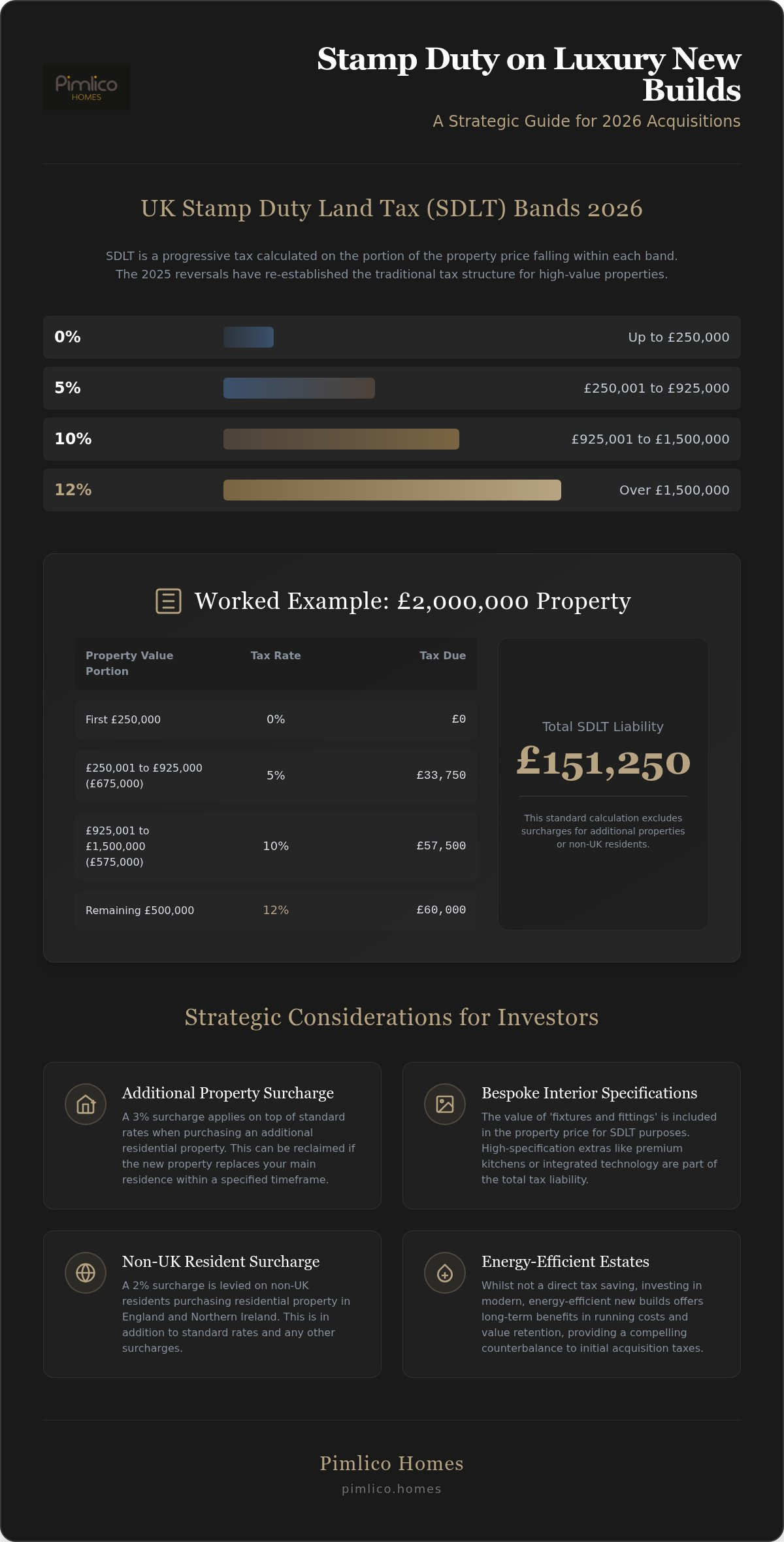
Following the sunset clauses of April 2025, the 0% threshold returned to £125,000. For high-end acquisitions, this lower threshold is a minor detail in a larger narrative, yet it signals the return to a traditional tax structure. The tax operates on a “slice” basis. You only pay the specific rate on the portion of the price that falls within each band.
- The portion from £250,001 to £925,000 attracts a 5% rate.
- The portion from £925,001 to £1.5 million is taxed at 10%.
- Any value above this enters the highest standard residential bracket.
The Luxury Band is defined as the portion of the purchase price exceeding £1.5 million. At this level, the rate reaches 12%, making it essential to calculate the impact of every high-specification detail.
Why 2026 is a Pivotal Year for Property Acquisition
The year 2026 represents a period of settled reality. The volatility of temporary tax holidays has passed, leaving a landscape where longevity and quality take precedence. The History of Stamp Duty Land Tax shows a consistent move towards higher rates for the premium sector, yet the luxury market remains remarkably resilient. Investors now prioritise permanent value over short-term savings. This stability is particularly evident amongst those commissioning bespoke estates, where the inherent value of the craftsmanship outweighs the initial tax burden.
Planning with foresight allows you to honour the architectural heritage of your future home whilst managing the fiscal requirements of the present. For a broader perspective on the journey, consult our buying a luxury new build guide. Clear fiscal planning allows our clients to focus on the emotional weight of their investment rather than the mechanics of the transaction. We remain dedicated to providing the authority and expertise needed to navigate these high-value acquisitions with confidence.
Calculating the SDLT Liability for Executive Homes and Estates
Determining the exact cost of acquisition requires a methodical approach. When assessing the financial landscape of stamp duty on new build luxury homes 2026, understanding the exact mechanics of the progressive tax system is paramount. The liability is not a flat percentage but a layered calculation. It reflects the scale and prestige of the residence. For the discerning buyer, these figures are a necessary detail in the broader vision of a long-term investment.
For a bespoke luxury home valued at £2,000,000, the calculation follows the current Stamp Duty Land Tax rates across five distinct bands. The first £125,000 is exempt. The subsequent £125,000 attracts a 2% rate. The portion between £250,001 and £925,000 is taxed at 5%. The slice from £925,001 to £1.5 million incurs 10%. Finally, the remaining £500,000 is subject to the 12% luxury rate. This results in a total liability of £153,750. This figure represents a critical entry cost into the ultra-prime market.
Managing this process requires absolute diligence. Your solicitor will handle the SDLT return. They ensure the complex nature of a new build contract, including any staged payments or bespoke additions, is accurately reflected. It’s a precise task. You must pay the balance to HMRC within 14 days of completion. Delays can lead to penalties that disrupt the quiet satisfaction of moving into your new estate.
The Progressive Banding System Explained
The effective rate of tax is often more telling than the headline band. Whilst the top rate is 12%, the staggered nature of the system means the actual percentage of the total price is lower. Executive courtyard homes often find their value concentrated in the 10% marginal band. The following table illustrates the progressive nature of the tax for high-value properties.
| Property Value | Total SDLT Liability | Effective Tax Rate |
|---|---|---|
| £1,000,000 | £43,750 | 4.4% |
| £2,000,000 | £153,750 | 7.7% |
| £3,000,000 | £273,750 | 9.1% |
First-Time Buyer Relief in the Luxury Sector
Relief for first-time buyers is a rare occurrence in the luxury sector. The government limits this benefit to properties costing £500,000 or less. Most buyers of high-specification residences will not qualify. This is particularly relevant for those investing in luxury barn conversions. These unique homes require an accurate valuation at the point of exchange to ensure tax compliance. If you are beginning your journey, exploring our luxury new build homes can provide the necessary inspiration for your next investment.
The Nuances of Bespoke Additions and Second Home Surcharges
Bespoke builds are a sophisticated collaboration of vision and craftsmanship. However, this creative freedom carries fiscal weight. Understanding the stamp duty on new build luxury homes 2026 is essential when commissioning a residence that mirrors your personal vision. HMRC requires that any ‘fixtures’—such as fitted designer kitchens, bespoke wardrobes, or integrated home cinema systems—are included in the total property value. ‘Chattels’, which include removable furniture and freestanding artwork, may sometimes be excluded, yet the distinction is remarkably fine. Consult the Official Stamp Duty Land Tax guidance to ensure every element of your interior specification is correctly categorised. Precision here is the hallmark of a well-managed acquisition.
Managing Bespoke Variations and Upgrades
Choosing high-specification finishes during the build phase often increases the final contract price, which in turn influences your tax bracket. Structural changes, such as extending a stone terrace or altering a floor plan to include a wine cellar, are fundamentally part of the property value. HMRC considers the ‘total consideration’ paid for the land and building as the definitive figure for tax purposes. We strongly advise against aggressive price splitting. HMRC frequently scrutinises luxury transactions where the value attributed to ‘chattels’ appears disproportionately high, as they look to ensure the integrity of the tax base.
The 5% Additional Property Levy
For those expanding a global portfolio, the 5% surcharge for additional residential properties is a significant factor in 2026. This levy applies if you or your spouse already own a home anywhere in the world. It’s a weightier burden than in previous years, specifically impacting luxury buy-to-let or holiday home acquisitions. International buyers must also account for the 2% non-resident surcharge, which can elevate the total tax to a substantial 19% in the highest bracket. These figures are vital when calculating the total entry cost of a new estate.
There is a vital provision for those in transition. If you pay the surcharge whilst waiting to sell your previous main residence, you can reclaim this 5% portion if the sale completes within 36 months. This provides a necessary buffer for those moving between significant estates. Such tax efficiency is a key consideration when evaluating the resale value of new build homes north east, where investment yields remain attractive despite the initial tax outlay. We remain committed to guiding you through these complexities with the quiet confidence your investment deserves.
Strategic Considerations for the High-Net-Worth Investor
For the sophisticated investor, the initial outlay for stamp duty on new build luxury homes 2026 is viewed through the lens of capital preservation and long-term yield. It’s a friction cost that demands a strategic approach to the holding period. Whilst the effective tax rate on a multi-million-pound estate is significant, the historical resilience of the luxury sector provides a reassuring counter-narrative. A holding period of five to seven years is typically sufficient to neutralise the tax burden through organic property appreciation. Unlike more volatile asset classes, a luxury detached home offers a tangible sense of security. It’s a cornerstone of a well-diversified portfolio.
Market liquidity remains a defining factor for high-value residences. In 2026, the demand for high-specification, future-proofed estates continues to outpace supply. This scarcity ensures that even with the 12% marginal tax rate, the entry cost is protected by the inherent value of the architectural excellence. The investment isn’t just in the land or the bricks; it’s in the exclusivity and the meticulous craftsmanship that defines a Pimlico home. This prestige ensures that when the time comes to divest, the property remains a highly desirable asset amongst a discerning global audience.
Comparing New Builds to Heritage Conversions
The choice between a ground-up luxury new build and a heritage conversion requires a careful fiscal and aesthetic analysis. Ground-up builds offer the pinnacle of modern structural integrity and tax clarity. Whilst Multiple Dwellings Relief has become a narrowing consideration following recent legislative shifts, it may still offer avenues for courtyard developments featuring secondary annexes. If your vision leans towards the rustic, our masterclass on modern barn conversion interiors illustrates how heritage can be seamlessly integrated with modern luxury. The tax treatment for these unique properties requires expert guidance to ensure every relief is explored.
Future-Proofing Your Investment
The 2026 luxury market rewards those who prioritise sustainable innovation. High-specification technology and A-rated energy performance are no longer optional extras; they are critical components of a home’s liquidity. These features offer a compelling offset to the initial tax burden by significantly reducing long-term maintenance and operational costs. There is a profound psychological advantage to a ‘turnkey’ residence. Future buyers are increasingly willing to pay a premium for a home that requires zero immediate intervention. We position the initial SDLT as a premium for this level of exclusivity and architectural excellence. Explore our bespoke luxury homes to see how we blend visionary design with enduring investment value.
Pimlico Homes: Excellence in Residential Acquisition
Pimlico Homes stands as a visionary creator in the premium residential sector, where every project is treated as a profound life investment. We understand that a home is more than a collection of high-specification materials; it’s a sanctuary and a lasting legacy. Our approach to development is rooted in the belief that architectural excellence should be matched by a seamless acquisition experience. By providing absolute clarity on the fiscal landscape, including the intricacies of stamp duty on new build luxury homes 2026, we allow our clients to focus on the emotional weight of their new beginning. We remain a reliable guardian of quality throughout every stage of the process.
Transparency is the cornerstone of our service. We recognise that navigating the thresholds and surcharges of the current tax year requires a methodical and deliberate partner. Our team ensures that every detail, from the valuation of bespoke interior additions to the timing of completion, is handled with meticulous care. This commitment to honesty builds a foundation of trust that lasts long after the keys are handed over. We invite you to experience a purchasing journey that is as refined and well-constructed as the homes we build.
A Heritage of Craftsmanship
With 25 years of industry experience, we’ve refined our expertise in delivering luxury detached homes that exceed the expectations of a discerning audience. Our portfolio, which includes everything from executive courtyard homes to bespoke luxury barn conversions, is a testament to our focus on high-specification craftsmanship. We understand the nuances of the high-end market. We know that our clients seek uniqueness and longevity. Our design philosophy is explored further in our look at the future of executive living, where innovative thinking meets traditional values. This heritage of excellence ensures that every Pimlico residence is prepared for the future whilst honouring the artistry of the past.
Securing Your 2026 Vision
The journey towards owning a bespoke estate begins with a clear understanding of your fiscal position. We encourage all prospective buyers to consult with their financial advisors to confirm their specific SDLT liability, particularly regarding additional property surcharges. Once your strategy is in place, we invite you to contact us for a private viewing of our exclusive developments. This is an opportunity to linger on the intimate details and grand visions that define our work. Your 2026 vision deserves a setting of unparalleled prestige. We’re here to help you secure it. Explore our curated portfolio of luxury new build homes and discover the pinnacle of modern residential excellence.
Securing Your Architectural Legacy in 2026
Acquiring a high-specification estate is a journey of precision. You’ve now gained the clarity needed to navigate the complexities of stamp duty on new build luxury homes 2026, from the 12% marginal rates to the nuances of bespoke interior additions. This knowledge ensures your investment is as structurally sound as the residence itself. By viewing SDLT as a strategic entry cost for an asset designed for longevity, you position yourself for sustained capital growth and the quiet satisfaction of a home that truly mirrors your vision.
Pimlico Homes brings 25 years of architectural excellence to every development. We’re specialists in high-specification executive homes that stand the test of time, focusing on bespoke craftsmanship and a transparent purchasing experience that respects the weight of your investment. We invite you to move beyond the calculations and begin the creative process of selecting your next residence. Our team remains dedicated to ensuring your acquisition is handled with the prestige and care it deserves.
Discover our exclusive portfolio of bespoke luxury new builds and take the first step toward a future defined by excellence.
Frequently Asked Questions
Is Stamp Duty different for new build homes compared to older properties?
Standard residential SDLT rates apply equally to both new build homes and existing properties. HMRC doesn’t distinguish between the age of a dwelling when determining the applicable tax bands. However, the stamp duty on new build luxury homes 2026 often reflects a higher total consideration because the purchase price includes modern high-specification finishes. Whilst the tax framework is identical, the meticulous craftsmanship and energy performance of a new residence offer long-term value.
How much is the Stamp Duty surcharge for second homes in 2026?
The additional property surcharge for second homes or buy-to-let investments is 5% in 2026. This levy is applied on top of the standard residential rates for each tax band. For a luxury acquisition exceeding £1.5 million, this results in a top marginal rate of 17%. It’s a significant consideration for those expanding a global portfolio. This surcharge applies even if the other property you own is located outside the United Kingdom.
Do I pay Stamp Duty on the VAT of a new build home?
You pay Stamp Duty on the total purchase price, which must include any VAT charged on the property. Whilst most new build residential sales are zero-rated for VAT, certain elements or professional fees within a complex contract might attract it. HMRC requires that the SDLT calculation is based on the total consideration given. This ensures the tax reflects the full financial weight of the investment, including any tax-on-tax implications.
Can I include the cost of bespoke kitchen upgrades in my Stamp Duty calculation?
Bespoke kitchen upgrades and other fixed additions must be included in your Stamp Duty calculation if they form part of the property’s purchase contract. HMRC distinguishes between fixtures, which are part of the building, and chattels, which are removable items. A fitted designer kitchen is a permanent fixture. Including these high-specification details in the total consideration ensures your tax return is accurate. It avoids the risk of future scrutiny regarding valuation.
What happens to Stamp Duty if I buy a luxury barn conversion?
A luxury barn conversion is typically taxed at the standard residential SDLT rates if it’s being purchased as a single dwelling. These unique properties often command premium prices that sit within the 10% or 12% marginal bands. If the conversion includes multiple self-contained units, you might have previously explored Multiple Dwellings Relief. However, for 2026 buyers, the focus is on ensuring the valuation accurately reflects the residential status of the finished masterpiece.
How long do I have to pay my Stamp Duty land tax after completion?
You have exactly 14 days to file your return and pay the tax to HMRC after the completion of your purchase. This window is relatively narrow, making the role of your solicitor vital in ensuring a seamless transaction. Delays can result in automatic penalties and interest charges. Given the significant sums involved in stamp duty on new build luxury homes 2026, precision in timing is a hallmark of a well-executed acquisition strategy.
Are there any Stamp Duty exemptions for energy-efficient new builds?
There are currently no specific Stamp Duty exemptions or reliefs solely for energy-efficient new builds in the UK residential market. Whilst sustainable design and high-specification technology reduce long-term operational costs, they don’t lower the initial tax liability. We view the SDLT as a premium paid for a future-proofed residence. The superior thermal performance and reduced maintenance of a modern estate provide a compelling financial offset to the tax burden over time.
Can international buyers claim any relief on luxury UK property acquisitions?
International buyers generally don’t have access to specific reliefs and instead face a 2% non-resident surcharge. This is added to the standard rates and any applicable 5% additional property levy. For a non-resident purchasing a second home in the luxury bracket, the effective top rate can reach 19%. It’s a substantial entry cost. Reaching out for professional financial advice is essential to ensure your strategy accounts for these layered surcharges.


