What if a developer’s accounts look sound, yet tell you little about the particular home you’re considering? Assessing financial resilience takes more than a quick search or a reassuring headline. A thoughtful developer financial stability checklist helps you examine both the company behind the name and the project taking shape, without treating one figure as a verdict.
It’s natural to want confidence that a development can progress and that your purchase is protected. Public records can offer useful evidence: Companies House provides free access to a developer’s filing history, annual accounts, company status, directors and ownership details. But accounts are a snapshot, not a promise of future performance, and company-level information may not reveal how an individual project is funded or structured.
This guide explains what to review, what each source can and cannot establish, and how to weigh potential warning signs in context. You’ll also learn to distinguish the developer’s overall position from project-specific funding and legal safeguards, so you can compare opportunities and make a considered decision about your new home.
Key Takeaways
- Use the developer financial stability checklist to compare company records, project information and buyer protections rather than relying on a single reassuring sign.
- Learn what Companies House accounts and director details can reveal, and why filing dates and company structure matter when interpreting them.
- Assess project progress and communication alongside financial evidence, noting where the available information leaves questions unanswered.
- Follow a clear sequence before reserving: identify the legal entity, review records, compare evidence and record uncertainties.
- Recognise when an independent solicitor or suitably qualified financial professional could help clarify legal or financial matters before you decide.
Developer financial stability: why it matters before buying a new build
Buying a home is a substantial personal and financial commitment. With a new build, you’re also relying on a company to manage its responsibilities as the development takes shape. Looking beyond presentation and reputation can help you understand what the available evidence says, and where its limits lie.
Developer financial stability means a company’s capacity to meet its obligations and maintain the resources and operations needed to support its work. This does not promise that a particular development will be completed. The wider idea of Financial Stability concerns resilience under pressure. For a homebuyer, the practical question is how the evidence relates to both the developer and the specific project.
Financial stability indicators can inform your judgement, but they cannot guarantee a development’s delivery.
What does financial stability mean for a property developer?
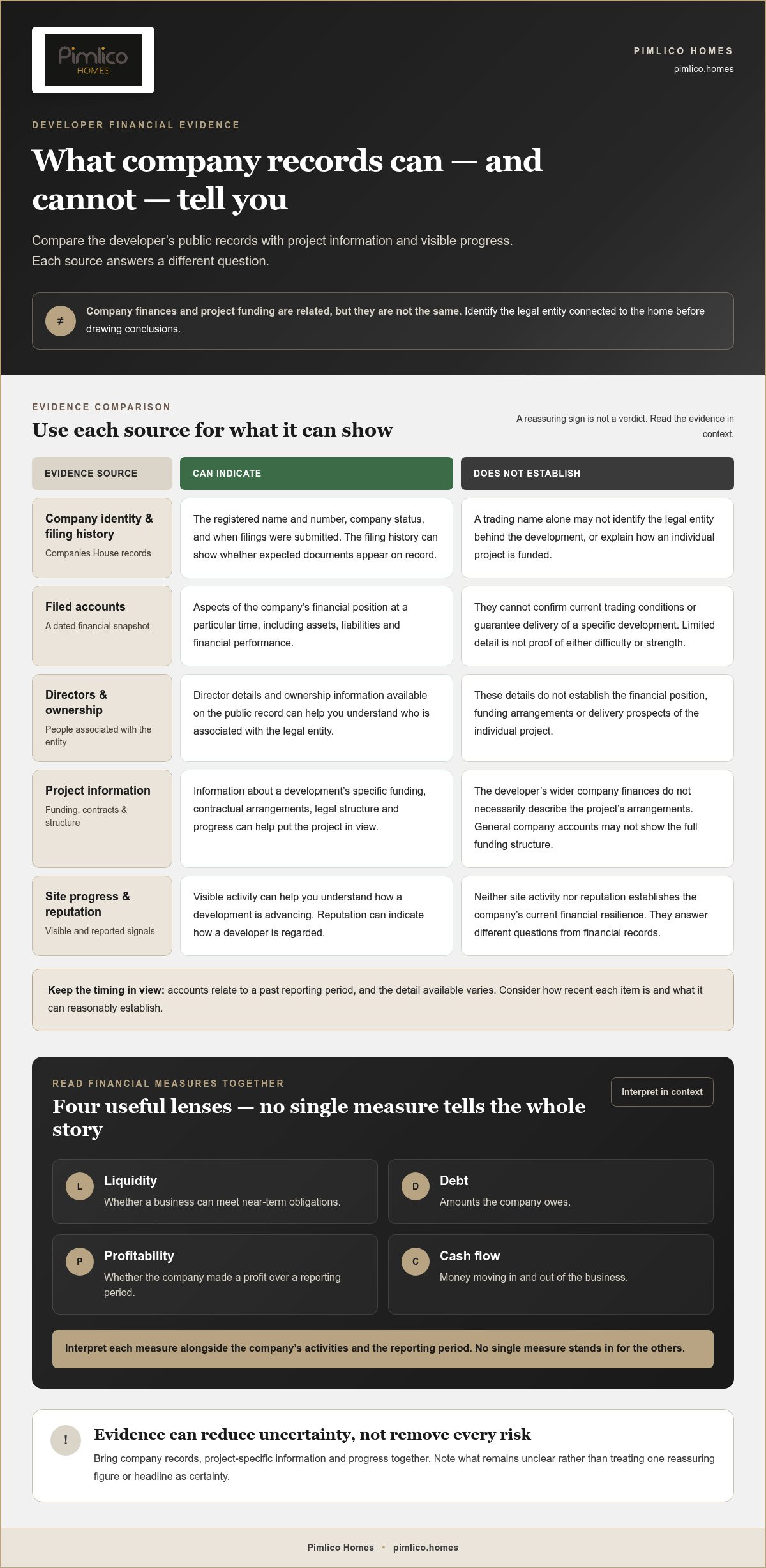
Resilience depends on several factors, including resources, obligations, cash management and operational continuity. A company’s accounts may show its assets and liabilities at a particular date, but they cannot capture every later change or predict what will happen. One strong figure, an active company status or a positive headline is not enough to establish the whole picture.
Keep the project in view, too. A developer’s wider company finances and an individual development’s funding, contractual arrangements and delivery structure are related, but they are not identical. A developer may have several activities, while a project may have its own legal or funding arrangements. Identify the entity responsible for the development before drawing conclusions.
Why should a homebuyer assess more than reputation?
Reputation, design quality and financial evidence answer different questions. A strong reputation can tell you how a developer is regarded; the design helps you judge whether the home suits your aspirations; financial records provide a limited view of the company’s position. None is a substitute for the others.
Progress on site is another distinct piece of evidence. Visible activity may help you understand how a development is advancing, but it does not establish the company’s current financial resilience. Equally, company accounts are a dated snapshot and may not explain the funding or obligations attached to one project. Consider each source in context, then note what remains unclear.
As you begin a developer financial stability checklist, keep these questions separate:
- Company: What do its available records indicate about resources, obligations and continuity?
- Project: What information is available about its specific funding and progress?
- Evidence: How recent is each item, and what can it reasonably establish?
Due diligence can reduce uncertainty, not remove every risk. Bring the available facts together without mistaking a single reassuring signal for certainty. That distinction matters when choosing a new home, where confidence should rest on evidence as well as the promise of thoughtful design.
How to read company accounts and other developer financial evidence
Companies House is a useful starting point for checking a developer’s filed company information. Its public record can help you establish which legal entity you are researching, review its filing history and accounts, and see director information. Start with the company’s registered name and number, rather than relying on a trading name that may be used across several businesses.
Filed accounts show aspects of a company’s financial position at a particular time. They cannot confirm its current trading conditions or guarantee the delivery of a specific development. Filing dates matter: accounts describe a past reporting period, and the detail available varies. Some filings provide only limited information, so a lack of detail should not be treated as proof of either difficulty or strength.
Which public records can a buyer review?
Check the company identity, filing history, accounts and director details together. Accounts may outline assets, liabilities and financial performance, while the filing history helps you see when information was submitted and whether expected documents appear on record. Director information can help you understand who is associated with the legal entity, but it does not establish the financial position of the project itself.
A developer may use separate companies for different activities or developments. Identify the entity connected to the home you are considering, then note whether the public filings relate to that entity or to a wider group. The distinction matters: a parent company’s position may not describe a project company’s arrangements, and the project’s own funding structure may not be fully visible in general company accounts.
What financial signals need careful interpretation?
Read financial indicators as separate parts of a wider picture. Liquidity concerns whether a business can meet near-term obligations; debt shows amounts owed; profitability records whether it made a profit over a reporting period; and cash flow reflects money moving in and out. No single measure stands in for the others. Interpret each alongside the company’s activities and the reporting period.
Compare accounts across available years where possible. A change in debt, profit or cash flow may be a reason to look more closely, but it is not, on its own, proof of distress. For broader context on how financial stability can be assessed, the Federal Reserve Financial Stability Report discusses risks and resilience at a system-wide level. It is not a report on UK developers, so use it for general perspective rather than as a judgement of a particular company.
Credit reports and insolvency records may add context, but they have limits too. Check the subject’s legal identity, the date and scope of any record, and whether it relates to the developer, a connected company or another party. An entry merits careful interpretation; it is not a complete assessment by itself.
For a practical developer financial stability checklist, record each source, its date, the entity it concerns and the question it leaves unanswered. Then distinguish filed company evidence from current project information and arrangements. Pimlico Homes develops and sells luxury new-build homes, including bespoke homes, executive courtyard homes and barn conversions. Its focus on considered design and craftsmanship is relevant when assessing the home itself, but should be considered separately from financial evidence.
Developer financial stability checklist: compare evidence, not impressions
A useful developer financial stability checklist brings different kinds of evidence together without turning them into a pass-or-fail score. Company filings describe a legal entity; project information relates to a particular development; buyer protections explain what routes may be available if concerns arise. Each source has a different purpose and a different limit.
Use the comparison below to organise what you find. Record the date and entity behind each item, then consider whether separate sources support a consistent picture. For example, a company filing and clear project updates may provide complementary context, but neither alone establishes how a development is funded or what will happen next.
| Evidence source | What it may indicate | Limitation | Follow-up action |
|---|---|---|---|
| Companies House filings | Company identity, filed accounts, directors and changes over time. | Information may be historic or limited, and may not describe the project entity. | Match the legal entity and company number to the development and note filing dates. |
| Trading history | Whether the business has an identifiable record of activity and completed work. | Past activity cannot establish current finances or future performance. | Compare relevant company information with project-specific details. |
| Project progress | Whether updates and observable progress provide a coherent picture of the development. | Progress at a particular point does not reveal all funding or contractual arrangements. | Keep dated updates and note any changes that need explanation. |
| Communication | Whether information about the development is clear and consistent over time. | A polished presentation is not financial evidence. | Record unanswered questions and compare later information with earlier statements. |
| Purchase protections | Which applicable warranty, code or complaint routes may be relevant. | These safeguards are not a guarantee of company solvency or project completion. | Review the reservation and purchase documents, and establish which protections apply. |
A practical checklist for reviewing a developer
Begin by matching the trading name to the legal entity responsible for the development. Review available filings alongside their dates, scope and changes across reporting periods. Then consider the project separately: look for clear, consistent information about its identity and progress. Finally, note which purchase protections apply. For registered developers, the New Homes Ombudsman Service handles relevant complaints under the New Homes Quality Code. This is a consumer safeguard, not a financial backstop.
How to interpret concerns without jumping to conclusions
Distinguish documented events, such as a filed notice or an official record, from online speculation, reviews or isolated comments. Missing, delayed or inconsistent information is a prompt to investigate, not proof of insolvency. Ask what the gap concerns, which entity it relates to and whether another independent source offers context. A pattern across several credible sources deserves closer attention than one ambiguous entry.
Keep a simple note of the evidence, its date and any unresolved questions. This makes comparisons more considered and helps prevent impressions from becoming conclusions before the facts support them.
Before reserving a new-build home: turn checks into informed decisions
Research is most useful when it leads to a clear next step. Before reserving, turn your findings into a short, repeatable process. The aim is not to predict a developer’s future with certainty, but to understand what the available evidence supports, what remains unclear and whether you are comfortable proceeding.
- Identify the legal entity. Match the company responsible for the development to its registered name and company number. Note any difference between that entity and the trading name used in sales information.
- Review available records. Gather the relevant company filings and record their dates and reporting periods. Note what each document covers and whether it relates to the developer or another connected company.
- Compare the evidence. Consider company information alongside project updates and details about the specific development. Look for consistency rather than relying on a single favourable sign or one concerning entry.
- Write down uncertainties. List missing documents, unclear explanations and questions about the legal entity, project arrangements or purchase terms. Distinguish what you know from what you have inferred.
- Decide with the full picture in view. If material questions remain, pause before committing and consider whether independent advice is needed. Your decision should reflect both the evidence and your own circumstances.
A considered reservation decision follows the same sequence each time: identify, review, compare, clarify, then decide. Dated notes make that process easier to revisit as new information arrives.
What to do when the evidence is incomplete or unclear
A missing public filing or a gap in project information is not, by itself, evidence of financial difficulty. It does mean you may have less information on which to base a decision. If an unanswered question could materially affect your understanding of the purchase, take time to resolve it rather than treating uncertainty as reassurance or as proof of a problem.
An independent solicitor can help interpret legal documents and obligations. A suitably qualified financial professional may assist with financial matters relevant to your circumstances. Their advice can help explain specific issues, but it cannot guarantee a future outcome.
Keep financial checks separate from purchase protections
Company accounts do not set out every contractual term or explain all protections that may apply to a buyer’s reservation or purchase. Those details depend on your documents and circumstances. Read the reservation and purchase paperwork carefully, paying attention to what it says about the parties, obligations, payments and any stated protection. Do not assume that a developer’s accounts establish how your individual transaction is protected.
Keep copies of the documents reviewed, the dates you accessed them and any answers or advice received. This creates a considered record, not a guarantee. For buyers exploring Pimlico Homes’ new-build homes, the purchase journey is shaped by attention to the home and the commitments in front of you.
A considered approach to developer confidence and your next steps
A measured view of a developer brings three strands together: company evidence, information about the specific project and the protections set out for you as a buyer. Read them side by side, but keep their purposes distinct. Company records can inform your view of the business; project updates add context about the development; purchase documents explain the terms and protections relevant to your transaction.
The developer financial stability checklist is a framework for asking better questions, not a test that can predict the future. A positive reputation, considered design or attentive service may matter to your choice, but none proves financial resilience. Likewise, a financial filing cannot tell you everything about the character of a home or the experience of buying it. Confidence is strongest when you understand what each piece of evidence can establish and what remains uncertain.
What a transparent homebuying journey should feel like
Clarity is practical. Information should help you understand the home, the purchase stages and the commitments you are being asked to make. Consider whether communications are coherent and whether your questions are addressed with care. These qualities can support a more informed experience, but they are not guarantees of a particular outcome or evidence of a company’s financial position.
Pimlico Homes describes its customer service through the Pimlico Pledge, from reservation through handover of keys. This describes the customer journey. It is not a financial guarantee, proof of completion or substitute for reviewing company and project evidence.
Pimlico Homes also emphasises craftsmanship, innovation and timeless design in its approach to homes. These are relevant considerations when deciding whether a home reflects your priorities. Assess them alongside, not in place of, your own financial, legal and project-level due diligence.
Bring your findings into the wider buying decision
Financial resilience is one part of a larger decision. A luxury new-build buying guide can help place your checks within the broader purchase journey, whilst a new-build resale-value guide addresses a separate, longer-term consideration. Neither replaces advice on your circumstances or careful review of the documents for the property you are considering.
Before you proceed, return to your notes. Are the company and project entities clear? Have you separated documented information from assumptions? Do you understand the relevant purchase terms, and are any material questions still open? If they are, take time to resolve them or seek independent professional advice. A careful pause can be part of a confident decision.
Pimlico Homes develops and sells luxury detached homes, executive courtyard homes, bespoke homes and luxury barn conversions. Explore Pimlico Homes’ residential developments and consider how the homes and customer journey align with what you value in a new home.
Take your next step with considered confidence
A home is more than a set of documents. It is a place to shape daily life, and the decision deserves both careful scrutiny and room for aspiration. Use your developer financial stability checklist as a foundation for informed judgement, then consider how the home’s design, setting and buying journey fit the life you hope to create. Due diligence can clarify the evidence, but no checklist can promise what lies ahead.
Pimlico Homes places craftsmanship, innovation, timeless design and customer service at the centre of its approach, and presents its homes as Award Winning Homes. The Pimlico Pledge describes customer service from reservation through handover of keys. These are expressions of the homes and customer journey, not evidence of financial stability or a guarantee of a particular outcome.
When you’re ready to explore homes shaped by these principles, explore Pimlico Homes. Discover the developments and take the next step towards finding a home that reflects what matters to you.
Frequently Asked Questions
How can I check whether a property developer is financially stable?
Build a view from several sources rather than relying on a single figure. Search the developer’s legal entity on Companies House, read its available accounts and filing history, and compare these with information about the specific development. Note how current each source is and whether it concerns the same company. A developer financial stability checklist can help you organise findings and identify questions for an independent solicitor or financial professional.
Do a developer’s company accounts prove that my new-build home will be completed?
No. Accounts report on a company’s financial position during a past period; they cannot establish what will happen to an individual development. For example, company accounts may not explain a project’s separate funding structure or current site arrangements. Read them as one part of your assessment, then consider project-specific information and your purchase documents. If a document makes a commitment about the home, ask your solicitor to explain its meaning and effect.
Can a profitable developer still experience financial difficulties?
Yes. Profitability records performance over a reporting period, but it does not necessarily show whether a company has sufficient cash available to meet obligations as they fall due. Timing can matter: money owed to a business may not yet have been received, whilst bills may be payable. Debt, cash flow and upcoming obligations add context. Consider a profit figure alongside other evidence, not as a complete measure of resilience.
What should I look for in a developer’s Companies House records?
First, match the registered company name and number to the entity named in the development or reservation paperwork. Review its status, filing history, accounts, directors and Persons with Significant Control information. Check when documents were filed and which period they cover. A change of director or a late filing is a reason to understand the context, not by itself evidence of financial trouble. If the development uses a separate company, review that entity too.
Should I delay reserving a new-build home if a developer’s information is unclear?
If an unresolved point could affect your understanding of the purchase, pausing to clarify it may be prudent. Missing public information alone does not establish financial difficulty, but you should understand which company is responsible and what your reservation documents require before proceeding. Write down the specific gap and seek independent legal or financial advice where needed. A solicitor can help interpret the relevant paperwork in light of your transaction and circumstances.
Are developer financial checks the same as protection for my reservation deposit?
No. Financial checks concern evidence about a developer or company; deposit arrangements depend on the terms and protections set out for your particular purchase. Before paying, read the reservation documents to understand who receives the deposit, what the document says about its handling and the conditions that apply. Do not assume company accounts explain these terms. Ask your independent solicitor to review any unclear wording before you commit or transfer funds.