
What is a parent company guarantee from a developer, and does it offer the protection you expect when buying a new home? The detail matters: who gives the guarantee, who can rely on it and which obligations it covers. A corporate guarantee may offer reassurance, but its name alone does not establish your rights.
A parent company guarantee is a contractual promise connected to a subsidiary’s obligations. It may give a beneficiary recourse if the subsidiary fails to meet those obligations, but it does not automatically give every homebuyer a right to claim. The beneficiary, wording, exclusions and financial strength of the guarantor all affect its value.
This guide explains what a developer’s guarantee may cover, how it differs from a performance bond and a new-build warranty, and which company details and contract terms deserve careful attention. It also explains why a guarantee should be considered alongside other protections when assessing a new-build purchase. Thoughtful customer care matters throughout the buying journey, but it does not replace clear legal protection.
Key Takeaways
- Understand what is a parent company guarantee from a developer, and why it is a specific contractual promise rather than a blanket assurance.
- See how the underlying contract, named guarantor and covered obligations can affect whether a claim may be made.
- Compare a parent company guarantee with a performance bond and new-build warranty by looking at their purpose, parties and source documents.
- Use a focused checklist to examine the guarantee’s wording, limits and whether you are entitled to rely on it.
- Weigh any guarantee alongside the developer’s track record, project information, purchase documents and warranty arrangements.
What is a parent company guarantee from a developer?
A parent company guarantee is a contractual promise made by a parent company concerning obligations its subsidiary has agreed to undertake. In a development context, the subsidiary may be the company named in a contract to carry out particular work, while the parent gives a separate commitment linked to that contract. The document sets out what the parent must do if the subsidiary fails to meet a covered obligation.
In practical terms, what is a parent company guarantee from a developer? It is a legal document with defined parties and terms, not a blanket assurance about the quality or completion of a development. The Parent Company Guarantee on Wikipedia provides a general overview. For a buyer, the key question is what the particular agreement says, not simply what it is called.
The wording should identify the parent acting as guarantor, the subsidiary whose obligations are supported, the obligations covered and the person or organisation entitled to rely on the promise. A guarantee given to one party under a contract does not automatically make every purchaser a beneficiary. Check how the guarantee relates to your own purchase documents before assuming you can make a claim.
Who gives a guarantee, and who may benefit?
The guarantor is the parent company making the promise. The subsidiary is the group company whose contractual obligations are covered. The beneficiary is the party identified as entitled to rely on that promise. These roles matter: a company’s position within the same corporate group does not, by itself, establish who can enforce a guarantee.
Hypothetical example: Cedar Developments Ltd enters into a construction contract, and its parent, Cedar Group Ltd, gives a guarantee relating to specified obligations in that contract. If the agreement names a client as beneficiary, a homebuyer who later purchases a property in the development should not assume they also have rights under it. Their position depends on the guarantee’s terms and the relevant purchase documents.
Why might a developer use one?
A parent company guarantee may support obligations where the company entering into a contract belongs to a wider group. It gives the named beneficiary a contractual promise from the parent, linked to the subsidiary’s performance of specified obligations. The promise may offer additional assurance about performance, but only to the extent set out in the wording.
There is no single effect that applies to every agreement. One guarantee may be limited to particular obligations or events; another may provide a different form of support. The commercial reason for providing it does not determine a buyer’s legal rights. Those depend on the agreement’s parties, scope and terms. For anyone considering a new-build home, a guarantee belongs within wider due diligence, alongside the purchase contract and warranty arrangements, rather than in place of them.
How does a developer’s parent company guarantee work in practice?
To understand how a guarantee might operate, trace the documents and responsibilities in order. A subsidiary enters into an underlying contract, a parent company is named as guarantor, and the guarantee states which obligations are supported. If a problem arises, the beneficiary’s ability to seek recourse from the guarantor depends on the wording and the circumstances.
- Start with the underlying contract. Identify the company that made the original commitment and the obligations it accepted. These may relate to specified work or another defined contractual duty.
- Identify the guarantor. The guarantee should name the parent company making the promise. A group connection alone does not establish that a company has accepted liability.
- Read the scope. Check which subsidiary obligations are covered, and whether the document sets exclusions, limits or a period during which the guarantee applies.
- Consider the potential claim. If the subsidiary fails to perform, the beneficiary may seek a remedy from the guarantor, but only if the guarantee’s conditions and the facts support that route.
Liability can be conditional, limited or linked to specified events. Some wording may require a particular notice or demand before the guarantor’s obligations apply. Other terms may affect the available remedy. The label “parent company guarantee” cannot answer these questions; the executed documents do.
What should the guarantee’s wording identify?
Look for the beneficiary, guarantor and subsidiary or contracting party, then match those names to the underlying agreement. The document should make clear which obligations are covered, along with any exclusions, liability limits and stated duration. Check whether a claim depends on notice, a formal demand, a breach or another defined trigger. Differences in wording can affect when and by whom the promise may be relied upon.
For a homebuyer, distinguish the developer’s obligations under a project contract from its separate promises to the purchaser. A guarantee supporting a contract with another party does not automatically extend those project obligations to every buyer. The answer to “what is a parent company guarantee from a developer?” depends on the group structure, the named beneficiary and the scope of the agreement.
What happens if the subsidiary does not perform?
A beneficiary may be able to seek performance or another remedy from the parent, subject to the guarantee’s terms. But the document does not, by itself, establish that a breach occurred, prove who is responsible or determine the appropriate outcome. Those questions may depend on the underlying contract, evidence of events and any steps required by the guarantee.
Have the executed documents considered in context before relying on a general explanation. Legal interpretation can depend on the wording and the facts of a dispute. This is especially relevant when a purchaser wants to understand whether rights under a project-level agreement relate to their own purchase. Clear communication and customer care can inform the buying experience, but they are not substitutes for contractual protection. You can also explore luxury new-build homes as part of considering the wider home-buying decision.
Parent company guarantee, performance bond or new-build warranty?
These protections can sound similar because each may offer recourse when something goes wrong. Their structure and purpose differ. A parent company guarantee supports specified obligations of a group company; a performance bond provides security under its own terms; and a new-build warranty addresses defined risks relating to the home. None should be treated as a promise that every project outcome, defect or loss will be covered.
| Protection | Purpose | Parties and potential beneficiary | Typical source document |
|---|---|---|---|
| Parent company guarantee | Supports specified obligations of a subsidiary under an underlying contract. | A parent company acts as guarantor. The beneficiary is whoever the guarantee identifies, which may not be an individual purchaser. | The executed guarantee, read alongside the underlying contract. |
| Performance bond | Provides a defined form of security if specified default or other triggering conditions occur. | A third-party bond provider gives the instrument for the benefit of the party named in its terms. | The bond document and the contract it relates to. |
| New-build warranty | Provides cover for specified risks or defects relating to a new home, subject to its terms. | The warranty provider issues the cover; the eligible homeowner or other beneficiary is determined by the documents. | The warranty certificate, policy or associated warranty terms. |
How is a parent company guarantee different from a performance bond?
The key distinction is who makes the promise and what triggers a remedy. Under a parent company guarantee, the parent’s support is tied to obligations of its subsidiary, as set out in the guarantee and underlying contract. A performance bond is a separate security instrument, commonly issued by a third party such as a bank or insurer. Its terms define the event that may lead to a claim and the security available.
Neither instrument guarantees that a project will be completed perfectly, nor does either automatically provide a buyer with payment or a remedy. The wording, named beneficiary, covered events and relationship to the relevant contract shape its practical effect. A bond may be limited to a stated amount, while a guarantee may be limited by the obligations it supports. The documents, not the label, set the boundaries.
Does a parent company guarantee replace a new-build warranty?
No. They have different purposes and should be considered separately. A group guarantee concerns obligations linked to a subsidiary’s contract. A new-build warranty is a distinct arrangement with its own provider, scope, exclusions and claim process. Read the warranty documents directly rather than inferring their protection from a developer-group agreement.
For a broader view of purchase decisions, the luxury new-build buying guide can complement this comparison. Consider the purchase documents, warranty arrangements and any relevant security together, while keeping clear which party each document names and what it covers. This helps distinguish reassuring terminology from the protection actually available.
How can a homebuyer assess whether the guarantee offers meaningful protection?
A guarantee’s presence is only a starting point. Its practical value depends on who made the promise, who can rely on it, what it covers and whether the guarantor could meet its obligations if called upon. Marketing language cannot answer those questions. Review the executed agreement and relevant company information carefully.
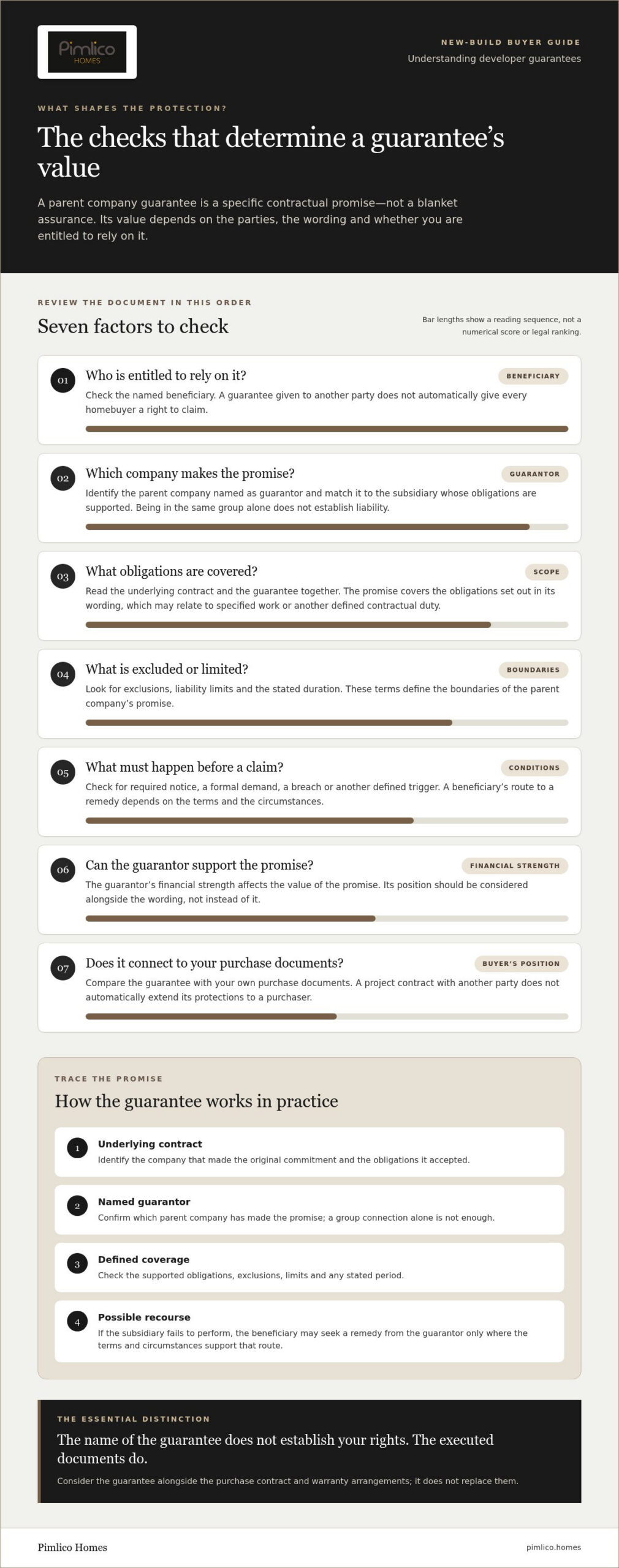
Use this checklist to focus your review:
- Confirm your position. Are you named as a beneficiary, or does the document clearly establish another route to rely on it?
- Identify the parties. Match the guarantor and subsidiary named in the guarantee to the companies involved in the development and underlying contract.
- Understand the scope. Note the obligations covered, exclusions, liability limits and duration. Check whether the promise relates to the project contract, your purchase agreement or both.
- Trace the claim process. Look for notice requirements, deadlines, evidence or other conditions that may need to be met before a claim can be made.
- Consider the guarantor. Review its identity and corporate relationship to the subsidiary. Public company information, such as available Companies House filings, may help you understand the company, but it is not a legal opinion or assurance of future financial strength.
A company search can help establish which entity you are dealing with and provide information about its filed records. It cannot determine whether the guarantee is enforceable, whether its wording covers a particular event or whether you personally have a right to claim. Those questions require the agreement to be read in context.
Which documents and details deserve attention?
Review the signed guarantee alongside the underlying contract and any schedules or amendments it refers to. Compare the company names, covered obligations, exclusions, limits, duration and claim procedure across the documents. A mismatch or missing document may make it harder to understand how the promise connects to the project. Note any unclear terms and consider them against your own purchase contract rather than relying on a summary or sales description.
When should a buyer seek independent legal advice?
Seek advice before relying on complex wording, assuming you are entitled to bring a claim or deciding what action to take after a dispute arises. A UK property solicitor can review the executed documents and explain any gap between the guarantee and your own contract. Without that review, it would be unwise to draw a definitive conclusion about your rights or the guarantee’s effect.
Understanding what is a parent company guarantee from a developer is useful, but the specific wording shapes its meaning for a purchaser. For wider context on choosing a home and reviewing the purchase journey, explore luxury new-build homes alongside your legal due diligence.
What does a parent company guarantee tell you about a developer?
A parent company guarantee can indicate that a parent has accepted a defined contractual responsibility connected to a subsidiary. On its own, it does not establish the standard of workmanship, the quality of customer care or whether every promise about a development will be met. Its significance depends on the agreement, the parties it names and the obligations it covers.
Consider it as one part of a wider assessment. Review the developer’s track record and project information alongside your purchase documents and warranty arrangements. Read each document for its own purpose: a guarantee connected to a group-company contract may not answer questions about your individual purchase or the finished home.
What else belongs in considered developer due diligence?
Give each part of the purchase its own attention. Review the sale contract, warranty documents, property specification and information provided about handover. These materials address different aspects of the buying process, so one should not be treated as evidence of matters covered by another.
Communication matters too. Consider whether information is clear, consistent and responsive as you move through the purchase journey. This can help you understand what has been agreed and what to expect, but it is not a substitute for legal protection. A corporate guarantee should not be treated as proof of every claim about quality or completion. Equally, the absence of a guarantee alone does not tell the whole story about a developer; the wider evidence and contractual arrangements matter.
The luxury new-build purchasing guide can help place contract and warranty questions within the broader process of choosing a home.
A considered next step with Pimlico Homes
Pimlico Homes develops new-build homes, bespoke homes, executive courtyard homes and barn conversions. Its Pimlico Pledge describes customer service from reservation through handover of keys. This provides context about the customer journey, not a substitute for reviewing the legal documents relating to a purchase.
As you consider a home, bring the practical and contractual picture together: understand the property, the information provided, the purchase documents and any warranty arrangements, and seek independent legal advice where the wording or your rights are unclear. The question “what is a parent company guarantee from a developer?” is best answered by the specific documents, not the label alone.
Explore Pimlico Homes and its developments to consider the qualities, design and purchase details that matter to your next home.
Make your next move with clarity
A home purchase is both a considered legal commitment and the beginning of a new chapter. Understanding what is a parent company guarantee from a developer can help you approach that commitment with clearer questions, but your decision should also reflect the home itself, the documents that shape your purchase and the experience you want from your developer.
Pimlico Homes presents its homes through a focus on craftsmanship, innovation and timeless design. The Pimlico Pledge describes customer service from reservation through handover of keys, bringing care to each stage of the buying journey. These commitments sit alongside, not in place of, your own review of the legal protections relevant to your purchase.
Consider what matters most in your next home, from its design to the clarity of the buying process. Explore Pimlico Homes and discover considered new-build living.
Frequently Asked Questions
Can a homebuyer claim under a developer’s parent company guarantee?
A homebuyer can claim only if the signed guarantee and applicable legal principles give them that right. The phrase “what is a parent company guarantee from a developer” describes the instrument, not who may enforce it. For example, a guarantee may name a contracting party as beneficiary, while the eventual purchaser is not named. Ask a solicitor to compare the guarantee with your purchase contract before relying on it.
Does a parent company guarantee protect a buyer if a developer becomes insolvent?
It may provide recourse against the parent for obligations covered by the guarantee, but it cannot ensure that a buyer will recover losses. The outcome may depend on the claim conditions, the parent’s financial position and the circumstances of the insolvency. A group relationship alone does not establish that the parent can meet a claim. A solicitor can consider the actual documents and explain what protection they may offer in your transaction.
Is a parent company guarantee the same as a new-build warranty?
No. A parent company guarantee concerns specified obligations of a group company, while a new-build warranty is a separate arrangement with its own provider, terms and scope. For instance, a purchaser should not assume that a guarantee given in relation to a project contract provides the same cover as a warranty for their home. Review each document independently, including who can make a claim and which process applies.
What happens if the parent company itself becomes insolvent?
The guarantee’s practical value may be affected if the parent company cannot meet its obligations. A guarantee is not risk-free simply because it comes from a parent, and the consequences of insolvency depend on the facts and applicable law. If the parent is in financial difficulty, the possibility of making a claim and the likelihood of recovery are distinct questions. Obtain legal advice on the guarantee and the circumstances before deciding what steps to take.
How long does a developer’s parent company guarantee last?
There is no standard duration that applies to every guarantee. The signed agreement may specify when liability ends, set conditions for expiry or address particular events that affect continuing obligations. Check the stated duration alongside any notice requirements or claim deadlines; these may not be identical. A solicitor can interpret the provisions with the underlying contract, helping you distinguish the guarantee’s expiry from time limits that may apply to a particular claim.
Can a parent company guarantee cover defects in a new-build home?
It may relate to defects only if the relevant obligations are included in its wording and the purchaser is entitled to rely on it. A defect, such as water ingress or a fault in a fitted element, does not by itself show that the guarantee applies. Check the sale documents and warranty separately to identify who is responsible and how an issue must be reported. Ask a solicitor to clarify any apparent overlap or gap.
What should I ask a solicitor to check in a parent company guarantee?
Ask the solicitor to confirm who the guarantor and beneficiary are, which obligations are covered, and what exclusions, duration and claim procedures apply. They can explain whether you personally may rely on the document and how it connects to your purchase contract. Provide the signed guarantee, underlying contract and relevant schedules, rather than a brochure or verbal description. Ask them to identify any gap between the guarantee’s promises and the protections in your own documents.





