A home you keep for life may not be the first one you buy. The concept of a ‘forever home’ describes a home intended to meet its owner’s needs over the long term and remain their home for life. Your first home can instead be a considered step towards a better fit later on.
It’s natural to want a home that feels right not just today, but as your circumstances evolve. Choosing for the long term doesn’t mean predicting every change or treating every decision as permanent.
This guide explores the qualities that can help a home suit you over time. Location, adaptable space, practical needs and how long you expect to stay all shape the decision. Consider which features are lasting essentials and which simply appeal in the moment.
Key Takeaways
- Assess the neighbourhood alongside the property, weighing transport, everyday amenities and whether the location will continue to suit your household.
- Consider how rooms and outdoor space could adapt as work, family life and practical needs change.
- Separate essential requirements from appealing extras, and look beyond décor to layout, storage and potential repair work.
- Choose a realistic time horizon for your move; a home that serves you well for several years can still be a thoughtful choice.
- Define what “home for life” means to you, rather than treating it as a promise that every future need must be predicted now.
1. Choosing a location and researching its neighbourhood
To find and plan a long-term home in the UK, shortlist neighbourhoods, research everyday amenities and transport, then compare each location with your household’s future needs. Visit at different times and weigh practical factors, such as access to a school, against the qualities that make a place feel right.
Start with the journeys you make regularly. Map routes to work, public transport links, nearby shops and green spaces, then consider how those routines might change. A city-centre home may make errands and travel more convenient, but offer less space and privacy. A home further out may provide a quieter setting, but the commute needs to remain manageable for everyone in the household.
Research the neighbourhood beyond the property listing. Check the school catchment area if education matters to your family, and note the distance to supermarkets, restaurants and healthcare. For later-life plans, consider access to a shop, GP practice and hospital. Look into planned developments too: changes to local transport or nearby building work could affect how you experience the area.
Use each viewing to test a location against your everyday priorities. Visit the nearest shops on foot, try the commute at your usual time, and explore a local green space. Compare what you observe with your shortlist:
- Transport links and the likely commute for each household member.
- Local schools, if a catchment area is a priority.
- Access to shops, supermarkets, restaurants and healthcare.
- Green spaces, safety and planned developments.
Location compromises can be part of a considered purchase. Buyers may accept a less central address to make a first home affordable, or choose greater convenience at the expense of space and privacy. Decide which trade-offs suit your circumstances instead of assuming one property must meet every preference.
Also consider how the setting could affect future changes to the home. In the UK, homes in Conservation Areas or Areas of Outstanding Natural Beauty may be subject to limits on construction and building work. If an extension or substantial alteration is part of your plan, those restrictions could affect your options. The concept of a ‘forever home’ is more useful when the location supports both your life now and the choices you may want later.
2. Space and amenities for long-term living
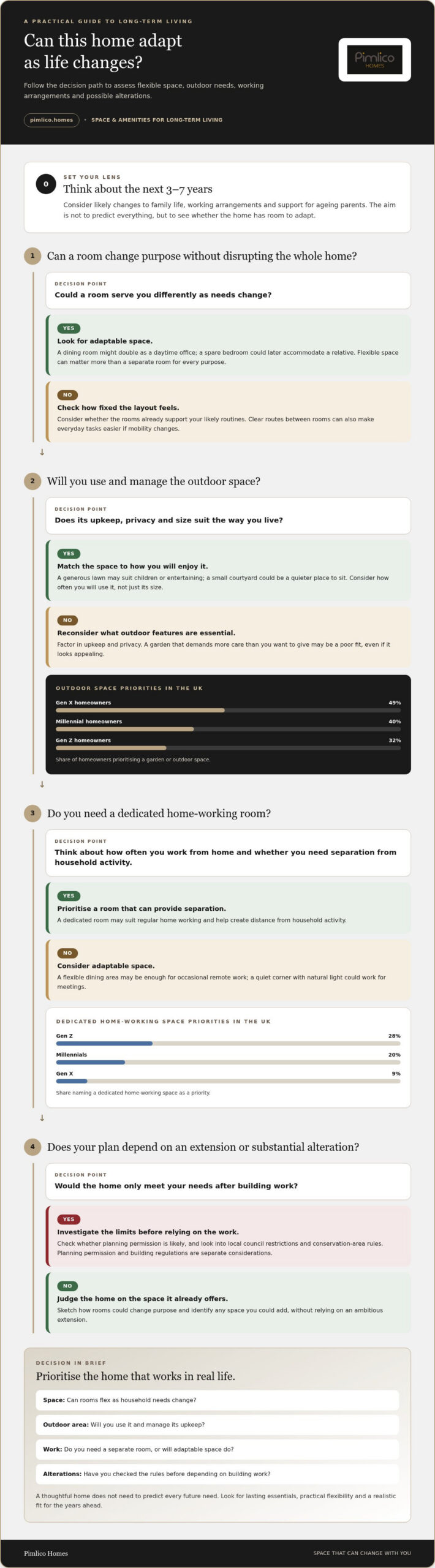
Consider how each room could serve you now and adapt as your household changes. A dining room might double as a home office during the day, while a spare bedroom could later accommodate a relative. Think about likely changes over the next three to seven years, including family growth, working arrangements and support for ageing parents.
Flexibility can matter more than having a separate room for every purpose. Look for spaces that can change function without disrupting the whole home. A quiet corner with good natural light may work for remote meetings, while a room with storage could become a nursery or hobby space. Consider circulation too: clear routes between rooms can make everyday tasks easier if mobility changes.
Outdoor space is another practical consideration, but the right garden is one you can enjoy and manage. A generous lawn may suit children or entertaining, while a small courtyard could offer a quieter place to sit. In the UK, 49% of Gen X homeowners prioritised a garden or outdoor space; the figure was 40% among millennial homeowners and 32% among Gen Z. Consider upkeep, privacy and how often you would use it, not just its size.
Work-from-home needs also vary. A dedicated room can provide separation from household activity, while a flexible dining area may be enough for occasional remote work. In the UK, 28% of Gen Z named a dedicated home-working space as a priority, compared with 20% of millennials and 9% of Gen X. Decide whether you need a permanent office or adaptable space that serves several purposes.
For an extension, assess whether planning permission is likely to be approved and investigate local council restrictions and conservation-area rules. Planning permission and building regulations are separate considerations, so account for both when shaping the design and project plan. A first home that needs alteration may also require renovation before it suits your household.
Buying costs depend on the property and location; extension costs depend on the design, scale and work required. Compare these commitments with the value of a home that already fits, and prioritise structural or functional needs over design-led changes.
Before choosing, sketch how a room might change purpose, list the outdoor features you will use, and identify any space you could add. These steps can show whether the home could evolve without relying on an ambitious extension or a garden that demands more care than you want to give.
3. Balancing emotional appeal with practical considerations
A home can feel compelling before you have examined its everyday realities. High ceilings, period details or a garden may create an immediate connection, but they cannot settle questions about layout, storage, repairs or asking price. Let emotion show you what matters, then test that feeling against the practical demands of living there.
Start by separating must-haves from nice-to-haves. A quiet study might be essential for regular home working, while a dramatic entrance hall may simply be desirable. Write down your requirements before viewing, then compare every property against the same list. This makes it easier to distinguish a genuine fit from features that look impressive during a viewing.
Look beyond cosmetic finishes. A freshly painted room can make a property feel ready, yet the layout may not suit your household. Consider storage, how rooms connect and what repairs may be needed. Structural issues or extensive renovation plans can turn a promising purchase into a long-term burden; cosmetic updates may be more manageable.
- Record the features that support daily routines, such as storage near the entrance.
- Note repairs separately from decorative changes, so essential work stays visible.
- Compare the asking price with the home’s condition and your financial limits.
- Imagine one ordinary weekday in the property, from breakfast through to evening.
Planning for future needs can be sensible, but avoid buying space without a clear purpose. In the UK, 22% of millennial homeowners said they bought a property with more bedrooms than they currently need to avoid upsizing later. An extra bedroom could suit a growing family or visiting relatives, but it also adds space to furnish, heat and maintain.
Accessibility deserves practical thought too. If you expect mobility needs to change, consider whether a staircase could accommodate a stair lift. Check whether a ground-floor bedroom and bathroom could be possible, or whether a wheelchair could turn comfortably through the main rooms. These details are easier to assess before purchase than after your routines depend on the layout.
Set a firm affordability boundary before falling in love with a particular property. A mortgage provider’s assessment limits what you can borrow, while household costs determine what feels manageable month to month. A financially stretched home may become stressful by the third year. A beautiful finish cannot compensate for a budget that leaves too little room for ordinary life.
Finally, assess the home as it stands and the changes you genuinely intend to make. New-build homes can be more readily liveable than doer-upper starter homes, reducing the time and effort spent on renovation, though their design may feel similar to neighbouring properties. The strongest choice balances attachment with the realities of upkeep, affordability and everyday use.
Intended length of stay
Decide how long you realistically expect to live in a property before treating it as a home for life. In the UK, 27% of recent buyers intend to stay in their new home for at least 10 years. A long horizon may support choices that suit changing routines, but it need not define what every buyer should do.
Start with the next three to five years. Consider whether work, family circumstances or caring responsibilities could change during that period. For example, a couple expecting to work from home more often may value a separate study, while someone planning to relocate for work may prefer not to commit to a larger property. The useful question is how well the home fits a plausible future, not an imagined one.
Buying a home for life is an important ambition for some people. According to a 2022 Mayflower-commissioned survey, 81% of respondents said finding their “perfect forever home” was the most important factor in deciding to buy. Yet intentions vary: 34% of people in the UK who moved in the last three years said they did so to buy their forever home.
Age groups also describe different reasons for moving. Among recent Gen Z buyers in the UK, 33% said they moved to buy their forever home; the figure was 36% among recent millennial buyers. These figures show why the label alone cannot determine whether a purchase is suitable. Your plans, budget and expected time in the property matter more than choosing a home that sounds permanent.
Give a shorter stay the same considered attention. A property that works for six years and enables a move better aligned with your next stage can be a strategic choice, not a failure. In the UK, a first home is commonly treated as a starter property and a foothold in the market. It can meet immediate needs while leaving room for a later move.
Use your likely time horizon to compare the commitment with the flexibility you need. If you expect to stay for a decade, prioritise features you will value as routines change, rather than details suited only to today. If you anticipate moving sooner, weigh the home’s present practicality against the effort of adapting it for needs that may never arise.
Before making an offer, write down why you are moving, the changes you expect over the next three to five years, and the circumstances that could prompt another move. Then decide whether the property still makes sense if those plans shift. This turns the idea of a lasting home into a realistic decision, rather than a promise to stay indefinitely.
5. Meaning of a forever home
The concept of a ‘forever home’ describes a home intended to meet its owner’s needs over the long term and remain their home for life. It is an intention, not a particular architectural style or a promise that circumstances will never change. A detached house, flat or converted barn could all hold that meaning for its owner.
The phrase also has another established use in adoption. A “forever home” can mean a permanent home for a child or animal who has been in care and is then adopted. In property decisions, however, it expresses an aspiration about belonging and continuity. Context makes clear which meaning applies.
For a homebuyer, the label matters less than what permanence means personally. One person may imagine raising children in a familiar neighbourhood; another may value a settled base near friends, work or cherished countryside. A couple who treasure cooking together might prioritise a generous kitchen over an additional reception room.
That personal definition can make a property search clearer. Translate the idea of “for life” into features you can assess during a viewing, rather than expecting one house to anticipate every future possibility. Ask whether everyday routines feel comfortable, whether favourite belongings have a place, and whether the home could accommodate changes you consider likely.
- Belonging: Does the setting feel connected to the people and routines you value?
- Continuity: Can the home support the activities you want to preserve, such as hosting family?
- Adaptability: Could a spare room become a study, nursery or space for visiting relatives?
- Practical fit: Can the layout and upkeep work with your ordinary day, not just viewing day?
These questions help distinguish emotional attachment from a workable long-term choice. A beautiful period home may feel deeply personal, for instance, while its stairs or maintenance demands may not suit your plans. Equally, a contemporary property might lack historic character yet offer a layout that better supports your household. The right meaning is yours to define.
There is no need to treat a future move as proof that an earlier choice failed. A home can be meaningful and right for a particular chapter, even if later circumstances call for a different setting. Lasting value comes from choosing deliberately, with a clear view of what you want home to make possible.
If you are shaping a home around the life you hope to lead, explore your vision for a lasting home as the next step.
Pimlico Homes: Luxury Detached Homes
Pimlico Homes offers Luxury Detached Homes for buyers seeking a considered home for the long term. Its range also includes Executive Courtyard Homes, Bespoke Luxury Homes and Luxury Barn Conversions, giving you distinct property types to consider against your priorities for space, setting and everyday living.
Turn to Pimlico Homes when you have clarified what matters most, from the property’s character to how it should serve your household over time. A clear sense of your preferred home and practical needs can help you explore which offering best reflects your vision.
To discuss your next step, contact Pimlico Homes.
Shape a home around what comes next
A lasting home begins with a clear sense of the life you want it to support. Give yourself room to refine that vision: which qualities feel essential, which can adapt, and what kind of setting will feel right as your circumstances evolve? The concept of a ‘forever home’ need not mean predicting every change. It can guide a thoughtful choice grounded in what matters to you.
If you are ready to explore that possibility, Pimlico Homes offers Luxury Detached Homes, Executive Courtyard Homes and Bespoke Luxury Homes. Consider these options in light of the atmosphere, layout and long-term fit you seek. A considered conversation can help you take the next step with greater clarity.
Discuss your home plans with Pimlico Homes, and begin shaping a vision that feels distinctly your own.
Frequently Asked Questions
What does “forever home” mean in UK property and housing?
In UK property, the concept of a ‘forever home’ describes a home someone intends to keep as their long-term residence, potentially for life. It is a personal aspiration, not a particular property type. One buyer may associate it with a settled family home; another may want a peaceful flat suited to later life. Depending on context, the phrase can also describe a permanent home for an adopted child or animal.
What features make a home suitable for long-term living?
A suitable long-term home supports everyday routines without relying on one room or feature alone. Think about secure storage for coats and equipment, space to host guests, and a kitchen layout where more than one person can prepare food comfortably. A utility area can keep laundry separate from living space. List the tasks you do regularly, then consider whether the home makes each one straightforward.
How do you assess whether a home can adapt to changing needs as you age?
Walk through the property imagining how you would use it with reduced mobility. Notice entrance steps, narrow doorways, changes in floor level and the distance between the bedroom and bathroom. Check whether essential rooms are accessible without using stairs, and whether furniture could be rearranged to keep routes clear. Visiting with someone who has mobility needs can reveal practical barriers that are easy to overlook during a viewing.
What are the risks of choosing a forever home, including maintenance and changing circumstances?
The main risks are committing to a property that becomes demanding to maintain, difficult to afford or unsuitable after circumstances change. A large garden, older heating system or extensive grounds can require ongoing attention. Before deciding, note visible maintenance tasks and consider how much time you want to spend managing them. Also think through changes such as working elsewhere, a household member moving out or needing regular care.
How do location, transport, healthcare and local services affect a forever home?
These factors determine how easily you can manage daily life without relying on one travel option. Try the journey to work or a regular appointment, and see how practical it feels on foot and by public transport. Map access to a pharmacy, GP practice and places you visit often, such as a library or community centre. A location that works for your routines today should also suit the support you may need later.
Is it cheaper to renovate an existing home or move to a forever home?
It depends on the renovation’s scope and the cost of a home that already meets your needs.