
A low-carbon home depends on how its systems work together. Renewable energy systems in luxury new builds can combine an air-source heat pump for heating and hot water with solar panels and battery storage. A grid connection can supply electricity when on-site generation falls short. The right balance depends on the home’s design, site and energy needs.
Comfort, considered architecture and efficient energy use need not compete in a new home. Planning them together from the design stage can make renewable technologies part of the home’s everyday performance, rather than additions considered later.
This article explains how heat pumps work, what net-zero targets and UK energy policies mean for new buildings, and how solar generation, batteries and grid electricity can complement one another. It also explores why a coordinated approach matters when designing a home intended to feel exceptional now and perform thoughtfully for years to come.
Key Takeaways
- Plan heating, hot water and electricity as one coordinated system, with the home’s design and site guiding the choice of technologies.
- Understand how air-source heat pumps transfer warmth from outdoor air and why building efficiency influences their role in a new home.
- Consider net-zero targets and energy-efficiency policies early, so renewable systems and supporting infrastructure can be integrated into the design.
- Explore how solar panels, battery storage and a grid connection can complement one another to meet household energy needs.
- Compare installation costs in context: system size, storage and the requirements of the new build all shape the overall investment.
Air-source heat pumps for home heating and hot water
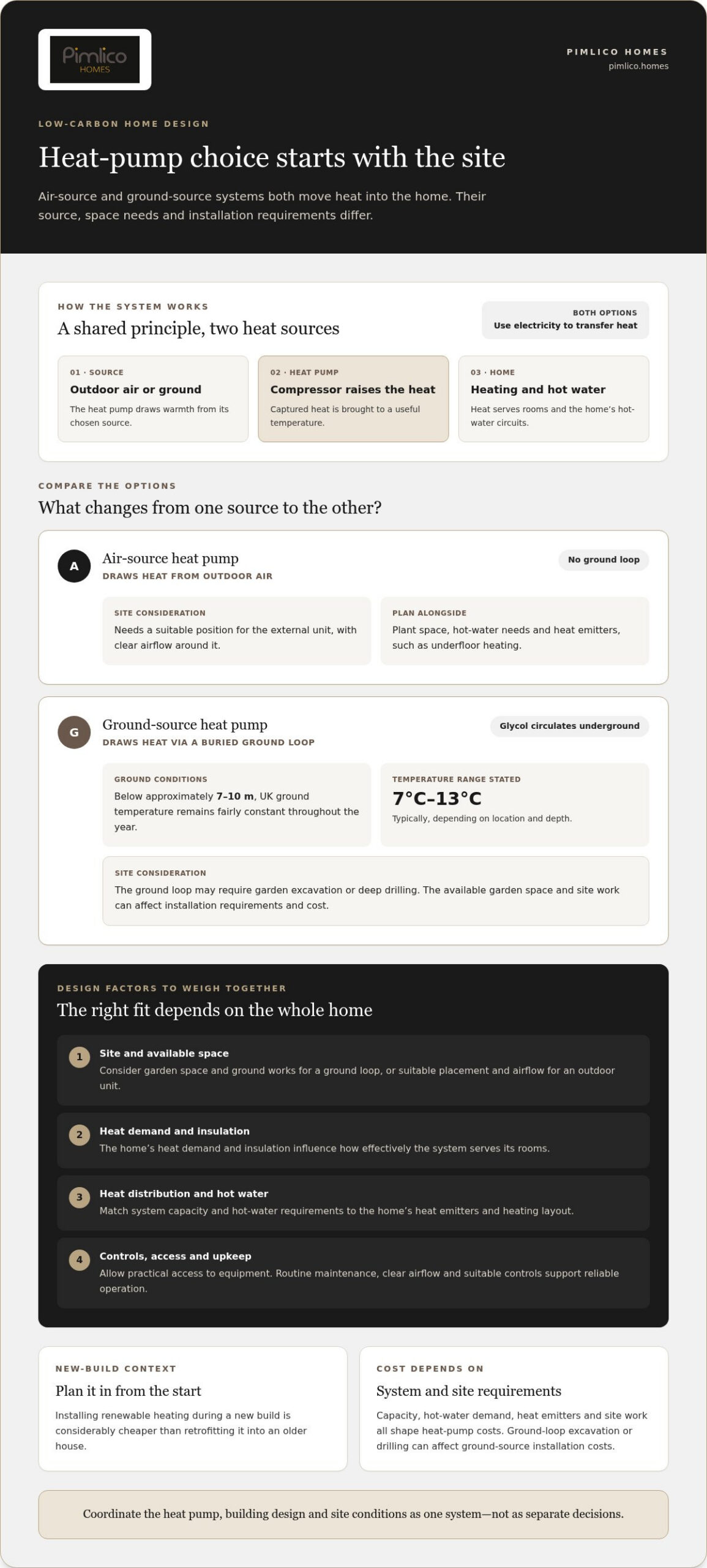
An air-source heat pump draws heat from outdoor air and transfers it to the home’s heating and hot-water circuits. Its compressor raises the captured heat to a useful temperature, so careful system design is central to everyday comfort.
Air-source heat pump applications
An air-source heat pump uses outdoor air as its heat source, providing warmth for rooms and hot water. In renewable energy systems in luxury new builds, it can form the centre of an all-electric heating design. The compressor needs electricity, so the home’s heat demand and insulation affect how effectively the system serves its rooms.
At the design stage, match the heat pump to the home’s hot-water requirements and heat emitters, such as underfloor heating. This allows the heating layout and plant space to be planned together, rather than treating the equipment as a later addition.
Heat pump comparison and electrification
Air-source and ground-source heat pumps both transfer heat into a home, but draw it from different sources. Air-source models use outdoor air; ground-source systems circulate glycol through a buried ground loop. Below approximately 7-10 m, UK ground temperature remains fairly constant throughout the year. Depending on location and depth, it is typically between 7°C and 13°C.
Ground-source heat pumps can draw on a steadier heat source, but their loops may require garden excavation or deep drilling. Air-source systems avoid this ground infrastructure, although the external unit needs suitable placement and airflow. The best fit depends on the site, available garden space, building layout and household demand. Effective renewable energy systems in luxury new builds match technologies to these conditions rather than choosing one in isolation.
Both options support efficient electrification by using electricity to transfer heat, rather than burning fossil fuels on site for heating and hot water. Performance also depends on the home’s insulation and heat distribution, so these should inform the system choice from the outset.
Costs, maintenance and reliability
Installing renewable heating during a new build is considerably cheaper than retrofitting it into an older house. Heat-pump costs depend on capacity, hot-water demand, heat emitters and site work. Ground-loop excavation or drilling can affect ground-source installation costs; air-source designs need space for the external unit.
For owners, routine maintenance and clear airflow around an outdoor unit help support reliable operation. Controls and heating performance also need attention. Poor sizing, obstructed airflow or unsuitable heat emitters can affect comfort and efficiency, making coordinated design important. Allow practical access to equipment and consider how the household will use the controls. These details help the system work as intended within the home’s heating circuit.
Net-zero emissions targets for new buildings
Net zero means balancing the greenhouse gases a building emits with reductions or removals elsewhere. For a new home, the route towards that ambition begins with its energy demand: the building fabric, heating, hot water and electricity all shape operational carbon. The Future Homes Standard is described as requiring a 75-80% reduction in carbon for 2025. The aim is a lower-carbon home from the outset, rather than relying on later changes to address avoidable emissions.
The supplied target for 2025 also states that homes will no longer rely on fossil fuels for heating and hot water under the Future Homes Standard. That places renewable heating at the centre of the design conversation. Air-source and ground-source heat pumps, solar panels, solar thermal and biomass boilers are identified as lower-carbon technologies. Their contribution depends on how they work with the building, not simply whether one appears in the specification.
Design-stage planning matters because a new building’s layout determines how readily energy measures can be integrated. Consider the building envelope, heating strategy, roof space and infrastructure together, then use an energy model to compare suitable efficiency measures against the project budget. For example, a solar PV system may be required for a self-build to achieve its SAP rating, depending on the chosen heating source. Early coordination helps prevent panels or plant from becoming awkward additions.
Net zero is broader than selecting equipment. The United Nations says emissions must be reduced by almost half by 2030 and reach net zero by 2050 to avoid the worst climate impacts. For a household, this global direction becomes tangible through lower demand, efficient heating and electricity generated with less reliance on fossil fuels. Avoiding the burning of gas, oil and coal for home heating and electricity reduces gases released into the atmosphere. The sequence matters: reduce demand first, then plan generation and low-carbon systems around what remains.
For prospective owners, the practical question is how these ambitions translate into a comfortable, enduring home. Review the energy model alongside room layouts, glazing, shading and heating choices, so measures support daily use as well as carbon goals. This is a long-term investment in the building’s performance, not simply a statement about the planet. If you are considering designing a new home, bringing energy strategy into the earliest planning conversations helps align architectural intent with the transition towards lower-carbon living.
Renewable energy and energy efficiency policies
For UK sites, solar panels generally perform better on south-facing properties. Their electricity can be used at home or stored in a battery. Hydropower depends on access to moving water, while standalone systems suit remote developments when grid connection costs more than the renewable system.
Policy shapes how technologies are designed into homes, but location still determines practical options. In 2024, 60 countries had policies aimed at integrating renewable energy and efficiency in buildings. UK measures can include efficient electrification of heating through heat pumps and rooftop solar. For a self-build, solar PV may be needed to achieve its SAP rating, depending on the chosen heating source.
Government incentives can support renewable and sustainable energy in new and existing homes. The Feed-in Tariff was introduced in 2010, and grid-connected renewable systems can sell surplus energy. This describes the policy mechanism, rather than identifying a particular current grant or payment rate.
To support household comfort and manage energy use, combine efficient technologies with lower demand. LED lighting and energy-efficient appliances can help reduce household expenses after construction, while solar PV can provide daytime electricity and offset energy costs. A battery can extend the use of solar generation beyond its production hours. These measures complement the building fabric and heating system; they do not replace the need to design them coherently.
Demand for efficient homes is also reflected in property searches and buyer priorities. Online searches for eco-friendly UK properties increased by 34% during 2025. Rightmove reported in 2023 that raising a property’s EPC rating from F to C could increase its value by as much as 15%. An EPC is one consideration among many, but this finding links energy performance with potential resale appeal.
Start by matching the system to the roof, site and grid connection, then consider how generation, storage and efficient appliances will serve the household. A shaded or unsuitable roof changes the case for solar; a remote site may favour standalone generation where connection costs outweigh system costs. These choices can influence comfort, energy use and the property’s appeal, while avoiding the assumption that one renewable arrangement suits every UK home.
In 2024, 40% of UK new builds integrated renewables from the outset, while just over 5.5% of UK homes have solar installed. The UK’s 2020 target was for renewable energy to supply 15% of its energy.
Some homes in current developments produce more energy than they use, and surplus energy can be returned to the local or wider grid. Consumers are prepared to pay 3.4% more for highly energy-efficient UK homes rated A to B than for homes rated D; UK homes rated F or G sell for 7.4 % less than homes rated D.
Combining renewable systems to supply household energy
A coordinated home-energy design matches generation and storage to household demand. In a UK new build, rooftop solar can provide electricity, a battery can store surplus, and a grid connection can supply power when generation falls short. Heat pumps add electrical demand while providing heating and hot water, so each system’s role should be considered alongside the others.
How much electricity can rooftop solar panels generate on a large UK home? There is no single output figure for every large property. Generation depends on usable roof area, panel capacity, orientation, shading and daylight. Household consumption determines how much electricity is used directly.
Consider how energy moves through the home. Panels generate electricity during daylight, which appliances and heat pumps can use; a battery can store surplus for later. A grid connection supplies electricity when renewable generation does not meet demand. In renewable energy systems in luxury new builds, this balance informs the required infrastructure, including panel placement, battery space and electrical connections.
Off-grid living requires a different level of coordination. Hydro, solar, battery and wind technologies need to match household consumption and local conditions. Hydropower requires moving water, while solar depends on suitable exposure. Standalone systems suit small, remote developments when connecting to the grid costs more than the renewable system itself. For grid-connected homes, the national grid remains a source of electricity when on-site generation is insufficient.
A housing scheme uses solar collectors and shared battery storage across 16 homes. This example shows how generation and storage can be planned across a development, rather than only within individual dwellings. Shared infrastructure affects how electricity is generated, stored and distributed, while each home’s demand still informs system design. It is an illustration of coordinated planning, not a template for every site.
Combining technologies can support lower operational emissions and a considered response to climate concerns. Solar PV generates electricity, batteries store surplus, and heat pumps use electricity to provide thermal comfort. Together, these technologies can meet different household needs, while the grid can remain part of the arrangement. The environmental benefit depends on the energy sources used and how the system operates in practice.
In a luxury home, the design challenge is integrating equipment with the architecture and landscape. Roof form, plant locations, battery space, grid connection and expected household demand all influence the arrangement. An energy model can compare estimated generation with expected use to help determine a suitable balance. A coordinated approach to renewable energy systems in luxury new builds considers these elements together, shaping an energy design around the home rather than assembling isolated technologies.
How much do solar PV, battery storage, heat pumps and solar thermal systems cost in UK new builds?
These figures offer a useful reference point, but the final specification depends on the home’s electricity demand, usable roof area and how the system is integrated during construction.
Barrows and Forrester’s analysis puts the average solar-panel cost at £5,875 and estimates that panels costing this amount add £11,500 to a property’s value. This is an analysis, not a guaranteed uplift for an individual home. Roof orientation, shading and system design affect generation; the household’s consumption patterns affect how much electricity is used directly or stored.
Battery storage is an additional investment, not a substitute for solar generation. Its capacity and the amount of electricity the household wants to retain shape the system design. For example, a home with substantial evening demand may value stored daytime generation differently from one that uses most of its electricity during daylight.
Heat-pump and solar-thermal costs vary according to design requirements. A heat pump’s price depends on system capacity, heating and hot-water demand, heat emitters and site work. Solar thermal uses collectors to heat water, so collector area, hot-water use and integration with the home’s plumbing affect its cost. In each case, price depends on the project and is provided after a quote request.
New-build timing can change the overall comparison. Installing renewable heating during construction is considerably cheaper than retrofitting it into an older house. Planning equipment, pipework and electrical connections alongside the building avoids treating them as later additions. It also allows the chosen technologies to be assessed together, rather than comparing headline installation figures without considering the home’s needs.
Compare systems by their role: solar PV generates electricity, batteries store surplus, heat pumps provide heating and hot water, and solar thermal heats water. The right combination depends on the site, household demand, roof and wider design. For a tailored new-build project, explore your new-build plans with the energy strategy considered alongside the home’s architecture.
Pimlico Homes: Luxury Detached Homes
Pimlico Homes offers Luxury Detached Homes, Executive Courtyard Homes, Bespoke Luxury Homes and Luxury Barn Conversions for those seeking a distinctive place to call home. If you are weighing energy performance alongside architecture, consider how a property’s layout and site can accommodate generation, storage and heating as a coherent whole. These priorities are most useful to explore while choosing a new home, when the relationship between design and household energy can inform your decision.
Explore the homes and contact Pimlico Homes to discuss your next step.
Shape a home for the years ahead
The next decision is not simply which technology to choose, but how your home should support the way you want to live. Planning renewable energy systems in luxury new builds as part of the wider vision can align architectural character, household comfort and energy priorities from the outset. It provides a clearer framework for weighing design choices and considering how the home may serve you over time.
Pimlico Homes offers Luxury Detached Homes, Executive Courtyard Homes and Bespoke Luxury Homes. Each provides a different setting for a considered approach to home design and energy needs. If you are beginning to shape a new-build project, bring your aspirations and priorities into the conversation early.
Contact Pimlico Homes to discuss your project, and take the next step towards a home that reflects your vision.
Frequently Asked Questions
Which renewable energy systems are suitable for luxury new-build homes in the UK?
Solar PV, air-source and ground-source heat pumps, solar thermal and biomass boilers are options for UK new homes. Suitability depends on the site and the home’s energy needs. For example, ground-source systems need space for ground loops or drilling, while hydropower requires a moving water source. A grid connection can complement on-site generation, supplying electricity when renewable output does not meet household demand.
What are typical installation costs and payback periods for renewable energy systems in luxury homes?
A solar-and-battery system can save around £600 to £1,000 a year on energy costs, with an estimated payback period between 5 and 12 years. These figures describe the stated typical-home example, not every luxury property or heat-pump installation.
What UK building regulations and planning rules apply to renewable energy systems in new homes?
For a self-build, a solar PV system may be required to achieve its SAP rating, depending on the chosen heating source. Building-control and planning considerations should therefore inform the design before roof layouts, equipment positions and external works are fixed. The relevant details depend on the proposed system and site. Treat energy assessment, equipment placement and site constraints as connected design decisions, rather than separate tasks for a later stage.
What are the UK Future Homes Standard requirements for low-carbon heating and energy efficiency?
For 2025, the Future Homes Standard is described as requiring a 75-80% reduction in carbon. Homes will no longer rely on fossil fuels for heating and hot water. For a new home, consider the whole energy design: fabric efficiency, heating source, hot-water provision and any planned generation. A solar PV system may also be needed for a self-build’s SAP rating, depending on its chosen heating source.
How should solar panels, batteries, heat pumps and smart home controls be integrated during new-build design?
Plan equipment and connections alongside the building layout. Reserve suitable roof areas for panels, accessible space for a battery, and positions for heating equipment before finalising interiors and landscaping. Coordinate controls with how the household uses electricity, heating and hot water throughout the day. For example, the control strategy can account for solar generation, battery storage and heat-pump demand while retaining grid electricity when required.





