
Questions about your deposit do not necessarily mean that anything is wrong. AML checks for buying UK property can feel intrusive, particularly when your funds come from savings, a family gift or overseas accounts. Their purpose is generally to establish who you are and understand where the money for the transaction came from.
It is natural to want clarity about who is requesting your information and why. Solicitors and estate agents may have legal obligations to carry out checks, and the evidence requested depends on your circumstances. A clear explanation, supported by relevant documents, can make the process easier to follow and help avoid preventable delays.
This guide explains the difference between identity checks, source-of-funds checks and source-of-wealth enquiries. It covers evidence that may be relevant for savings, gifts and international transfers, how to organise it without oversharing, and what to expect if further questions arise. Understanding the compliance process can help you approach the practicalities of buying a home with greater confidence.
Key Takeaways
- AML checks for buying UK property help establish who is involved and where purchase funds originated; the evidence requested depends on the transaction.
- Identity, source-of-funds and source-of-wealth checks examine different things. Knowing which question is being asked helps you provide relevant records.
- Further questions may reflect a risk-based review, not an accusation. Clear explanations and consistent documents can make your circumstances easier to understand.
- Before progressing, trace your deposit and completion funds, gather supporting records and note their origins in a simple timeline.
- AML checks sit alongside funding preparation and conveyancing, so unresolved enquiries may affect progress towards completion.
AML checks for buying UK property: what they are and why they happen
Being asked for identity or financial documents is a routine part of many property purchases, not an accusation. AML checks for buying UK property help regulated businesses meet legal duties and understand who is involved in a transaction and where its money comes from. The questions may feel personal, but they are not a judgement on your character or a test of whether you deserve to buy a home.
Anti-money laundering checks are measures used by regulated businesses to identify customers, assess relevant risks and examine the origin of funds connected with a transaction. Their purpose is to help prevent property transactions from being used to conceal the proceeds of crime or support terrorist financing. The broader concept of money laundering involves disguising the criminal origin of money. Checks are one part of efforts to detect and deter it.
What does AML mean when you are buying a home?
AML stands for anti-money laundering. In a home purchase, checks can include confirming your identity and asking for information about the funds being used. The legal framework includes the Money Laundering, Terrorist Financing and Transfer of Funds (Information on the Payer) Regulations 2017, as amended. Changes effective from 30 June 2026 update parts of the framework, while the core responsibilities for regulated firms remain. These checks concern risk and compliance, not your creditworthiness.
A firm’s legal obligations and the documents it requests are not the same thing. Regulations require relevant businesses to carry out appropriate due diligence and keep records of their decisions. The evidence requested depends on the circumstances. One buyer may be asked for identification and bank statements; another may need to explain a gift, an asset sale or funds transferred from abroad. These are examples, not a universal checklist.
Who may carry out AML checks during a property purchase?
Different regulated businesses can have their own obligations. A conveyancing firm must conduct due diligence within its legal and regulatory framework. Estate agents carrying out relevant estate agency work are also subject to AML requirements, with HMRC supervising estate agency businesses for compliance. A lender may conduct its own customer and financial checks when assessing an application. The precise supervisory arrangements depend on the type of firm and its professional status.
One organisation’s checks do not necessarily replace another’s. Each business must decide what is appropriate for its role and risk assessment, so you may be asked similar questions more than once or need to provide different evidence to different parties. An estate agent might request initial identification or evidence of funds, while a conveyancer may need documents tracing how the purchase money was accumulated and transferred. A lender’s requests may relate to its lending assessment as well as its own compliance duties.
The scope can vary with the buyer, the structure of the purchase and the funds involved. A straightforward purchase funded from established savings may prompt different enquiries from one involving a gift, a company or a trust. Extra requests are not, by themselves, evidence of wrongdoing. They are part of a regulated process intended to make the transaction understandable and properly documented.
Identity, source of funds and source of wealth: what the checks examine
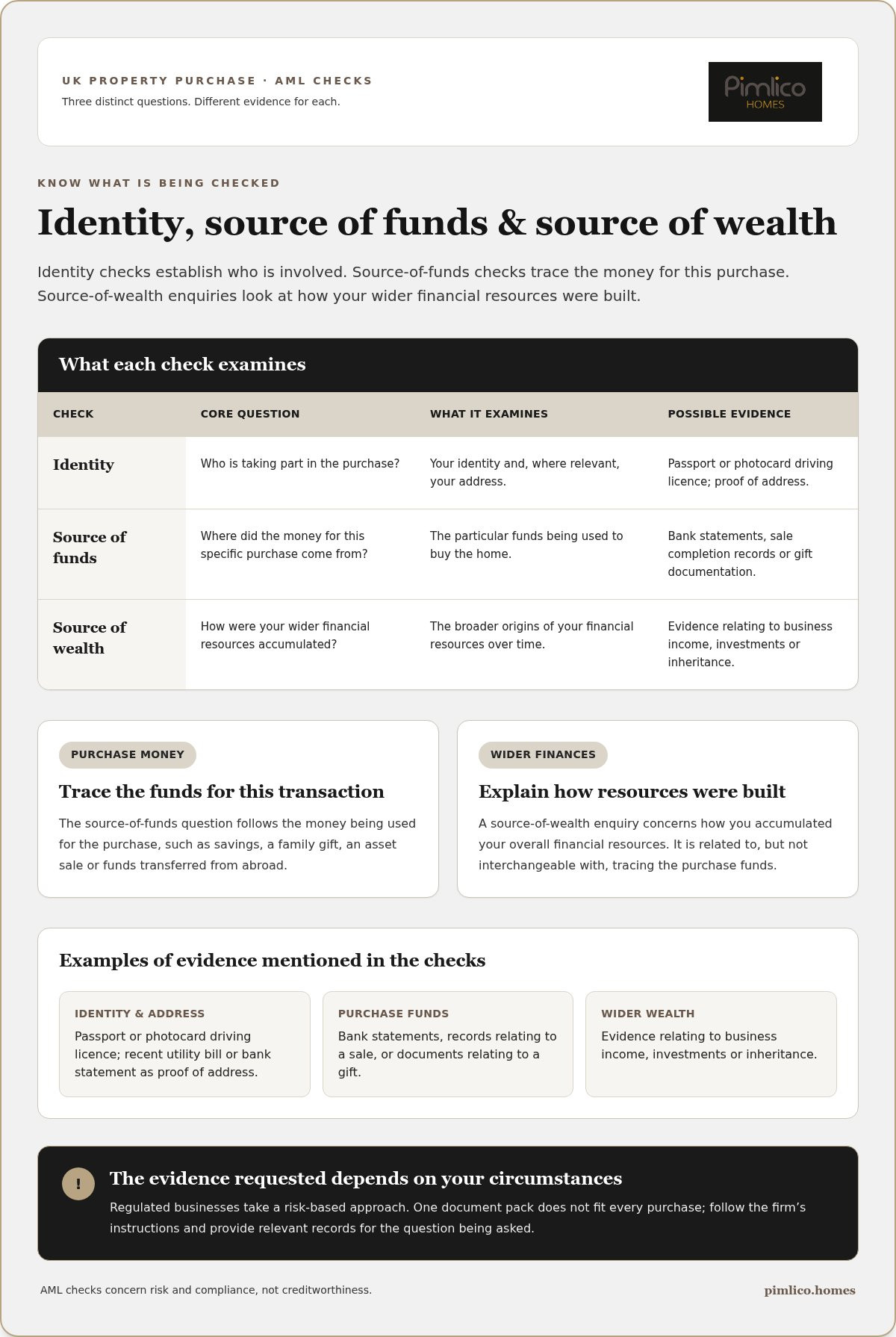
These checks ask different questions. Identity establishes who is taking part; source of funds traces the money for this purchase; source of wealth looks at how you built your wider financial resources. Keeping those distinctions clear helps you understand why a document is requested and avoid sending unrelated personal records.
| Check | What it examines | Possible evidence |
|---|---|---|
| Identity | Who you are and, where relevant, your address | Passport or photocard driving licence; proof of address |
| Source of funds | Where the money for this specific purchase came from | Bank statements, sale completion records or gift documentation |
| Source of wealth | How you accumulated your broader financial resources | Evidence relating to business income, investments or inheritance |
Source of funds follows the particular money being used to buy the home, whereas source of wealth explains how you accumulated your overall financial resources over time. A firm may ask about both where its risk assessment calls for it, but the terms are not interchangeable. Under the Money Laundering Regulations 2017, as amended, regulated businesses take a risk-based approach to due diligence. The information required can therefore vary according to the transaction and the buyer’s circumstances. No single document pack fits every purchase.
What identity documents might a buyer be asked to provide?
A firm may request an identity document, such as a passport or photocard driving licence, and separate proof of address, such as a recent utility bill or bank statement. These are examples, not a guaranteed list of acceptable documents. The firm’s verification method and requirements matter: some use electronic identity verification, while others request documents or further checks. Follow the instructions provided and ensure you understand which evidence is required before sending it.
How do buyers evidence funds from savings, gifts or a sale?
For savings, bank statements can show funds building up and moving towards the account used for the purchase. If money comes from selling an asset or property, completion statements or related account records may help connect the proceeds to the deposit. A family gift may require evidence of the transfer and, depending on the risk assessment, information showing how the gifted money originated. Inheritances, investments and business income each have their own supporting records.
Focus on a clear trail rather than a large bundle of paperwork. If savings moved between accounts before being used for the deposit, records showing each step can make the sequence easier to follow. If funds came from a gift, the transfer alone may not explain their original source, so the firm could request relevant evidence from the donor. Requests should be proportionate to the circumstances, and an enquiry does not by itself imply wrongdoing.
Before sharing documents, check that names, dates and amounts align across the records. Provide only what has been requested through the firm’s stated process. This measured preparation can bring clarity to the financial side of a major home purchase, whether you are considering a luxury new build home or another residential property.
What can trigger extra AML questions: and what those questions mean
An additional request for information can feel unsettling during a carefully planned purchase. It does not, by itself, establish wrongdoing or mean that a transaction will be refused. AML checks for buying UK property follow a risk-based approach, so a firm may seek more detail when it needs to understand an aspect of the buyer, the funds or the transaction.
Additional checks seek clarity about a transaction; they are not an automatic rejection of the buyer. A gift, overseas connection or layered finances can all have legitimate explanations. The important point is whether the information available gives the regulated business a clear, documented understanding of the risks.
| Possible circumstance | Why clarification may be requested | What may help explain it |
|---|---|---|
| Funds moving through several accounts | The firm may need to follow the movement and establish how the money accumulated. | A simple sequence of statements showing transfers between accounts. |
| Family gift or financial support | The firm may need to understand both the transfer and the original source of the gifted funds. | Records of the transfer and relevant information about the donor’s funds. |
| Property sale, investment or business proceeds | The stated origin may need to be matched to documents and the amount received. | Sale, investment or business records relevant to the funds being used. |
| International connection or transfer | The firm may consider the context, route and risk factors associated with the transaction. | Transfer records and a clear explanation of the funds’ history. |
When might enhanced due diligence be relevant?
Under the Money Laundering Regulations 2017, as amended, a firm’s risk assessment can lead to enhanced due diligence where the circumstances call for it. This may include screening for politically exposed persons, their family members or known close associates, and sanctions screening. PEP status or an overseas connection is not, on its own, proof of wrongdoing; the firm must consider the relevant risk and apply appropriate measures. Since 30 June 2026, mandatory enhanced due diligence applies to relevant dealings involving countries on the Financial Action Task Force’s Call for Action list. A grey-list connection may still be considered as a risk factor, but does not automatically trigger mandatory EDD.
How can layered or unusual funds lead to follow-up?
Several transfers, an asset sale followed by a currency conversion, or money arriving from an overseas account can create a longer trail to explain. A gap in statements, a difference in names or an unclear date may prompt a focused question so the firm can reconcile the records. No single transfer pattern proves criminal conduct; context and supporting evidence matter.
A short timeline can make a complicated route easier to follow. Note when funds were received, where they moved and when they were set aside for the purchase. If a request is unclear, identify the part of the trail that needs explaining and provide relevant records with a concise note. Clear, consistent information helps the firm assess the transaction without treating legitimate complexity as a conclusion in itself.
How to prepare AML documents before progressing with a UK property purchase
Good organisation makes it easier to answer questions clearly and avoid preventable follow-up. AML checks for buying UK property are assessed according to the circumstances, so treat any checklist as a starting point, not a universal document requirement. The receiving firm’s instructions take priority.
Use this sequence to prepare:
- 1. Identify the funds. List the money intended for the deposit and completion, including savings, gifts, inheritance, sale proceeds or other sources.
- 2. Assemble relevant records. Gather documents showing where each part came from and how it reached the account from which it will be paid.
- 3. Check for consistency. Compare names, dates and transfer amounts across statements and supporting records. Note any differences that need a straightforward explanation.
- 4. Respond promptly. Read each request carefully, provide relevant evidence through the firm’s stated secure process and follow the instructions if anything is unclear.
A simple timeline can bring the whole trail into focus. Note when funds originated, any accounts they passed through and when they were set aside for the purchase. Include the deposit and expected completion funds, as these may come from different sources. This overview helps you spot missing links before submitting documents.
A simple evidence checklist for property buyers
Depending on the firm’s requirements, examples may include a passport or photocard driving licence and proof of address, such as a bank statement or utility bill. For the money itself, organise relevant bank records alongside supporting paperwork for savings, a family gift, inheritance or sale proceeds. Keep evidence in date order where practical, and make sure the sequence and figures are understandable. The firm determines which documents and verification methods it accepts.
Share only what is needed to respond to the request. Use the secure submission method provided by the requesting organisation rather than sending sensitive files through an unverified channel. A focused set of relevant records is generally clearer than a broad bundle containing unrelated financial or personal details.
What should you do if a document is missing or unclear?
Explain the gap plainly. Provide the records you have and brief context about what they show; never alter a statement or create a document to make the trail appear complete. Follow the requesting organisation’s instructions for alternative records it can consider. This keeps your explanation relevant and avoids disclosing unrelated sensitive material.
Preparation can reduce avoidable questions, but it cannot guarantee a particular completion date. The time needed depends on the transaction, the evidence and any further enquiries. A measured approach to the paperwork is one part of preparing for a considered home purchase. Explore Pimlico Homes and the residential homes available to private buyers.
AML checks and your home purchase: a calmer route from offer to completion
A property purchase brings several strands of preparation together. After an offer is accepted, identity and financial checks may take place alongside conveyancing and funding arrangements. There is no single sequence for every transaction, and different tasks can overlap. Knowing what each check is designed to establish helps keep AML requests in perspective as you move towards a purchase.
How AML checks fit alongside other purchase checks
AML checks focus on identifying the parties and understanding relevant risks, including the origin of funds used in the transaction. They are distinct from a lender’s underwriting, which considers matters such as affordability and the proposed mortgage. Property searches and title investigations are separate conveyancing enquiries about the property and the legal interest being bought. Each process serves its own purpose.
The organisations involved may therefore ask for different information, even where some details appear similar. A conveyancer’s customer due diligence does not automatically replace an estate agent’s checks or a lender’s own verification. Completing AML checks does not guarantee mortgage approval, acceptance of an offer or completion. Each party makes decisions within its role and according to the information it needs.
Timing can matter. If a regulated firm cannot complete required checks or needs clarification, that may affect its ability to progress its part of the transaction. Follow-up questions can take time to resolve, particularly where records need to be obtained from another person or institution. No fixed timetable applies to every buyer, so an AML enquiry does not mean a purchase will fail or be resolved by a particular date.
Prepare confidently while choosing your next home
Gathering documents can sit alongside wider decisions, including arranging your deposit, considering mortgage funding and understanding the steps involved in the purchase. Keep a clear record of where the money for the deposit and completion is coming from, and respond to requests through the relevant organisation’s secure process. An organised file can make it easier to answer specific questions, though it cannot remove every possible enquiry or guarantee a completion date.
The financial checks are one part of a much larger decision: choosing a home that suits your priorities and the life you intend to build there. Pimlico Homes develops luxury residential properties, including luxury new builds, executive courtyard homes and bespoke barn conversions for private buyers.
With the process understood, you can give attention to the home itself. Explore the homes developed by Pimlico Homes, including luxury new builds, executive courtyard homes and bespoke barn conversions.
Move towards your next home with confidence
A property purchase is not only a sequence of checks. It is a decision about the place you want to call home and the future you hope to shape there. Understanding AML checks for buying UK property can help you approach the process with a clearer sense of what is being asked, while leaving space to focus on the qualities that matter most in your next home.
As you consider your next step, look beyond the paperwork to the setting, design and lasting character you want from a property. Pimlico Homes develops luxury detached homes, executive courtyard homes and bespoke barn conversions for private buyers, with a focus on high-end residential property.
Explore Pimlico Homes’ luxury new build properties and discover homes designed for considered living. With a thoughtful approach to the practicalities and possibilities, you can move forward with confidence and look ahead to a home that feels distinctly yours.
Frequently Asked Questions
Are AML checks compulsory when buying a property in the UK?
Relevant regulated businesses must carry out customer due diligence where required by the Money Laundering Regulations 2017, as amended. This means AML checks for buying UK property are a normal part of many purchases involving estate agents and conveyancing firms, although each firm’s duties depend on its role and the circumstances. There is no single statutory document list that every buyer must provide; the firm assesses what it needs to meet its obligations.
How long do AML checks take when buying a house?
There is no fixed timeframe for AML checks, and firms may need different evidence in different cases. Straightforward digital verification may involve less document gathering than a purchase involving a gift or several funding sources. To help avoid preventable hold-ups, respond promptly to requests and provide any missing-record context as soon as possible. AML checks are only one part of the wider purchase timetable.
Can a family member gift money towards a property deposit?
Yes, a family member can contribute a gift towards a deposit, subject to the relevant lender’s requirements and the checks carried out by the firms involved. The lender may ask for a gift declaration explaining whether the contribution is repayable and whether the donor expects an ownership interest. Separately, the conveyancer may need information about the transfer and the money’s origin. Discuss the proposed gift with the relevant parties before funds are moved.
What happens if I cannot provide the requested source-of-funds documents?
Explain what is missing and why, then provide any alternative records you have, such as a sale completion statement or account history. Follow the requesting firm’s instructions about evidence it can assess. Do not alter documents or guess at dates or amounts. If the firm cannot complete the checks required for its role, it may be unable to proceed with its work, which can affect the transaction. The outcome depends on its assessment and obligations.
Do joint buyers each need to complete AML checks?
Usually, each person buying jointly will need to have their identity verified because each is a customer involved in the purchase. The firm may also ask how each buyer’s contribution is funded, particularly if one person is providing most or all of the deposit. Where a buyer acts through a company, trust or another arrangement, further information about the parties involved may be needed. One buyer’s completed checks do not automatically cover the other.
Will buying with money from overseas mean extra checks?
Not automatically. Overseas funds can be entirely legitimate, but the firm may request more information if it needs to understand the transfer route, relevant country risks or records that are unfamiliar. Keep statements showing the money leaving the overseas account and arriving in the UK account, alongside supporting evidence for its origin. If documents use a different language or currency, include a clear explanation of the context and follow the firm’s instructions on any clarification it needs.
Are AML checks the same as a mortgage affordability assessment?
No. AML checks help a regulated firm verify identity and assess the financial trail relevant to a transaction. A mortgage affordability assessment is carried out by a lender to decide whether the proposed borrowing is suitable under its lending criteria, including consideration of income, outgoings and existing commitments. A lender may carry out both types of checks for different reasons. Passing one assessment does not guarantee the outcome of the other or confirm that a purchase can complete.





