
What if the most reassuring review tells you less than a measured account of a snag, a delay or a home’s day-to-day comfort? Analysing online resident reviews of a property developer means looking beyond star ratings to understand what feedback can reveal, and what it cannot.
It’s natural to seek reassurance before making a significant purchase, particularly when reviews seem unusually glowing, sharply critical or difficult to verify. A single complaint may reflect an individual dispute, while similar concerns from different residents could point to a pattern. Yet review platforms rarely show the full context of a purchase or the details of a particular development.
This guide explains how to assess review patterns, distinguish isolated experiences from recurring themes and compare resident feedback with independent, verifiable evidence. You’ll also learn why site-specific factors matter, and how to weigh comments about craftsmanship, finishes and post-move-in issues alongside other signs of quality. For anyone considering a luxury new build, the aim is a clearer, more balanced view of the developer and the home.
Key Takeaways
- When analysing online resident reviews of a property developer, look for recurring, specific experiences rather than relying on star ratings alone.
- Record when reviews were written and which development they concern to judge whether accounts offer a fair comparison.
- Distinguish repeated, detailed feedback from isolated claims, and consider the context before drawing conclusions.
- Cross-check review themes against relevant public information and purchase documents, remembering that company records cannot measure build quality on their own.
- Bring together the strongest themes, supporting evidence and remaining uncertainties before weighing a home’s design, specification and fit for your needs.
What analysing online resident reviews of a property developer can, and cannot, tell you
Resident reviews offer something polished brochures cannot: an account of how a home and the buying experience felt to someone who lived through them. These first-hand accounts can bring useful detail to your research, but they are not the complete picture of a development, a company or the quality of every home.
A useful guiding principle is this: reviews are evidence of reported experiences, not proof of every claim. Treat each account as a signal to examine, rather than a verdict. This balanced approach matters when analysing online resident reviews of a property developer, because user-generated content reflects individual perspectives and may lack context. The broader reliability of user-generated content offers a useful parallel: online contributions can inform understanding, but their reliability depends on the detail, evidence and context available.
What resident reviews can reveal about a property developer
Look for accounts that describe particular parts of the experience, rather than relying on general praise or frustration. Reviews may discuss the buying process, communication during construction, workmanship observed in the home, the handover or support after completion. Keep these themes distinct: a smooth sales experience does not, by itself, establish build quality, just as a complaint about a delay does not automatically describe the finished home.
Specificity makes a review more useful. An account that identifies what happened, when it happened and how it was addressed gives you more to assess than a broad statement such as “excellent service”. For instance, a resident might describe a particular finish noticed at handover and explain how the issue was handled afterwards. That detail helps you understand the reported experience, while still leaving the claim to be weighed against other evidence.
Why a rating cannot tell the whole story
A star rating compresses several dimensions into one simplified signal. A reviewer might be pleased with the design but dissatisfied with communication or aftercare; the rating alone cannot show which mattered most. Read the accompanying account, note its date and development context, and consider whether it describes an experience similar to those in other reviews.
Reviews also come from people who choose to post, not necessarily every resident. Their experiences may differ, and online comments cannot independently establish construction standards or predict how a home will perform in future. Use reviews to identify questions and themes, then assess those alongside evidence about the specific home and development.
How to analyse online resident reviews of a property developer systematically
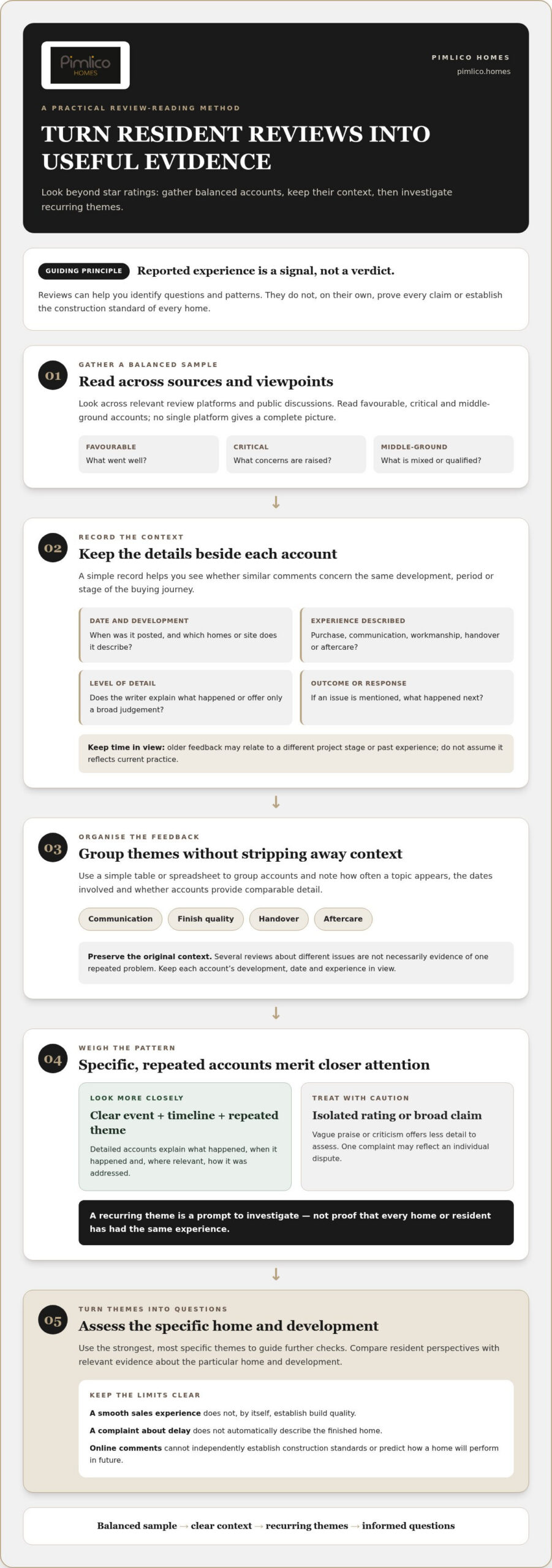
A consistent method helps turn scattered comments into useful evidence. Rather than letting the most striking review shape your view, gather a balanced set of accounts, organise what they describe and keep the surrounding context visible. This makes analysing online resident reviews of a property developer more deliberate and less dependent on instinct.
Build a balanced sample across review sources
Search across relevant review platforms and public discussions, but remember that each source attracts a different mix of contributors. No single platform provides a complete picture. Read favourable, critical and middle-ground accounts, and note the date and development each review refers to. Older feedback may describe a different project stage or past experience, so don’t assume it reflects current practice.
As you read, capture the details that make each account easier to assess:
- Date and development: When was the review posted, and which homes or site does it describe?
- Experience described: Does it concern the purchase, communication, workmanship, handover or aftercare?
- Level of detail: Does the writer explain what happened, or offer only a broad judgement?
- Outcome or response: If an issue is mentioned, does the account say what happened next?
This simple record can reveal whether apparently similar comments relate to the same development, period or stage of the buying journey. It also helps prevent a comment about one home from being treated as representative of every project.
Code recurring themes without losing context
Next, group accounts by theme, such as communication, finish quality, handover and aftercare. A simple table or spreadsheet can help you note how often each topic appears, the dates involved and whether the accounts provide comparable detail. Keep the original context beside each entry: several reviews about different issues are not necessarily evidence of one repeated problem.
Give close attention to specific accounts that describe a clear event and timeline. Vague praise or criticism can still signal what mattered to a resident, but offers less detail to assess. Repeated, specific accounts deserve closer attention than an isolated rating. That is a prompt to investigate a theme, not proof that every home or resident has had the same experience.
Once you have mapped the feedback, take the same measured approach to the home itself. Our luxury new-build buying guide offers further considerations for assessing a purchase alongside resident perspectives.
How to judge mixed reviews without mistaking a pattern for a verdict
A favourable average can offer reassurance, but it doesn’t prove consistent quality. Equally, one severe complaint is not a complete verdict on a developer or every home it has built. The useful question is whether the accounts provide relevant, detailed and independent evidence of a recurring experience.
Give each review weight according to its recency, specificity and relevance to the home or development you’re considering. A recent account about handover may be more pertinent to that stage of the buying journey than an older comment about the purchase process. Age alone doesn’t settle the matter: a detailed older account may still highlight a point worth checking against current evidence.
Distinguish recurring issues from one-off experiences
Look for similar concerns appearing independently, across different dates and review sources. Then check whether the accounts describe comparable circumstances. Several residents discussing the same type of finish issue after moving in may warrant closer attention; a single complaint about a delayed appointment is a different kind of signal. Neither should be dismissed automatically, but don’t infer a systematic defect from one account without corroboration.
If reviewers appear to disagree, first ask whether they are discussing the same development, stage or type of experience. If the contradiction remains unresolved, record it as uncertainty. It doesn’t mean one account must be true and the other false.
Read positive and negative feedback with equal care
Specificity matters in both directions. Praise that describes clear communication at a particular stage, or explains what stood out about a home’s finish, gives you more to assess than a string of general superlatives. A critical review is more informative when it includes dates, particulars and what happened afterwards. A developer’s public response adds context, but doesn’t establish that the complaint was resolved or that the response tells the full story.
Use this comparison as a guide, not a scoring system:
| Review signal | How to interpret it |
|---|---|
| Specific accounts describing a similar issue across dates or sources | Give the theme closer attention and look for corroborating information. |
| One detailed account without similar reports | Keep it in view, but treat it as a reported individual experience. |
| Repeated vague praise or criticism | Note the sentiment, but recognise that limited detail makes it harder to assess. |
| Conflicting accounts with no clear explanation | Record the uncertainty rather than forcing a firm conclusion. |
When analysing online resident reviews of a property developer, the aim isn’t to produce a definitive score. It’s to identify which themes merit further attention and how much confidence the available accounts reasonably support.
How to cross-check resident reviews against evidence about a developer
Reviews become more useful when considered alongside information about the homes and the purchase itself. If residents describe concerns about handover or aftercare, compare those accounts with the relevant development details and documents available to buyers. The aim is not to prove or disprove an individual account, but to see whether other evidence supports its relevance to the home you are considering.
Corroboration makes a review-based assessment more grounded, but it doesn’t make every online claim conclusive. Each source has limits. A review records a person’s account; a document sets out information relevant to a particular purchase; company records provide background. Together, they can help you form a more considered view.
Compare resident experiences with project and company information
Start by checking that a review concerns the same developer, project type and period that matter to your decision. A comment about a different development, or an earlier stage of a company’s work, may offer context but should not be assumed to describe the home in front of you. Where a review raises an issue about specification, handover or aftercare, compare its account with the relevant purchase documents, such as the written specification and warranty information available to you.
Companies House records can provide useful background on a company’s identity and filed information. They don’t directly establish workmanship, construction standards or resident satisfaction. Treat them as one strand of research, not a substitute for inspecting the specific home, understanding its specification or assessing the evidence behind a resident’s account.
Understand the role of quality codes and redress schemes
Quality codes and redress schemes may offer a further point of reference, but their relevance depends on their current scope and whether the developer and purchase fall within it. Before relying on a scheme, use its official information to establish what it covers, who can use it and whether it applies to the circumstances you’re researching. Don’t assume every developer or new-build purchase is automatically covered.
The New Homes Quality Board and New Homes Ombudsman Service are names buyers may encounter in this area. Check their current guidance and the particular scheme’s applicability before treating membership, a code or a route to redress as evidence about a specific home. Scheme information describes standards or processes within its stated scope; it doesn’t verify residents’ online opinions or independently certify the quality of every property.
As you compare the evidence, keep design and craftsmanship in view alongside the resident experience. Explore Pimlico Homes’ new-build homes to consider how these qualities come together in its residential portfolio.
Turn developer review analysis into a confident home-buying decision
Review research is most valuable when it helps you make a proportionate judgement, not when it tries to deliver certainty. Before deciding, bring your findings together in a short record: what themes recur, what evidence supports them, what questions remain and what the review sample cannot establish. This gives you a clear basis for comparing reported resident experiences with the home itself.
Create a proportionate review-analysis summary
Separate what you have found into evidence, opinion and interpretation. For example, a review may report a particular handover experience; the reviewer’s conclusion about what it says about the whole development is their interpretation. Note whether other accounts describe a comparable experience and whether relevant documents or public information offer further context.
- Recurring positive themes: record the experience described and how consistently it appears.
- Recurring concerns: note the details, dates and development context, rather than relying on sentiment alone.
- Corroborating evidence: identify relevant information from purchase documents or other sources.
- Open questions and limits: state what remains unclear and remember that online reviews cannot represent every resident’s experience.
This summary keeps uncertainty visible instead of allowing a handful of accounts to stand in for a complete picture.
Bring reputation research into the wider buying decision
A developer’s reputation is one consideration among several. Compare the review picture with the home’s written specification, purchase documents, design and the features that matter most to you. Your priorities may include layout, materials, craftsmanship or how the property suits your plans. The luxury new-build buying guide can help you consider other aspects of the purchase, while new-build resale value considerations offer another perspective for your research.
Ultimately, analysing online resident reviews of a property developer should sharpen your questions and inform your judgement, not make the decision for you. Pimlico Homes’ detached homes, courtyard homes and barn conversions are options to explore in their own right, not proof of what reviews say. Take a measured look at Pimlico Homes’ luxury residential developments as you consider which home may suit your aspirations.
Make your next move with greater confidence
Resident reviews can illuminate aspects of buying and living in a new home, but they’re most useful as part of a wider picture. Look for themes that are specific and repeated, then weigh them against relevant documents and evidence about the home you’re considering. A rating or individual account can prompt further thought; neither should make the decision for you.
By analysing online resident reviews of a property developer with care, you can separate reported experiences from verifiable information and keep any uncertainty in view. Then bring that perspective together with the home’s design, specification and fit with your priorities. A considered decision draws on several sources, not one signal.
Pimlico Homes specialises in luxury residential development, with homes that include detached properties, courtyard homes and bespoke barn conversions. Explore Pimlico Homes’ luxury residences and discover homes shaped around thoughtful design and craftsmanship.
Frequently Asked Questions
How do you analyse online resident reviews of a property developer?
Read accounts across relevant sources, noting their dates, development context and the stage of the experience described. Group specific comments into themes such as communication, workmanship, handover and aftercare, then compare favourable and critical accounts. Look for similar experiences reported independently and record what remains unclear. Finally, compare relevant themes with project information and purchase documents. Reviews can inform your decision, but they can’t prove every claim or represent every resident.
What should I look for in a property developer’s resident reviews?
Look for detailed accounts that explain what happened, when it happened and whether the review concerns buying, handover or living in the home. Repeated comments about communication, workmanship or aftercare may warrant closer attention, particularly when different residents describe comparable experiences. General praise or criticism can still provide a sense of sentiment, but offers less to assess without supporting detail. Even a specific account remains one person’s experience, not a complete record.
Can online reviews tell me whether a property developer builds good-quality homes?
Reviews can offer first-hand descriptions of residents’ experiences, including comments about finishes, handover and aftercare. On their own, however, they can’t establish construction quality across every home or predict how a particular property will perform. Look for repeated, specific accounts, then consider them alongside the home’s written specification, relevant purchase documents and other evidence about the development. This gives you a broader basis for assessment than ratings or comments alone.
Are negative resident reviews a reason to avoid a property developer?
Not automatically. Consider whether each review is recent, specific and relevant to the home or development you’re assessing. Then look for similar accounts from independent sources and compare the reported concern with relevant supporting information. A repeated issue described in detail deserves careful consideration. One unresolved account may raise a question, but it shouldn’t be treated as a complete verdict on the developer or every home they have built.
How many reviews should I read before choosing a property developer?
There’s no single review count that makes an assessment reliable. A small number of detailed accounts may help identify useful questions, while a larger collection may still be incomplete or skewed towards particular experiences. Read across relevant sources and consider dates, project context and whether specific themes recur. Note any gaps in what you’ve found. Volume alone isn’t proof of quality, a recurring issue or a complete picture of residents’ experiences.
Should I trust a property developer’s average review score?
Treat an average score as an initial signal, not a conclusion. It can conceal differences in dates, development context and the experiences behind individual ratings. Read the accounts that contribute to the score, compare favourable and critical feedback, and look for themes supported by other evidence. A score can help you organise your research, but it can’t replace considering the specific home, its documentation and the context of residents’ accounts.





