Could a project that is not yet visible alter the view that makes a home feel exceptional? For buyers, assessing the risk of view obstruction from future construction means looking beyond the current outlook and following a chain of evidence. A clear horizon today is valuable, but it does not promise that neighbouring land will remain unchanged.
Planning proposals can be difficult to find or interpret because plans, supporting documents and application status each tell only part of the story. This guide explains how to identify relevant development activity, check records and publication dates, and judge how a proposal’s scale, position and design could affect sightlines from a property. It also covers questions for the seller, useful records and when professional advice may help. As part of due diligence for a new home, this measured assessment can help you weigh the outlook alongside the property’s other qualities, without treating a proposal as a certainty or assuming that today’s view is protected.
Key Takeaways
- Assess the outlook from the rooms, garden or terrace that matter most. Distinguish a defined sightline from a distant prospect.
- Begin assessing the risk of view obstruction from future construction by identifying nearby sites and checking the relevant local planning authority’s records.
- Compare proposal plans with the property’s actual viewing points, paying attention to height, massing, distance and orientation.
- Check application status and publication dates, and keep dated notes and copies of official documents.
- Separate confirmed facts from plausible scenarios and unanswered questions before weighing the outlook in your property decision.
Assessing the Risk of View Obstruction: What Buyers Need to Establish
A property’s outlook can shape how its rooms feel and how you experience its setting. Yet a view seen during a viewing reflects the present, not a promise that surrounding land will remain unchanged. Assessing the risk of view obstruction from future construction starts with defining what could be affected and how much that outlook matters to you.
View obstruction risk is the possibility that future development could materially alter a valued outlook. A known proposal is evidence to investigate, while the general possibility of development is not proof that a change will happen. This distinction helps keep an early assessment measured. A submitted scheme, an approved permission, a site identified in a development plan and an undeveloped neighbouring plot are different situations, with different levels of certainty.
Which parts of the view matter most to you?
Be specific about where you experience the outlook. Note the principal room and window, garden seating area, balcony or terrace, and the direction each faces. A broad distant prospect may be meaningful, but it is not the same as a defined sightline through a particular window or across a garden.
Then record what gives the view its character, such as open land, a skyline, mature planting or a neighbouring site. Separate personal value from observable features. You may prize a sense of openness, while a practical assessment considers visibility, distance, orientation and what lies between the property and the feature. This makes it easier to compare a proposal with the outlook you actually value, rather than relying on a general impression.
What can a preliminary assessment establish?
Public records and a visit to the property can reveal relevant information and help indicate risk. They cannot predict every future planning decision or establish that development will, or will not, take place. Record the status and publication date of any application, and distinguish a submitted proposal from an approved permission, an allocated site or a possibility with no confirmed scheme.
The term air rights describes interests in the space above land, but it should not be mistaken for an automatic right to keep a view unobstructed. The legal position depends on the property and applicable planning framework. If the outlook is central to your decision, seek property-specific advice from an appropriately qualified legal or planning professional before relying on an assumed right or outcome.
A preliminary assessment is a disciplined starting point, not a guarantee. It helps you identify what is known, what remains speculative and which questions need an authoritative answer before you proceed.
How to Find Future Construction Plans Near a Property
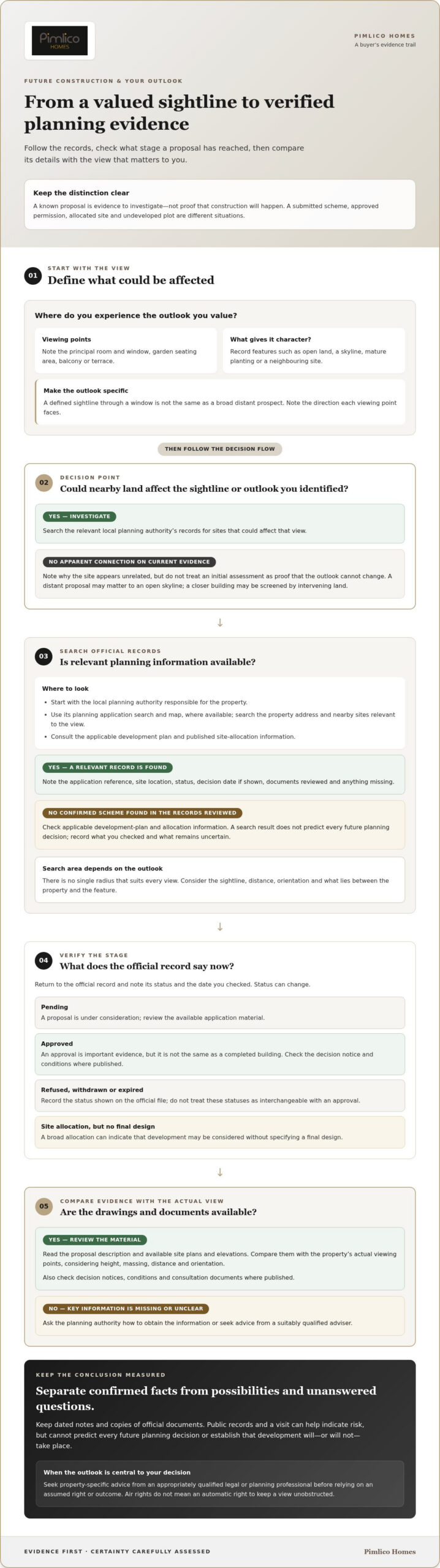
A targeted search is more useful than a broad trawl through online listings or general news. Begin with sites that could affect the outlook you have identified, then work through official planning records, check each proposal’s current status and save what you find. This sequence helps distinguish a relevant nearby project from development activity that has little bearing on the property.
An application, a site allocation and a completed development represent different levels of certainty. Each is a distinct stage of information, not an interchangeable indication that construction will occur. Keep that distinction in mind while assessing the risk of view obstruction from future construction.
Search planning applications and development plans
Start with the local planning authority responsible for the property. Use its planning application search and map, where available, to search the property address and identify nearby sites within an area relevant to the view. There is no single radius that suits every outlook: a distant proposal may matter to an open skyline, while a closer building may be screened by intervening land.
For relevant applications, review the description and available drawings, including site plans and elevations. Check decision notices, conditions and consultation documents where published. Then consult the applicable development plan and any published site-allocation information. Planning frameworks differ across the UK, so confirm which authority and documents apply. Note each document’s date and status rather than relying on an old summary.
Check proposal status and evidence quality
Return to the official record to establish whether an application is pending, approved, refused, withdrawn or expired. Status can change, so record the date you checked. An approval is important evidence, but it is not the same as a completed building. A broad allocation can indicate that development may be considered without specifying a final design.
Make a short record of the application reference, site location, status, decision date if shown, documents reviewed and anything missing. If key drawings are unavailable or the record is unclear, ask the planning authority how to obtain the information or seek advice from a suitably qualified adviser. A general list of due diligence questions may help prompt enquiries, but it should not replace guidance based on the UK planning framework that applies to the property.
Clear records make it easier to revisit your findings before committing to a purchase. If you are also considering the setting and design of a new home, explore luxury new build homes as part of your wider assessment.
How to Judge Whether Proposed Construction Could Block the View
A proposal’s presence nearby does not, by itself, show whether it will affect the outlook. Compare its verified plans with the view from the window, garden or terrace that matters to you. Consider how high and wide the proposed building is, how far away it sits, what lies between it and the property, and how much of the valued sightline could be affected.
Map the sightline from the property
Visit the relevant viewing points and note fixed reference features, such as a roofline, tree or distant landmark. If practical, observe the outlook at the times you use the space. Record changes in ground level, existing buildings and vegetation, but do not assume that trees or other screening will remain unchanged. A view across open land, for example, may be more exposed than one framed by permanent built features.
If you have a material concern, ask a suitably qualified professional whether a measured sightline assessment would help. An informal sketch, estimate or comparison is indicative only unless its measurements, viewpoint and assumptions have been professionally verified.
Interpret drawings, massing and visualisations carefully
Before comparing a scheme with the outlook, check that its drawings show the relevant site and revision. Confirm the orientation, scale, stated heights and viewing points. A site plan may establish where a building is proposed, while elevations and sections can help indicate its height and form. Consider the building’s full massing, not only the part most prominent in a presentation image.
Computer-generated visualisations can be useful, but they are not predictions unless their methodology and assumptions are disclosed. Perspective, camera position, planting and other details may shape what an image appears to show. Keep your conclusions proportionate to the evidence.
Comparison framework
- Proposal status: Is this a current application, an approved scheme or an illustrative plan?
- Likely visual relevance: Do its height, massing, distance and orientation intersect the sightline?
- Evidence confidence: Are the drawings scaled, dated and clear about viewpoints and dimensions?
- Unresolved questions: Are levels, final design details, screening or other assumptions unclear?
This structured comparison makes assessing the risk of view obstruction from future construction more precise, without suggesting certainty where the evidence is incomplete. If the property’s outlook raises questions about planning policy, title documents or possible rights, check the framework that applies to the property and seek property-specific advice from an appropriately qualified UK professional.
Buyer Due Diligence: Questions, Records and Professional Advice
Before making a decision, bring the evidence together in one place. A clear record helps you distinguish what has been verified from what remains uncertain, and makes it easier to revisit the issue if an application or proposal changes. This is especially useful when the outlook is a meaningful part of the property’s appeal.
Questions to ask the seller or developer
Ask whether they are aware of proposals or development information relating to nearby land, and where you can review the relevant records. If a property description, sales conversation or document refers to a view, outlook or neighbouring site, request clarification of the basis for that statement. Ask for responses in writing, including any assumptions about future development or screening.
A written reply is useful evidence of what was said, but it does not replace independent checks of official records or appropriate advice. For wider purchase considerations, Pimlico Homes’ luxury new build purchasing guide offers a broader due-diligence resource.
Keep a clear evidence file
Organise your findings so they can be reviewed before you proceed. Include:
- Planning information: application references, descriptions, current status and copies of key documents or decision notices.
- Development-plan material: relevant policies or site-allocation documents, with publication dates and the date you accessed them.
- Site observations: dated notes about the viewing point, visible features, intervening land and existing buildings or planting.
- Open questions: missing plans, unclear measurements, unanswered enquiries and assumptions that still need checking.
Save official documents rather than relying solely on web pages that may be updated. Add brief notes explaining what each item does and does not establish. This creates a practical record, not a prediction of what will ultimately be built.
When to seek independent advice
The right professional depends on the question. A solicitor can review title documents, relevant rights and the wording of sale information. A planning consultant may help interpret complex applications, site allocations or policies. If the outlook has a material bearing on your choice, consider asking a surveyor or visual-impact specialist whether a more detailed assessment is appropriate.
When assessing the risk of view obstruction from future construction, do not treat an informal assurance or visual estimate as definitive. Confirm the relevant planning framework for the property and ask professionals to explain the limits of their assessment. To explore Pimlico Homes’ luxury new homes as part of your property search, visit the website.
Make a Confident Property Decision Despite Uncertain Future Development
No search can remove every uncertainty about what may be built in future. The aim of assessing the risk of view obstruction from future construction is to reach a proportionate judgement: separate confirmed facts from plausible scenarios, then identify what remains unknown. This gives you a clearer basis for weighing the outlook alongside the property’s other qualities.
Create a proportionate view-risk summary
A simple label can help organise your findings, provided it is supported by an explanation rather than treated as a prediction. For example, “moderate concern” might describe a nearby proposal that could intersect part of a valued sightline while important design details remain unconfirmed. Avoid assigning numerical probabilities unless a qualified specialist has used a defensible method.
For each relevant site, record the proposal and its current status, the part of the outlook potentially affected, how reliable the evidence is, and the next step needed to verify it. Keep these elements distinct:
- Known facts: information confirmed in current official records or documents.
- Plausible scenarios: potential outcomes suggested by the available plans or land-use information.
- Unresolved uncertainties: missing details, changing application status or assumptions that need professional review.
Revisit your summary before exchange, particularly if a material application, revised plan or decision emerges. Check its current status and publication date, then consider whether it changes your assessment or calls for further advice. Your decision should reflect both the possible visual effect and how important that particular outlook is to you.
Explore a home with clear questions in hand
Review the property’s setting and the available information about nearby development before relying on assumptions. For a broader perspective on long-term ownership considerations, read the new build resale value guide. It can complement, but not replace, your own property-specific checks and professional advice.
Pimlico Homes develops luxury detached homes, executive courtyard homes, bespoke homes and barn conversions. Explore these residential offerings as you consider a property’s surroundings and the evidence available. No present-day outlook should be treated as guaranteed protection from future change.
Explore Pimlico Homes’ luxury homes as you plan your next property purchase.
Make Your Next Property Decision with Clarity
A valued outlook deserves careful consideration, but no current view can be treated as a guarantee against future change. By checking official planning records, comparing relevant proposals with the sightline from the property, and keeping dated evidence, you can distinguish established facts from possibilities that still need clarification.
Assessing the risk of view obstruction from future construction is one part of thoughtful property due diligence. Weigh the potential impact against the importance of the outlook to you, and revisit your findings if a material application or decision emerges before you proceed. Where significant questions remain, seek advice suited to the property and the issue.
Pimlico Homes develops luxury detached and executive courtyard homes, alongside bespoke homes and premium barn conversions. Explore these residential offerings as part of your property search. A well-informed decision begins with clear evidence and a considered understanding of what matters most to you.
Explore Pimlico Homes’ homes and take your next step with confidence.
Frequently Asked Questions
Can a neighbour build something that blocks my view?
Possibly, if the proposed work can proceed under the planning rules and any relevant property restrictions. In the UK, a current view does not usually create an automatic right to keep it unobstructed, but the position can depend on the property’s title, applicable planning controls and other specific circumstances. Check official records and seek property-specific legal advice if you believe a covenant, easement or other right may affect what can be built.
How do I find out if construction is planned near a property?
Search the relevant local planning authority’s application register and map, where available, using the property address and nearby sites that could affect its outlook. Review application documents and check the current status and publication date. Also look at the applicable development plan and published site-allocation information, confirming that the documents relate to the property’s jurisdiction. A site visit and direct questions to the seller can help identify matters that need further checking.
Does planning permission mean a proposed building will definitely be built?
No. Planning permission means a proposal has received consent, subject to its terms and any conditions. It does not, by itself, establish that construction will start or be completed. The outcome may depend on factors such as the developer’s plans and whether the project proceeds. Check the official decision notice, conditions and current records rather than relying on a summary. If the permission’s status or implications are unclear, ask the planning authority or a qualified adviser.
Is there a legal right to a particular view in the UK?
There is generally no automatic right to preserve a particular view, but the legal position depends on the property and the relevant UK jurisdiction. Specific rights or restrictions may arise from title documents or other property arrangements, while planning controls can influence development without guaranteeing an outlook. Do not assume that long-standing enjoyment of a view protects it. Ask a solicitor to review the title and advise on any relevant rights or restrictions for the property.
What should I check in a planning application when assessing a view?
Compare the proposal’s site plan, elevations and sections with the actual outlook from the room or outdoor space that matters. Check orientation, drawing scale, stated heights, site levels, distance and revision dates, then consider how much of the sightline might be affected. Review the application description, decision notice and conditions where available. Treat visualisations as indicative unless their method and assumptions are clear. Assessing the risk of view obstruction from future construction depends on the quality and relevance of this evidence.
Can a property survey identify the risk of future view obstruction?
A standard property survey may describe the home’s condition and setting, but it may not include a search for nearby proposals or a detailed visual-impact assessment. Ask the surveyor what the agreed scope covers and whether observed development concerns will be reported. If the view is central to your decision, a planning consultant or suitably qualified visual-impact specialist may be better placed to examine proposal documents and sightlines. Treat any assessment according to its stated scope and limitations.
What happens if a development proposal changes after I make an offer?
Check the relevant planning authority’s records again, particularly before exchange, and compare any revised drawings or new decision with the documents you previously reviewed. Keep dated copies and notes so the change is clear. Tell your solicitor promptly and ask how the new information may affect your purchase and what options are available under the transaction’s circumstances. An offer does not settle every question; get advice before deciding whether to proceed, renegotiate or take another course.