
What if the most important decision about a family home comes before choosing the property? For families exploring “buying a luxury home through a trust UK”, the structure can affect who owns the home, who makes decisions and how family members may use it. A trust may provide a way to hold property for beneficiaries, but it is not a shortcut to tax savings or guaranteed control.
It is understandable to want clarity before committing to a significant family investment. Buying a property through a trust is different from transferring a home you already own, and each route can raise distinct legal, tax and conveyancing questions. This guide explains the roles of trustees and beneficiaries, the decisions to resolve before making an offer, and the considerations involved in holding a property for children or other family members. It also outlines why registration rules and tax treatment depend on the type of trust and where in the UK the property is located. With these points in view, you can consider the purchase more confidently and seek specialist legal and tax advice where needed.
Key Takeaways
- Clarify the trust’s purpose and the roles of trustees and beneficiaries before making a property decision.
- Understand that the steps involved in buying a luxury home through a trust UK can vary with your circumstances and the property’s jurisdiction.
- Distinguish planning aims from guaranteed outcomes: a trust does not automatically reduce tax or protect a home from every claim.
- Prepare for legal and tax discussions by considering funding, occupation, future sale and ongoing administration.
- Assess the home separately, weighing its layout, privacy and suitability for your family’s long-term needs.
Buying a Luxury Home Through a Trust in the UK: What the Arrangement Means
Family provision, control and the purchase of a significant home can feel inseparable. However, the trust structure and the property are distinct decisions. A trust is an arrangement in which trustees hold or manage assets for beneficiaries under defined terms. Put simply, a trust sets out who manages an asset and for whose benefit. It does not automatically guarantee protection, tax savings or family control.
For families considering buying a luxury home through a trust UK, the outcome depends on the trust’s purpose and terms, how legal ownership is structured, and where the property is located. Trust law and property processes are not uniform across the UK. The overview of English trust law relates to England and Wales, so it should not be treated as a guide to every UK jurisdiction.
Who owns, manages and benefits from a trust-held home?
The settlor creates the trust and places assets into it. The trustees hold or manage those assets in accordance with the trust terms and applicable law. The beneficiaries are the people intended to benefit, who may include children. Being named as a beneficiary does not, by itself, make a child responsible for administering the property. The deed and ownership arrangements determine how decisions are made and who may benefit.
Buying through a trust versus transferring a home later
Timing changes the questions to resolve. With a trust purchase, the family considers the structure before acquiring the home: who will provide the funds, who will act as trustee, and how the property will be held and used. These decisions need to be considered alongside the purchase process, with the precise legal steps depending on the circumstances.
Transferring a property you already own is a separate route. The current owner needs to consider the existing title, any mortgage and the home’s ownership history, as well as the proposed trust terms. A transfer may require different conveyancing work and raise distinct tax and lender questions from a purchase made through a trust from the outset. Do not assume that the two routes have identical consequences.
Before settling on either approach, define the intended beneficiaries, the trustees’ responsibilities and whether the home is for family occupation, future sale or both. Independent legal and tax advice is essential, particularly because the relevant rules depend on the UK jurisdiction and the details of the arrangement.
How a UK Property Trust Purchase Takes Shape, from Purpose to Completion
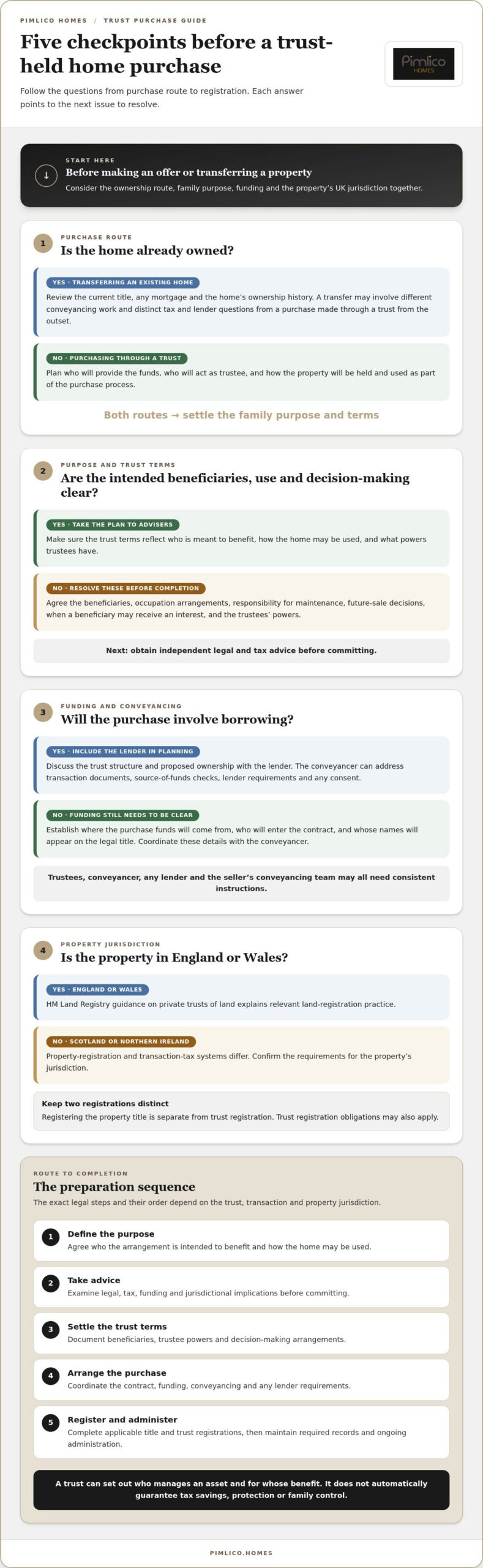
Plan the trust before making an offer or transferring a property, so the purchase route, funding and intended family use can be considered together. The broad preparation is straightforward to map, but legal steps and their order depend on the trust, transaction and property’s UK jurisdiction.
For families considering buying a luxury home through a trust UK, the process often involves trustees, a conveyancer, any lender and the seller’s conveyancing team. Clear, consistent instructions help align the trust terms, purchase contract and intended ownership arrangements.
Set the family purpose and trust terms before choosing a property
Start by agreeing who the intended beneficiaries are, how the home may be used and who should make decisions about occupation, maintenance or a future sale. The trust terms need to address matters such as when beneficiaries may receive an interest and what powers trustees have. These are drafting decisions to resolve before completion, not assumptions to leave until later. No single trust type suits every family; its appropriateness depends on the circumstances and objectives.
Coordinate conveyancing, funding and registration
Before proceeding, establish who will enter the purchase contract, where the purchase funds will come from and whose names will appear on the legal title. The conveyancer can address the transaction documents, source-of-funds checks and any lender requirements or consent. If borrowing is involved, discuss the trust structure and proposed ownership with the lender as part of the transaction planning.
Registration and tax steps depend on where the property is situated. In England and Wales, HM Land Registry’s guidance on private trusts of land explains relevant land-registration practice. Scotland and Northern Ireland have different property-registration and transaction-tax systems, so requirements should be confirmed for the property’s jurisdiction. Trust registration obligations may also apply; these are separate from registering the property title.
A practical sequence to discuss with independent legal and tax advisers is:
- Define the purpose: agree who the arrangement is intended to benefit and how the home may be used.
- Take advice: examine the legal, tax, funding and jurisdictional implications before committing.
- Settle the trust terms: document beneficiaries, trustee powers and decision-making arrangements.
- Arrange the purchase: coordinate the contract, funding, conveyancing and any lender requirements.
- Register and administer: complete applicable title and trust registrations, then maintain required records and ongoing administration.
This framework helps you consider the trust alongside the qualities you want in a home. Explore luxury new-build homes as you reflect on what may suit your family’s long-term plans.
Trusts for Children and Property: What They Do Not Automatically Guarantee
A trust does not guarantee that a family home will be protected from claims or that less tax will be due. It may support a carefully considered plan, but its effect depends on the trust structure, when and how the property is placed in it, family circumstances and the rules applying at the time. The intention behind a trust and the legal or tax result are not necessarily the same.
For anyone considering buying a luxury home through a trust UK, weigh potential aims against the responsibilities and limits of the arrangement.
| Possible planning aim | What it does not guarantee | Trade-off to consider |
|---|---|---|
| Providing for children or other beneficiaries | A particular person’s occupation, control or access to the property | Trustees must administer the asset under the trust terms and applicable law |
| Managing inheritance-tax exposure | A lower tax bill or exemption from inheritance tax | Tax treatment depends on the arrangement, transfers and current rules |
| Seeking protection from creditors or care-fee assessments | That the property will be excluded from a claim or assessment | Timing, purpose and individual circumstances may be relevant to the outcome |
| Planning how a home may be sold or passed on | Unrestricted personal control or an easy change of plan | Trustee decisions, formal terms and ongoing administration can limit flexibility |
Can a trust protect a home or reduce inheritance tax?
Do not assume that a trust will protect an asset or reduce tax. For example, gifts into most trusts are treated as chargeable lifetime transfers and may incur an immediate inheritance-tax charge at 20% if they exceed the available £325,000 nil-rate band. Other rules and reliefs may affect the calculation. The residence nil-rate band, currently £175,000 for qualifying estates passing a main residence to direct descendants, also has eligibility conditions and can taper for larger estates. Check these figures and their application against current rules and the family’s full circumstances.
A plan described as “for inheritance tax” does not determine the tax outcome. The completed structure, value and nature of the transfer, and relevant exclusions or thresholds all matter. Care-fee and creditor questions also require individual advice; a trust is not a universal shield.
Control, children’s interests and changing family circumstances
Trust terms shape decisions about occupation, sale and distribution, while trustees have duties to act in accordance with those terms and applicable law. This can mean less direct control for the person who provided the property. A child’s interest may also change as they grow older or reach an age specified by the arrangement, but the effect depends on the trust and jurisdiction. Review the plan if family circumstances, beneficiaries’ needs or the intended use of the home change.
A Practical Checklist Before Putting a Property in Trust for Children
Before committing to a purchase or transferring a home, prepare a clear picture of your family’s intentions and the property involved. This checklist can structure legal and tax discussions. Advice should address both the trust terms and the proposed transaction; considering one without the other may leave important questions unresolved.
Questions to resolve about the family and the property
- Purpose and beneficiaries: What is the trust intended to achieve, and who is meant to benefit? Record the intended beneficiaries and any planned timing for their interests.
- Trustees and decisions: Who is expected to act as trustee? Consider how decisions about occupation, upkeep, a sale or a change in use should be handled under the proposed terms.
- Funding and ongoing costs: Identify where purchase funds will come from and who expects to meet ongoing property costs. Explain the source and movement of funds as part of the advice process.
- Use and future plans: Is the home intended for family occupation, long-term holding or eventual transfer to beneficiaries? Note possible changes, such as a child reaching adulthood, a move or a change in family circumstances, without assuming a particular outcome.
- Sale and administration: Consider what may prompt a future sale and how proceeds should be dealt with. Include ongoing record-keeping and trust administration in your planning.
UK jurisdiction, tax and professional review
First identify where the property is situated. England and Northern Ireland use Stamp Duty Land Tax (SDLT); Wales uses Land Transaction Tax (LTT); Scotland uses Land and Buildings Transaction Tax (LBTT). The relevant property-registration system also depends on jurisdiction. Check current rules, rates and filing requirements for the specific transaction rather than assuming they are interchangeable across the UK.
For a family considering buying a luxury home through a trust UK, the review should bring together the intended trust, proposed ownership and funding arrangements, and home purchase. Ask for advice covering potential tax consequences, transaction documents, registration and ongoing obligations, including whether Trust Registration Service requirements apply. HMRC guidance and the relevant official land-registration and tax sources can help verify current requirements, but their application depends on the facts.
Once you have set out the planning questions, turn to the home itself. Explore luxury new-build homes as you consider what may suit your family’s long-term plans.
Choosing the Home After the Trust Plan: A Considered Route to Purchase
A trust plan can shape how a property is held and decisions are made, but it cannot determine whether a particular home suits your family. Keep the questions connected but distinct: first understand the proposed legal purchase structure with independent professional advice, then assess the home on its own merits before committing.
For families considering buying a luxury home through a trust UK, the order matters. Clarify the family purpose, obtain legal and tax advice, understand who will contract and hold the title, then compare suitable homes with the intended use in mind. Understand the purchase structure before making commitments; conveyancing will address the requirements of the specific transaction.
Match the property to its intended role in family life
Consider who is expected to live in the home, how the household may change and which spaces will support everyday life. A layout that provides room for shared time as well as privacy may suit one family; another may prioritise adaptable living spaces or a quieter setting. These are questions of suitability, not trust benefits.
Look closely at build quality and specification, and consider the responsibilities of ownership, including maintenance and ongoing costs. A trust does not establish a home’s future value or make it more suitable for its beneficiaries. The property should work for the people who will use it, on the terms your family has planned.
Move from family planning to a confident home search
Once the purpose, advice and purchase structure are clear, you can assess homes with more confidence. Keep the trust arrangements and property decision in view together, but do not rely on the trust as a substitute for reviewing the home’s design, condition, specification and fit for your family’s needs.
Pimlico Homes develops luxury new-build homes and bespoke homes for private buyers, including executive courtyard homes and premium barn conversions. For guidance on the property search itself, read The Ultimate Guide to Buying a Luxury New Build Home in 2026, then consider the qualities that matter most to your family.
Explore luxury homes by Pimlico Homes as you consider a home suited to your family’s long-term plans.
Make Your Next Move with Clarity
A trust can shape how a family home is owned and managed, but it does not automatically secure tax savings, asset protection or personal control. The terms, funding, intended use and property’s UK jurisdiction all matter. Before making an offer or transferring a home, consider the trust plan and proposed transaction together, with independent legal and tax advice tailored to your circumstances.
That preparation gives you a clearer foundation for choosing a home. Consider who will live there, how the layout can support family life and whether the property’s specification suits your long-term needs. Buying a luxury home through a trust UK is both a planning decision and a personal one, and neither should be rushed.
Pimlico Homes develops luxury residential homes and executive courtyard homes, as well as bespoke new builds and premium barn conversions for private buyers. Explore luxury homes by Pimlico Homes as you consider a home for your family’s long-term plans.
Frequently Asked Questions
Can I buy a house in the UK through a trust for my children?
Yes, a trust can be used to hold a home for children, but plan the purchase and trust arrangements together. Trustees manage the property under the trust terms and applicable law, while the children may be beneficiaries. Before buying, clarify who will fund the purchase, hold the legal title and make decisions about occupation or sale. For buying a luxury home through a trust UK, seek legal and tax advice specific to the property’s jurisdiction.
Is putting a property in trust for children a way to avoid inheritance tax?
No, transferring a property into a trust does not automatically avoid inheritance tax. The tax outcome depends on the trust type, the value and nature of the transfer, the timing and the family’s circumstances. For 2026/27, the standard nil-rate band is £325,000, but how it applies to a transfer requires individual assessment. Some transfers into trusts may trigger an immediate inheritance-tax charge. Have the proposed arrangement assessed against current HMRC guidance before acting.
What is the difference between buying a home through a trust and putting my home into a trust?
Buying through a trust means planning the trust structure before the purchase, including who funds it, enters the contract and holds the legal title. Putting an existing home into trust is a later transfer by its current owner. That route may involve questions about the title, any mortgage, ownership history and potential tax consequences. The two approaches are not interchangeable, so advice should cover the specific transaction and trust terms.
Can children own a property held in trust?
Children can be named as beneficiaries of a trust that holds a property for their benefit. In the UK, a child under 18 cannot legally own property in their own name, so trustees generally hold and administer the legal title under the trust terms. A beneficiary’s interest and any rights to occupy or receive the property depend on the arrangement and relevant jurisdiction. Take advice before assuming when a child can control or receive the asset.
Does a trust protect a house from creditors or care fees in the UK?
Not automatically. Whether a home held in trust is considered in relation to creditors or care-fee assessments depends on the trust, when and why it was created, how it is funded and the family’s circumstances. A trust is not a guaranteed way to put property beyond a claim or assessment. Because the relevant rules and outcomes are fact-specific, obtain independent legal advice before transferring a home or relying on a protection objective.
Do I pay stamp duty when buying a property through a trust?
Property transaction tax may be payable, but the applicable tax and calculation depend on where the home is situated and the purchase details. SDLT applies in England and Northern Ireland, LTT in Wales, and LBTT in Scotland. The trust structure, whether the property is an additional dwelling and other buyer circumstances can affect the treatment. Have the conveyancer assess the transaction under current jurisdiction-specific rules before the purchase completes.
What happens if trustees want to sell a home held in trust?
Trustees must act under the trust terms and applicable law, so a sale is not simply one trustee’s personal decision. The deed may set out decision-making powers and how sale proceeds are to be held or distributed. The beneficiaries’ interests and any lender or conveyancing requirements may also matter. Before a sale, trustees should obtain advice on authority to sell, required consent, tax consequences and the handling of proceeds.





