
What makes a luxury new build worthy of the name once the show-home styling is stripped away? It can be difficult to separate lasting quality from polished presentation, particularly if the property is still taking shape. The distinction matters: this is a significant investment, and the home needs to work well beyond the first viewing.
Thoughtful design, craftsmanship and a clear understanding of what is included all deserve close attention. So do the practical details of the buying process, from reviewing plans and specifications to understanding what happens as construction progresses. It is reasonable to want a clear picture at every stage.
This guide explains how to assess a luxury new build against your priorities, compare detached, courtyard, bespoke and barn-conversion homes, and review the questions and documents that can help you make an informed decision. It also looks at how design and craftsmanship shape the experience of living in a home over time. Pimlico Homes develops luxury detached homes, executive courtyard homes, bespoke new builds and barn conversions.
Key Takeaways
- Look beyond polished presentation to assess whether a home’s design, function and craftsmanship suit the way you intend to live.
- Compare specifications consistently, noting what is explicitly included, from materials and finishes to storage and outside space.
- Explore how detached, courtyard, bespoke and converted homes differ in character, privacy and upkeep before deciding which form fits you.
- Before committing to a luxury new build, understand the reservation terms, payment stages and cancellation provisions.
- Consider how Pimlico Homes’ focus on considered design and craftsmanship informs its range of luxury homes.
What makes a luxury new build worth considering?
A polished show home can make an immediate impression, but presentation alone cannot establish lasting quality or show whether the property will suit your life. Look past the styling and consider how the design, function and documented specification work together.
A luxury new build is a newly constructed home in which coherent design, practical function and quality of build combine to meet the buyer’s needs over time. The term is subjective: broad descriptions such as “exceptional” or “premium” do not explain what has been built or specified. The wider idea of luxury real estate can encompass prestige and investment appeal, but neither price nor presentation proves that a particular home is right for you.
A new build is constructed as a new dwelling. A conversion adapts an existing building for residential use. Both can have distinctive character, but their architecture, layouts and construction contexts differ. Understand which type of property you are considering, then assess it on its own merits.
How can you recognise substance behind luxury presentation?
Look for coherence across the whole home. The exterior, room arrangement, circulation and detailing should feel considered together, rather than like a collection of impressive finishes. A beautifully specified kitchen, for instance, cannot make up for a layout that makes everyday movement awkward.
Separate observable or documented features from promotional language. A written specification can describe materials and finishes, while plans show how rooms connect. Treat words such as “exceptional” as a prompt to look more closely, not as evidence in themselves. Assess the home as a complete design, including how its details support comfort and function.
Which questions reveal whether the home suits daily life?
Picture an ordinary day, not just a formal viewing. Where will coats, shoes and household essentials go? Does the layout allow for both quiet privacy and shared family time? Is there room to host guests without disrupting the rest of the household? Consider how these needs might change over time, too.
Room proportions affect whether spaces feel comfortable and adaptable, while circulation shapes how easily you move between them. Natural light can change a room’s mood and usefulness throughout the day. Compare the plans with your routines and note where specific design choices would make a practical difference.
True luxury lies in enduring usability, supported by design that continues to serve the people who live there.
When buying a luxury new build, a useful measure is the fit between what is promised, what can be evidenced and how the home will work in daily life. This buyer-led perspective helps you look beyond the first impression and judge whether the property deserves closer consideration.
How to assess a luxury new build’s design and specification
A specification turns a strong first impression into details you can compare. Review the home in layers: how it works, what it is made from, which finishes are included, and how storage and outside space support everyday use. Keep notes as you go. A consistent record makes it easier to distinguish clear inclusions from descriptions that leave room for interpretation.
Which design details matter beyond the show-home impression?
Study the plans as well as the rooms. Consider whether circulation feels natural, whether proportions suit the furniture and activities you have in mind, and how living spaces relate to quieter areas. Think about privacy, too: consider sightlines between rooms and how the home may feel when household members are working, relaxing or entertaining at the same time.
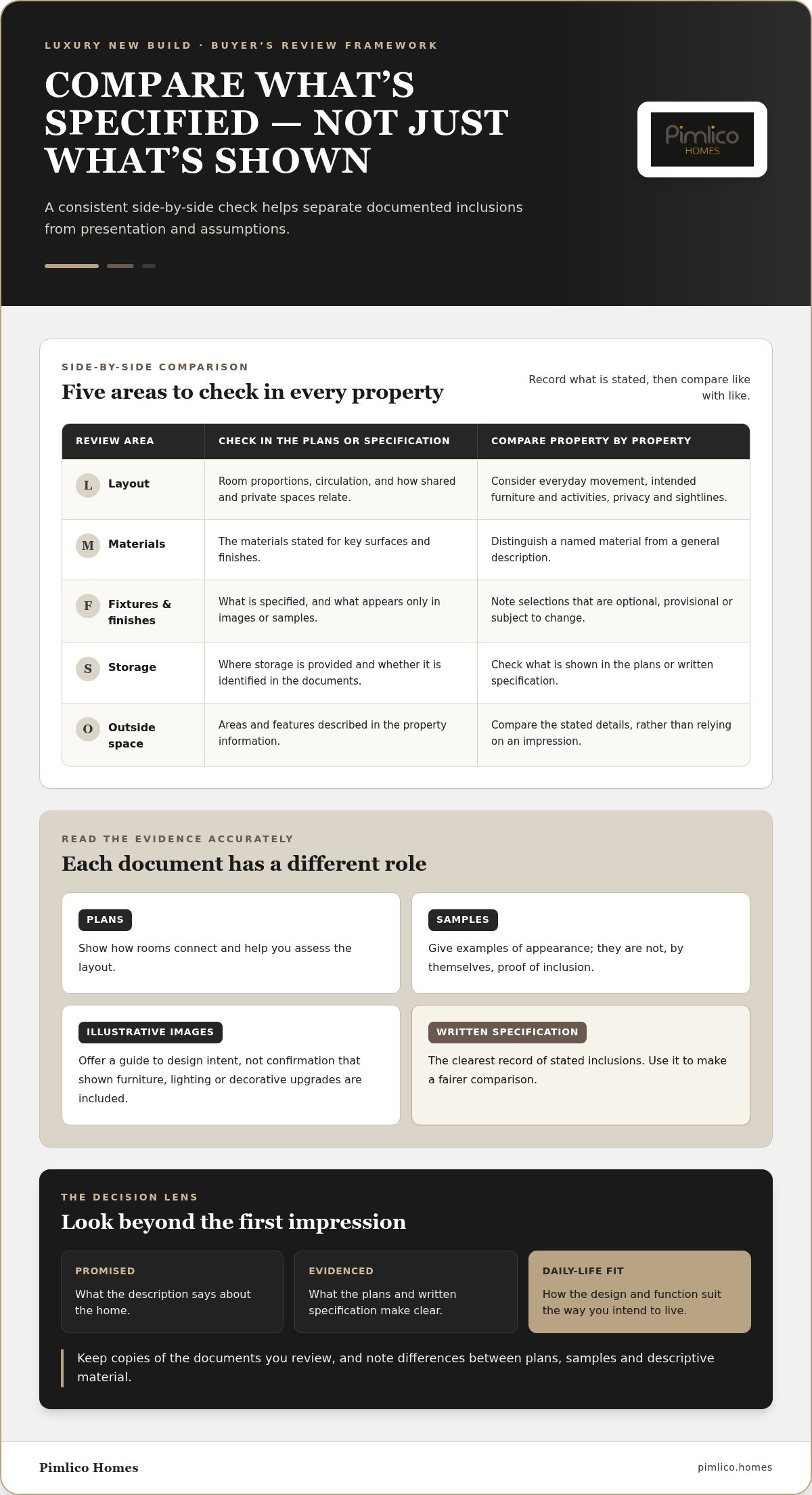
Staging can suggest possibilities, but it does not prove that furniture, lighting or decorative upgrades are included in the purchase. Treat illustrative images as a guide to design intent, samples as examples of appearance, and the written specification as the clearest record of stated inclusions. The RIBA Plan of Work provides context on how design and construction processes are organised; it does not replace reviewing the documents for the individual home.
How should buyers compare a new build specification?
Create a side-by-side record for each property. Compare like with like, distinguishing a named material or fixture from a general description. Note where a selection is optional, provisional or subject to change so that it is not mistaken for a fixed inclusion.
- Layout: room proportions, circulation and the relationship between shared and private spaces.
- Materials: stated materials for key surfaces and finishes.
- Fixtures and finishes: what is specified and what appears only in images or samples.
- Storage: where storage is provided and whether it is identified in the plans or specification.
- Outside space: the areas and features described in the property information.
A written specification makes comparison fairer because it lets you assess stated inclusions instead of relying on impressions or assumptions. Keep copies of the documents you review and note any differences between plans, samples and descriptive material. This gives you a clearer basis for understanding the home before moving towards a purchase.
For buyers considering a luxury new build, this method brings clarity to a decision shaped by both design and detail. To see how considered design and craftsmanship inform a range of residential homes, explore Pimlico Homes’ residential range.
Detached, courtyard, bespoke or converted: which home form fits?
Luxury is not defined by one architectural form. A detached home may offer a greater sense of separation, while a courtyard arrangement can create a more enclosed setting. Bespoke homes and barn conversions bring different kinds of character. The right choice depends on how you value privacy, space, design individuality and the responsibilities of ownership.
| Home form | Privacy | Architectural character | Layout | Upkeep |
|---|---|---|---|---|
| Detached | Can offer separation from neighbouring homes. | Varies with the individual design. | May provide scope for distinct living and private areas. | Consider the home and outside space as a whole. |
| Courtyard | Enclosure and outlook are shaped by the arrangement of homes. | Centred on a shared spatial concept. | May suit buyers who value a defined setting. | Depends on the property and any shared areas. |
| Bespoke new build | Shaped by the design and setting. | Reflects an individual design intent. | Can be tailored around particular priorities. | Depends on the specification and home design. |
| Barn conversion | Varies with the building and its arrangement. | Can unite retained character with contemporary living. | Influenced by the original building and its adaptation. | Consider the specific building and its ongoing needs. |
When might a detached or courtyard home suit your priorities?
A detached home may appeal if separation and a sense of private space are high priorities. It is not the default measure of luxury: a well-considered courtyard home may better suit someone who values an enclosed outlook or a defined relationship with neighbouring homes. The experience depends on the individual layout and setting, not the label alone.
Think through your household routines. Do you want outdoor space that feels private, or does a sheltered, contained setting appeal? How much separation matters during work, family time or entertaining? These questions help connect the home form to your daily preferences, rather than to status or appearance.
What distinguishes bespoke homes and barn conversions?
A bespoke home is shaped by individual design intent, with priority given to a particular vision and set of needs. A barn conversion starts with an existing building, bringing its architectural character into a home adapted for contemporary living. Character and layout vary from property to property, so assess the actual design rather than assuming particular materials or features.
Compare these forms by how they support the life you want to lead. No type is universally superior. The strongest fit is the one whose privacy, character, layout and upkeep align with your priorities.
What should you check before reserving a luxury new build?
Reservation is an important commitment, so review the property and paperwork methodically before signing. Read the documents together: a plan may show the layout, while the written specification and sale contract explain details that an illustration cannot. If information differs between documents, seek a clear written explanation before proceeding.
- Confirm the property details. Check that the plot or home you intend to reserve is identified consistently, and review the plans for its layout and relevant outside space. Make sure you understand which documents relate to your chosen property.
- Read the specification alongside the plans. Identify stated materials, fixtures, finishes and other inclusions. Note exclusions, buyer selections and details described as optional, provisional or subject to change. Treat images and samples as illustrative unless the purchase documents say otherwise.
- Understand the reservation terms. Read the reservation information carefully, including the period it covers, any conditions and what happens if either party does not proceed. Pay particular attention to the cancellation provisions and any consequences set out in the terms.
- Map the payment stages. Establish when payments are due, what each payment relates to and how the arrangements are recorded in the purchase documents. Keep a copy of the relevant terms and written communications.
- Review the sale contract and expected completion. Understand the contractual terms, the process for agreeing completion and how the documents describe the timing. Construction progress and completion expectations depend on the specific terms, so do not rely on informal estimates alone.
- Prepare for inspection and handover. Plan a systematic walk-through of finishes, fixtures and the operation of features in the home. Record defects or incomplete items clearly, including their location and a concise description. Keep the written record and related communications as a reference for following up outstanding points.
Which documents and details should buyers understand?
Plans, the written specification, reservation information and sale contract each serve a different purpose, but together they should give you a consistent picture of the purchase. Check them for inclusions, exclusions, selected finishes and any permitted changes to the specification. Understand completion dates and construction details in the context of the purchase documents, rather than assuming they are fixed by marketing material.
How can you prepare for inspection and handover?
Move through the home room by room. Look at visible finishes, check fixtures and operate features where appropriate. Record concerns precisely and keep copies of relevant correspondence, so there is a clear account of what was noted and when. For a fuller overview, read this guidance on the new-build snagging process.
Careful preparation brings clarity to a significant purchase. Explore Pimlico Homes’ luxury homes and consider how their design and craftsmanship align with your priorities.
Choosing a luxury new build with Pimlico Homes
A confident purchase brings together several considerations: whether the design suits your routines, whether the home form reflects your priorities, and whether the written specification and purchase information give you a clear understanding of what you are buying. These questions are connected. Together, they help you judge how a home may serve you beyond the initial impression.
How does Pimlico Homes approach luxury residential development?
Pimlico Homes is a specialist residential developer creating luxury homes for private buyers. Its range includes luxury detached homes, executive courtyard homes, bespoke new builds and luxury barn conversions. Each form answers different preferences, from the separation of detached living to the individual design intent of a bespoke home or the distinctive character of a conversion.
The company focuses on considered design and high-quality craftsmanship. Buyers can assess how those priorities are reflected in the home’s arrangement, the coherence of its design and the care given to its details. Their value lies in how they contribute to everyday living, not simply in the words used to describe them.
There is no single form that defines a luxury home. A courtyard setting may feel more fitting than a detached property for someone drawn to enclosure and a defined outlook. Another buyer may favour a bespoke design shaped around particular needs. The important question is how the individual home’s character, layout and specification align with the life you intend to lead.
What is a considered next step for a prospective buyer?
Start with the home form that most closely reflects your priorities, then assess each property on its own merits. Review its plans, written specification and purchase information together. Note the details that matter to you, such as how the layout supports daily routines, what is documented as included and how the purchase terms describe the steps ahead. This keeps your decision grounded in the specific home rather than assumptions about a category.
Buying a luxury new build is a personal decision. Confidence comes from a clear connection between design, documented details and your expectations as an owner. Explore Pimlico Homes’ residential range and consider which home form reflects your priorities and the way you want to live.
Choose a home with confidence
A considered purchase begins with a clear view of what matters to you. Look beyond presentation to assess how the design supports daily life, compare the home’s form with your priorities, and read the plans, written specification and purchase information as a connected whole. These steps help distinguish lasting suitability from a first impression.
Pimlico Homes is a specialist residential developer of luxury detached, courtyard, bespoke and converted homes, with a focus on considered design and high-quality craftsmanship. Each form offers a distinct approach to living, so the right choice is the one that aligns with your expectations and plans.
Careful assessment can bring greater assurance to an important decision. Explore Pimlico Homes’ homes and consider which design, character and setting feel right for you.
Explore Pimlico Homes and discover considered luxury living. A home chosen with care can become a lasting expression of how you want to live.
Frequently Asked Questions
Is a luxury new build worth the investment?
It can be a worthwhile purchase if the home suits your needs, budget and longer-term plans, but “luxury” alone does not guarantee financial returns or future value. Consider how the layout will serve your household, what the written specification states and what ongoing upkeep may involve. A sound decision weighs the home’s practical and design qualities alongside the purchase terms, rather than relying on presentation or price as proof of quality.
What should I look for when buying a luxury new build?
Look for a home where design, function and documented details align with your priorities. Review the plans for room proportions, circulation, privacy and storage, then read the written specification to understand stated materials, finishes and inclusions. Consider outside space and how the home supports everyday routines as well as entertaining. Before reserving, understand the reservation terms, payment stages, cancellation provisions and how completion expectations are described in the purchase documents.
Are luxury new builds better than older properties?
Neither is inherently better; each offers different qualities. A new build may appeal if you value a home designed as a whole around contemporary living, while an older property may offer established character and a distinct architectural history. Compare the actual home, its condition, layout, specification and likely upkeep with your preferences. The most suitable choice depends on what you want from ownership, not simply the age of the building.
What is usually included in a luxury new build?
There is no universal set of inclusions for every luxury new build. Fixtures, finishes, appliances, storage and outside-space features depend on the individual property and its written specification. Show-home furniture, decorative accessories and upgraded finishes shown in images may be illustrative rather than included. Read the specification alongside the plans and purchase information, noting exclusions, optional selections and details described as subject to change.
Can I change the specification of a new build home?
Changes may be possible in some purchases, depending on the property, construction stage, available selections and terms agreed for the sale. Do not assume a finish or layout can be altered simply because work is ongoing. Review the written specification and reservation or sale documents for information about selections and permitted changes. Record any agreed variation clearly in writing, including what it replaces or affects.
What happens if my new build is not ready on the expected date?
The next steps depend on the completion terms in your purchase contract and any related documents. Check how the date is described, what happens if it changes and whether the contract sets out notice or cancellation provisions. Keep written records of updates and request clear information about revised timing and outstanding work. Avoid relying on informal estimates; use the agreed terms and written communications about your purchase.
How do I compare a detached home with a courtyard home?
Compare how each setting supports your preferred level of privacy, outdoor use and daily routines. A detached home may offer greater separation from neighbouring homes, while a courtyard arrangement can create a more enclosed outlook and a defined shared setting. Neither is automatically more luxurious or suitable. Review the specific layout, outside space and relationship between homes, then consider which best fits your household and expectations of ownership.





