
When buying an executive home, the most impressive property at a viewing is not always the one that proves the best choice over time. A polished finish and generous proportions can catch the eye, but they do not tell you everything about build quality, specification or the realities of ownership.
The label itself can be hard to judge. Executive living may take the form of a luxury detached home, a courtyard design or a bespoke new build, and each needs to be assessed against the same practical questions. Look beyond first impressions and consider how the property will serve you in the years ahead with Pimlico Homes.
This guide offers a clear framework for comparing homes, checking details before making an offer and deciding whether the design, setting and likely upkeep suit your plans. From visible craftsmanship to purchase and ownership checks, it will help you weigh distinction against lasting fit, so a significant commitment feels considered as well as inspiring.
Key Takeaways
- “Executive” is a market description, not a quality grade. Look for evidence of craftsmanship, comfort and lasting quality.
- Compare homes consistently, from layout and natural light to storage, privacy and outdoor space.
- Before buying an executive home north east, check what is included, review ownership details and seek appropriate professional advice.
- Separate essential needs from preferences, then use your priorities to guide viewings and comparisons.
- Detached, courtyard, bespoke new-build and barn-conversion homes can each offer a different approach to executive living.
What makes an executive home worth considering?
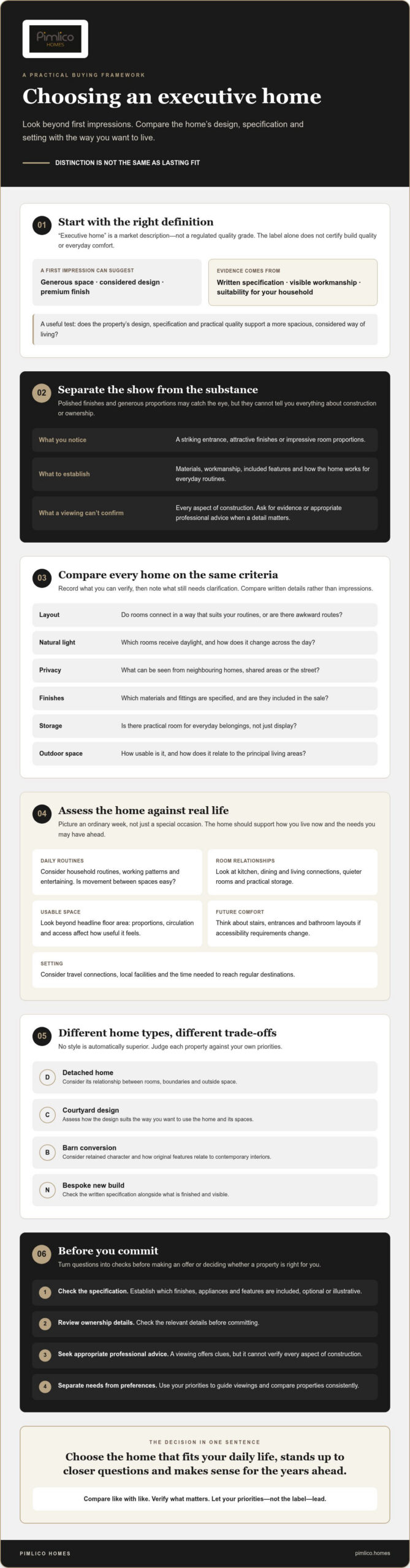
“Executive home” is a market description, not a regulated quality grade. The label may suggest generous space, considered design and a premium finish, but it does not certify how well a property is built or how comfortably it will support daily life. A useful definition is simple: an executive home is a property whose design, specification and practical qualities support a more spacious, considered way of living, whatever its marketing label.
For context, Wikipedia’s overview of what defines an executive home describes characteristics commonly associated with the term. Treat such descriptions as a starting point, not proof that a particular home meets a standard. Evidence comes from the property’s written specification, visible workmanship and suitability for the people who will live there.
Assess the whole experience. Architectural character and carefully chosen materials may create an immediate impression, but craftsmanship, usable space, privacy and practical comfort matter just as much. A striking entrance cannot compensate for awkward circulation, insufficient storage or rooms that do not work for your routines. Nor does a polished finish confirm the quality of what lies behind it.
Look beyond the executive label
Ask which specific design, material and service features justify the description. Compare the written specification with what you can see during a viewing. If a finish, appliance or feature appears in marketing material, establish whether it is included, optional or illustrative. Broad claims such as “high quality” should prompt questions about materials, workmanship and supporting documentation, rather than being taken as proof.
Look closely at details you can inspect, including how doors and windows operate, whether visible finishes appear consistent and how rooms connect. A viewing can reveal useful clues, but it cannot verify every aspect of construction. Where a detail matters to your decision, ask for evidence or appropriate professional advice.
Match the home to the life you want to lead
Picture an ordinary week, not just a special occasion. Consider household routines, working patterns and how you entertain. A home that feels impressive on arrival should also make everyday movement easy. Think about the relationship between kitchen, dining and living spaces, whether quieter rooms offer separation, and whether storage is practical for the things you own.
Look beyond headline floor area. Room proportions, circulation and access between spaces affect how much of that area feels genuinely useful. Consider future needs too, including whether stairs, entrances and bathroom layouts are likely to remain comfortable if accessibility requirements change.
Finally, assess the setting against your daily commitments. Travel connections, local facilities and the time needed to reach regular destinations can affect a home’s long-term fit. When buying an executive home north east, use consistent criteria to distinguish a genuinely suitable property from one that simply presents beautifully.
How to compare executive homes by design, specification and setting
A reliable comparison starts with the same questions for every property. Record what you can verify, then note what still needs clarification. As a guiding principle: compare like with like, using written details rather than impressions.
| What to compare | Questions to ask |
|---|---|
| Layout | Do the rooms connect in a way that suits your routines, or does the floor plan create awkward routes? |
| Natural light | Which rooms receive daylight, and how does it change across the day? |
| Privacy | What can be seen from neighbouring homes, shared areas or the street? |
| Finishes | Which materials and fittings are specified, and are they included in the sale? |
| Storage | Is there useful space for everyday belongings, not just display? |
| Outdoor space | How usable is it, and how does it relate to the principal living areas? |
Property type adds another dimension, but none is automatically superior. A detached home may offer a different relationship between rooms, boundaries and outside space than a courtyard home. A barn conversion may place more emphasis on retained character and the relationship between original features and contemporary interiors. Compare each against your priorities, rather than an assumed hierarchy.
Compare the written specification with the finished home
Request the current written specification and clarify which fixtures, finishes, appliances and other items are included. Separate these from optional upgrades, furnishings and features shown for illustration. If details change, ask how substitutions or amendments will be recorded and communicated. Check that photographs, plans and show-home details represent the home under consideration. Do not assume every displayed feature is part of the sale.
Assess architecture and setting as everyday experiences
At a viewing, look past the first impression. Consider sightlines through the home and garden, boundaries, overlooking and how easily indoor spaces connect with outdoor areas. In a barn conversion, ask whether the character you value works alongside practical needs such as comfortable circulation, useful storage and well-planned living spaces. For ideas on balancing heritage with contemporary design, explore this guide to modern barn conversion interiors.
Keep a separate record of confirmed details and unanswered questions for each property. This makes buying an executive home north east a more evidence-led decision, helping you distinguish lasting qualities from presentation. To see how different residential forms can express considered design, you can also explore Pimlico Homes.
What should you verify before committing to an executive home?
A considered purchase depends on more than the viewing and sales particulars. Organise your checks around five areas: property condition, title and ownership, written specification, purchase and ongoing costs, and aftercare. Keep a record of what has been confirmed, what remains unclear and who is best placed to answer each question.
Marketing material can introduce a property, but it cannot replace legal checks by a conveyancer, an appropriate survey or a careful review of the relevant warranty documents. Each serves a different purpose, so do not treat one as a substitute for another.
Review condition, title and ownership information
Instruct an appropriately qualified conveyancer to review the legal documents and explain the tenure, title information, recorded obligations and any restrictions that could affect how you use or access the property. Ask how boundaries, shared spaces, access routes and service arrangements are documented, rather than relying only on what appears obvious during a visit.
Discuss the right survey and inspection scope with a suitably qualified surveyor. The appropriate approach may depend on the property, its age and construction, and any concerns identified during your own inspection. For a conversion or a home with unusual features, explain those details when seeking advice. Keep a written list of unanswered questions and seek clarification before proceeding.
Clarify specification, protection and aftercare
Request written confirmation of what is included and excluded from the sale. Check that this covers fixtures, fittings, appliances, finishes and any items shown in photographs or during a viewing. Establish the proposed completion arrangements and whether any works remain outstanding, including how they will be recorded and addressed.
Review the purchase costs and likely ongoing commitments with the relevant professionals. Ask for clear information about any charges linked to shared areas or services, as well as responsibilities for maintenance and insurance. Do not assume these details are identical across properties. Establish which costs apply to the home you are considering and where they are set out in the documents.
For a new build, identify the warranty provider and check the current policy itself. Confirm its scope, duration, exclusions and any steps or deadlines relevant to making a claim. Ask how defects are reported and handled, and have the arrangements for that specific purchase confirmed in writing. Warranty terms and aftercare processes can vary, so a general description is not enough.
These checks create a sounder basis for a decision. If an answer is unclear, pause and ask your conveyancer, surveyor or the relevant provider to explain it before you commit.
How to move from a shortlist to a confident purchase
A shortlist is useful when it reflects your priorities, not simply the homes that made the strongest first impression. Follow a consistent process: define what matters, select properties to view, record what you learn, compare supporting evidence, seek professional advice and then decide. Each step should make the choice clearer.
Build a shortlist around priorities, not prestige alone
Separate essential needs from preferences before arranging viewings. Essentials might include a workable layout, a suitable level of privacy, accessibility features or manageable maintenance expectations. Preferences could include a particular architectural style or finish. This distinction helps prevent an impressive presentation from outweighing a genuine mismatch.
Use the same criteria for every home. After each viewing, record what you observed, what was confirmed in writing and what remains unanswered. Note how well the property meets each essential need, then score preferences separately. Revisit your notes once further information or professional advice is available. A home’s ranking may change when the evidence is complete.
Prepare for professional advice and an offer
Before making commitments, share the property details and open questions with your conveyancer. Ask them to explain the proposed transaction timetable, documents and any conditions that need attention. Offer, reservation and exchange arrangements depend on the specific transaction, so confirm the process and implications with your conveyancer rather than relying on a general assumption or verbal summary.
A practical sequence is:
- Define: write down essential needs and preferences.
- Shortlist: select homes that appear to meet the essentials.
- View: use the same questions and criteria each time.
- Compare: review your notes alongside written information and identify gaps.
- Seek advice: discuss outstanding points and transaction arrangements with the relevant professionals.
- Decide: proceed only when the home and available evidence align with your priorities.
This method keeps the decision measured without removing the pleasure of finding a home that feels right. For further context on the steps involved in a new-build purchase, read the luxury new-build purchasing guide.
If you are beginning your search, explore Pimlico Homes’ residential homes as one possible source of detached, courtyard, bespoke new-build and barn-conversion properties.
Finding an executive home that reflects your standards
A confident decision rests on three things: lasting quality supported by evidence, a practical fit for the way you live, and clear documentation of what you are buying. The executive label may help describe a property, but your own priorities should determine whether it merits a place on your shortlist.
There is no single architectural form that defines executive living. A detached home, courtyard home, bespoke new build or barn conversion can each offer a distinct experience of space and design. Consider how each option aligns with your preferences for privacy, layout and ongoing maintenance, then judge the individual property against the evidence available. Do not assume a particular type will automatically suit you better.
Consider which residential form suits your priorities
For one buyer, separation between living spaces may be essential; another may value an arrangement that brings rooms together. A barn conversion may appeal for its character, whilst a courtyard home may offer a different way to organise indoor and outdoor areas. Focus on the qualities that matter to your household, and confirm property-specific details through current written information rather than relying on general descriptions.
Pimlico Homes is a specialist residential developer offering luxury detached homes, executive courtyard homes, bespoke new builds and luxury barn conversions. These different forms illustrate the breadth of executive-style living, but the right choice depends on how a specific home meets your requirements.
Take the next step with informed questions
Before progressing, ask whether a suitable property is currently available and request its current specification. Clarify what is included, which purchase stages apply, what documents you will receive and how aftercare arrangements work for that particular home. Treat each answer as a point to verify, not as a substitute for independent advice.
Share the information with your conveyancer and discuss an appropriate survey with a suitably qualified professional. Their advice can help you understand the legal documents and condition of the property before you commit. The decision should feel assured because your questions have been answered and the evidence reviewed, not simply because a home made a strong first impression.
Once you have established your criteria, you can Explore Pimlico Homes and review its residential offering with those priorities in mind.
Buying an executive home north east: what to check first
The executive label is only a starting point. A considered choice rests on evidence of lasting quality, a clear written specification and a practical fit with the way you live. Compare properties against consistent criteria, and let legal and survey advice inform your decision before you commit.
The most compelling option may not be the one with the grandest first impression. It is the home whose design, setting and ownership details stand up to careful scrutiny and continue to suit your needs over time.
Pimlico Homes is a specialist developer of luxury detached and executive courtyard homes, with a residential portfolio that also includes bespoke new builds and high-end barn conversions. Each form offers a different architectural experience; the right fit depends on your priorities and the verified details of the property.
Once you know what matters to you, explore Pimlico Homes’ residential homes, review the available information and ask clear questions. Check the documentation and seek independent advice before deciding.
Frequently Asked Questions
What qualifies as an executive home?
An executive home is a market description, not a regulated quality grade or formal guarantee of construction standards. It commonly suggests considered design, generous or well-planned space, quality finishes and practical features, but the exact meaning varies. Assess the property itself: ask for its written specification, check what is included and look for evidence behind claims about materials and workmanship. The label alone cannot establish quality or suitability.
What should I look for when buying an executive home?
Look for a home that combines documented quality with a practical fit for your life. Consider room layout, natural light, privacy, storage, outdoor space and how easily you can move between rooms. Check the written specification against what you see, and establish which displayed items are included. Ask about tenure, boundaries, access, ongoing costs and aftercare, then discuss legal and condition checks with the relevant professionals.
Is a new-build executive home a better choice than an older property?
Neither is automatically better; the right choice depends on your priorities and the evidence available for each property. A new build may offer a recently completed specification, whilst an older home may have established character or features that appeal to you. Compare condition, layout, maintenance expectations, documentation and any warranty or relevant protection. Arrange appropriate professional advice before deciding, and weigh the specific home rather than relying on broad assumptions about its age.
What documents should I check before buying a new executive home?
Ask your conveyancer to review the title and tenure documents, plans, recorded obligations or restrictions, and information about boundaries, access and shared areas. Request the current written specification, confirming inclusions, exclusions and any agreed changes. Also review completion arrangements, relevant warranty documents and information about service or maintenance responsibilities. The documents required can vary by transaction, so ask your conveyancer which records apply and what remains outstanding before proceeding.
Do executive new-build homes come with a warranty?
Most new homes come with a warranty, commonly covering a period of 10 years, but the provider, terms and cover can vary. Do not assume every defect or issue is included. Check the policy for its scope, exclusions, claims process and which responsibilities apply during each part of the cover period. Ask for the documents relating to the specific property and have any unclear wording explained before you rely on it.
How can I compare the specification of two executive homes?
Request the current written specification for each home and compare equivalent items side by side. Check finishes, fixtures, appliances, storage and outdoor features, noting what is included, excluded or offered as an optional upgrade. Treat furnishings and show-home details as separate unless confirmed in writing. Record any substitutions or unanswered questions, then ask for clarification. This makes differences easier to judge than relying on photographs or the impression of a viewing.
Should I arrange a survey on a new-build executive home?
Discuss an appropriate survey or inspection with a suitably qualified surveyor, even if the property is newly built. The right scope depends on the home and your concerns. You may also wish to ask about a snagging inspection, which can identify visible defects or incomplete items, but it does not replace reviewing the warranty or legal documents. Ask your conveyancer and surveyor what checks are relevant before you commit.





