
Two properties aren’t automatically a safer investment than one. Buying multiple properties from a single developer can broaden a portfolio, but the right mix depends on how each home supports your goals and how much exposure you’re willing to the same market.
It’s natural to weigh spreading capital across more than one property against the simplicity of owning a single home. The difference lies not only in the number of properties, but also in their type, location and intended role. Several homes in one area may still be exposed to the same local market conditions.
This guide compares property types for a multi-property portfolio and explains how a considered mix may help manage risk. You’ll also find a practical way to decide whether one property or several better suit your priorities, including the trade-offs of buying homes from one developer.
Key Takeaways
- Compare detached homes, courtyard homes and other property types by the role each could play in your portfolio, rather than focusing on property count alone.
- Consider how location and shared market exposure could affect several properties at once when weighing the potential benefits of spreading investment.
- Assess any developer incentive against the full purchase terms and your financing needs before treating it as a portfolio advantage.
- Explore whether Pimlico Homes’ luxury homes or barn conversions align with the type of property investment you are planning.
Property types for a multi-property portfolio
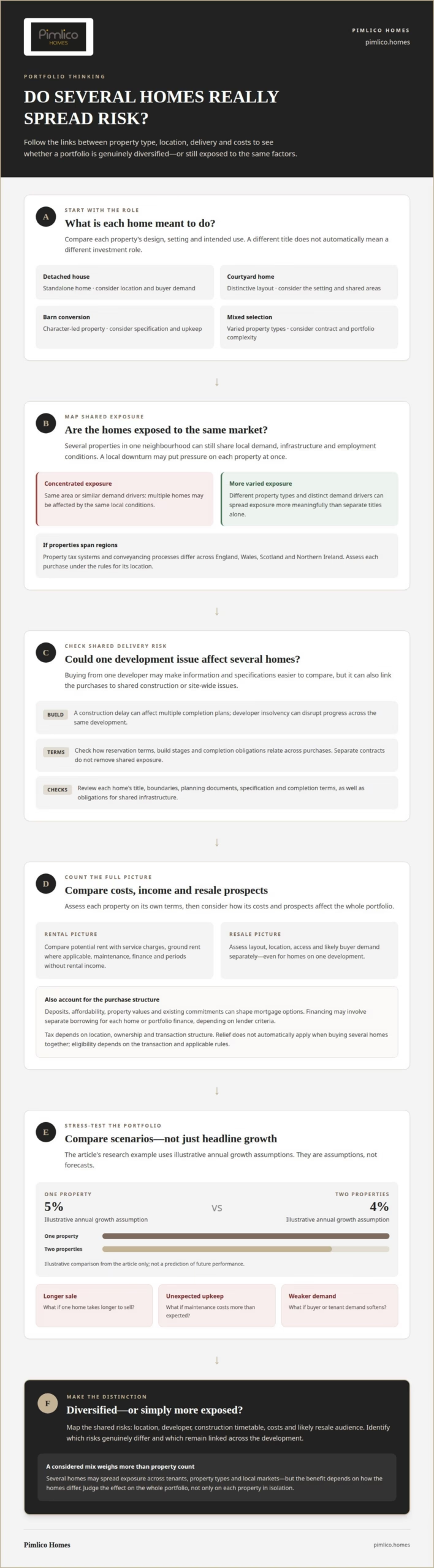
Start by considering each home’s role. A detached house may suit one buyer profile, while a courtyard home offers a different layout. A barn conversion brings its own architectural character. Investors buying multiple properties from a single developer should compare each home’s setting, design and intended use, rather than treating them as interchangeable.
Mortgage options may include separate borrowing for each home or portfolio finance, depending on lender criteria. Affordability, deposits, property values and existing commitments can all shape the available structure.
Tax depends on location, ownership and transaction structure. In England, stamp duty land tax (SDLT) may apply to direct purchases. A forum contributor stated that a purchaser of a property-owning company would pay 0.5% stamp duty on the company sale, rather than SDLT on a direct property purchase, according to HM Revenue & Customs.
Multiple Dwellings Relief or another SDLT relief does not automatically apply when buying several homes together. Eligibility depends on the transaction and applicable rules, so ownership and contract arrangements matter.
Legal checks include the title, boundaries, planning documents, specification and completion terms for each home. Review obligations for shared infrastructure too. Contracts should identify each property and set out the relevant works and deadlines.
Consumer protections and warranty cover depend on the contract and warranty documents for each new build. Review the coverage, defect-reporting process and applicable cover period for every home.
Reservation fees, deposits, exchange deadlines and completion dates are set out in the relevant documents. Before buying multiple properties from a single developer, establish whether payments and dates apply separately or link the transactions.
| Property option | Portfolio role | Key consideration |
|---|---|---|
| Detached house | Standalone home | Location and buyer demand |
| Courtyard home | Distinctive layout | Setting and shared areas |
| Barn conversion | Character-led property | Specification and upkeep |
| Mixed selection | Varied property types | Contract and portfolio complexity |
Choose by matching each home’s design, location and contractual terms to its intended role in your portfolio.
One investor reported an 85% loan-to-value limit across remaining portfolio properties after remortgaging one elsewhere. Another contributor had mortgages with 8 lenders. Concentrating in one area risks multiple properties facing a local downturn.
Spreading investment risk across properties
Several homes can spread exposure across tenants, property types and local markets, but the benefit depends on how they differ. Three properties in one neighbourhood still share local demand, infrastructure and employment conditions. A downturn affecting the area can put pressure on each asset at once. Diversification works best when properties have distinct demand drivers, not simply separate titles.
Rules and transaction costs differ across England, Wales, Scotland and Northern Ireland. The applicable property tax system and conveyancing process depend on where each home is located, while the purchase structure and property circumstances influence the overall cost. For a portfolio spanning regions, assess each transaction under its own jurisdiction instead of applying one set of assumptions to every purchase.
Buying several homes from one developer also concentrates delivery risk. A construction delay can affect multiple completion plans, while developer insolvency can disrupt progress across the same development. Separate contracts do not remove shared exposure to construction or site-wide issues. Before committing to several homes, review how reservation terms, build stages and completion obligations relate across the purchases.
Investors can compare potential rent with each property’s full costs. Include service charges and ground rent where applicable, as well as maintenance, finance and periods without rental income. Then assess resale prospects separately: layout, location, access and likely buyer demand can differ even between homes on one development. A strong headline yield alone does not capture the whole investment.
Use scenarios to test how a portfolio performs under different conditions. An illustrative comparison could assume 5% annual growth for one property and 4% for two, as the research example does. These are assumptions, not forecasts. Consider what happens if one home takes longer to sell, incurs unexpected upkeep or experiences weaker demand. Compare the effect on the whole portfolio, not just the affected property.
Before purchase, map the shared risks: location, developer, construction timetable, costs and likely resale audience. Then identify which risks are genuinely diversified and which remain linked across the development. This distinction helps investors judge whether several properties create a more balanced portfolio or simply increase exposure to the same underlying factors.
What are the benefits and drawbacks of buying multiple properties from one developer in the UK?
Buying from one developer can provide a coherent purchase process. Property information, specifications and development details may be presented consistently across homes, making layouts easier to compare and their fit with your investment strategy easier to assess. If you buy several properties together, aligned construction and completion arrangements may also simplify planning, provided the terms of each contract are clear.
There may be a substantial upfront commitment. A landlord buying both at the same time needs enough deposit funds and must meet lending criteria for each mortgage. Let the total acquisition cost, not just the advertised value, guide your decision.
Financing can become more complex if several properties are held within one company. Lenders may restrict mortgage access or charge higher interest rates because the security is less clear. This can affect borrowing costs and structure, so consider how ownership and finance arrangements work across all the purchases before agreeing to a package.
Buying from one developer also concentrates exposure. A shared development, construction programme or buyer market can link the performance of otherwise separate properties. A consistent specification may help with comparison, but it does not remove differences in position, outlook, layout or demand. Assess each home on its own merits rather than assuming a group purchase makes every property equally suitable.
For a disciplined decision, compare the offer property by property:
- Purchase: Set out each home’s price, associated costs and deposit requirement.
- Finance: Confirm how lenders assess each mortgage and any company-held security.
- Terms: Compare specifications, completion arrangements and contractual obligations.
- Portfolio fit: Consider whether each property serves a distinct purpose or adds similar exposure.
A multi-property purchase is most compelling when every home supports your portfolio’s aims and the combined funding remains manageable. If one property weakens that balance, buying fewer may be the more considered choice.
Do UK developers offer discounts or incentives for buying multiple properties?
Some developers may structure an incentive around a multi-property purchase, but no standard discount applies across UK developments. Terms depend on the homes, the transaction and the developer’s approach. One possible arrangement is a lower purchase price; another might be an agreed specification change or a contribution towards a purchase-related cost.
Assess the whole offer, not just its headline. Compare the written price and specification for each home, then set out any incentive alongside them. A change to fixtures or finishes may suit one property but add little value to another. A price reduction may better support your plans, but consider its effect across the complete purchase.
Ask for the offer and any conditions to be recorded clearly in the relevant reservation or sale documents. Check which properties it covers, when it applies and whether it depends on buying all the homes together. If one purchase falls through or completion dates change, the written terms should explain what happens to the remaining transactions.
Keep financing and tax considerations in view. A lender assesses the borrowing and security for the proposed purchases, while tax depends on the transaction and ownership structure. An incentive is no substitute for checking how the full arrangement affects your funding and costs. In England, SDLT may apply to direct purchases, as discussed earlier.
Use this comparison before deciding:
- Price: Record each property’s agreed purchase price and any reduction.
- Specification: List included finishes or changes for every home.
- Conditions: Note deadlines, linked purchases and consequences if one sale does not proceed.
- Overall value: Compare the complete terms with the portfolio role of each property.
A clear, property-by-property comparison helps distinguish a useful incentive from one that simply makes a larger commitment appear more attractive. Explore new-build property choices as you shape a considered purchase.
Pimlico Homes
Pimlico Homes can help you consider how its homes may fit the property mix you are planning. When comparing several purchases, each home’s design, setting and character can inform its role within your wider portfolio.
Pimlico Homes offers luxury detached homes, executive courtyard homes, bespoke luxury homes and luxury barn conversions. These distinct property types give you options to consider when weighing layout and character across a selection of homes. The right choice depends on how each property aligns with your intended portfolio, not simply on how many homes you acquire.
Consider Pimlico Homes when exploring new-build homes or barn conversions and discussing how different property types relate to your plans. A considered conversation can help you focus on the homes that best reflect your priorities.
Contact Pimlico Homes to discuss the properties you are considering.
Define the portfolio you want to build
Your next step is to define what a well-balanced portfolio means for you. Consider the homes you want to own, the role each should play and how closely their locations and audiences align. A strategy for buying multiple properties from a single developer should reflect those priorities, rather than treating a larger number of purchases as an end in itself.
Pimlico Homes offers luxury detached homes, executive courtyard homes and bespoke luxury homes. These options provide distinct starting points for considering the character and design that may suit your plans. The right choice is the one that fits the portfolio you intend to create.
Bring your priorities into the next conversation, whether you are exploring one property or considering several. Contact Pimlico Homes to discuss your options and take a considered step towards your next property decision.
Frequently Asked Questions
Should I Buy Two Properties or One?
Buy two only if you can manage both purchases and their ongoing ownership at the same time. If this is your first multi-property investment, starting with one can help you establish how you’ll handle administration, maintenance decisions and property oversight before expanding. Choose the route that fits your capacity and long-term plan, rather than assuming a larger portfolio is automatically stronger.
What UK consumer protections and warranty cover apply to multiple new-build property purchases?
Consumer protections and warranty cover depend on the contract and warranty documents for each new build. Review the coverage, defect-reporting process and applicable cover period for every home.





