
What if a quieter route to a new-build home offers discretion, but not less risk? Buying off-market new build homes can mean hearing about a property before it appears in public listings. Yet “off-market” describes how a home is marketed, not how complete its plans are or how certain its delivery will be.
It’s understandable to want an experienced professional to make introductions and negotiate on your behalf, particularly when details are still taking shape. A buying agent may help source opportunities and represent your interests, but they don’t build the home, control the developer’s decisions or remove the need for careful checks.
This guide explains what a buying agent can and cannot do, and how their role differs from buying directly from a developer. You’ll learn how to compare both routes, assess the value of an agent’s involvement and review plans, specifications, build progress and key purchase documents before committing. The aim is to help you weigh discretion against due diligence and make a clear-eyed decision.
Key Takeaways
- Understand what “off-market” means in practice, and why discreet marketing alone says nothing about a home’s quality or value.
- See how a buying agent may clarify your brief, identify opportunities and coordinate information, without guaranteeing access to a property.
- Compare buying off-market new build homes through an agent with approaching a developer directly, based on the representation and coordination you need.
- Use a structured review of the property, seller and development information, including plans, specifications, included items and completion expectations.
- Decide whether an agent-led search, direct developer information or a combination best suits your priorities before you commit.
Buying off-market new build homes: what the term really means
Discreet marketing can sound exclusive, suggesting a home is being shown only to a select group of buyers. But privacy in the sales process does not establish quality, value or suitability. The same careful judgement is needed whether a property is widely advertised or introduced privately.
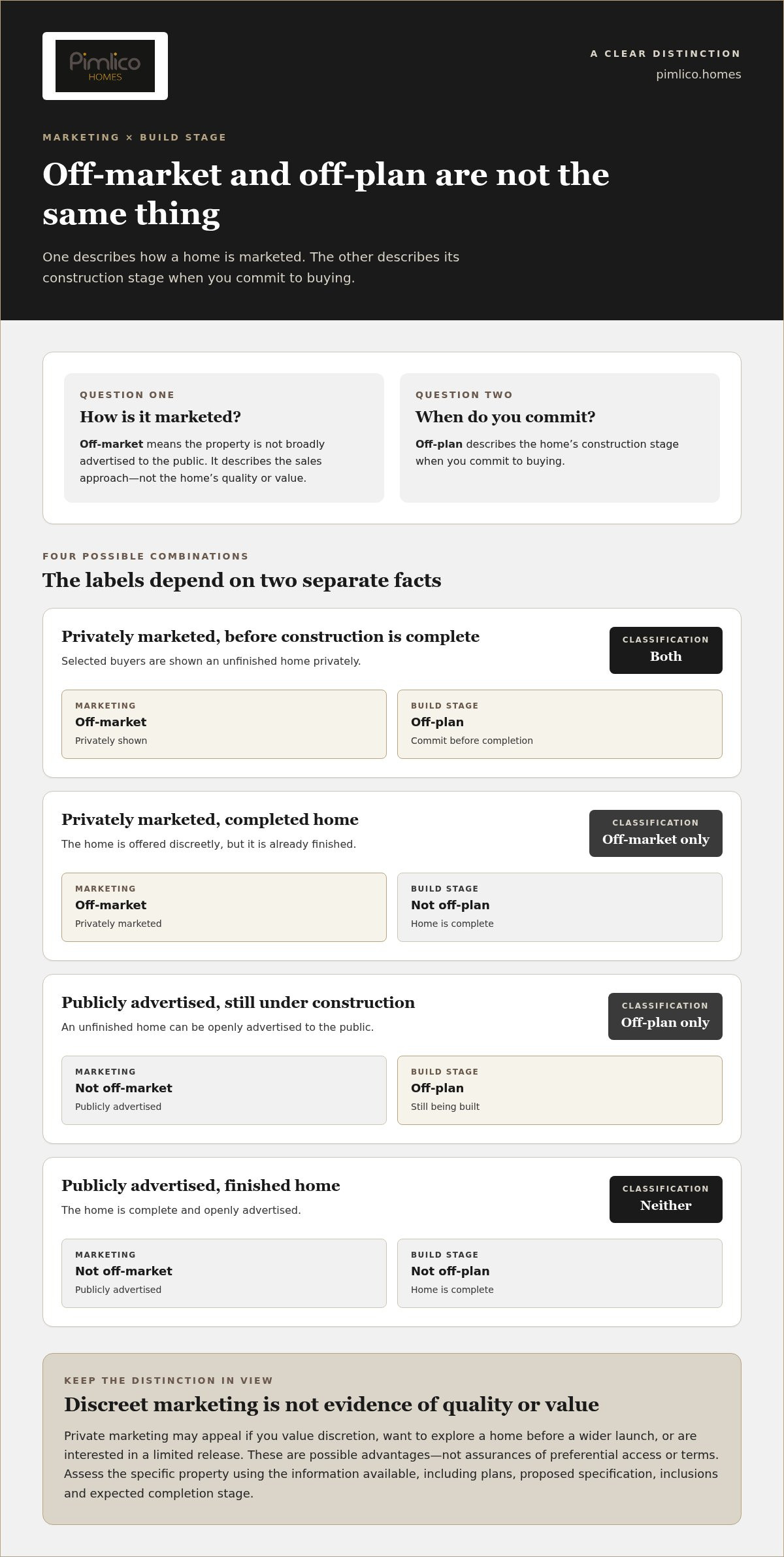
Off-market describes how a property is marketed; off-plan describes its stage of construction when you commit to buying. An off-market home is not broadly advertised to the public, although sellers and agents may use the term differently. It can include a pocket listing, where a property is marketed privately rather than through public listings.
New builds can be presented at different stages. You might assess a proposed home through plans and specifications, view a show home that illustrates the intended finish, or visit the completed property. These stages affect what you can see and assess, but do not determine whether the home is being marketed publicly.
That distinction matters. A completed home could be offered discreetly, making it off-market but not off-plan. A home still under construction could be widely advertised, making it off-plan but not off-market. A privately marketed home shown before construction is complete fits both descriptions. A finished, publicly advertised home may fit neither.
Off-market versus off-plan: two different questions
Ask two separate questions: who is being shown the property, and when would you commit in relation to completion? The first concerns marketing; the second concerns build stage. For example, a developer might share plans for an unfinished home with selected buyers, while another unfinished property is openly advertised. The labels overlap only when both conditions apply.
Why buyers consider discreet new-build opportunities
Private marketing may appeal if you value discretion, want to explore a purchase before a wider launch or are interested in a limited release. Timing can also matter if your plans align with when a home is introduced. These are possible advantages, not assurances of preferential access or terms.
Discretion can also mean fewer public details to consult. Before forming a view, establish what information is available about the specific property and its purchase process. Plans, the proposed specification, inclusions and expected completion stage help turn an intriguing introduction into something you can assess. A quiet launch may create a sense of rarity, but the evidence still needs to support your decision.
What a buying agent can do when searching for off-market new builds
A buying agent represents you, the buyer, under an agreed brief. When searching for a privately marketed new build, they may help define what you want, identify potential opportunities and coordinate information so you can assess each property. Their role is to facilitate the search, not promise access. An introduction depends on what is available and whether a seller is willing to engage.
A buying agent can facilitate the search, but cannot replace your due diligence. Sourcing and negotiation support are distinct from legal advice, mortgage advice, surveying and construction assessment. An agent may help organise questions or information, but that does not make them responsible for checking title, confirming lending suitability or assessing a build’s quality and progress.
What to establish before appointing a buying agent
Begin with a precise brief. Set out your budget parameters, preferred property type, essential features and flexibility on location or timing. Distinguish between a must-have, such as a detached home, and a preference, such as a particular layout. A clear brief helps both parties judge whether an opportunity merits further consideration.
Before signing, read the engagement terms closely. The written agreement should explain the services included, how the fee is calculated, when it becomes payable, whether the arrangement is exclusive and how either party can end it. Fee structures and payment triggers vary, so clarity matters. If the agent’s role is limited to introductions, establish what support is included once a property is identified and what falls outside the agreement.
Where an agent’s role ends
Professional boundaries are essential. Your conveyancer reviews the contract and title documents; your mortgage adviser and lender assess borrowing and lending terms; and appropriate independent professionals can assess condition, specifications or build progress. An agent can help coordinate information, but the relevant specialists provide advice and assessments within their areas.
For a wider overview of the UK purchase journey, this luxury new-build purchasing guide offers further context on the stages involved.
Buying off-market new build homes through an agent may suit buyers who want a representative to shape and manage a wider search. If you already have a particular development in mind, speaking directly with its developer may be a practical alternative. Pimlico Homes develops luxury new-build homes, with a focus on craftsmanship. Exploring Pimlico Homes’ luxury homes offers a developer-direct perspective alongside an agent-led search.
Buying off-market through an agent or directly from a developer?
There is no universally better route. An agent-led search may help if you want someone to represent your interests across a broader brief; approaching a developer directly can be more straightforward when you have a particular development in mind. Neither route guarantees access, a lower price or a specific outcome. Compare them by how well they fit your priorities and how much of the work you want to manage yourself.
| Consideration | Buying through an agent | Buying directly from a developer |
|---|---|---|
| Representation | The agent acts for you within the agreed engagement. | You communicate with the developer’s sales team; they represent the development. |
| Search scope | May cover opportunities across a brief, depending on the agent’s mandate and reach. | Centres on the developer or development you approach. |
| Communication | The agent may coordinate discussions and information across potential homes. | You can discuss the property and purchase process with the developer directly. |
| Coordination | You’ll need to understand which checks the agent handles and which remain yours. | You’ll generally organise your own comparisons and independent advice. |
When an agent-led search may suit your brief
If you have limited time or requirements across several criteria, an agent may help organise a search and keep information about different opportunities together. This can be useful when comparing layout, completion stage and fit with your priorities. The practical value depends on the engagement: establish what the agent will search for, what support they will provide and where their responsibility ends.
When a direct developer conversation may be more straightforward
If you already know which development interests you, speaking with its developer gives you a direct route to property-specific sales information. You can discuss the relevant plans, specification and purchase process with the party responsible for the development, then make your own comparisons and arrange independent checks. Pimlico Homes develops luxury new-build homes, with a focus on craftsmanship, offering buyers a developer perspective on this route.
Whichever path you choose, look beyond the initial introduction. Review the details that matter to your intended use, and assess longer-term value on its own merits rather than assuming discreet marketing makes a property more valuable. The resale value of new-build homes is one useful consideration in that wider assessment.
Buying off-market new build homes may involve an agent, a direct developer conversation or both at different points. Start with your brief, decide how much search coordination you need, then choose the route that gives you clear information and room to complete due diligence. Exploring Pimlico Homes’ luxury new-build homes offers a developer-direct perspective.
Due diligence for an off-market new-build purchase
A discreet introduction may mean fewer public details are available, so build a clear record before making a commitment. Review the information in sequence, note what remains unanswered and have the relevant points considered by your professional advisers. When buying off-market new build homes, privacy should never mean proceeding on assumptions.
- Identify the property, seller and development. Record the exact home or plot being discussed, who is selling it and what information is available about the wider development. Keep document versions together so you can track any changes.
- Match the plans to the home. Review the plans for the specific property, including its layout and position within the development. If you have seen a show home, establish which features demonstrate the intended finish and which are specific to that display property.
- Read the specification and inclusions. Look for written details of materials, fixtures, finishes and items included in the purchase. Distinguish stated inclusions from illustrative presentation, and understand how agreed variations or later changes will be recorded.
- Review reservation terms and the draft contract. Before signing or paying a reservation amount, understand what the terms require and what happens next. Ask your conveyancer to explain the contract, title, deposit arrangements, planning matters and any obligations that affect your purchase.
- Clarify timing and outstanding checks. Understand the stated completion expectations and, if building is under way, how progress updates are provided. Have your conveyancer explain any contractual provisions relating to timing or delay. Ask your mortgage adviser or lender about lending suitability, and ask qualified professional advisers to verify current legal and tax implications for your circumstances.
Documents and details to understand before committing
Read the plans, written specification, reservation terms and draft contract as a connected set. Do not assume a finish shown in a presentation forms part of the purchase unless the relevant documents say so. If a change is agreed, establish how it will be documented and reflected in the final paperwork. Your conveyancer can explain the legal effect of the documents, including title, contractual obligations, deposit arrangements and applicable tax treatment. Tax and lending rules can change, so seek current advice rather than relying on general guidance.
Assessing a home that is not yet complete
For a home under construction, compare the agreed specification with what you have seen in any show-home presentation, and identify what is illustrative. Understand what the contract says about build timing, changes to the proposed home and how progress updates will be communicated. These details help distinguish a visual impression from the documented agreement.
Snagging is a separate practical stage. It concerns checking the home for issues as completion approaches or after handover, rather than replacing earlier contract and specification checks. For a wider view of the purchase journey, consult this luxury new-build purchasing guide.
For a considered starting point in your search, explore Pimlico Homes’ luxury new-build homes.
Making the right next move on a luxury new-build search
A confident purchase begins with clarity, not speed. Define the home you want, decide how you wish to search and make sure the information behind an opportunity is strong enough to support your decision. Buying off-market new build homes does not require one fixed route: an agent-led search, direct contact with a developer or a combination may suit different briefs.
If you want to explore several possibilities and value help coordinating conversations, an agent may be useful within a clearly agreed mandate. If a particular development already interests you, a direct conversation with its developer may be the simpler starting point. Some buyers use both, provided everyone understands who represents them and how information and responsibilities are being managed.
A concise decision checklist before proceeding
Before taking the next step, pause to make sure the essential parts of the decision are clear:
- Define your brief. Record your priorities, budget parameters, preferred home type and timing, distinguishing essentials from preferences.
- Separate the facts. Confirm whether the home is being marketed privately or publicly, and establish its construction stage. These are different matters.
- Choose your route. Consider whether you need a broader search, direct information about one developer’s homes, or both. Do not assume either route means preferential access or a particular outcome.
- Understand the engagement. If using an agent, make sure their responsibilities, fee basis, payment triggers, exclusivity and termination terms are set out in writing.
- Keep the right professionals involved. Progress finance discussions with your lender or adviser, legal review with your conveyancer, and appropriate independent assessment of the property and build information.
Explore a considered luxury new-build purchase
A considered purchase starts with the right questions: what is being offered, what is documented and what further advice do you need before committing? Taking time to understand those points can help you assess a home on its merits, rather than allowing discreet marketing or a sense of urgency to shape the decision.
Pimlico Homes develops luxury new-build homes, with a focus on craftsmanship. If you are exploring the developer-direct route as part of your search, you can explore luxury new-build homes and consider whether this style of home aligns with your priorities.
Take the next step with confidence
The right property search should reflect the life you want to build, not the pressure of a discreet introduction. Treat exclusivity as a reason to look closely, not to hurry. When buying off-market new build homes, a thoughtful next step is to decide what matters most in your future home and pursue the route that lets you assess it with care.
Pimlico Homes develops luxury detached homes and executive courtyard homes, alongside bespoke luxury homes and luxury barn conversions. Craftsmanship is central to its high-end residential projects, where considered design and the experience of living in the finished home both matter.
Explore the possibilities at your own pace. Explore Pimlico Homes’ luxury new-build homes and take a confident step towards finding a home that feels right for you.
Frequently Asked Questions
Is buying off-market the same as buying off-plan?
No. “Off-market” describes how a home is offered to buyers; “off-plan” describes buying before that home is complete. A completed property might be marketed privately, while an unfinished home could be advertised publicly. For example, a buyer could reserve a home shown on plans through an open sales campaign. Keep the descriptions separate when comparing opportunities, as each tells you something different about the purchase.
Can a buying agent find off-market new-build homes?
Yes, a buying agent may search for privately marketed new builds as part of the agreed brief, but cannot guarantee that a suitable property will be available or offered to you. Their ability to source opportunities depends on the scope of the search and their relationships with sellers and developers. Ask how they will report relevant opportunities, including those that do not meet every preference in your brief.
What does a buying agent do when purchasing a new build?
A buying agent can act on the buyer’s behalf during the search, help compare options against the agreed brief and support purchase discussions. For instance, they might help organise information about two homes with different layouts or completion stages. Their work does not replace your conveyancer, mortgage adviser or independent property assessment. Be clear about what the agent will handle after identifying a home.
Is it better to use a buying agent or approach a developer directly?
Neither route is automatically better; it depends on where you are starting. If you have identified a development, a direct enquiry may give you a clear channel for property-specific information. If your search spans several possibilities, an agent may help manage the wider brief. Some buyers combine both routes, but should make sure the agent’s agreement explains how direct approaches and introductions are treated.
How much does a buying agent charge?
There is no single fee structure. An agent may charge a retainer, a fixed fee or a percentage-based fee, depending on the service agreed. Before appointing one, ask for the complete fee basis in writing, including when payments fall due, whether VAT or other expenses are additional, and what happens if you buy a property introduced during the engagement after it ends.
What should I check before reserving an off-market new build?
Before reserving, read the reservation terms carefully. Check which property or plot they relate to, how long the reservation lasts, what steps or payments follow, and the circumstances in which any reservation payment might be returned. Compare the stated home with its plans and specification, and note any unresolved points. Have your conveyancer review the legal documents and explain the effect of the terms before you commit.
Can I view an off-plan new build before it is finished?
You may be able to view a show home or another completed home that illustrates the proposed design, though it may not be identical to the one you are considering. Plans, specifications and visualisations can also help you understand a home that is not yet built. Access to a particular plot or construction site depends on the circumstances, so do not assume you can inspect unfinished areas in person.
Does buying a new build off-market mean I will pay less?
No. Private marketing does not, by itself, mean a lower price or a better deal. Assess the asking price against relevant comparable homes and the specific plot, specification and purchase terms. A headline figure may not tell the whole story if included items or agreed changes differ. Consider an independent valuation where appropriate, and discuss mortgage valuation and lending implications with your adviser and lender.





