
What if the biggest challenge in buying a UK home from overseas isn’t permission, but preparation? If you’re researching “buying a UK property as a non-resident 2026”, the reassuring starting point is that foreign nationals can own property in the UK. Ownership alone, however, does not grant a visa or residency. The practical steps depend on where the home is located and your personal circumstances.
It’s understandable to feel uncertain about tax, legal formalities and arranging a purchase across time zones. The details matter: England and Northern Ireland use Stamp Duty Land Tax, while Scotland and Wales have different property tax systems. Your residence status can also affect tax liabilities, lender requirements and the identity and source-of-funds checks you need to complete.
This guide explains what to resolve before committing, from funding and tax advice to conveyancing. It also sets out the purchase sequence, so you can prepare documents, assess suitable homes and make considered decisions from abroad. With the practical foundations in place, you can weigh each property on its merits, including whether a carefully designed new build aligns with your plans.
Key Takeaways
- Separate your place of residence, nationality and immigration position before assessing the practical requirements of a purchase.
- Identify the UK jurisdiction first, then check current official guidance on the transaction taxes and rules that apply there.
- Compare cash and mortgage funding by the documents, timing and lender assessment each route may involve.
- Prepare for an overseas purchase by organising your paperwork and representation, then following the relevant local transaction stages.
- Use your intended ownership plans to assess layout, upkeep and future suitability, including whether a new-build home fits your priorities.
Buying UK Property as a Non-Resident: What You Need to Know First
A non-resident property buyer is someone who lives outside the UK and is purchasing a home here; the term describes where they live, not their nationality. It is a useful starting point, but not a complete legal or tax classification. Residence tests can depend on the question being considered, so your tax position should not be assumed from your passport or current address alone.
For anyone researching buying a UK property as a non-resident 2026, the first distinction is between owning a home and having permission to live or work in the UK. A purchase does not itself grant a visa, residency or work rights. Those questions follow separate rules and should be considered independently, especially if buying a property forms part of a planned move.
Can a non-resident buy a home in the UK?
In general, living abroad does not prevent someone from buying residential property in the UK. The purchase process and relevant rules depend on where the home is situated, how it will be owned and the buyer’s circumstances. Nationality, residence, immigration permission and ownership are related considerations, but they are not interchangeable.
The UK does not have one uniform property-law system. England and Wales share some legal foundations, while Scotland and Northern Ireland have distinct rules and transaction processes. A useful introduction to the framework in England and Wales is UK Property Law in England and Wales; it is a starting point, not a substitute for advice on a particular purchase. If you are considering an unusual ownership structure or have complex immigration circumstances, seek current advice from appropriately qualified legal and immigration professionals before committing.
First decisions before choosing a property
Begin by deciding what role the home will play in your life. Will you use it during visits, keep it for a future move or buy it for another purpose? Your answer affects the ownership and funding questions to raise, as well as your search criteria. A home intended for occasional use may call for different priorities from one planned as a long-term residence.
Next, identify the UK jurisdiction where you intend to buy. Transaction taxes, thresholds and conveyancing stages are not identical across England, Northern Ireland, Scotland and Wales, and official guidance can change. Confirm the current position for the relevant jurisdiction before estimating your total budget or setting a timetable.
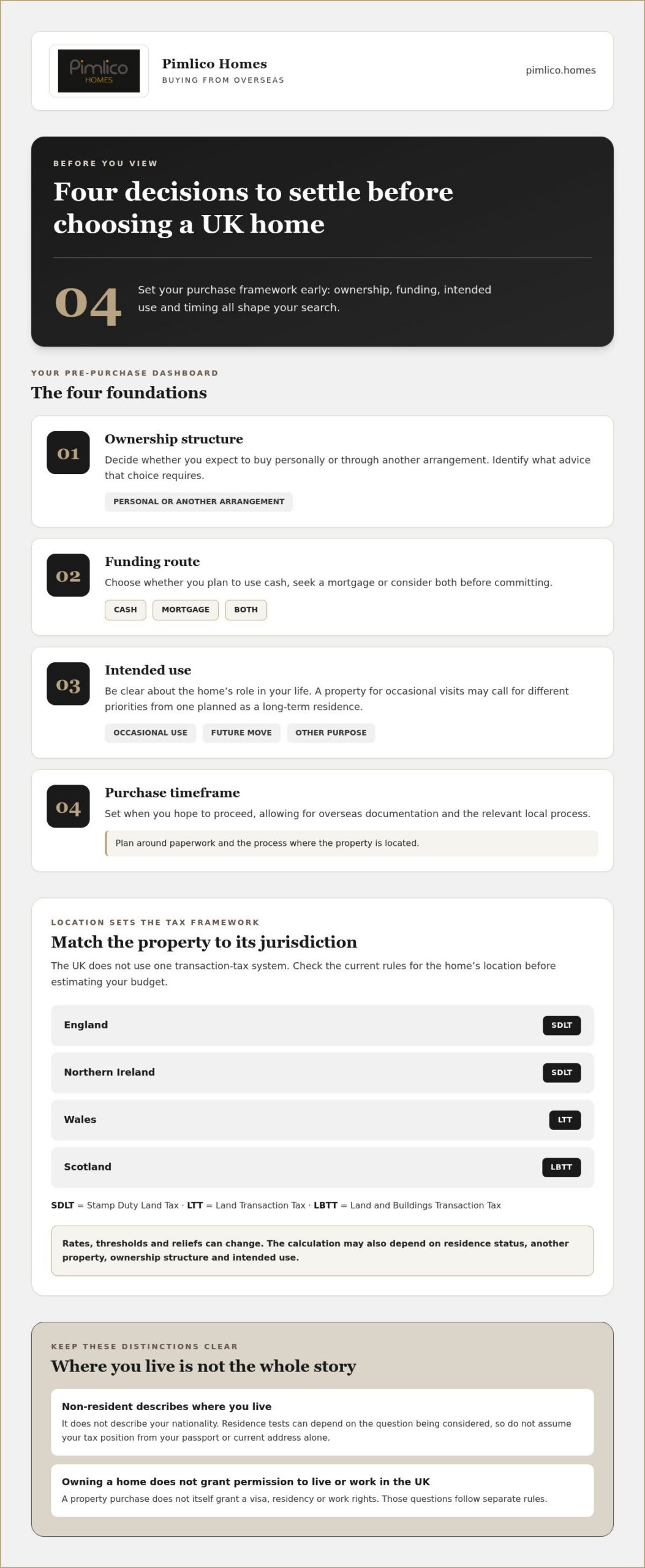
Before viewing homes, write down four decisions that will shape your search:
- Ownership structure: whether you expect to buy personally or through another arrangement, and what advice that choice requires.
- Funding route: whether you plan to use cash, seek a mortgage or consider both.
- Intended use: how often the home will be occupied and what you want it to support over time.
- Purchase timeframe: when you hope to proceed, allowing for overseas documentation and the relevant local process.
Settling these points early gives your search a clearer framework. It also helps you assess whether a home’s design and ownership experience fit your plans before the appeal of a particular property begins to shape decisions that need careful thought.
UK Property Tax and Legal Rules: Start with the Right Jurisdiction
The property’s location determines which UK transaction-tax framework applies. A home in England or Northern Ireland is generally considered under Stamp Duty Land Tax (SDLT), while purchases in Wales and Scotland use separate systems: Land Transaction Tax (LTT) and Land and Buildings Transaction Tax (LBTT), respectively. The distinctions matter from the outset. Tax rules, conveyancing stages and legal terminology can vary across the four nations.
For buyers researching buying a UK property as a non-resident 2026, avoid treating “UK tax” as one calculation. Rates, thresholds and reliefs can change, and the result may depend on more than the property price. Residence status, whether you own another home, the ownership structure and intended use can all be relevant. Non-resident treatment is not determined by nationality alone.
How purchase taxes differ across the UK
Start with the tax authority for the property’s jurisdiction. In England and Northern Ireland, GOV.UK explains the applicable Stamp Duty Land Tax rules for non-UK residents. Wales and Scotland have their own tax authorities and guidance for LTT and LBTT. Do not use an SDLT estimate for a property elsewhere in the UK, even if the purchase price and buyer circumstances appear similar.
Before exchange, ask for an individual calculation based on the specific property and your circumstances. Confirm which residence rules apply, whether another property affects the calculation, and whether the ownership arrangement changes the analysis. Check current official guidance and obtain specialist tax advice where the position is complex. A headline rate or a calculator using incomplete information may not reflect the total liability.
Conveyancing, title and ownership structure
A conveyancer helps examine the legal title, review contract documentation, raise property enquiries and coordinate the steps towards completion. Their review should bring important details into view before you become committed. These may include whether the home is freehold or leasehold, whether the title contains restrictions and whether the property carries particular obligations. The relevance of each point depends on the title and the property.
Ownership structure deserves equal care. Buying personally and buying through a company can have different legal and tax consequences, and neither should be assumed to suit every overseas buyer. Consider the present purchase alongside your longer-term plans, including how you expect to use the property and what may happen if you later sell or transfer it. Obtain tailored legal and tax advice before settling the structure; changing course after key documents are prepared can add complexity.
Keep a written record of the jurisdiction, proposed ownership structure, intended use and tax questions to resolve. That brief gives your advisers a clearer basis for reviewing the transaction and helps you compare homes with a sound understanding of the obligations attached to each. Once these foundations are in place, you can consider the design and ownership experience you want from a home, including the qualities of Pimlico Homes’ luxury properties.
Cash or Mortgage? Compare Funding Routes Before Committing
Funding shapes more than the size of your available budget. It can influence how much evidence you need to assemble, how quickly you can proceed and how much flexibility you retain after completion. For an overseas buyer, decide on a funding approach early, before a preferred home turns into a time-sensitive decision.
A cash purchase avoids a lender’s affordability assessment and mortgage conditions, but it still requires clear evidence of identity and the origin of funds. A mortgage may preserve capital for other plans, yet approval and terms depend on the lender’s criteria, the property and your financial position. Some lenders have specific processes for applicants who live overseas, so establish eligibility rather than assume it.
What overseas mortgage applicants may need to prepare
Requirements vary between lenders. Prepare to document who you are, how you earn or hold wealth, what you owe and where the purchase funds come from. A lender may assess income from employment or business interests alongside assets, regular commitments and existing liabilities. It may also ask for evidence relating to the property and proposed deposit.
Build a document file early. Depending on your circumstances, it may include identity documents, proof of address, income records, bank statements, details of assets and liabilities, and records showing the movement and origin of funds. These are examples, not a universal checklist: the lender sets its own evidence and affordability requirements.
Documents issued overseas can take additional time to obtain or verify. Ask about any translation, certification or authentication requirements before submitting them, and keep names, addresses and account activity consistent across your records. Enhanced identity and source-of-funds checks may apply to overseas buyers, whether the purchase is funded with cash or borrowing.
Choosing a funding route without false certainty
Cash can simplify coordination because there is no mortgage offer or lender valuation to await. It does not remove the need for conveyancing checks or proof of funds, and committing a large share of your available capital may reduce liquidity after purchase.
Borrowing can preserve some capital, but introduces lender conditions, affordability checks and a separate approval timetable. An agreement in principle should not be treated as a final mortgage offer. Before relying on borrowing, understand what must still be assessed and whether the property itself needs to meet lender requirements.
Plan currency transfers with care. If your funds are held in another currency, consider how exchange-rate movements, transfer limits and processing time could affect the amount available in pounds sterling and when it will reach the required account. Allow for verification and transfer arrangements rather than assuming funds can be moved immediately.
Before making a contractual commitment, align your intended timetable with confirmed funds, lender requirements and the relevant purchase process. The point at which a transaction becomes binding varies across UK jurisdictions, so establish the sequence with your conveyancer. For individual borrowing decisions, take advice from an appropriately qualified financial professional. This preparation is central to buying a UK property as a non-resident 2026.
The Non-Resident Buying Process: From Preparation to Completion
A purchase from overseas can be managed in a measured sequence, provided decisions, documents and communication are organised early. The terminology and legal stages differ across England, Northern Ireland, Wales and Scotland, so treat the outline below as a guide and confirm the precise steps with your conveyancer for the property’s jurisdiction.
Before making an offer, organise your identity and funding evidence, appoint a conveyancer, understand the property’s condition and legal position, and confirm how you’ll review and sign documents from abroad. That preparation gives you a clearer view of what remains to be checked and helps prevent avoidable delays.
- 1. Prepare documents. Gather identity, address and source-of-funds evidence, alongside any lender documents. Ask early about verification, translation or signing requirements that may apply to overseas paperwork.
- 2. Appoint representation. Instruct a conveyancer familiar with the relevant jurisdiction and agree how they will communicate with you. If you want someone to handle practical matters locally, discuss the scope of any authority and formal requirements before relying on it.
- 3. Assess the home. Review the property’s condition and legal information, and arrange appropriate independent checks before proceeding. A remote viewing can help you shortlist, but it cannot replace an inspection suited to the property or independent professional advice.
- 4. Agree terms. Make an offer with a clear understanding of what remains conditional and what steps follow. Do not assume an accepted offer has the same legal effect in every part of the UK.
- 5. Complete. Follow the jurisdiction-specific process for signing, transferring funds and completing the purchase. Afterwards, confirm registration and any tax administration with your conveyancer and check current official requirements.
Remote checks, representation and due diligence
Agree a dependable communication routine with your conveyancer. Decide how documents will be shared, how quickly you can respond and who can discuss details on your behalf. An authorised representative may help coordinate practical communications, but the authority they need depends on the task and applicable formalities.
Property-specific due diligence may include a survey, title review, planning enquiries and contract checks. The findings can affect both your understanding of the home and the terms on which you proceed. Remote photographs and video calls offer useful context, but are not a complete substitute for suitable inspection or independent advice.
From offer to completion
After an offer is agreed, legal work and enquiries progress before the point at which the contract becomes binding. In Scotland, the process and terminology differ, including the use of missives; elsewhere, confirm the sequence and commitment point with your conveyancer. Signing may be handled through arrangements suitable to the transaction, but do not assume every step can be completed remotely.
There is no single timetable for every purchase. Progress depends on the parties, property checks, funding readiness and any issues raised during legal work. Once completion takes place, registration and tax administration may follow. Verify the current requirements and deadlines for the property’s jurisdiction rather than relying on a general UK-wide assumption.
With the practical sequence in view, you can assess homes with greater confidence. Explore Pimlico Homes’ luxury homes as you consider which design and ownership experience best suits your plans for buying a UK property as a non-resident 2026.
Choosing a Home as a Non-Resident: A Considered New-Build Option
A home should suit the life you intend to lead in it, not simply appeal during a viewing. For overseas buyers, distance makes a clear set of selection criteria especially valuable. Consider how often you expect to stay, who will use the property, how much upkeep you can manage from abroad and whether your plans may change over time. A considered new build can be one option, alongside an existing home or a conversion.
Translate those plans into practical questions. Is a ground-floor bedroom important? Would a more manageable layout help if the property is used for shorter stays? Do you need space for visiting family, or features that support accessibility now or later? These priorities help you look beyond presentation and assess whether the home can support your intended ownership experience.
What to assess in a premium new build
Study the available plans, written specification, inclusions and tenure documents rather than relying on assumptions about what “new build” means. Compare the stated details with your priorities: room proportions, storage, circulation, materials and how the design works for everyday living. If viewing remotely, request clear information about the home and its surroundings, then use appropriate independent advice to understand any points that remain uncertain.
Craftsmanship is experienced in the details as well as the overall design. Consider how the choice and finish of materials contribute to the spaces you will use, and whether the layout feels coherent for your routine. Ask for written information about aftercare arrangements and any applicable warranty, and keep these distinct from snagging matters, which concern items requiring attention. Resale is another separate consideration: think about how the home’s layout, tenure and setting may fit future needs, without assuming that a particular property will appreciate in value.
For a more detailed overview of the considerations involved, consult a luxury new-build buying guide. As with any purchase, review the documents relating to the specific home and take independent advice where needed.
When a developer purchase may suit your plans
Different home types offer different experiences. A detached home may appeal if you value a distinct home and plot; an executive courtyard home may suit a preference for a more considered, shared setting. Bespoke homes allow design choices to be shaped around a brief, while a barn conversion brings a different architectural character. The right fit depends on the home itself, its setting and how you expect to occupy it, rather than the category alone.
Compare each option against your longer-term requirements: day-to-day layout, accessibility, upkeep and the flexibility you may need as circumstances evolve. If a thoughtfully designed new build aligns with those priorities, explore Pimlico Homes’ residential developments and consider how their homes might fit the life you are planning.
Make Your Next Move with Confidence
Buying a UK property as a non-resident 2026 can be more than a transaction. It can be the beginning of a lasting connection with a home shaped around the way you intend to live. Before taking the next step, consider what would make a property feel right not only on arrival, but through the years ahead: its proportions, character, setting and the experience of owning it from overseas.
Pimlico Homes is a specialist developer of high-end residential homes, with a portfolio that includes detached, executive courtyard, bespoke and barn-conversion homes. Each type offers a distinct perspective on contemporary living, giving you considered possibilities to explore as your plans take shape.
Let practical preparation guide your search, then allow design and craftsmanship to bring your priorities into focus. Explore Pimlico Homes’ collection of luxury homes and discover a setting for the next chapter you have in mind.
Frequently Asked Questions
Can a non-resident buy property in the UK in 2026?
Yes, a person living abroad can generally buy a UK property, subject to the rules relevant to the property and their circumstances. Buying a UK property as a non-resident 2026 does not itself grant permission to live or work in the country. If your purchase is connected to a planned move, check immigration requirements separately and before making commitments. Nationality, tax residence and permission to enter or remain are distinct considerations.
Do I need to visit the UK to buy a property?
Not necessarily. Some buyers arrange viewings and communicate with their conveyancer remotely, but signing, identity verification and completion arrangements depend on the transaction and jurisdiction. A visit can help you understand the property and its setting, though an in-person visit does not replace a suitable survey or legal checks. If you cannot travel, plan how an independent inspection will be arranged and agree how documents and decisions will be handled from overseas.
Can I get a UK mortgage if I live abroad?
Possibly, but availability and terms depend on the lender’s criteria and your financial circumstances. A lender may assess overseas income, existing debts, credit history, the property and the source of your deposit. If you earn in another currency, clarify how income will be assessed and whether exchange-rate movements affect affordability calculations. Speak with an appropriately qualified mortgage adviser about your situation, and avoid treating an early indication as a confirmed mortgage offer.
What documents might I need to buy a UK property from abroad?
Expect to provide identity and address evidence, alongside records showing where the purchase funds came from. If applying for a mortgage, you may also need income documents, bank statements, asset details and information about liabilities. Requirements vary between conveyancers and lenders. Overseas documents may need translation, certification or additional verification, so ask for the applicable requirements early and allow time to obtain correctly prepared copies.
Are property taxes the same throughout the UK?
No. England and Northern Ireland use Stamp Duty Land Tax, Wales uses Land Transaction Tax, and Scotland uses Land and Buildings Transaction Tax. The applicable system follows the property’s location, not the buyer’s address. Rates, thresholds and reliefs can change, and a buyer’s circumstances may affect the calculation. Check current guidance from the relevant tax authority and obtain an individual calculation before proceeding with a purchase.
Can I buy a UK property through a company as a non-resident?
A company may be able to buy a UK property, but that does not mean company ownership is automatically simpler or more tax-efficient. The consequences depend on the company, the property, its intended use and your wider circumstances. For example, Annual Tax on Enveloped Dwellings may be relevant to companies holding UK residential property valued above £500,000. Take tailored legal and tax advice before choosing an ownership structure.
How long does it take to buy a UK property from overseas?
There is no single reliable timescale. Progress can depend on the property’s legal position, the seller and other parties, the checks required, funding readiness and how quickly overseas documents can be verified. A mortgage application or a title issue may add steps. Ask your conveyancer to explain the sequence for the property’s jurisdiction and update the estimate as enquiries and funding arrangements progress. Avoid making travel or moving plans around an unconfirmed completion date.





