
A polished show home and a confident sales presentation can make a strong first impression. Neither tells you whether the company behind a development is financially resilient. Checking a developer’s solvency and credit history UK records is a sensible part of your research, but a credit score is only one signal. The company’s filed information and the documents for the specific purchase matter too.
If you’re unsure which company to search for or how to interpret filed accounts, credit information and possible insolvency indicators, you’re not alone. A concerning entry does not prove that a developer is insolvent, just as a clean report cannot guarantee that a build will finish as planned or that after-sales support will be available.
This guide explains how to identify the relevant legal entity, where to find UK company information and what its limits are. It also suggests questions to raise with your conveyancer about the financial position of the contracting seller, the development and the protections attached to your purchase. A careful review can help you identify what needs clarifying before you commit.
Key Takeaways
- Confirm the exact legal entity and company number for the seller or development company before searching its records.
- Use Companies House as a starting point, review filed accounts and consider a business credit report for additional context.
- Distinguish routine uncertainty from issues that need clarification and formal insolvency events.
- Treat accounts as historical snapshots. Ask your conveyancer what they reveal, what they omit and which project documents to review.
- Record your findings, resolve unanswered questions before significant commitments and remember that no public search can guarantee a development will complete as planned.
Why check a property developer’s solvency and credit history in the UK?
Buying a new-build home is a significant commitment, and the company selling it is central to the decision. Before exchanging contracts or making another substantial commitment, financial checks can help you understand the developer’s ability to meet its obligations. Financial pressure may affect a project’s progress or the support available after completion. These checks are one part of due diligence, alongside conveyancing and a careful review of the contract.
Solvency means a company can meet its financial obligations as they fall due. It is not a permanent status or a credit score. A company’s position can change, and a credit score is an assessment based on information available to the reporting provider. Neither a reassuring score nor the absence of obvious concerns guarantees that a development will finish as planned.
What does a developer solvency check actually tell you?
Different records answer different questions. A business credit report may summarise reported payment history and other credit information. Filed accounts show the company’s finances for a past reporting period, not necessarily its position today. Formal insolvency information relates to specific legal processes or events. Each source has a different scope, level of detail and update cycle, so compare them rather than treating them as interchangeable. For context on the legal framework, see this overview of UK insolvency law.
A personal credit file concerns an individual’s borrowing and repayment history. A company credit check concerns a business. They are not substitutes: a director’s personal report does not, by itself, establish the financial position of the company named in your purchase documents.
Which company should a homebuyer investigate?
Start with the developer’s name, the seller shown in your reservation paperwork and the legal entity expected to sign the sale contract. These names may differ. A development may also use a separate company, so a search for the trading name alone may not find the records relevant to your purchase.
Ask your conveyancer to confirm the contracting seller’s registered company name and number, and whether another development company is relevant. This makes your search more precise and reduces the risk of drawing conclusions from a similarly named or connected business.
Searching the right entity is the foundation of checking a developer’s solvency and credit history UK. The aim is not to predict the future from a single report, but to identify questions that need clear answers before you proceed.
How to check a developer’s company records and credit history
Follow a clear sequence: confirm the relevant company, inspect its official record, read its filed accounts, then consider whether a commercial credit report adds useful context. Note the date of each search. Company records and financial circumstances can change, so your findings are a snapshot rather than a lasting verdict.
Search Companies House using the exact legal identity
Use the registered company name and number supplied in the sale documents or confirmed by your conveyancer. The GOV.UK service, Get information about a company, links to Companies House records, including company details and filed documents. Check that you have the proposed seller or relevant development company, not a similarly named business or another entity in the developer’s structure.
Review the company status, filing history, accounts and confirmation statements. Note the periods covered by the accounts, when documents were filed and whether the filing history raises questions. A company’s registered status and filed documents are useful evidence, but they do not certify that it can meet future obligations or that a particular project has adequate funding.
Keep the dates in mind when reviewing accounts. They describe a past reporting period and may not reflect the company’s position when you are making a commitment. Save or note the records you reviewed, including the company number and search date, so you can discuss specific documents with your conveyancer.
When can a business credit report help?
A commercial credit report may bring together payment information, public records and a provider’s assessment of financial risk. It can supplement your Companies House search if you want another view of available business information. It is not an official certification of solvency and does not replace reviewing company filings and purchase documents.
Providers may use different sources, scoring methods and update schedules. One report may therefore omit relevant information or reach a different assessment from another. Treat its conclusions as prompts for further questions, not as a definitive pass or fail.
Checking a developer’s solvency and credit history UK records is most useful when each source is matched to the correct legal entity and its limitations are understood. If you are considering a new-build purchase, you can also explore Pimlico Homes’ luxury new-build homes as part of your wider research.
How to interpret accounts, credit signals and possible warning signs
Financial records rarely give a simple verdict. A late filing, negative net assets or an adverse credit marker may justify questions, but none alone proves that a developer is insolvent or that a project will fail. Check which company the information concerns, consider its context and distinguish an issue to clarify from a formal insolvency event.
What financial information deserves closer attention?
Start with the type of accounts filed and the period they cover. Check whether they are full or abbreviated accounts, how recently they were filed and whether the notes explain changes in the business. Accounts are historical snapshots. Even recent figures may not show the company’s current position, the resources available to a particular development or how its project funding is arranged.
Read financial figures together, not in isolation. Cash indicates funds held at the reporting date; liabilities show amounts owed; net assets compare assets with liabilities. Low cash, substantial liabilities or negative net assets can prompt further enquiry, but their significance depends on timing, commitments, company size and wider structure. If the business is part of a group, relationships with other entities may not be obvious from a single set of accounts.
Late filings and repeated changes in company details or reporting patterns are also reasons to ask what has changed and why. They are not automatic evidence of financial failure. If you can’t confidently interpret a figure or note, ask your conveyancer or a suitably qualified financial professional to explain its possible relevance to the transaction. Companies House offers guidance on how directors measure business health, including cash-flow and balance-sheet considerations.
What do insolvency records and adverse signals mean?
An adverse credit marker, such as a recorded payment concern, is not the same as a court process or formal insolvency appointment. Check the exact wording, date and source, then confirm whether it relates to the developer, the contracting seller or another company in the project structure. A similarly named entity can lead to a misleading conclusion.
Check formal information against the relevant company record and look for subsequent updates. A notice may describe a process involving one legal entity, not every company connected with a development. Ask your conveyancer to confirm the context before treating it as evidence about the seller’s position.
When checking a developer’s solvency and credit history UK records, take a measured approach: note the signal, verify its source and ask a specific follow-up question. Uncertainty calls for clarification. It should not be mistaken for proof of either safety or insolvency.
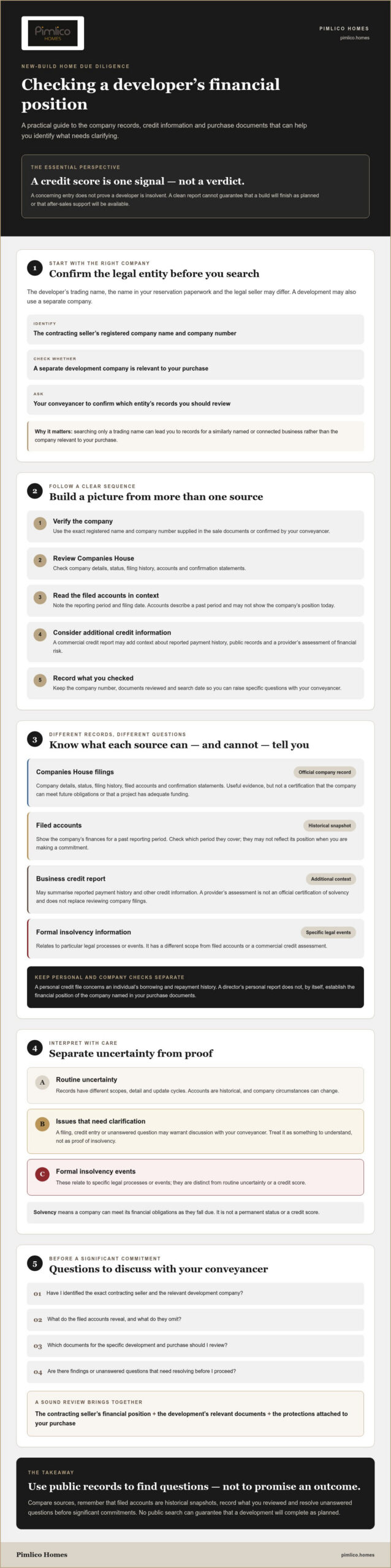
A practical due diligence checklist before committing to a new-build home
Make financial and legal checks part of the purchase process, rather than an afterthought. Review available information before reservation, then ask your conveyancer to revisit relevant records and documents before exchange and any other significant contractual commitment. The aim is to understand who is selling the home, which entity carries the contractual obligations and what the evidence can and cannot tell you.
Use this checklist to organise your next steps. Keep a note of responses and unresolved questions so your conveyancer can follow them up.
Questions to ask the developer and conveyancer
Seek clear, consistent answers about the legal seller, the entity responsible for contractual obligations and any project-specific arrangements. Ask what current financial or development information can be shared, without assuming every detail will be publicly available. Your conveyancer can compare the responses with company records and the contract, then explain what protections the documents provide.
When should you pause and seek independent advice?
Pause before proceeding if company names differ between the reservation paperwork, company records and draft contract without a clear explanation. The same applies to inconsistent filing information, unclear group structures or adverse records you can’t confidently interpret. Ask your conveyancer to investigate rather than relying on an informal assurance. For wider purchase considerations, consult The Ultimate Guide to Buying a Luxury New Build Home in 2026.
Financial checks are one part of buying a new-build home. You can explore Pimlico Homes’ luxury new-build homes while reviewing property information alongside independent conveyancing and contract advice.
What to do with findings and how to proceed with confidence
Company records and credit reports help you ask informed questions, but they cannot guarantee a particular outcome. No public search or commercial report can promise that a development will finish as planned. Consider your findings alongside the contract terms, warranty arrangements and independent legal advice before deciding how to proceed.
How should you assess conflicting or incomplete information?
Before comparing records, check that they concern the same legal entity and reporting period. A difference between a developer’s trading name and the company named in its accounts may have a straightforward explanation, but make sure you understand it. The same applies to a gap between a filed account and a more recent credit report, as each may draw on information from different dates and sources.
Write down the discrepancy and ask the company or your adviser for a clear explanation. Keep relevant written responses with your purchase records. Don’t make allegations based on a credit score, late filing or accounting figure in isolation. If the explanation remains unclear, ask your conveyancer what further evidence or advice may be appropriate before you make a significant commitment.
Your next steps as a considered new-build buyer
Give your conveyancer the exact company name and number, the records you reviewed, the dates you checked them and a concise list of questions. Ask them to consider the findings alongside the proposed seller’s identity, the contract and any warranty arrangements. Your conveyancer can advise on legal and contractual matters. A qualified financial professional may help you interpret accounts that are beyond your expertise.
For a wider view of the purchase process, consult The Luxury New Build Purchasing Guide. Financial due diligence is one part of a considered decision, alongside the property itself and the terms on which it is being sold.
Pimlico Homes is a residential developer selling new-build homes, including luxury homes, executive courtyard homes, bespoke homes and luxury barn conversions. Explore Pimlico Homes’ residential developments as part of your wider research, and raise questions about the specific seller and purchase documents with your independent conveyancer.
Make your next step an informed one
Careful due diligence begins with the correct company identity. Confirm the legal seller and company number, then review Companies House records, filed accounts and any business credit information in context. A credit score, late filing or isolated figure is a reason to ask questions, not a verdict on its own.
Checking a developer’s solvency and credit history UK records can help you frame those questions, but no public search can guarantee a development’s completion. Keep a record of what you find, clarify inconsistencies and ask your conveyancer to consider the evidence alongside the contract and warranty arrangements before you commit.
Pimlico Homes specialises in luxury new-build residential properties, including detached homes, courtyard homes and barn conversions. Explore these homes as part of your wider research, while carrying out independent checks on the specific seller and purchase documents.
Explore Pimlico Homes’ residential developments and take your next step with care and confidence.
Frequently Asked Questions
How can I check a property developer’s credit history in the UK?
Start by confirming the exact legal company named as the seller or contracting party, then search its record on Companies House. Review its filed accounts, filing history and any available insolvency information. For additional context, consider a commercial credit report, which may summarise payment information and other records. Checking a developer’s solvency and credit history UK sources is most useful when you verify that each result relates to the correct company.
Can I check a developer’s solvency for free?
You can access company details and filed documents through Companies House without paying for a commercial credit report. These records can help you check a company’s identity, filing history and accounts, but they do not provide a complete or live assessment of its financial position. Business credit reports may involve a fee, depending on the provider. A free personal credit file concerns an individual, not the developer’s company.
What should I look for on Companies House?
Check the registered company name and number against the reservation documents and proposed contract. Review the company’s displayed status, filing history, accounts, confirmation statements and any available insolvency information. Note the dates: accounts describe a past reporting period, and a filing may not show the company’s current position. If a name, date or document raises questions, ask your conveyancer to help interpret it.
Does a good credit score mean a property developer is financially safe?
No. A credit score is an assessment based on information available to its provider, not a guarantee of solvency, project funding or completion. Providers may use different information and scoring methods, and their reports cannot establish every project-specific detail. Read a score alongside official company records, accounts, relevant contract terms and professional advice. Treat a reassuring result as one useful signal, not proof that a purchase carries no risk.
What are warning signs when checking a developer’s financial history?
Late accounts, negative net assets, adverse payment information or unexplained changes in company records may warrant questions. None alone proves insolvency or that a development will fail. First check the legal entity, the period covered and whether later information changes the picture. Ask the developer or your conveyancer to clarify discrepancies, and seek professional interpretation of accounts or group structures you can’t confidently assess.
Can a property developer use a separate company for each development?
Yes, a development may involve a company separate from the wider developer, so don’t assume the trading name is the legal seller. Compare the company named in the reservation paperwork and draft contract with the developer’s details and Companies House records. Ask your conveyancer to confirm the registered name and company number, and explain which entity is responsible for the contractual obligations relevant to your purchase.
When should I check a developer’s solvency before buying a new-build home?
Begin before reservation where possible, then revisit relevant information before exchange and other substantial contractual commitments. Company records can change, so note when you searched and ask your conveyancer whether updated checks are appropriate as the purchase progresses. Share the company number, documents and specific questions with them. Consider financial information alongside the contract and warranty arrangements; no search can promise that a development will finish as planned.





