
When choosing a luxury property developer, distinctive design and a confident vision are only part of the decision. A significant home purchase also calls for clear checks on the company behind the development, its role in delivering the project, and the documents that explain what protection applies. A polished presentation can introduce a home, but it cannot replace that evidence.
Start by confirming the legal entity and reviewing its record. Then assess project information and read any insurance or warranty documents in full. Check the named parties, property or work covered, dates, scope and exclusions. A certificate may confirm that a policy exists, but it does not establish that every project risk or future defect is covered.
This guide sets out practical checks to make before reservation, ways to compare developers consistently, and questions to raise with a qualified adviser. Pimlico Homes has over 25 years’ experience and describes its customer service from reservation through hand-over under The Pimlico Pledge. Its focus on craftsmanship, innovation and timeless design is part of the home-buying experience; documentary checks remain an important part of an informed decision.
Key Takeaways
- When choosing a luxury property developer North East, distinguish the developer’s responsibilities from those of the builder or contractor carrying out construction work.
- Compare insurance and warranty documents by the parties, risks and periods they cover. The existence of a document does not mean its scope is comprehensive.
- Use the same comparison framework for each company: legal identity, relevant experience, project evidence and customer support.
- Complete pre-reservation checks in a clear order, and seek qualified advice where contract wording or insurance scope is unclear.
- Consider documentary evidence alongside the home-buying experience, including Pimlico Homes’ stated focus on craftsmanship, timeless design and service through hand-over.
Before choosing a luxury property developer, verify who you are dealing with
A striking home can make an immediate impression, but it does not identify the organisation selling it or explain that organisation’s role in the project. Before weighing up design and specification, establish the legal entity behind the development and look for evidence that supports its claims.
A developer typically shapes and coordinates a project, while a builder or contractor carries out construction work. These roles can overlap, but they are not interchangeable. Knowing which organisation is responsible for which part helps you understand project histories and documents. This overview of the real estate development process provides broader context on the stages involved.
Use a simple sequence: identify the legal entity, review its record and stated project role, then assess the documents relevant to the home. Treat credentials as useful when they can be checked independently, rather than relying on a confident statement in marketing material.
How to establish the developer’s legal identity
Search Companies House by company name or number. Compare the registered entity with the trading name used in the development’s sales material and the name shown on reservation or contract documents. If the names differ, record the difference and establish which entity your agreement identifies. This check helps you understand who you are dealing with; it does not assess design or workmanship.
Pimlico Homes’ legal identifier is Company No. 13527402. A Companies House record can help confirm an entity’s identity and show information such as its status and filing history. It does not certify build quality, prove financial strength or establish that a particular home is insured. Assess each of those questions using evidence relevant to it.
What a track record can, and cannot, tell you
When reviewing a portfolio, ask what the developer actually delivered. Look for completed developments, the organisation’s stated role and project details that help explain the work, such as descriptions and images. A portfolio can illustrate the character of a developer’s projects, but it may not show who carried out construction or how closely a past project compares with the home you are considering.
Separate verifiable information from broad descriptions such as “prestigious” or “exceptional”. Record the project name, the developer’s stated role and the evidence supporting each claim. If a detail is absent, note it as an open question rather than assuming either success or failure. Pimlico Homes states that it has over 25 years’ experience. This gives context to the company’s experience, but it is not proof of insurance or a prediction of future outcomes.
When choosing a luxury property developer North East, a clear legal identity and a traceable record give you a firmer basis for the checks that follow than presentation alone.
How to assess a luxury developer’s insurance and warranty evidence
A policy name alone does not tell you what is covered. Different types of insurance address different risks, and the relevant protection depends on the named party, the project and the policy wording. A structural warranty is also distinct from general insurance, with its own terms and scope.
Read the schedule alongside the full wording rather than relying on a certificate or verbal summary. Check who is insured, which activities or property are covered, the relevant dates, any limits and the exclusions. A document may exist but still have a scope that does not answer the question you need resolved.
Which insurance documents should a buyer understand?
The policy types below can serve different purposes. Their relevance depends on the circumstances, so this list should not be treated as a universal requirement or as proof that every risk is covered.
| Document type | What it may address | What to inspect |
|---|---|---|
| Public liability | Claims involving injury to a member of the public or damage to third-party property. | Named insured, covered activities, dates, limits and exclusions. |
| Employers’ liability | Claims connected with injury or illness involving employees. | Insured entity, period of cover and relevant exclusions. |
| Contract works or Contractors’ All Risks | Risks affecting construction work or materials during a project. | Project or site description, insured parties, dates and scope. |
| Professional indemnity | Claims related to professional services or design responsibilities, where relevant. | Covered activities, insured party, limits and exclusions. |
| Structural warranty | Defined defects or damage within the warranty’s stated scope and terms. | Provider, covered home and parties, start date, duration and exclusions. |
Design quality and insurance evidence answer different questions. The UK government new build design guidance offers context on design expectations, but it does not establish the scope of a particular policy or warranty.
How to read warranty and policy wording carefully
For each document, identify the provider, the party covered, the property or work described, the period of cover and the exclusions. Check that the named entity matches the organisation and project under consideration. If a schedule refers to a different site, activity or party, do not assume it applies to the home you are assessing.
A structural warranty is not a substitute for general insurance, and neither is the same as a developer’s customer-service pledge. A pledge describes a service commitment; a policy or warranty sets out defined terms and limitations. If a key phrase, exclusion or relationship between documents is unclear, independent legal or insurance advice can help you understand what the wording establishes before you proceed.
For context on how craftsmanship and service feature in the home-buying experience, explore Pimlico Homes’ approach to its homes. Assess that information separately from the actual insurance and warranty documents.
Compare luxury property developers using evidence, not presentation alone
A consistent comparison helps you see what is supported, what remains unclear and what matters to your decision. Keep design and specification in view, but assess them separately from legal identity and insurance evidence. A considered layout may appeal to you, but it cannot establish whether a policy names the right entity or applies to the relevant project.
Comparing the same evidence for each developer makes headline claims easier to assess. Use one framework for every company under consideration. Record the source and date of each check, and distinguish documented facts from your own impressions.
Create a consistent developer comparison framework
Use the categories below as a working grid. For each one, note the evidence, where it came from and any point that needs clarification. This makes it easier to weigh a public record or project document appropriately against a general portfolio statement or online comment.
- Legal identity: Record the company name, company number and source used to check them. Note whether names align across sales material and transaction documents.
- Relevant experience: Capture the developer’s stated experience and the projects that demonstrate work relevant to the home you are considering.
- Project evidence: Note completed developments, the developer’s stated role and the information available to support that account.
- Insurance documents: List the documents supplied, the named insured, the activity or property described, relevant dates, limits and exclusions you can identify.
- Customer support: Compare what each developer explains about communication and support through the purchase and hand-over process, using written information where available.
Make like-for-like comparisons. For example, one company’s detailed information about a completed project is not equivalent to another’s general portfolio statement. Keep presentation notes, including design, materials and specification, in a separate part of your assessment. These qualities matter, but they answer different questions from a company record or policy schedule.
Recognise gaps and inconsistencies without jumping to conclusions
A missing document and a limited document are not the same. If no policy schedule has been supplied, record “not provided” rather than assuming what it covers. If a schedule names another entity, describes a different activity or excludes the matter you are assessing, record that limitation. The document’s existence alone does not settle whether relevant protection applies.
Compare company names, project roles and dates across marketing material, contracts and documents. Note each difference and seek clarification through the relevant transaction process before relying on an assumption. An unexplained gap calls for further due diligence; it is not, by itself, proof of wrongdoing.
When choosing a luxury property developer North East, this method gives you a traceable record rather than a comparison based on instinct alone. It leaves room for personal judgement about design and service while keeping documentary evidence clear.
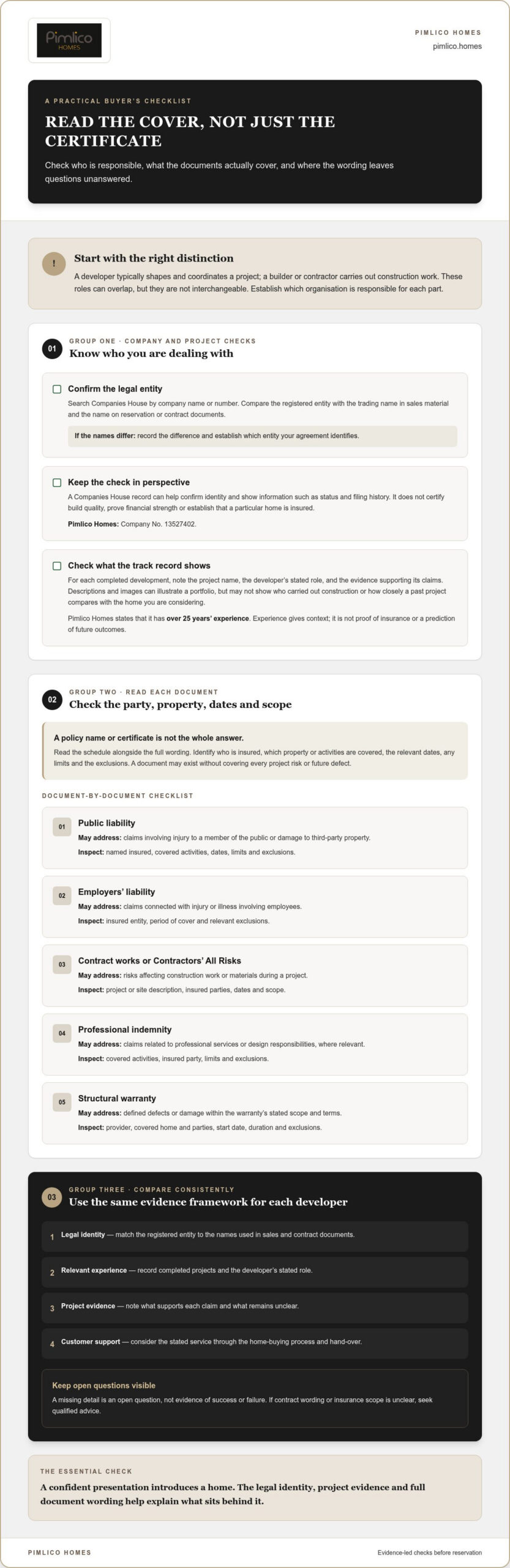
A practical pre-reservation checklist for vetting a developer
Following a clear order makes due diligence easier to manage before reservation. Begin with checks you can carry out yourself, keep a record of what you find, then take transaction-specific questions to a qualified adviser. This process does not replace professional advice, but it can help you identify what needs explanation before you make a commitment.
Work through the checks in a clear order
Use the checklist as a working record. For every item, note the source, the date you checked it and any unresolved point. This helps keep open questions visible amongst brochures, emails and contract papers.
- Confirm the legal identity. Search Companies House using the developer’s company name or number. Record the legal entity and compare it with the name shown on the development material and reservation documents. For Pimlico Homes, the identifier is Company No. 13527402.
- Review the developer’s record. Look at completed-project information and note the developer’s stated role on each relevant project. Keep specific details separate from general descriptions of quality or prestige.
- Read the supplied insurance and warranty documents. Identify the named parties, covered activity or property, relevant dates, scope and exclusions. Record whether a document is absent or appears limited in its application.
- Compare claims with paperwork. Check for differences in company names, project descriptions or dates across marketing material and documents. Write down discrepancies and questions rather than assuming what they mean.
- Organise the reservation and contract material. Save important claims, documents and correspondence together. Mark any wording you do not understand so it can be addressed during professional review.
- Seek transaction-specific advice. A qualified conveyancer can review transaction documents and explain relevant contractual protections. If the meaning or scope of insurance wording remains unclear, independent insurance advice may help you interpret it.
Prepare for reservation and professional review
Public company records and project information are useful starting points. The meaning and effect of contract clauses depend on the documents and circumstances, so a general guide cannot replace advice on the agreement you are considering. For broader purchase-stage context, consult the luxury new build buying guide.
When choosing a luxury property developer North East, a well-organised evidence file helps you see what is established and what still needs attention before reservation. It also gives your adviser a clearer basis for focused questions.
To explore how craftsmanship, timeless design and customer service from reservation through hand-over inform Pimlico Homes’ approach, discover the Pimlico Homes approach.
What Pimlico Homes’ approach means when choosing a developer
Due diligence and customer experience serve different needs. Records and documents help you assess the organisation and the terms attached to a purchase. Design priorities and communication shape how the home and buying journey feel. One should not stand in for the other. A clear service commitment can be reassuring, while insurance and warranty evidence still needs to be understood on its own terms.
Pimlico Homes describes its priorities as craftsmanship, innovation and timeless design. Its homes include luxury detached homes, executive courtyard homes, bespoke luxury homes and barn conversions. The website also uses the phrase “Award Winning Homes”. These statements give you context on the company’s approach, but do not replace your assessment of project information and transaction documents.
The Pimlico Pledge: support across the buying journey
The Pimlico Pledge describes customer service from reservation through to hand-over of keys. It places the buyer relationship within the wider experience of purchasing a home, rather than limiting attention to the property’s design. This commitment offers useful context when considering how a developer presents its customer support.
The pledge is a customer-service commitment, not insurance, a structural warranty or a guarantee of a particular outcome. Each has a different purpose and should be considered separately. You can value thoughtful service without mistaking it for documentary protection, and assess both aspects on their own terms.
A considered next step for discerning buyers
A home should reflect more than a visual preference. Your choice may depend on how its form, setting and design priorities align with the way you wish to live. Pimlico Homes’ portfolio includes luxury detached homes, executive courtyard homes, bespoke luxury homes, luxury new build homes and luxury barn conversions. Each offers a different starting point for considering character and lifestyle, without implying that every home has the same specification.
Pimlico Court comprises four homes. This is a concrete example of a defined development, but the number alone does not establish its design details, documentation or suitability for an individual buyer. Those questions still call for a property-specific review.
Confidence comes from considering the home’s design, the developer’s stated priorities, the customer relationship and the evidence relevant to the transaction. Together, these give you a fuller basis for a decision than presentation alone.
Explore Pimlico Homes’ approach and residential developments to discover the homes and design principles that may speak to you.
Take your next step with confidence
A home is more than a considered purchase. It is the setting for everyday life, shaped by enduring design and the relationship you build with its developer. As you continue choosing a luxury property developer North East, let your priorities guide what you explore, from architectural character to the experience of buying and settling in.
Pimlico Homes brings together a focus on craftsmanship, innovation and timeless design with The Pimlico Pledge, which describes customer service from reservation through hand-over of keys. Its website uses the phrase “Award Winning Homes” without naming specific awards. These statements can help you decide whether its approach to home and service resonates with your aspirations.
Your decision is personal. Explore the homes, consider what feels right for your future and continue your documentary checks at each stage. A measured choice can make the prospect of a new home feel all the more meaningful.
Explore Pimlico Homes’ luxury homes and discover its approach to design and customer service.
Frequently Asked Questions
How can I check a property developer is a registered company?
Check the developer’s exact legal name and company number against its Companies House record. Search the official register, then compare the entity shown there with the name on reservation paperwork and any draft contract. Registration helps identify the company you are dealing with; it does not certify build quality, solvency or insurance. If the trading name and transaction entity differ, note the discrepancy and ask a qualified adviser to explain its significance before proceeding.
What insurance should a property developer have?
There is no universal checklist. Relevant cover depends on the developer’s role, activities, project and policy terms. Public liability may address certain third-party injury or damage claims; employers’ liability relates to employees; contract works cover may concern construction activity; and professional indemnity may be relevant to professional or design responsibilities. The labels alone do not establish what applies. Read the schedule and wording, and seek qualified advice on questions specific to your transaction.
Is a new-build structural warranty the same as building insurance?
No. A structural warranty and building insurance are not interchangeable. A warranty has its own provider, covered parties, scope, terms and exclusions, while an insurance policy responds to risks defined in its wording. For example, a warranty document may describe cover for a particular home, while a separate policy relates to a developer’s project activities. Read each document in full and do not assume one replaces another or covers matters outside its stated terms.
Can I check a developer’s experience independently?
Yes. When choosing a luxury property developer North East, compare the company’s stated project history with publicly available company information and development records. Look for project names, completion details and evidence of the developer’s role, rather than relying only on promotional descriptions. Note where and when you found each item. A track record provides context, but it cannot guarantee future performance or prove that particular insurance is currently in force.
What does Company No. 13527402 identify?
Company No. 13527402 is the company identifier for Pimlico Homes. It identifies a legal entity in company records; it is not a quality award, insurance policy or warranty. Use the number to distinguish the company from a trading name when reviewing relevant records and transaction documents. If another entity is named in paperwork, do not assume the relationship. Record the difference and ask a qualified adviser how it relates to your purchase.
Should a conveyancer review a new-build purchase before reservation?
A conveyancer can advise on transaction documents, contractual terms and protections relevant to your circumstances. Discussing the purchase before reservation may help you understand what should be reviewed and when, but the appropriate timing depends on the transaction and documents involved. Your own checks of company and project information remain useful; professional advice complements them by interpreting the legal wording. Raise unclear clauses or differences between documents with your conveyancer before relying on your understanding.





