
What if the lasting expression of luxury isn’t a dramatic feature, but a home that makes everyday life work better? Customising a bespoke luxury new build home starts with understanding how you live, what you value and which design choices will matter long after first impressions fade.
It’s natural to want a home that feels personal while wondering whether customisation means escalating costs or showy finishes. Often, the most meaningful choices are practical: how rooms connect, where natural light falls, what needs to be stored and whether a space can adapt as routines change. The challenge is deciding which choices will improve daily life and which are mainly decorative.
This article explains how to turn your priorities into a clear design brief, assess lasting value beyond specification and prepare useful questions when considering a bespoke new build. Timing matters too: options vary between homes, so ask the development team what may be possible for a specific property and when decisions are needed. A well-crafted home should feel distinctly yours, while remaining suited to the life it is meant to support.
Key Takeaways
- Start with the routines and principles you want your home to support, then separate essential needs from preferences.
- When customising a bespoke luxury new build home, consider everyday usefulness, personal meaning, upkeep and adaptability, not appearance alone.
- Use a clear design brief to compare trade-offs and keep decisions aligned with what matters most to you.
- Before committing, ask which choices are available for the specific property, when decisions are due and how agreed details will be documented.
- Assess whether the existing layout, materials and specification suit your priorities before assuming changes are possible.
Customising a bespoke luxury new build home: begin with what matters to you
Before considering finishes or features, think about the life a home needs to support. Customising a bespoke luxury new build home is most meaningful when choices make daily routines easier, reflect important relationships and express personal priorities. That might mean a quiet place to work, a welcoming setting for shared meals or a layout that feels comfortable for everyone in the household.
Bespoke means made to a particular specification. In that sense, customising a bespoke home begins by defining a specification around the people who will live there, rather than treating premium details as the goal. Luxury and restraint can sit comfortably together: considered craftsmanship and a well-resolved layout may matter more than a conspicuous feature.
What does a home that reflects your values look like?
Start with questions, not a shopping list. Do you value hospitality, quiet, family time, working from home, accessibility or a closer connection with the outdoors? Picture ordinary moments: preparing dinner while others gather nearby, finding a calm corner to read or moving between indoor and outdoor spaces.
The same priority can suggest different design responses. A household that loves entertaining might value an open area for cooking and conversation. Another may prefer a separate dining room for a more intimate atmosphere. Use these as prompts to clarify what matters, not as assumptions about what a developer can change. Confirm any options for a particular home with its development team.
Separate personal meaning from visible status
A feature’s value isn’t measured only by its price or prominence. A practical entrance that keeps everyday belongings organised may make routines easier; a familiar material or detail may bring a sense of continuity and belonging. These choices can matter deeply to the people who live there, even if visitors barely notice them.
Consider whether a preference is likely to endure or is driven by a passing trend or someone else’s expectations. Ask yourself: would this choice still matter if visitors never noticed it? If the answer is yes, it may reflect how you want to live. If not, take time to decide whether it deserves priority.
Meaningful personalisation isn’t a longer list of premium finishes. It is a thoughtful response to the lives, relationships and routines a home is meant to support. That gives you a more assured starting point for your design brief and a clearer way to judge which decisions genuinely feel like yours.
Turn personal values into a coherent new-build design brief
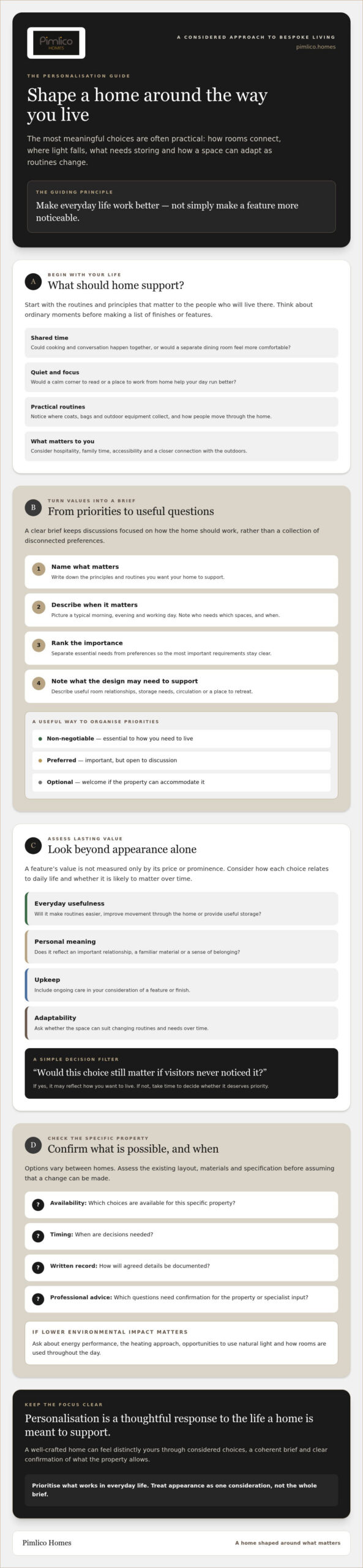
A clear brief turns broad principles into decisions you can discuss and assess. When customising a bespoke luxury new build home, use a simple sequence: name what matters, describe when it matters in daily life, rank its importance, then note what the design may need to support. This keeps discussions focused on how the home should work, rather than a collection of disconnected preferences.
For example, if a lower environmental impact matters to you, ask about the home’s energy performance, heating approach, opportunities to use natural light and how rooms are used throughout the day. These questions don’t prescribe a solution. They help you identify which design details relate to your priorities and which need professional advice or confirmation for the specific property.
Translate everyday routines into spatial requirements
Picture a typical morning, evening and working day. Who needs the kitchen at the same time? Does anyone work from home while others need a quiet place to concentrate? Where do coats, bags and outdoor equipment tend to collect? A household with overlapping morning routines might prioritise clear circulation and convenient storage. Someone who needs uninterrupted focus may place greater importance on separation from shared spaces.
Map how you spend time together and apart. This can reveal useful relationships between rooms, where storage might reduce friction and whether a place to retreat would be valuable. Treat these as requirements to discuss, not assumed features or options in any particular Pimlico Homes property.
Prioritise the brief before discussing finishes
Sort each requirement into three groups: non-negotiable, preferred and optional. Then consider its importance in daily life, relevance over time and flexibility if the property cannot accommodate it. A requirement that affects access or the way household members move through the home may need attention before a finish that can be reconsidered later.
Keep a record of questions, assumptions and decisions, including points that need professional advice or confirmation from the developer. RIBA’s Plan of Work provides a framework for understanding how a construction project progresses through stages. Ask the development team when relevant decisions must be made and which details are confirmed for the home you’re considering.
A ranked brief makes design conversations clearer. It shows what matters most, where you can be flexible and which questions need answers before you decide. To start assessing what a considered new-build design might offer, explore luxury new-build homes from Pimlico Homes and discuss the design intent and confirmed details of a specific property.
Choose bespoke home features for daily life, not appearance alone
A feature can be beautifully made and still prove awkward in daily use. When customising a bespoke luxury new build home, assess each choice for more than its visual impact. Consider how it supports your routines, what it means to you, how it may wear and whether it can adapt as your needs change.
A comparison framework helps you keep the design brief in view. Use it to explore possibilities, not to find one “correct” answer. A material that needs more upkeep may be worthwhile if its character matters to you, while a practical choice needn’t look plain.
| Consideration | Questions to ask |
|---|---|
| Everyday function | Does the choice improve movement, storage, privacy, comfort or the way a room is used? |
| Personal meaning | Does it express a lasting preference, memory or principle that matters to the household? |
| Visual impact | Does it sit comfortably with the home’s overall character, or draw attention for its own sake? |
| Upkeep | How might the material wear, age and need care under your household’s actual routines? |
| Adaptability | Could the feature or space continue to serve you if work, family life or mobility needs change? |
Balance beauty, comfort and long-term use
Look beyond first impressions. Natural light, acoustics, storage, privacy and ease of movement all shape how a home feels over time. A striking surface may give a room character, but its suitability also depends on how it responds to regular use and what maintenance it requires. Ask for relevant care guidance and material information for the specific project before deciding.
Apply the same scrutiny to environmental claims. Ask what evidence supports them, including information about materials, performance and the specification for the particular home. A broad sustainability statement alone may not explain how a product or feature performs in context.
Make choices that remain adaptable
Consider whether rooms could serve more than one purpose as circumstances change. A study might later become a guest room, or a shared space could need to accommodate different patterns of work and leisure. By contrast, fixed joinery or a highly specialised room may work well now but leave fewer alternatives later. Neither is inherently wrong; the right choice depends on your priorities and the property.
Personalisation needn’t fragment a home’s design. Return to the brief: choices that share a clear purpose can feel cohesive, even when they are distinctive. For questions about structural implications, material performance or future flexibility, seek appropriate professional advice and confirm relevant details with the developer for the specific home.
Plan customisation early and verify what a new-build purchase allows
Personalisation isn’t automatic. Choices depend on the specific property, its specification, the stage of construction and the developer’s process. Before making assumptions, ask what can be considered for that home, what is fixed and when decisions are due. Confirm agreed choices in writing, including any conditions or limits.
Timing varies by project, but it helps to think in broad stages. Before reservation, establish which options may be available and whether any decisions have firm deadlines. During construction, ask whether a requested change remains feasible and whether it affects other specifications or programme milestones. After completion, don’t assume an alteration is included in the purchase or can be made by the developer. Confirm the scope directly.
Questions to ask before committing to a property
Use your priorities to guide a practical conversation with the development team. Ask:
- Which choices or changes are available for this specific home, and which elements are fixed?
- What are the decision deadlines, and how are requests reviewed or approved?
- Could a requested change affect other specifications, construction milestones or anyone’s responsibilities?
- How will any associated costs be confirmed, without relying on informal estimates?
- Which drawings, specifications or other documents will record the agreed details?
Answers may differ between properties, even within the same development. Note who confirmed each point and ask for written clarification if an answer is provisional. For contractual questions, seek advice from an appropriately qualified professional. For technical implications, ask a relevant professional to explain what a proposed change would involve.
Keep the design vision coherent through delivery
Keep one current brief alongside the property’s relevant documents. Record your priorities, confirmed choices, outstanding questions and decisions to revisit. If a drawing, written specification and conversation appear inconsistent, pause and ask which information is current. Clear records help prevent an early assumption from being mistaken for an agreed detail.
A bespoke home doesn’t necessarily mean unlimited alterations. Customising a bespoke luxury new build home requires a clear understanding of what the developer can consider for that property and at what stage. Confirm the scope before treating a preference as agreed.
If you’re assessing whether a home’s design intent aligns with your priorities, explore luxury new-build homes from Pimlico Homes and ask the relevant development team which details are confirmed and what options, if any, apply to the specific property.
Find a luxury new build that feels personal from the first conversation
A home may already reflect many of your priorities before you make any personal choices. Assess the property as it stands: how its rooms connect, whether its layout supports your routines and how its materials and specification feel in everyday use. Compare what you see with your ranked brief, rather than judging it only by its potential.
Craftsmanship and thoughtful development matter, but they don’t imply unlimited personalisation. The aim is to understand the home’s design intent and decide whether its qualities suit the people who will live there. Furnishings, familiar objects and daily rituals can also make a well-considered space feel personal.
Assess the home as it is, as well as its potential
Walk through the property with your priorities in mind. Notice which needs the existing layout and specification already meet, and where there may be a gap. Ask which features are included, optional or subject to confirmation for this particular home. This helps you assess what the property offers now, without relying on changes that may not be available.
Make the next conversation specific and informed
Bring your brief and priority questions to your discussion with the sales team. Ask how the design supports the intended way of living, and request clear answers about confirmed options for the individual property. If a response is provisional, ask when it can be verified and how any agreed detail will be recorded.
- Which elements of the specification are confirmed for this home?
- Are any choices available, and what is the relevant decision stage?
- Where can I find the current drawings and written specification?
These questions are especially useful when customising a bespoke luxury new build home, because possibilities depend on the property and its progress. Consider the answers alongside the home’s existing design, not as a promise that it can be reshaped without limit. If a detail matters to your decision, seek confirmation before relying on it.
A considered conversation should leave you with a clearer sense of what the home offers now, what may be possible and what remains unconfirmed. Explore Pimlico Homes’ luxury new-build homes and ask the relevant development team about the design intent and confirmed details of the homes available.
Shape a home around the life you want to live
The most rewarding choices begin with a clear understanding of what your household values. Customising a bespoke luxury new build home means translating those priorities into a considered brief, then weighing each decision for its everyday usefulness, personal meaning and ability to endure. A striking finish may delight, but comfort, thoughtful layout and craftsmanship help a home feel right over time.
Keep your priorities close as you assess a property. Consider how its existing layout and specification support your routines, and ask the development team which options, if any, are confirmed for that particular home and at what stage. Record important answers in writing, and seek appropriate professional advice where technical or contractual questions arise. Personalisation should be grounded in clear information, not assumption.
Pimlico Homes develops luxury detached and executive courtyard homes, bespoke new builds and premium barn conversions, with an emphasis on high-quality craftsmanship. Explore Pimlico Homes’ luxury new-build homes and discuss the design intent and confirmed details of the homes available. With a thoughtful brief and the right questions, you can move towards a home that feels distinctly yours in the ways that matter every day.
Frequently Asked Questions
What does it mean to customise a bespoke luxury new-build home?
It means shaping relevant design choices around the needs and preferences of the people who will live there. That could involve considering how the layout supports daily routines, which materials suit the household or whether a space can serve more than one purpose. Bespoke doesn’t automatically mean every detail can be changed. Available choices depend on the individual property, its specification, construction stage and developer.
How do I make a new-build home reflect my personal values?
Begin by naming the principles that matter to you, then connect them to everyday life. If family time is a priority, consider how shared spaces support gathering. If quiet matters, think about privacy and separation between rooms. Rank essential needs above preferences, and note what each might mean for the home’s design. Use your brief to guide discussions while confirming which options apply to the specific property.
Can I customise a new-build home after reserving it?
Possibly, but reservation doesn’t guarantee that changes will be accepted. Options may depend on the home’s construction stage, specification and the developer’s process. Ask promptly which choices remain available, when decisions are due, whether approvals are needed and how a change could affect other specifications or programme milestones. Request written confirmation of agreed details, and check the relevant purchase documents before relying on an informal discussion.
Which customisations are most useful in a luxury new-build home?
The most useful choices address your household’s real routines. Assess storage, circulation, privacy, natural light, acoustics and whether a room could adapt to changing work or family needs. Consider materials in relation to upkeep and how they may age with regular use. There’s no universal priority list, so compare each possibility with your brief and verify whether it’s available for the property.
How can I make a luxury home feel personal without making it ostentatious?
Focus on choices with lasting personal meaning rather than features selected mainly for display. A material you enjoy living with, a calm arrangement of familiar objects or a room that supports a valued activity can make a home feel distinctive without excess. Consider whether a choice would still matter if visitors never noticed it. Restraint and luxury aren’t opposites; thoughtful design and high-quality craftsmanship can give a home quiet character.
When should I discuss design changes with a new-build developer?
Start the conversation as early as you can, ideally before making assumptions about what a particular purchase includes. Ask what is fixed, which options may be available and when decisions must be made. Timing varies by property and construction progress, so confirm deadlines directly with the developer. Keep written records of questions and agreed details, and seek suitable professional advice if a change raises contractual or technical questions.
Does bespoke mean I can choose every detail of a new-build home?
No. Bespoke describes a home shaped to a particular specification, but it doesn’t mean a buyer can select or alter every element. Some details may already be fixed by the property’s design, specification or construction stage. Ask the developer what choices are confirmed for that home, what may be considered and how decisions will be documented. Pimlico Homes develops bespoke luxury homes, but options should be verified for each individual property.





