
The appearance of a fine hairline fracture on a flawless silk-finish wall isn’t a sign of failure; it’s the first breath of a home finding its place in the world. When dealing with minor settlement cracks, it’s essential to understand that even the most meticulously crafted luxury new builds undergo a period of maturation. You’ve invested in a masterpiece. It’s entirely natural to feel a sense of unease when the pristine aesthetic of your residence appears compromised. We recognise the weight of this investment and the desire to maintain every detail in its intended state of perfection.
This guide will provide the clarity you need to distinguish between these expected cosmetic shifts and genuine structural concerns, ensuring your property remains a sanctuary of quality. We’ll explore the science behind the natural drying out process and the specific thresholds established by the 2026 NHBC Standards. You’ll gain a clear understanding of the ideal timeline for repairs, alongside the reassurance that these subtle movements are simply part of your home’s journey toward permanent stability.
Key Takeaways
- Understand the vital distinction between ground settlement and the natural shrinkage of materials, ensuring you can view your home’s maturation with confidence.
- Learn to apply the 2mm rule when dealing with minor settlement cracks to identify which apertures are purely cosmetic and which require professional inspection.
- Discover why waiting through a full twelve month heating cycle is the only way to achieve a permanent, seamless repair of your home’s interior finish.
- Gain insight into how modern, high-specification construction methods and energy efficiency influence the pace at which your new residence breathes and settles.
- Recognise the markers of structural integrity that signify a well-built home, providing peace of mind regarding your significant life investment.
Understanding the Natural Evolution of Your Luxury Home
A new build is more than a mere assembly of brick and mortar; it’s a complex, handcrafted structure integrating with its environment. This initial phase of life is often when homeowners find themselves dealing with minor settlement cracks. Far from being a flaw, these subtle apertures represent a home finding its equilibrium. It’s a sign of a high-quality home “breathing” as it finds its permanent posture within the landscape.
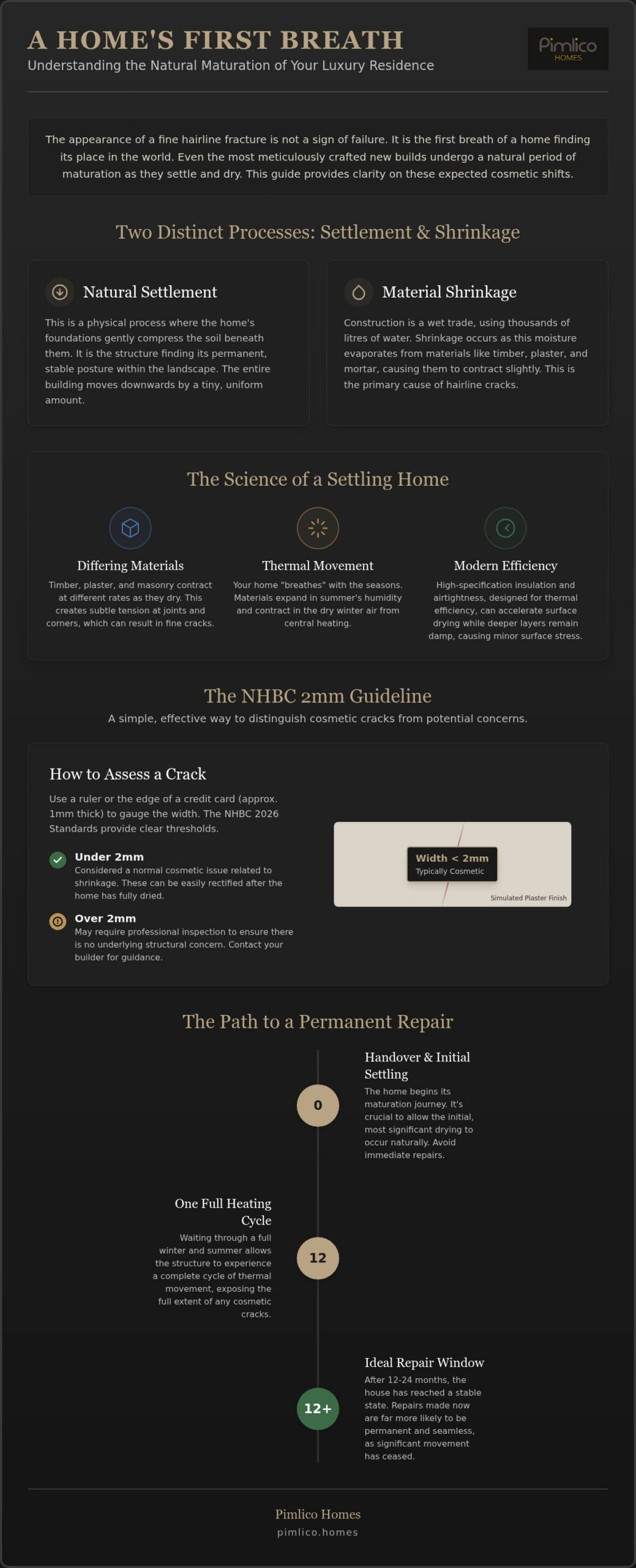
To understand this maturation, we must distinguish between two distinct physical events. The natural settlement process refers to the way foundations compress the soil beneath them. Conversely, “shrinkage” involves the evaporation of moisture from materials like timber, plaster, and mortar. Traditional construction uses thousands of litres of water during the build. As this moisture leaves the structure, materials contract slightly. As the house dries out, the timber and plaster undergo a delicate transition, occasionally resulting in hairline separations at the joints. This is entirely expected and a sign of a building reaching its final, stable state.
Why Even Bespoke Properties Experience Movement
Excellence in construction doesn’t exempt a property from the laws of physics. High-specification materials often carry significant weight. Whether it’s the robust timbers of bespoke barn conversions or the substantial masonry of luxury detached homes, these elements must settle onto their footings. Local climate and soil density also play their parts in this initial transition. This period of architectural harmony between the build and the site typically spans the first 12 to 24 months. We call this the maturation period of a premium residence.
The Emotional Journey of New Home Ownership
We understand that for an executive homeowner, perfection is the baseline. Discovering a hairline crack in a pristine hallway can feel like a compromise of your significant life investment. Your concern is valid. However, our 25 years of industry experience suggests a methodical approach is best. We remain your dedicated guardian of quality throughout this transition. Dealing with minor settlement cracks is not a task for the first few weeks of occupancy. It’s a conversation between the home and its inhabitants that requires patience. We provide the expert reassurance you need to navigate this phase with refined pride and complete security.
Construction is fundamentally a wet trade. Thousands of litres of water are poured into mortar, plaster, and floor screeds during the meticulous creation of a residence. As you begin your life in a new property, this moisture must exit the structure. In a high-specification Pimlico home, our advanced insulation and airtightness are designed for superior thermal efficiency. This same efficiency means internal temperatures remain consistent, which can accelerate the surface drying of plaster whilst the deeper masonry remains damp. This disparity is often the root cause when homeowners find themselves dealing with minor settlement cracks.
Different materials react to this drying process with varying degrees of flexibility. Masonry is inherently rigid. Plasterboard serves as a smooth, decorative skin over a more complex skeleton. Timber, being an organic material, is the most dynamic of all. When these materials meet at joints or corners, their differing rates of contraction create subtle tension. It’s a natural physiological shift as the house matures into its final form.
Thermal Movement and Seasonal Rhythms
The internal climate of your home changes with the seasons. During the winter months, central heating reduces humidity, causing timber and plaster to contract. In the summer, higher moisture levels in the air cause these same elements to expand. Thermal movement is the expansion and contraction of building elements due to temperature fluctuations. This rhythmic breathing is a permanent feature of any building. It’s why we recommend a gentle, steady approach to heating during your first year of occupancy.
The Specific Challenges of Luxury Barn Conversions
Bespoke barn conversions present a unique interplay between heritage and modern engineering. Original oak beams have often spent centuries reaching their equilibrium. When integrated with new structural elements, they may develop “shakes”; longitudinal cracks that are a hallmark of aged timber. These are not defects. They are expressions of character that enhance the aesthetic of bespoke luxury homes. To minimise extreme shifts, we advise maintaining a consistent internal temperature, allowing the historic and contemporary materials to settle in unison. This careful management ensures the longevity of the craftsmanship whilst the property finds its new rhythm.
The 2mm Rule: Identifying Minor Cracks vs Structural Concerns
Precision is the hallmark of a Pimlico home, yet even the most stable structures possess a degree of flexibility. When dealing with minor settlement cracks, the most reliable metric at your disposal is the 2mm rule. This industry benchmark, aligned with the 2026 NHBC Standards, distinguishes between the superficial movements of drying materials and more significant shifts. Typically, these hairline fractures appear where stress naturally concentrates. You will often find them above door frames, at the delicate junctions of ceiling joints, or tucked into the corners of a room where different planes meet.
A measured approach is always superior to a reactive one. By monitoring these apertures over a period of months, you can observe whether they stabilise or evolve. This methodical process of dealing with minor settlement cracks ensures that you do not rush into premature repairs that may need repeating as the home finds its final posture. Maintaining this quiet confidence is essential to the experience of luxury home ownership.
Characteristics of Cosmetic Settlement
Cosmetic cracks often follow the linear path of a plasterboard joint. They frequently manifest where two differing materials converge, such as where a timber architrave meets a plastered wall. Because timber and plaster react to humidity at different rates, a small separation is a logical physical outcome. These are rarely a cause for alarm and are a standard part of a building’s maturation.
| Feature | Cosmetic Settlement | Structural Concern |
|---|---|---|
| Width | Hairline to 2mm | Exceeding 5mm |
| Direction | Vertical or diagonal | Horizontal or “stepped” |
| Visibility | Internal surfaces only | Visible on external masonry |
When to Seek Professional Guidance
Whilst most movement is benign, certain indicators warrant a more formal investigation. If you observe cracks wider than 5mm, or those that appear on the external brickwork in a stepped pattern, professional counsel is advised. Sticking doors or windows that suddenly resist their frames can also signal a shift beyond normal maturation. In these instances, your structural warranty serves as a vital safeguard. Understanding luxury new build warranties is essential for any discerning homeowner. It ensures your investment remains protected through every phase of the property’s life, providing the security that a high-end investment deserves.
Best Practices for Maintenance and Rectification
When dealing with minor settlement cracks, the most effective tool in your possession isn’t a trowel or a paintbrush. It is patience. We recommend a “Patience Period” of at least twelve months before attempting any cosmetic repairs. This duration ensures the property has experienced one full cycle of seasonal heating and cooling, allowing materials to reach a state of permanent equilibrium. Rushing to fill a gap whilst the structure is still finding its posture is often a wasted effort. The material will continue to contract, inevitably pulling the new filler apart and causing the fracture to reappear. By waiting for the maturation period to conclude, you ensure the repair is final and the aesthetic remains unblemished.
The Art of the Professional Repair
Achieving a seamless finish requires a methodical approach that mirrors the original craftsmanship of the home. A common mistake is simply spreading filler over the top of a hairline crack. Instead, the technique of “raking out” should be employed. This involves gently widening the crack into a small “V” shape using the edge of a scraper. This process creates a larger surface area, ensuring the filler can establish a deep, lasting bond with the substrate.
- Select Flexible Fillers: Avoid rigid, brittle products that cannot accommodate subtle thermal movement. Premium flexible fillers are designed to move with the home.
- Precision Sanding: Once dry, the area should be sanded with a fine-grade abrasive to ensure it is perfectly flush with the surrounding plaster.
- Exact Colour Matching: Always use the original paint colour and finish. Even slight variations in sheen can become visible under the sophisticated lighting often found in executive homes.
Managing Internal Environment for Stability
The way you inhabit your home during its first year significantly influences how it settles. We advise maintaining a consistent, moderate temperature throughout the first winter. Turning the heating to an extreme high can accelerate drying too rapidly, leading to more pronounced shrinkage. Managing moisture is equally vital. Modern properties are designed to be airtight, so utilising trickle vents and extractor fans is essential to prevent moisture from becoming trapped within the materials.
This level of climate control is one of the many benefits of buying a new build. Our homes are engineered for superior energy efficiency, providing a stable foundation for a comfortable lifestyle. If you are ready to experience this level of quality firsthand, explore our current range of luxury new build homes and discover the Pimlico difference. By following these maintenance rhythms, you protect both the structural integrity and the exquisite finish of your residence for decades to come.
The Pimlico Promise: Excellence Beyond the Handover
Excellence is a journey, not a destination. At Pimlico Homes, we believe the completion of a build is merely the beginning of a property’s story. Dealing with minor settlement cracks is a natural chapter in that narrative. It’s the process of a new structure harmonising with its environment. Our construction methods are designed to respect this evolution whilst minimising the impact on your daily life. We employ high-specification materials and advanced masonry techniques that provide a robust skeleton for your home. These methods are specifically engineered to mitigate excessive movement, ensuring that the maturation of your residence is a subtle, quiet transition rather than a disruptive event. We view this period as a testament to the home’s organic integration with the ground beneath it.
A Legacy of Quality in Every Detail
We apply a meticulous eye to every phase of construction. From the precise depth of the foundations to the moisture content of the bespoke timbers, our standards are uncompromising. This precision ensures that any movement remains within the expected cosmetic thresholds discussed throughout this guide. We don’t just build houses; we create legacies. Investing in such quality doesn’t just provide immediate luxury. It secures the long-term resale value of new build homes. We position ourselves as your partner in property stewardship, ensuring your investment matures as beautifully as the landscape surrounding it. Our 25 years of experience have taught us that true quality is measured by how a home stands the test of time.
Discover the Future of Executive Living
Our portfolio of executive courtyard homes and luxury detached residences is built on a foundation of trust. We don’t vanish after the handover. Our dedicated post-purchase support is a core pillar of our service, blending the authority of an industry expert with the warmth of a dedicated provider. We guide you through the initial snagging process with the same care we used during the build. This methodical approach ensures that every hairline separation is addressed at the optimal time, preserving the prestige of your residence. We remain a reliable guardian of your home’s quality, long after you’ve first turned the key in the lock.
If you’re currently navigating the maturation period of your property or seeking further advice on dealing with minor settlement cracks, our team remains at your disposal. We invite you to contact us to discuss your home’s maintenance or to explore our vision for future developments. A Pimlico home is a promise of permanence, artistry, and unwavering support. It’s a significant life investment, and we’re here to ensure it remains as pristine as the day it was finished. Your peace of mind is our ultimate output, and your satisfaction is the true measure of our success.
Securing the Legacy of Your New Residence
Your home is a living masterpiece. It’s finding its permanent equilibrium within the landscape. By recognising that cosmetic shrinkage is a sign of a house “breathing,” you can navigate the first year of occupancy with quiet confidence. Dealing with minor settlement cracks requires only a methodical approach and the patience to allow materials to reach their final state. This maturation period is a natural phase of property stewardship, ensuring the long-term beauty of your investment. It’s a journey from a new structure to a timeless heritage asset.
We remain your dedicated guardian of quality. Pimlico Homes brings 25 years of luxury development experience to every project, ensuring NHBC-standard construction quality is always the baseline. Our expert-led post-purchase support provides the security you deserve, protecting the prestige of your home long after the final brick is laid. Your sanctuary is built to endure. It’s a place where traditional values and innovative thinking converge to create a lasting legacy for your family.
Discover our exclusive range of luxury new build homes and explore a future defined by excellence. Your vision of a perfect home is our enduring commitment.
Frequently Asked Questions
Is it normal for a new build home to have cracks?
Yes, it’s entirely expected for a new build home to develop minor cracks. New homes contain thousands of litres of water within the plaster and mortar. As these materials dry, they naturally shrink. This is a sign of the property finding its unique equilibrium. Even in high-specification luxury detached homes, these hairline fractures are a standard part of the maturation process. They reflect the house settling into its foundations and adjusting to the landscape.
How long does a new house take to settle completely?
The maturation process typically spans the first 12 to 24 months. This timeline allows the structure to experience at least one full cycle of seasonal changes. During this period, the heating and cooling of the seasons cause materials like timber and masonry to expand and contract. Once the home has passed through these cycles and the internal moisture has evaporated, the movement usually stabilises into a permanent state of stability and grace.
Should I fix settlement cracks immediately?
You should wait at least one full year before attempting repairs. Filling cracks too early is often counterproductive. If the structure is still drying, the material will continue to shift, causing any new filler to crack or pull away. By observing a patience period of twelve months, you ensure that the repair is a final, seamless addition to your home’s pristine finish. It’s about long-term property stewardship rather than a quick fix.
Will settlement cracks affect my home’s resale value?
Minor cosmetic cracks won’t impact the value of a high-end property. Discerning buyers and surveyors understand that hairline fractures are a natural byproduct of the drying out process in new builds. In fact, seeing a property that has been allowed to settle properly can be a sign of quality. Dealing with minor settlement cracks correctly demonstrates that the owner has maintained the residence with meticulous care and expert guidance since the handover.
Are settlement cracks covered by my home warranty?
Cosmetic cracks are often the homeowner’s responsibility unless they exceed specific thresholds. Under the 2026 NHBC Standards, builders typically address defects in the first two years, but minor shrinkage is often excluded as it’s considered maintenance. However, cracks wider than 3mm or 5mm may be covered as defects. It’s essential to check your specific structural warranty documentation to understand the dedicated support available for your executive residence during the initial years.
What is the “2mm rule” for settlement cracks?
The 2mm rule is a standard industry benchmark for classifying cosmetic movement. Cracks that are hairline or up to 2mm in width are generally considered a natural result of materials drying and shrinking. These aren’t structural concerns. If a crack exceeds this width or appears on external masonry, it warrants a professional inspection. This rule helps homeowners distinguish between expected maturation and issues that require more formal architectural investigation and structural survey work.
How can I prevent cracks from appearing in my new home?
You can mitigate movement by maintaining a consistent internal climate. Avoid turning the heating to extreme levels during the first winter, as rapid temperature shifts can accelerate shrinkage. Ensure your home is well-ventilated by using trickle vents and extractor fans to manage moisture levels effectively. Whilst you can’t stop the natural drying process, a steady and methodical approach to heating helps the materials settle more gently and harmoniously within the structure.
Can I use a normal filler for settlement cracks?
We recommend using high-quality flexible fillers rather than standard rigid products. Rigid fillers are prone to cracking again if the home undergoes even the slightest thermal movement. A flexible alternative is designed to move with the structure, providing a more durable and seamless bond. When dealing with minor settlement cracks, using the correct professional-grade material is vital to preserving the artistry and sophisticated finish of your silk-smooth walls and detailed cornicing.


