
A luxury home is the ultimate expression of permanence, yet the current construction environment can feel unexpectedly fragile. With 3,841 firms entering insolvency in the twelve months preceding July 2026, the question of developer insolvency what happens to my deposit has moved from a legal footnote to a primary concern for the astute buyer.
It’s natural to feel a sense of trepidation when committing substantial capital to a vision that is still unfolding. We believe that true luxury is found in peace of mind, not just in the meticulous finish of a bespoke luxury home. This article provides a definitive roadmap to securing your investment, ensuring you understand exactly how your funds are shielded whilst navigating market volatility. We will examine the essential layers of protection, including ironclad NHBC deposit limits and the vital role of your solicitor in managing stakeholder accounts. You’ll gain the actionable insights required to conduct rigorous due diligence, allowing you to move forward with the quiet confidence that your legacy is secure.
Key Takeaways
- Distinguish between reservation fees and contract deposits to ensure you possess a clear and accurate view of your initial financial commitments.
- Navigate the complexities of structural warranties and learn how providers such as the NHBC safeguard your capital through specific deposit protection schemes.
- Discover why insisting that your solicitor holds funds as a stakeholder is the most robust way to address the question of developer insolvency what happens to my deposit.
- Implement a rigorous due diligence framework to scrutinise a developer’s corporate stability, financial health, and long-term industry heritage.
- Understand how the Pimlico Standard ensures your investment is protected through meticulous legal structuring and a commitment to transparency.
Understanding Developer Insolvency and Your Financial Exposure
The landscape of UK residential construction has faced significant headwinds recently. In the twelve months leading up to July 2026, 3,841 construction firms entered insolvency, representing a 19% increase compared to 2019 levels. For a buyer committed to a luxury new build, these figures are more than mere statistics; they represent a potential disruption to a significant life investment. Developer Liquidation is the formal closing of a construction business whilst assets are distributed to creditors. When this occurs, the primary concern remains developer insolvency what happens to my deposit, as the legal standing of your funds depends heavily on the stage of the transaction.
The timing of a developer’s collapse changes the trajectory of your recovery. If insolvency occurs pre-exchange, your reservation fee is the only capital at risk. However, post-exchange, the contract deposit, typically 10% of the purchase price, becomes the focal point of legal protection. It’s essential to understand the nature of Deposit insurance schemes and how they mirror property safeguards to ring-fence your wealth effectively.
Reservation Fees vs. Exchange Deposits
Reservation fees are often smaller sums paid to secure a plot. They carry limited legal protection and are frequently held directly by the developer, making them harder to recover if the firm fails early. In contrast, exchange deposits are substantial sums governed by the contract of sale. These are usually protected by structural warranties, though the level of cover varies. A critical component of your contract should be the “Longstop Date.” This clause provides a contractual right to rescind the agreement and reclaim your deposit if the home isn’t completed by a specific deadline, offering a vital exit strategy amongst the uncertainty of a delayed build.
The Immediate Impact of a “Site Stop”
A “site stop” is a distressing moment where the rhythmic progress of craftsmanship ceases. When work stops on an executive development, an administrator is appointed to manage the developer’s affairs. Their role is to assess the value of unfinished luxury builds and determine if the project can be sold to another firm or completed under new management. Your first step must be to contact your solicitor to verify the status of your funds. You’ll need to confirm whether your money was held in a secure account or released to the developer, as this determines your priority in the hierarchy of creditors.
The Safety Net: Structural Warranties and Deposit Insurance
The structural warranty is the cornerstone of security in the luxury market. It serves as a binding promise that your vision will manifest, even if the original creator falters. When considering developer insolvency what happens to my deposit, the answer often lies within the meticulous details of these insurance policies. Providers like NHBC, ICW, or Premier Guarantee offer a specific “Insolvency Cover” clause that activates if a builder ceases trading before completion. This protection is not merely a formality; it’s a vital financial shield for your capital.
Standard Warranty Protections (NHBC and Beyond)
The mechanism is designed to be precise. If a developer fails, the warranty provider may either arrange for the build’s completion or refund the deposit. As of September 2026, the NHBC Buildmark policy typically covers a deposit of up to 10% of the purchase price, capped at £100,000. For those investing in bespoke luxury homes where a 10% deposit can easily reach six figures, this cap presents a significant consideration. It’s imperative that your solicitor confirms if the policy limits align with your financial commitment. You must ensure the Insurance Certificate is issued at the point of exchange. This document confirms that the cover is live, providing the necessary reassurance before the first brick is laid.
Deposit Release Bonds for Premium Developments
In some high-end projects, developers may utilise Deposit Release Bonds to access capital during the construction phase. This tool allows the developer to use your deposit for building costs whilst providing an insurance bond as security. While this can aid project liquidity, it introduces a layer of complexity regarding credit risk. If the bond provider’s credit rating is insufficient, your capital is exposed to the insurer’s own stability. We find that the most secure route involves traditional methods where funds remain legally ring-fenced. At Pimlico Homes, we prioritise heritage-backed stability to ensure your journey toward owning one of our luxury detached homes remains serene and secure. Your solicitor must rigorously vet the bond provider’s financial standing to ensure the security is as robust as the architecture it funds. Addressing developer insolvency what happens to my deposit requires this level of forensic attention to detail.
The Solicitor’s Role in Ring-Fencing Your Investment
In the premium property sector, the role of a solicitor transcends standard conveyancing; they act as the technical architect of your financial security. When a 10% deposit on a high-specification residence exceeds £100,000, the standard protections offered by warranty providers may not cover the full breadth of your exposure. This is why the legal framing of the purchase contract is paramount. Your legal representative must conduct a forensic review of the developer’s standing, ensuring that the “Report on Title” includes robust insolvency clauses. This rigorous approach is a cornerstone of The Ultimate Guide to Buying a Luxury New Build Home in 2026, where legal due diligence is positioned as the primary defence against market volatility.
Stakeholder vs. Agent: A Critical Distinction
The technical designation of how your funds are held is perhaps the most significant factor in determining developer insolvency what happens to my deposit. Contracts typically allow for two paths. If funds are held as “Agent for the Vendor,” the developer may access the deposit immediately to fund construction costs. Whilst this aids project liquidity, it leaves the buyer as an unsecured creditor if the firm fails. Conversely, insisting on “Stakeholder” status ensures the deposit remains in a solicitor’s client account, untouched until the moment of completion. For executive buyers, this status is non-negotiable. It provides a literal ring-fence around your capital, ensuring that even if the developer falters, your investment remains exactly where you left it. Negotiating these terms requires a solicitor familiar with bespoke luxury home contracts who can advocate for your security over the builder’s cash flow.
The Conveyancing Process for High-Specification Homes
Beyond the deposit itself, your solicitor must verify that the developer holds a clear title to the land. They will scrutinise the “Disclosure Note” to identify any prior charges or financial encumbrances that might take precedence over your interest in the event of a collapse. This level of protection is not just about the present; it is a vital component in maintaining the resale value of new build homes north east. A property with a clean legal heritage and a transparent construction history will always command a premium in the secondary market. By ensuring that no third-party lender can claim priority over your deposit, your legal team provides the peace of mind that allows you to focus on the design and lifestyle your new home will provide.
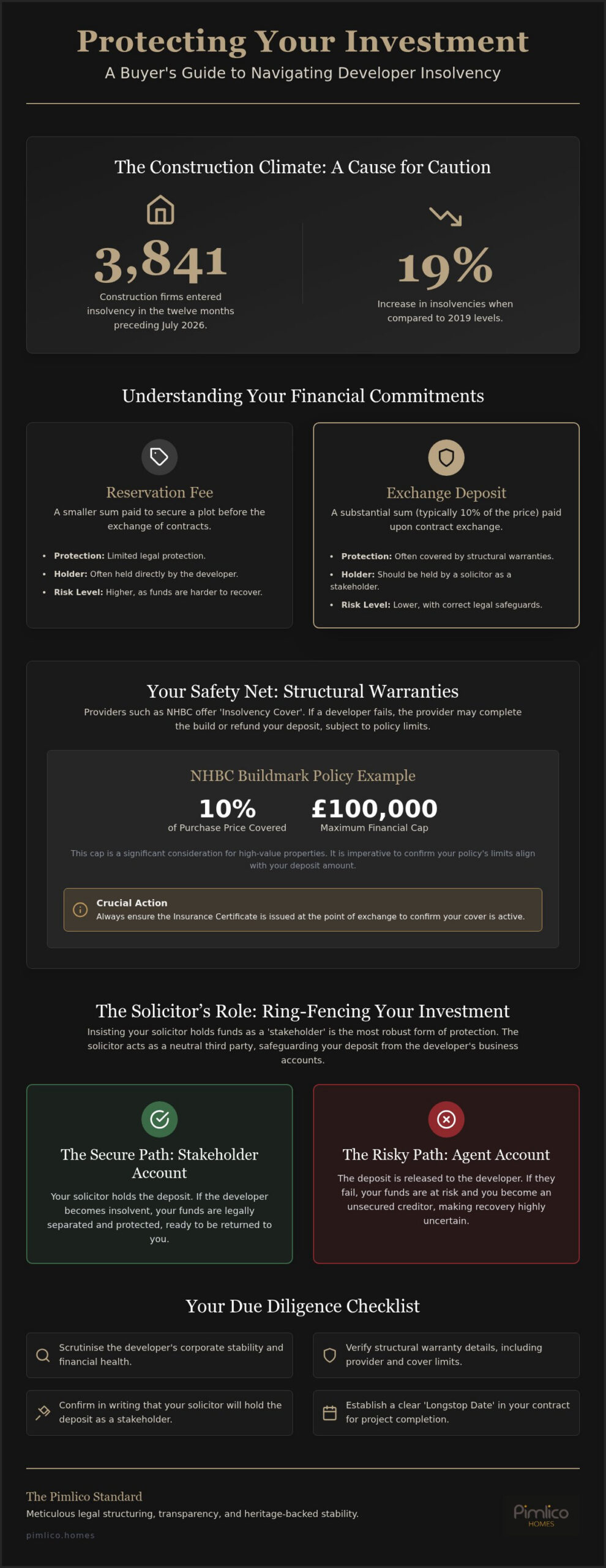
Due Diligence Checklist for the Discerning Buyer
The acquisition of a premium property requires a forensic level of scrutiny that extends far beyond the aesthetic appeal of a show home. For the high-net-worth investor, due diligence is an exercise in rigorous risk mitigation. It ensures that the architectural vision is underpinned by corporate substance. When investigating developer insolvency what happens to my deposit, the pedigree of the builder is your first line of enquiry. A firm with a multi-decade history offers a level of permanence that a newly formed entity simply cannot match.
Financial Health and Track Record
A builder’s heritage is often reflected in their corporate filing history. You should use Companies House to review the accounts of the parent company, looking specifically for any “Notice of Liquidator” or signs of financial distress in the group structure. It is common for developers to use a “Special Purpose Vehicle” (SPV) for individual projects. Whilst this is a standard industry practice, you must verify that the SPV is backed by a parent company with significant assets and a 25-year industry pedigree. Bespoke luxury home builders often provide greater stability than volume housebuilders. This is because their business models rely on craftsmanship and reputation rather than high-leverage land banking. Stability is a product of deliberate growth and meticulous financial management.
On-Site Evidence of Stability
Physical evidence on the construction site often reveals more than a balance sheet. The presence of owned plant and machinery, rather than a reliance on short-term leased equipment, suggests a developer with deep roots and long-term commitment. You should observe the pace of construction on existing luxury residential developments to ensure a consistent rhythm of work. A stagnant site is a primary warning sign. Seeking testimonials from previous buyers regarding the handover process provides an intimate view of the developer’s reliability. You should also verify the presence of a 10-year structural warranty from a reputable provider as a final, non-negotiable step. At Pimlico Homes, our heritage of excellence ensures that every one of our new build homes is built on a foundation of financial transparency and structural integrity. This methodical approach ensures that the question of developer insolvency what happens to my deposit is answered by the strength of the developer itself.
The Pimlico Standard: Stability, Heritage, and Peace of Mind
Prestige is not merely an aesthetic choice; it’s a commitment to enduring stability. At Pimlico Homes, we recognise that the journey to owning a bespoke luxury home should be as refined as the architecture itself. Whilst the broader market may grapple with uncertainty, our 25-year industry pedigree provides a foundation of corporate strength. When clients ask about developer insolvency what happens to my deposit, they find the answer in our heritage-backed stability and meticulous financial structuring. We position ourselves not just as builders, but as reliable guardians of your long-term investment. This authority isn’t something we take lightly. It’s earned through decades of excellence and a steadfast refusal to compromise on the security of our clients.
A Legacy of Excellence
Our history is defined by the successful delivery of premium barn conversions and executive estates. These projects stand as a testament to our focus on high-specification craftsmanship and meticulous care. Discerning clients trust the Pimlico name because we prioritise the security of their capital alongside the artistry of the build. This “Quiet Confidence” stems from a deep-seated pride in our output and an unwavering focus on the human experience. We don’t believe in aggressive sales tactics. Instead, we offer a sophisticated narrative that emphasises longevity and uniqueness. We understand that a home is a significant life investment, and our heritage ensures that your property’s value remains protected through every market cycle, amongst the shifting sands of the wider economy.
Your Future, Secured
Choosing a Pimlico bespoke home means engaging with a visionary creator who values transparency. We employ robust legal safeguards, ensuring that funds are ring-fenced through stakeholder status and protected by comprehensive 10-year structural warranties. These layers of protection are designed to eliminate the anxiety often associated with market volatility. If you’re concerned about developer insolvency what happens to my deposit, our team is here to provide the precise, elevated clarity you require. We invite you to discuss these specific security measures with our executive team, who remain accessible and supportive throughout the construction process. By blending innovative thinking with traditional values, we create a legacy of security for every buyer. It’s a methodical process that creates a sense of scale and depth, ensuring your vision is realised with absolute certainty.
Explore our current luxury developments and secure your vision.
A Foundation Built on Certainty
Securing a luxury home is a significant life investment that demands more than just aesthetic appreciation. It requires a meticulous understanding of legal safeguards and developer stability. By ensuring your solicitor insists on stakeholder status and verifying that warranty caps align with your capital, you transform a potential risk into a protected asset. Understanding developer insolvency what happens to my deposit is the first step toward a secure acquisition. This knowledge, coupled with rigorous due diligence into a builder’s corporate heritage, ensures that your vision is never compromised by market volatility.
With 25 years of specialist experience, Pimlico Homes has built a reputation for delivering high-specification executive courtyard homes with an unwavering commitment to buyer security and legal transparency. We invite you to discover the security and prestige of a Pimlico Home. Your future residence should be a sanctuary of peace, supported by the quiet confidence of a master craftsman who prioritises your protection as much as the artistry of the build. We look forward to helping you secure a legacy of excellence.
Frequently Asked Questions
Can I get my deposit back if the developer goes bust before exchange?
If a developer enters insolvency before the exchange of contracts, your ability to recover a reservation fee depends on the terms of the reservation agreement. These smaller sums are typically not covered by structural warranties. If the developer held the funds directly, you might become an unsecured creditor. However, if the fee was held in a solicitor’s client account, recovery is significantly more straightforward. It’s essential to verify these holding terms before making any initial payment.
Is my deposit protected if I am buying a bespoke luxury barn conversion?
Your deposit for a bespoke luxury barn conversion is protected provided the project is registered with a reputable structural warranty provider like the NHBC or Premier Guarantee. These policies include specific insolvency cover designed to safeguard your capital during the construction phase. At Pimlico Homes, we ensure every conversion project adheres to these rigorous standards. This provides a layer of legal and financial security that mirrors the permanence and artistry of the architectural work itself.
What is the maximum NHBC deposit protection limit in 2026?
As of September 2026, the maximum NHBC Buildmark deposit protection limit remains capped at £100,000. This figure represents 10% of the original purchase price up to that specific maximum value. For executive buyers investing in properties where the deposit exceeds this cap, it’s vital to discuss additional security measures with your legal team. Addressing developer insolvency what happens to my deposit requires understanding these specific thresholds to ensure your full financial exposure is appropriately managed.
What happens if the cost to complete my home exceeds the original price after insolvency?
If the cost to finish your home exceeds the original contract price following a developer’s collapse, the warranty provider typically has two options. They may choose to pay the additional costs to complete the building work, subject to their policy limits, or they might simply refund your original deposit. This decision rests with the insurer and is based on the most viable financial outcome. Your solicitor should review these policy nuances to ensure your interests are protected.
Should I pay my deposit to the developer directly or to my solicitor?
You should always pay your deposit to your solicitor to be held in a secure client account. Paying a developer directly is a high-risk strategy that leaves your capital vulnerable to the firm’s immediate cash flow needs. By ensuring your solicitor holds the funds as a stakeholder, the money remains legally ring-fenced until completion. This methodical approach is a hallmark of the security we provide at Pimlico Homes, ensuring every transaction is governed by transparency.
Does a structural warranty cover the full purchase price or just the deposit?
A structural warranty provides two distinct phases of cover. During the construction period, it specifically protects the deposit, typically up to 10% of the purchase price or a set cap. It doesn’t cover the full purchase price if the developer fails before completion. Once you move in, the policy shifts to cover the structural integrity of the building for ten years. Understanding developer insolvency what happens to my deposit involves recognising this specific distinction in insurance coverage.
How long does it take to claim a deposit refund through a warranty provider?
The timeframe for claiming a deposit refund through a warranty provider varies depending on the complexity of the insolvency proceedings. It typically takes several months for the insurer to verify the claim and assess the developer’s status with the administrator. Whilst this process requires patience, the presence of a valid insurance certificate ensures that your capital is legally prioritised. Maintaining clear communication with your solicitor during this period is essential for a steady and successful recovery.
What is a “Longstop Date” and how does it protect my capital?
A “Longstop Date” is a definitive contractual deadline by which the developer must complete the property. If the home isn’t finished by this date, you have the legal right to rescind the contract and reclaim your full deposit. This clause acts as a vital safety net, preventing your capital from being indefinitely tied up in a stalled development. It provides a clear exit strategy, allowing you to move forward with your life if the project falters.





