
Can a developer change the home you agreed to buy? The answer may depend on the wording of your contract, the reason for the proposed change and its effect on the finished property. It’s understandable to feel uncertain when a revised plan or specification affects the design, materials or details you carefully chose. The developer’s right to vary plans and specifications explained in context is not a simple yes-or-no question: the contract and circumstances matter.
Before accepting a change, look beyond whether it’s described as minor. Identify what has changed, compare it with the plans and schedules you received, and consider whether the alteration could affect the home’s quality, appearance or use. This article explains what a variation clause may allow, what to review when a change is communicated and which documents to revisit before committing to a new-build purchase. A clear record of the agreed design and specification gives you a practical basis for assessing any revision.
Key Takeaways
- The developer’s right to vary plans and specifications explained depends on the wording of the signed contract and the circumstances of the proposed change.
- Read the variation clause closely, including any exceptions and the process for notifying you or seeking approval.
- Compare the proposed revision with the agreed plans and specification, noting what changes and how it could affect the home in practice.
- Keep the change notice and related documents, and seek written clarification of the reason, timing and documents that will be updated.
- Reviewing plans and specifications before committing can help you understand the design and details that shape your new-build purchase.
What does a developer’s right to vary plans and specifications mean?
A new-build contract may describe a home before every finish, fitting or construction detail is final. For a buyer, that can raise a natural concern: how much room does the developer have to change what was agreed? The answer starts with the contract. A variation clause sets out whether and how the developer may change the home’s plans or specification. Its effect depends on the precise terms, the rest of the agreement and the circumstances of the proposed change.
Contractual variation is separate from planning permission. Planning permission concerns whether a development or change has the required planning approval; a variation clause concerns what the purchase contract allows between buyer and developer. One does not automatically settle the other. Keeping these questions separate is central to having a developer’s right to vary plans and specifications explained clearly.
What counts as plans and specifications in a new-build contract?
Plans and specifications are the documents that describe the home you’re buying. They may include drawings showing layout and dimensions, schedules of finishes setting out materials and fittings, and written descriptions of features such as doors, windows or external details. Check which documents the contract incorporates, and note their dates or revision numbers. A later drawing may differ from the version attached to, or referred to by, the agreement.
Why might a developer propose a change?
A proposed revision might arise from design coordination, a technical constraint or a product substitution. For instance, a fitting shown in a schedule may be replaced with an alternative. These are possible explanations, not assumptions about a particular proposal. A stated reason can help explain the change, but does not by itself establish whether the contract permits it. The clause and the relevant documents remain central to understanding the position.
In construction, a variation generally refers to a change to the agreed work. The Variations in construction contracts overview provides useful context on how such changes may be addressed. For a homebuyer, the practical point is that “variation” is not a universal permission: the contract wording and circumstances determine its scope.
What can a developer’s variation clause allow, and where are its limits?
A variation clause may give a developer scope to alter aspects of a home, but it does not provide a universal permission to change anything. The signed contract, its incorporated documents and the circumstances all matter. Broad wording may appear to allow flexibility, whilst listed exceptions, limits or required procedures may narrow how that flexibility operates. The phrase developer’s right to vary plans and specifications explained has no reliable answer without reference to the actual agreement.
Contractual discretion is also distinct from planning permission and other regulatory requirements. A clause in a sale contract does not, by itself, grant planning approval or settle whether other rules apply to a change. These questions must be considered separately. The legal framework can also differ between England and Wales, Scotland, and Northern Ireland, so buyers should have the documents reviewed in the context of the relevant jurisdiction.
Which contract documents define the developer’s discretion?
Gather the sale contract, the plans and specification it incorporates, and any schedule dealing with variations. Check for an order-of-precedence clause, which may state which document governs if, for example, a drawing and a written description appear inconsistent. Record the exact clause and the version or date of each relevant document. This gives your conveyancing solicitor a clear basis for reviewing the wording and identifying any conflict.
Read the clause closely for the kinds of changes it addresses, any stated limits or exceptions, and the process it sets out. Does it refer to materials, dimensions, layout or other features? Does it require notice, consultation or approval? The answer depends on the words used and their relationship to the rest of the contract, not simply on a developer’s summary of the clause.
How do notice, consent and remedies depend on the wording?
These terms are not interchangeable. Notice means being informed; consultation may involve an opportunity to give views; consent suggests approval is required. A remedy describes what may follow if a contractual obligation is not met. None of these automatically gives a buyer a right to reject a change, cancel the purchase or receive compensation. Those outcomes require contract-specific analysis, including consideration of any applicable law.
Statutory protections and consumer-code arrangements may also be relevant, but their application should be checked against current requirements and the contract before relying on them. Keep communications and revised documents together, and seek advice on the exact wording before responding to a consequential change. Careful scrutiny of the agreement is part of choosing a considered home. You can also explore Pimlico Homes’ new-build homes.
Is a proposed specification change minor or materially significant?
Start by comparing the agreed contract documents with the proposed revision, rather than relying on a general description such as “like for like” or “minor”. Identify exactly what differs, then consider its practical effect on the home. A finish substitution may leave a room’s function unchanged, whilst a revised partition could affect circulation, storage or the relationship between living areas.
There’s no universal checklist that decides whether a change is significant. Its importance depends on the contract, the details of the proposal and the home’s particular design. The aim is to understand the difference clearly, not to assume a legal outcome from the label attached to it.
Which changes could affect everyday use or design?
Consider more than the item being replaced. A different finish may seem small, but could matter if the specification named a particular material or quality. A change to the room arrangement may influence daylight, privacy, access or how indoor spaces connect with a garden or courtyard. Consider how the home will look and function, and whether its intended use or stated performance could be affected.
| Affected feature | Practical effect to consider | Evidence to compare | Contract wording to review |
|---|---|---|---|
| Internal layout | Could circulation, storage, privacy or room use change? | Agreed and revised floor plans | How does the clause address layout changes? |
| Finish or material | Could appearance, durability or stated performance differ? | Specification schedule and product description | Does the contract identify the material or allow alternatives? |
| Window or external detail | Could daylight, outlook or the home’s appearance be affected? | Elevations, drawings and written descriptions | Are these details covered by a specific term or exception? |
How can buyers document the practical difference?
Keep dated copies of the plans, specification schedules, sales particulars and written change notices. Mark each difference and note questions about function, appearance, performance and replacement materials. If an explanation is unclear, request clarification in writing and retain the response with the revised documents.
The agreed documents are your comparison baseline. They show what the proposed revision changes and help you assess why that difference matters to the home. This evidence-led comparison makes the developer’s right to vary plans and specifications explained in practical terms, whilst leaving any contract-specific legal conclusion to a qualified adviser.
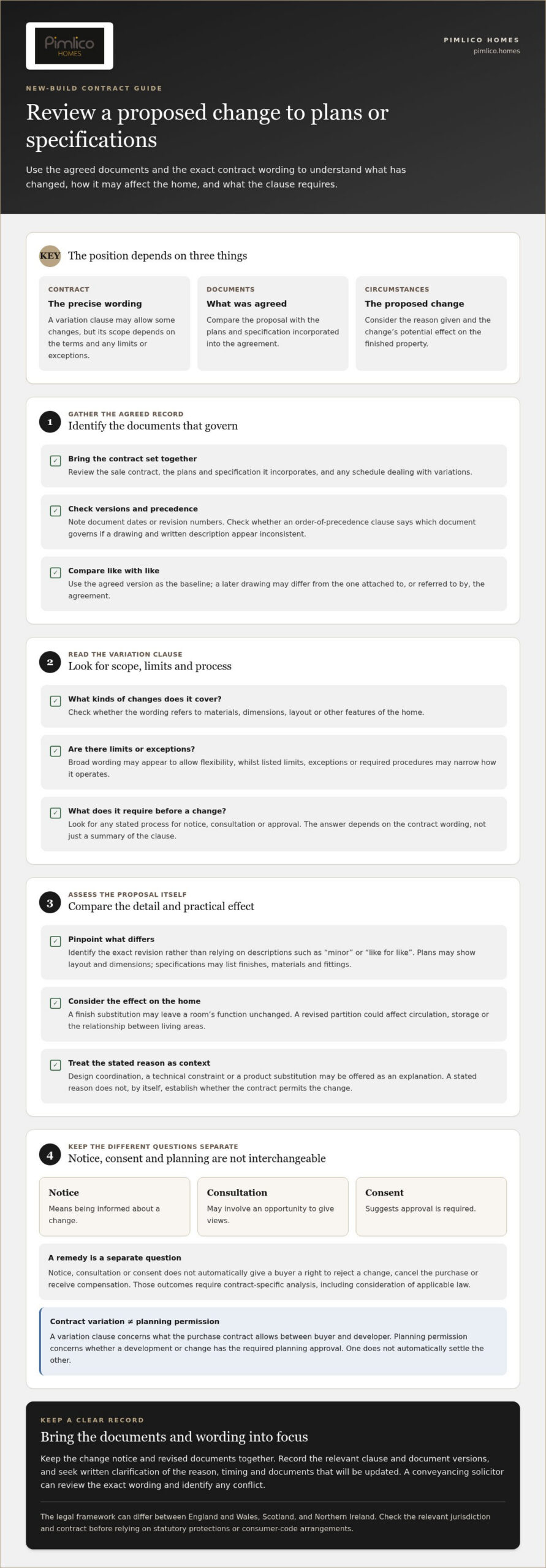
How should you review a proposed change to plans or specifications?
A clear, measured review can help you understand a proposed change without assuming that it signals a problem. Keep the notice and accompanying documents, then work through the contract and compare the revisions carefully. Establish what is changing, how the proposal relates to the agreed documents and what response, if any, the contract requires.
What should you check before responding?
Gather the reservation documents, sale contract, incorporated plans and specification, including any revised versions. Check the dates and document references so you can distinguish the agreed material from the latest proposal. Then locate the variation clause and note any deadlines, notification procedures or response requirements it sets out.
Separate what is confirmed in writing from what has been explained verbally. If key details remain unclear, request written clarification. A focused list can help:
- What exactly will change, and which plan or specification item does it affect?
- Why is the change proposed, and when will it take effect?
- Will a replacement material, fitting or detail be used, and how is it described?
- Which contract documents will be revised, and will updated versions be provided?
Keep the notice, your questions and any responses together. This creates a useful record and makes it easier to review the change against the contract, rather than relying on recollection or an informal summary.
When should you seek independent legal advice?
Consider taking advice before accepting or rejecting a change that could affect the home’s layout, use, appearance or other important features. A solicitor familiar with the relevant UK jurisdiction can interpret the clause in the context of the full agreement, explain which legal framework applies and advise on the contractual options available in your circumstances. This is especially valuable if the proposed change is unclear or the contract sets a response deadline.
General guidance can help you organise the documents and identify questions, but it cannot determine your individual rights or predict the outcome of a disagreement. A careful review is about gaining clarity, not presuming fault. Understanding the documented design is also an important part of choosing a home with confidence. Explore thoughtfully designed new-build homes from Pimlico Homes.
How do plans and specifications support a confident new-build purchase?
A confident decision begins with a clear understanding of what the contract documents describe. Plans show the home’s arrangement; the written specification records details such as finishes, materials and fittings; variation wording explains how changes may be addressed. Read these together, rather than treating any one document as the complete picture. Keep dated copies of the agreed versions and retain written updates so you can track changes to the documented design.
What should buyers understand before committing?
Before signing, make sure you can identify the plans and specification referred to in the contract, and understand how the agreement addresses potential changes. Note any differences between documents and ask for unclear details to be explained in writing. If you need an interpretation of your rights or obligations, seek advice that reflects both your contract and the relevant UK jurisdiction. General information about a developer’s right to vary plans and specifications explained cannot replace advice on the terms of an individual purchase.
A luxury new-build buying guide can help place document checks within the wider process, from considering the home’s design to reviewing the purchase arrangements. The aim is not simply to collect paperwork. It is to understand what you are choosing and how the plans and specification describe the home you hope to live in.
How does considered design shape a home?
Layout, materials and detailing work together. The position of a room can influence how it connects to other spaces; finishes contribute to its appearance and atmosphere; carefully resolved details help make the home function as intended. Together, these elements shape everyday experience as well as the character of a residence.
Pimlico Homes specialises in luxury new-build homes, with a focus on considered design and craftsmanship. The documented specification gives buyers a practical way to understand those qualities through features described in the plans and written details. Reviewing them carefully can help you assess whether the home’s design, function and finish align with your priorities.
For a clearer sense of how design and craftsmanship come together in a new home, explore the homes developed by Pimlico Homes.
Make your next home decision with confidence
The developer’s right to change plans is not decided by a general rule or by a label such as “minor”. The contract wording, the documents it incorporates and the circumstances of the proposed change all matter. Compare revisions with the agreed plans and specification, keep written records, and seek advice that reflects your contract and jurisdiction if the implications are substantial.
Understanding the developer’s right to vary plans and specifications explained in this way can help you assess changes with greater clarity, while keeping sight of the design and details that make a home right for you. Plans and specifications are more than paperwork; they describe the setting, materials and practical character of a significant purchase.
Pimlico Homes specialises in luxury new-build homes and executive courtyard developments, alongside bespoke homes and premium barn conversions. Explore the homes and developments by Pimlico Homes, and take the next step towards a home chosen with care and confidence.
Frequently Asked Questions
Can a developer change the plans after I have signed the contract?
Possibly, but whether a developer can change the plans depends on the signed contract, the wording of its variation clause and the circumstances. Check which plans and specifications the agreement incorporates, then compare those versions with the proposed revision. Do not assume that signing means every detail is fixed, or that a clause permits any change. If the proposal could affect the home’s design or use, ask a solicitor to review the documents.
Can a developer substitute materials or fittings in a new-build home?
A substitution may be possible if the contract’s variation wording allows it, but there is no automatic rule that every material or fitting can be replaced. Compare the agreed specification with the proposed alternative, noting differences in appearance, function and any stated performance. Check whether the contract names a particular product or allows alternatives, and ask for the proposal and explanation in writing. The significance of a substitution depends on the contract and its effect on the home.
What happens if I do not agree with a proposed change?
Disagreement does not automatically mean you can reject the change, cancel the purchase or claim compensation. First, check the variation clause, any response deadline and the process set out in the contract. Ask for written details of the change and which documents will be updated. If the proposed alteration has important practical or design consequences, seek advice from a solicitor familiar with the relevant UK jurisdiction before responding or taking action.
Does a developer have to tell me about changes to my home’s specification?
Whether and how a developer must notify you depends on the contract wording and any applicable legal requirements. Look for terms covering notice, consultation, consent and the timing or form of communications; these describe different processes and should not be treated as interchangeable. Keep copies of notices and revised specifications, and request written clarification if a change is explained verbally or the documents do not clearly show what has been amended.
Does planning permission give a developer the right to change my home’s specification?
No, planning permission and the purchase contract address separate matters. Planning permission concerns whether a development or change has planning approval; it does not automatically amend the terms agreed between buyer and developer. The contract’s variation clause and incorporated documents remain central to understanding the contractual position. A proposal may need consideration under both planning requirements and the purchase agreement, so do not treat approval in one context as a decision in the other.
Should I ask a solicitor to review a variation clause before buying?
Yes, having a solicitor review the clause before you commit can help clarify what changes it addresses, what process applies and how it fits with the rest of the contract. Ask them to consider the incorporated plans and specification as well as any notice, consent or remedy wording. The legal framework differs across England and Wales, Scotland, and Northern Ireland, so advice should reflect the jurisdiction governing your purchase and your particular circumstances.





