
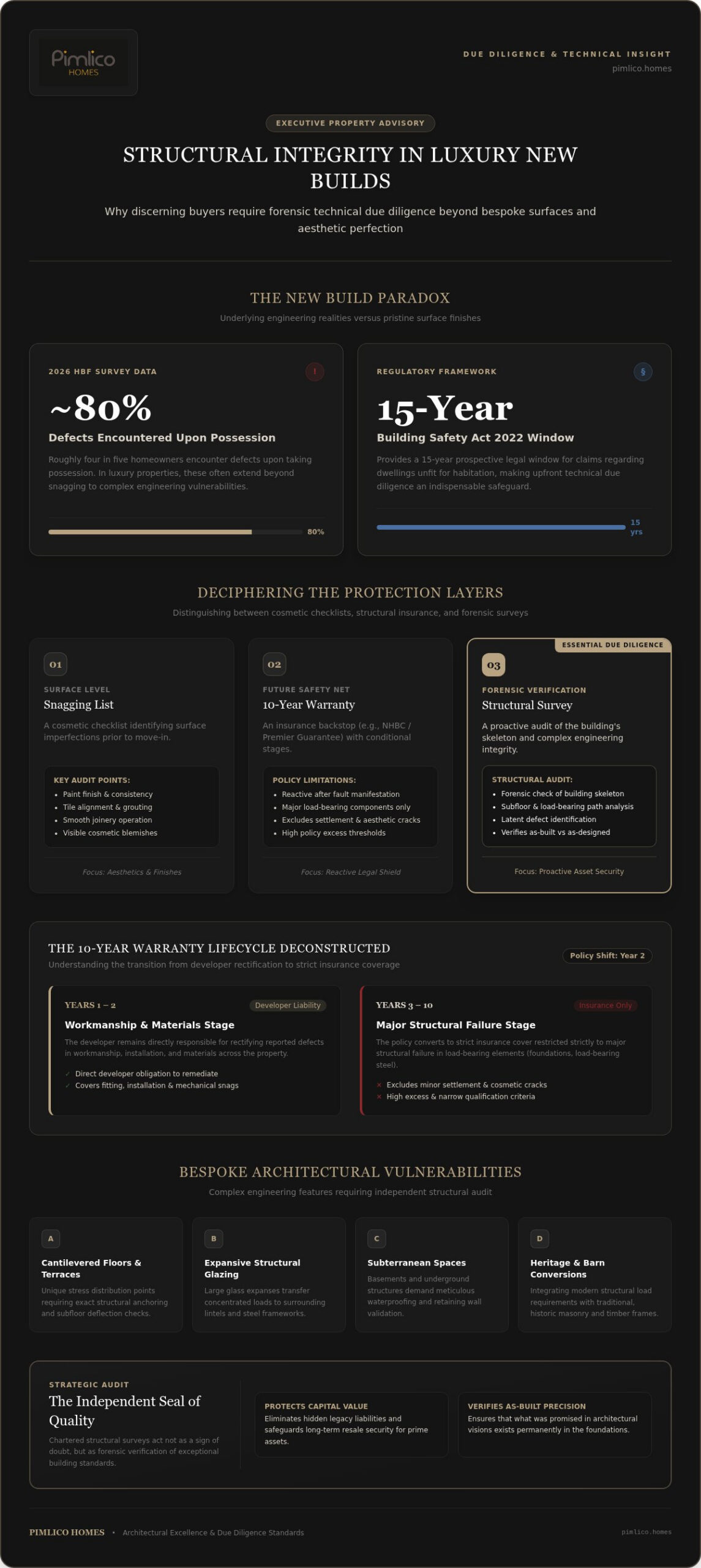
You might assume that a pristine residence fresh from the architect’s vision is inherently flawless. However, the most significant risks to your investment often lie beneath the bespoke finishes and hand-polished surfaces. When asking do new builds need a structural survey, it’s vital to look past the aesthetic perfection of a high-end development. While many buyers feel a sense of security in modern construction, the 2026 HBF survey suggests that roughly 80% of homeowners encounter defects upon taking possession. For a luxury property, these aren’t just minor snags; they can be complex engineering vulnerabilities that standard inspections miss.
It’s natural to feel that a ten-year warranty provides a total safety net for your capital. Yet, the true value of a bespoke home rests in its invisible foundations and load-bearing artistry. This guide will reveal why a structural survey is an indispensable audit of excellence, ensuring your home’s longevity matches its magnificent design. We’ll clarify the ‘warranty vs survey’ debate, examine the latest RICS Level 3 standards, and provide a framework for protecting your property’s long-term resale value and your peace of mind.
Key Takeaways
- Distinguish between superficial snagging lists and the rigorous technical assessments required to verify the integrity of complex architectural features.
- Navigate the inherent limitations of standard 10-year warranties to understand exactly what remains protected during the first decade of your residency.
- Evaluate the specific structural risks associated with bespoke elements such as cantilevered floors and expansive glazing to ensure your capital is secure.
- Gain a clear perspective on why do new builds need a structural survey to identify latent defects that standard building regulations might not fully address.
- Discover how independent structural audits act as a sophisticated seal of quality, complementing the meticulous standards of premier luxury developers.
The New Build Paradox: Why Structural Integrity Matters in 2026
The allure of a new home lies in its untouched state. Everything feels permanent; every surface is pristine. However, many sophisticated investors ask, do new builds need a structural survey, especially when the property is backed by a developer’s reputation. In 2026, architectural ambition has reached new heights. With that ambition comes engineering risk. A structural survey isn’t a gesture of doubt. It’s a sophisticated audit of excellence. It ensures the home’s legacy matches its initial visual impact. For the discerning buyer, this verification is a proactive investment in future resale value and long-term peace of mind.
Verifying Excellence Beyond the Aesthetic Surface
Executive homes often feature intricate designs that standard developments avoid. Cantilevered terraces, subterranean spaces, and vast glass expanses create unique stress points. High-end finishes like book-matched marble or bespoke cabinetry are breathtaking. They can also inadvertently mask technical complexities in the subfloor or load paths. Auditing these bespoke elements early in the ownership journey is essential. This is particularly true for complex projects like luxury barn conversions, where integrating traditional materials with modern structural requirements demands precision. It provides the psychological security required when investing millions. It transforms a house into a secure, permanent legacy.
The Shifting Landscape of Construction Standards
The regulatory environment has evolved significantly. The Building Safety Act 2022 now provides a 15-year prospective window for claims regarding dwellings unfit for habitation. This makes upfront due diligence vital. Chartered Surveyors act as the ultimate guardians of quality. They ensure that what was promised in the architectural plans exists in the foundations. A structural survey is a comprehensive forensic audit of a building’s skeleton. This oversight confirms that the ‘as-built’ property matches the ‘as-designed’ prestige. It offers total transparency between the visionary creator and the end user. Reputable developers like Pimlico Homes welcome this independent verification. It serves as a final, professional testament to their high standards of craftsmanship. By confirming the integrity of the load-bearing components, you ensure your bespoke home is as structurally sound as it is aesthetically magnificent.
Warranties, Snagging, and Surveys: Deciphering the Protection Layers
Protecting a high-value asset requires a multi-tiered approach. Many purchasers wonder, do new builds need a structural survey when a comprehensive warranty is already in place? The answer lies in understanding that these safeguards serve entirely different purposes. A warranty is a safety net for the future, whilst a survey is a shield for the present. When combined with a professional snagging list, they create a robust framework for long-term security. This trinity of protection ensures that your residency begins with total confidence rather than lingering uncertainty.
The Reality of Structural Warranties
A standard 10-year structural warranty, such as those provided by the NHBC or Premier Guarantee, is often misunderstood by the layperson. During the first two years, the developer is responsible for rectifying defects in workmanship. However, from years three to ten, the policy transitions into an insurance period. This cover is strictly limited to major structural failures affecting load-bearing components like foundations or structural steel. Minor settlement, aesthetic cracks, or mechanical systems are typically excluded. For owners of bespoke luxury homes, the high policy excess and narrow definitions can make claiming a complex, time-consuming ordeal. Relying solely on a warranty is a reactive strategy; it only triggers once a problem has already manifested and caused disruption.
Snagging vs. Structural Surveys: A Crucial Distinction
It’s vital to distinguish between a snagging list and a full building assessment. Snagging is essentially a cosmetic audit. It focuses on the finishing touches, such as paint consistency, tile alignment, and the smooth operation of joinery. While these details are essential for executive courtyard homes, they don’t look beneath the surface. In contrast, an RICS Level 3 Survey is a forensic deep-dive into the building’s core stability. Using the RICS Home Survey framework, a chartered surveyor inspects load-bearing masonry, foundation suitability, and complex roof structures.
This proactive oversight identifies latent defects before they become catastrophic. It ensures your investment is sound from the moment you receive the keys. For a deeper look at the acquisition process, consult The Ultimate Guide to Buying a Luxury New Build Home in 2026. By integrating these three layers, you move from a position of hope to one of absolute certainty. You ensure your home’s artistry is supported by impeccable engineering, creating a residence that truly stands the test of time.
The Hidden Vulnerabilities of Luxury New Build Construction
High-end architecture often pushes the boundaries of conventional engineering. Cantilevered terraces, floor-to-ceiling glazing, and subterranean wellness suites create immense structural loads that require precise management. Sophisticated investors often wonder, do new builds need a structural survey when these features are designed by industry-leading experts. The reality is that technical complexity naturally increases the margin for error during the construction phase. A survey provides a meticulous audit of these high-risk elements. It confirms that the engineering behind the elegance is as robust as the design is beautiful. It’s about ensuring that a bold architectural statement doesn’t become a long-term liability.
Detached executive properties are typically heavy-set structures. They require substantial, deep-seated foundations to mitigate ground movement and potential settlement issues. The surveyor verifies compliance with Approved Document A for structural safety, ensuring the loading capacities are sufficient for the property’s grand scale. While minor settlement is a natural process for any new building, in bespoke builds, it must be carefully monitored to prevent structural distress in oversized glass panels or integrated masonry. A professional eye identifies these risks before they manifest as costly repairs.
Bespoke Architecture and Technical Complexity
Unique designs demand more than a cursory glance. Unlike standard estates, bespoke luxury homes often feature non-standard load paths and complex junctions. For those questioning if do new builds need a structural survey, the answer often lies in the hidden junctions of a bespoke roof or a grand staircase. Surveys are particularly adept at detecting thermal bridging, where insulation is compromised at structural junctions. This is vital for maintaining the high-spec energy efficiency promised by contemporary designs. Artisan masonry and intricate timber work must also be audited to ensure they meet structural expectations over decades. The surveyor acts as a reliable guardian of quality, looking beyond the surface to verify that every joint is executed with absolute precision.
The Challenge of Modern-Traditional Hybrids
Purchasing premium luxury barn conversions introduces a unique set of structural variables. These buildings are complex hybrids. They balance heritage charm with the rigid requirements of 21st-century living. A survey is essential here to inspect how new steel frames interact with ancient stone or timber. It ensures the transition between the original fabric and the modern additions is seamless and secure. For more on the aesthetic side of these projects, explore Modern Barn Conversion Interiors: A Masterclass in Refined Rural Luxury. Balancing these elements requires a visionary creator who understands that longevity is as important as beauty. The surveyor ensures that the damp-proofing and thermal envelope remain intact despite the inherent challenges of an older structure, protecting your investment for generations to come.
Making the Decision: When a RICS Level 3 Survey is Essential
A RICS Level 3 Building Survey is the definitive standard for any high-value detached home. While mass-market advice often suggests a Level 2 report for modern properties, this typically fails to account for the unique engineering of a bespoke residence. A Level 3 survey offers a forensic level of detail. It provides an exhaustive analysis of the property’s condition, including the potential for hidden defects that only become apparent through professional scrutiny. Determining when do new builds need a structural survey is a matter of architectural ambition. The more complex the design, the more essential the independent audit becomes.
During a viewing, certain subtle signs should trigger an immediate request for a full structural assessment. These indicators often point to underlying technical challenges that require expert interpretation. Look for these specific red flags:
- Slight misalignments in large-format floor-to-ceiling glazing pockets.
- Unevenness or a noticeable ‘bounce’ in wide-span flooring systems.
- Hairline fractures in artisan stonework or external rendering that suggest early settlement stress.
- Signs of moisture or salt staining near complex flat roof junctions or parapets.
Criteria for Commissioning a Full Survey
Financial thresholds often dictate the necessity of a Level 3 report. For properties valued above £1,000,000, the cost of a survey is a negligible fraction of the total investment. It acts as a non-negotiable safeguard for your capital. Properties situated on steep sites or those featuring extensive hard landscaping also demand this level of oversight. If you intend to carry out future modifications or extensions to luxury detached homes, the survey provides the structural baseline required for your architect to work with absolute certainty. It ensures that your vision for the future is built on a stable, verified foundation.
Selecting the Right Surveyor for a Prestige Property
Not all surveyors possess the expertise to evaluate a high-spec development. You require a professional who understands the nuances of modern luxury construction. The process of commissioning should be methodical. First, identify a specialist with a portfolio of executive estates. Second, verify that their professional indemnity insurance matches the property’s stature. Ask specifically about their experience with subterranean tanking or integrated mechanical ventilation systems. Finally, use the completed report as a constructive dialogue tool during the final handover. It ensures that the transition of ownership is marked by transparency and mutual respect for quality. To ensure your next acquisition meets these exacting standards, view our portfolio of bespoke luxury homes.
A Legacy of Excellence: How Pimlico Homes Ensures Lasting Quality
Transparency is the cornerstone of trust. At Pimlico Homes, we believe that the relationship between a creator and a resident should be defined by absolute clarity. When clients ask, do new builds need a structural survey, we encourage them to see it as a final, independent validation of our artistry. It isn’t a gesture of suspicion; it’s a celebration of craftsmanship. Our philosophy is rooted in architectural integrity, ensuring every home we create is built to endure for generations. We deliver the ‘Pimlico Standard’, a commitment where every residence is engineered to transcend standard building regulations. This dedication to excellence is why we welcome the scrutiny of chartered surveyors. It serves as a professional testament to the meticulous care we invest in every foundation and load-bearing beam.
The Developer-Buyer Partnership
Open communication is the hallmark of our process. Throughout the construction journey, we provide consistent updates and technical clarity, reducing the likelihood of ‘surprises’ during a final survey. We select superior materials that are designed to stand the test of time and professional inspection. With a 25-year heritage of excellence, we understand that a home is more than a structure. It’s a significant life investment that carries immense emotional weight. By choosing a developer that values independent verification, you gain absolute peace of mind. Our team acts as both a visionary creator and a reliable guardian of your property’s future, ensuring the handover is a seamless transition of quality. We invite you to explore our current portfolio of luxury detached homes to see this commitment in practice.
Securing Your Future in an Executive Courtyard
Investing in a residence that has been built and audited to the highest standards ensures long-term capital security. Our developments are designed for those who appreciate the finer details of engineering. The structural resilience of our homes is matched only by their aesthetic magnificence. Whether you are drawn to a grand detached estate or the intimate prestige of an enclave, the quality remains consistent. If you are still weighing the question, do new builds need a structural survey, consider it the final step in a journey of excellence. It’s the ultimate reassurance for the discerning owner who values longevity over the temporary. Discover The Allure of Executive Courtyard Homes: A Masterclass in Privacy and Prestige to see how we define modern living. Our legacy is built on the satisfaction of our clients and the permanence of our output.
Securing Your Architectural Legacy
A home of distinction deserves more than a standard inspection. We’ve explored how a RICS Level 3 survey acts as a forensic audit, revealing the technical integrity of a building’s skeleton. While cosmetic snagging captures the finishing touches, it’s the structural assessment that verifies the engineering behind bespoke features like cantilevered floors and expansive glazing. When you ask do new builds need a structural survey, you’re choosing a proactive shield for your investment rather than a reactive safety net.
Pimlico Homes brings 25 years of architectural excellence to every project. We specialise in high-end detached living and pride ourselves on unrivalled craftsmanship in every development. We welcome independent verification because we believe in the absolute transparency of our work. Your residency should begin with the quiet confidence that your home is as structurally sound as it is aesthetically magnificent. To discover a property built to transcend the ordinary, Explore Our Collection of Exquisite New Build Homes today. We look forward to helping you secure a residence that truly stands the test of time.
Frequently Asked Questions
Is a structural survey worth it for a new build home?
A structural survey is a vital investment for any high-value property. It offers an independent audit of the building’s core integrity, going beyond the developer’s own quality checks. For those asking do new builds need a structural survey, the answer lies in the peace of mind it provides. It ensures that complex engineering, such as subterranean levels or cantilevered structures, meets the highest standards, protecting your capital and future resale value from the very first day.
What is the difference between a snagging list and a structural survey?
The distinction is fundamental to property due diligence. A snagging list identifies surface-level defects, such as paint finishes, cabinet alignment, or tile grout. In contrast, an RICS Level 3 survey examines the load-bearing skeleton of the home. This includes foundations, structural masonry, and roof integrity. While snagging ensures your executive courtyard home looks perfect, the survey ensures it is built to endure, uncovering latent technical issues that visual inspections often miss during the initial handover.
Does a 10-year warranty cover all structural issues?
Standard 10-year warranties are insurance policies with specific limitations rather than all-encompassing guarantees. During the first two years, the builder is responsible for most defects. From years three to ten, the cover usually shifts to major structural failures only. Minor settlement, damp-proofing issues, or non-structural cracks are often excluded from these policies. This makes a proactive survey essential, as it identifies potential vulnerabilities before they fall outside the initial builder’s two-year warranty period.
How much does a RICS Level 3 survey cost for a luxury property?
For prime properties, a RICS Level 3 survey in 2026 typically starts at £1,500. Depending on the architectural complexity and unique features like sub-basements or extensive structural glass, fees can exceed £4,500. While this is higher than a standard home survey, it reflects the specialised expertise required to audit high-spec engineering. Investing in this level of forensic detail is a negligible cost compared to the protection it offers for a multi-million-pound luxury asset.
Should I get a survey before or after exchanging contracts?
You should ideally commission the survey before exchanging contracts to ensure total transparency before a legal commitment. This allows you to address any structural concerns during the pre-completion phase. Under the New Homes Quality Code updated in 2026, buyers have formal rights to conduct professional pre-completion inspections. Carrying out this due diligence early ensures that the final handover is a celebration of quality rather than a process of discovery regarding hidden technical defects.
Will a structural survey affect my relationship with the builder?
A professional survey should strengthen the relationship through mutual respect for quality. Reputable developers, like those with a 25-year heritage of excellence, welcome independent verification as a testament to their high standards. It transitions the conversation from subjective opinion to objective, technical fact. For a master craftsman, a surveyor’s report is a tool for perfection, ensuring that the finished residence meets the precise architectural vision and engineering standards promised to the discerning purchaser.
What happens if the structural survey reveals a defect in a new build?
If a defect is identified, the developer is typically responsible for rectifying it before completion or within the initial two-year builder warranty period. The survey report provides a clear, technical framework for these discussions. It allows for precise remedial work to be carried out under professional oversight. This proactive approach prevents minor technical oversights from developing into significant structural issues, ensuring your bespoke home remains a sound and secure investment for decades to come.
Can I use a structural survey to negotiate the price of a new build?
When considering do new builds need a structural survey, it is important to view the report as a mechanism for quality control rather than a negotiation tactic. In the luxury market, the primary goal is ensuring the builder rectifies all issues before the keys are handed over. While significant structural findings could theoretically lead to price adjustments, most buyers prefer to secure the quality they have invested in, ensuring the property’s long-term value remains untarnished.





