
The most imposing gate isn’t necessarily the most effective choice. For buyers searching for gated executive developments, the real question is how to balance controlled access, clear visibility and everyday convenience without allowing security equipment to dominate the home’s design.
That balance depends on arrival routines, driveway layout and the level of privacy you want. This guide compares gates, access control, intercoms, cameras, lighting and driveway sensors, and explains how to choose measures that work together without adding needless complexity. It also offers practical questions to use when assessing a home, including how its security approach fits its architecture and the way you want to live. A considered plan should feel reassuring, not overbearing.
Key Takeaways
- Plan driveway security as layers for access, observation and visibility, rather than relying on a gate alone.
- Map how arrivals are detected, visitors identified and access granted to see where measures could complement one another.
- Compare gates, access control, intercoms, CCTV and lighting by purpose, privacy, convenience and upkeep.
- Use a practical checklist to assess entrances, boundaries, sightlines and household visitor patterns.
- When considering a gated executive home, weigh security alongside design, privacy and the rhythms of everyday life.
What advanced driveway security means for a gated executive home
Advanced driveway security is not a single imposing feature. It is a planned combination of measures that manage access, help residents observe arrivals and make the entrance less exposed. The right balance depends on who uses the driveway, how visitors are received and what the layout makes visible. For buyers considering a gated executive home, these practical details belong in the wider conversation about privacy, design and daily life.
Access control determines who can enter; surveillance helps residents observe or record what is happening. A gate can create a physical boundary, but it cannot identify every visitor or account for every approach. A camera can provide a view without controlling entry. Each has a distinct role.
Start with the household’s routines. Regular deliveries, guests arriving at different times and a pedestrian entrance separate from the vehicle access can all shape what matters. A well-planned system should make ordinary arrivals straightforward, not add unnecessary steps or visual clutter.
What does driveway security include?
Different measures serve different purposes. Some create a physical boundary; others help identify visitors, illuminate an approach or provide a record of activity. Their usefulness depends on their position and how they are used.
- Gates define an entrance and can restrict vehicle access when closed.
- Access control provides a way to grant or refuse entry, with the method chosen to suit household and visitor routines.
- Video intercoms allow occupants to see and speak with a visitor before deciding whether to admit them.
- CCTV can show or record activity in selected areas. Consider its position in relation to privacy as well as visibility.
- Lighting makes an approach easier to see and use after dark, while helping avoid poorly lit entrance points.
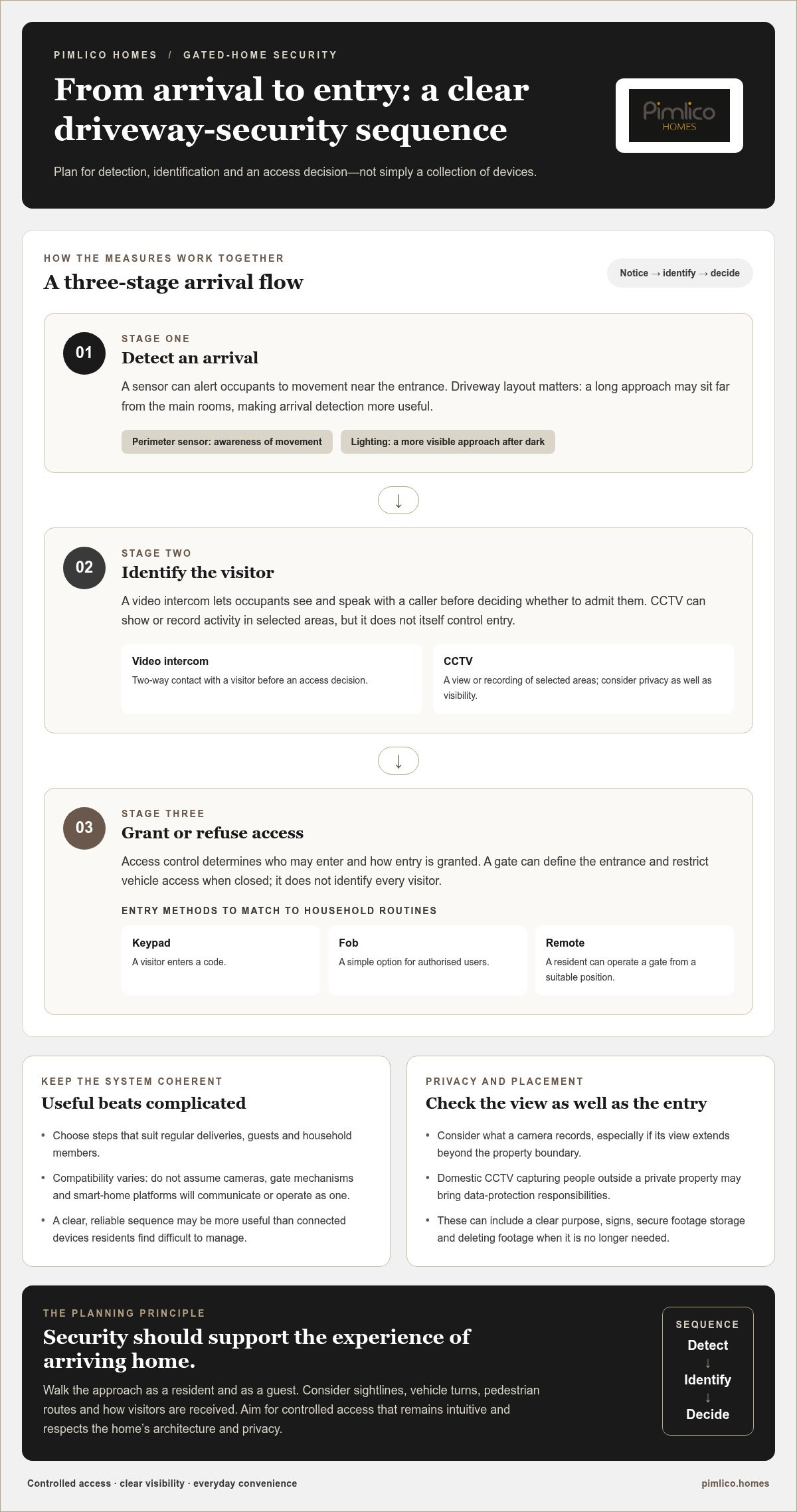
These technologies can be brought together through home automation systems and security integration, but integration is not an end in itself. Aim for a clear sequence of detection, identification and access, rather than a collection of devices that makes everyday use more complicated.
Why does the home’s layout matter?
Layout determines what a system can observe and where access decisions need to happen. Check whether a driver can be seen from the house, whether planting or walls interrupt sightlines, and whether pedestrians have a separate route. A long driveway may place the entrance well away from the main rooms, making arrival detection or a clear means of communication more useful.
Shared access brings another consideration: an entrance serving more than one household may have different movement and visitor patterns from a private drive. Walk the approach as both a resident and a guest. Notice where the view opens, where vehicles turn and whether the entrance feels welcoming as well as controlled. A well-considered plan respects the architecture, preserves privacy and keeps access intuitive. Security should support the experience of arriving home, not overwhelm it.
How driveway security systems work together at a gated home
A coherent driveway-security plan follows a simple sequence: detect an arrival, identify the visitor, then grant or deny access. Each measure has a particular role. A sensor might alert occupants to movement near an entrance; an intercom can help them establish who is there; and a gate or access-control system determines whether the visitor can proceed. The aim is a sequence suited to the household, not simply the largest possible collection of connected devices.
Access control is the means of deciding who may enter a property and how entry is granted. Surveillance, by contrast, helps occupants observe or record activity. The two can support one another, but neither automatically replaces the other.
Compatibility varies. A camera, gate mechanism and smart-home platform may use different systems, so don’t assume connected devices will communicate or operate as one. Clear, reliable steps can be more useful than a complex arrangement that residents find difficult to manage. For buyers searching for gated executive developments North East, understanding how an arrival is handled can reveal as much about everyday convenience as the presence of a gate itself.
Access control, gates and video intercoms
Entry methods suit different routines. A keypad lets a visitor enter a code; a fob offers a simple option for authorised users; and a remote can allow a resident to operate a gate from a suitable position. An intercom lets occupants respond to a caller before deciding whether to admit them. Choose an arrangement based on who needs access, how often they use it and whether visitors are expected or occasional.
Deliveries, guests and household members may each need a different experience. Consider how the chosen system handles routine arrivals as well as unexpected callers. A smooth process should feel deliberate, not obstructive.
CCTV, lighting and perimeter detection
Cameras support observation of selected areas; they do not physically restrict entry. Lighting can improve visibility around an approach and make it easier to see visitors after dark. Perimeter detection, such as a sensor that alerts occupants to movement, adds another layer of awareness, not a physical barrier. Together, these measures can help occupants notice activity and respond, but they cannot promise that every incident will be prevented.
Privacy deserves equal attention. Consider what a camera records, particularly if its view extends beyond the property boundary. The Information Commissioner’s Office (ICO) advises that domestic CCTV capturing people outside a private property may bring data-protection responsibilities, including having a clear purpose, displaying signs, storing footage securely and deleting it when no longer needed. Consult current ICO guidance on domestic CCTV when assessing camera use.
For a wider view of the home itself, explore luxury detached and executive courtyard homes, and consider how design and everyday routines shape the experience of arriving home.
Comparing driveway security options: protection, privacy and usability
No single measure addresses every concern. A gate controls a physical entrance, access systems manage permission, cameras support observation and lighting improves visibility. Their value depends on the property’s layout and the household’s routines. For buyers considering gated executive developments, compare what each option contributes and what it asks of residents, rather than looking for one universally “best” solution.
| Option | Purpose | Everyday convenience | Privacy | Likely upkeep |
|---|---|---|---|---|
| Gate | Creates a physical boundary at the entrance. | Can make vehicle access more deliberate; operation depends on the arrangement. | Generally limited recording concerns, though placement and visibility matter. | Moving parts and surfaces may need routine attention. |
| Access control | Allows entry to be granted or restricted. | Keypads, fobs or remotes suit different household and visitor patterns. | Consider how permissions are managed and who can use them. | Access details and devices may need managing over time. |
| Intercom | Supports communication with a caller before entry. | Useful for responding to expected and unexpected visitors. | Video models add an image as well as conversation. | Equipment needs to remain usable and in working order. |
| CCTV | Provides views or recordings of selected areas. | Can help occupants review activity, depending on the system. | Field of view and recording make positioning important. | Equipment and stored footage require ongoing attention. |
| Lighting | Improves visibility around an entrance or approach. | Can make arrivals easier to see after dark. | Direction and spill onto neighbouring areas deserve consideration. | Fittings may need cleaning and upkeep. |
Which security measures suit different household routines?
Frequent visitors can make straightforward access and a manageable way to respond to callers especially valuable. For deliveries, consider how a driver can make contact without an awkward arrival. For household members, think about the entry method they will use regularly. If the home is often empty, observation or lighting may be priorities, but suitability still depends on the layout and residents’ preferences. Choose for real routines, not a hypothetical ideal.
How can security remain discreet and privacy-conscious?
Equipment need not dominate the entrance. Choose camera positions with a clear purpose, direct lighting towards the approach rather than into windows, and consider how entry equipment sits with the home’s design. A camera’s field of view and any recording can raise privacy considerations, particularly if areas beyond the property are captured. The ICO’s current domestic CCTV guidance is a useful reference. Thoughtful placement helps balance observation with a considered, private arrival experience.
A practical checklist for planning driveway security
A viewing offers more than a first impression of the home. Trace how people and vehicles arrive, notice where privacy and visibility meet, and consider whether the arrangements suit everyday life. For buyers comparing gated executive developments, work through the questions in sequence, from household routines to ongoing operation. Separate what you can observe from claims about system performance.
What should buyers assess during a viewing?
Walk or look along the approach as both a resident and a visitor. Notice how vehicles enter, where pedestrians go and whether planting, walls or parked cars interrupt useful sightlines. Consider how a caller communicates with someone inside before access is granted, and whether delivery access feels clear and practical. A discreet entrance should still be easy to understand and use.
How should buyers think about ongoing use?
Consider who needs access, how entry methods or credentials are managed, and what happens when a regular user changes. Ask how equipment is powered and what the household would do if a component were unavailable. Routine upkeep matters too. A visible camera or keypad does not, on its own, demonstrate how well a system works or how reliably its parts operate.
Use this ordered checklist to turn your observations into a considered assessment:
- Start with household needs. Note who arrives regularly, how often visitors are expected and whether deliveries need a straightforward way to reach residents. Include household members with different access needs.
- Map the approach. Identify vehicle and pedestrian entrances, shared routes, turning points and the boundary between public and private space. Consider how a long drive might affect communication between the entrance and the home.
- Review sightlines. Look for areas obscured by planting, walls or changes in level. Consider whether occupants can see arrivals, and whether cameras or lighting would serve a clear purpose without intruding on neighbouring spaces.
- Match measures to the gaps. Decide whether the priority is controlling vehicle entry, speaking to visitors, improving visibility or observing activity. Don’t treat one feature as a substitute for all the others.
- Consider practical operation. Think through how residents, guests and delivery drivers would use the entrance. Consider power needs, upkeep and what happens if an access method or device is temporarily unavailable.
- Distinguish appearance from evidence. A substantial gate or visible camera may look reassuring, but does not establish the capabilities or condition of a system. Record what you can see and separate it from performance claims.
This structured review also complements wider home-buying preparation. Pimlico Homes’ luxury new-build buying guide can help you consider security alongside design and the details of daily living. Explore Pimlico Homes’ luxury homes and consider how each property’s setting and layout could support the way you want to arrive home.
Choosing a gated executive home with security in mind
Security is one part of a home’s wider character. The approach, boundaries and outdoor spaces influence how private a property feels, as do its architecture, natural light and the ease of moving between inside and out. A considered choice brings these elements together, rather than allowing equipment or a single security feature to define the experience.
For buyers considering gated executive developments, the key is to assess how a home supports the way they want to live. Controlled entry may matter, but so does the welcome a visitor receives, the comfort of household members arriving home and the relationship between the entrance and the surrounding landscape. No single arrangement suits every household or setting.
How does security fit into the wider home experience?
Think about arriving as a sequence: approach, entrance and transition into the home. Boundaries can contribute to privacy, while planting and outdoor spaces shape views and movement. The aim is balance, with access that feels considered and clear rather than imposing. A carefully designed setting can feel private without making residents or invited guests feel unwelcome.
Home design can offer different ways to approach that balance. For example, executive courtyard homes are a related design option for buyers thinking about the relationship between privacy and shared outdoor space. Assess the details of each home on their own merits; a design category alone does not establish which security features are present.
What are considered next steps for a prospective buyer?
Before comparing homes, note your priorities. Decide what matters most in daily use, such as a welcoming arrival, a sense of privacy, straightforward visitor access or clear sightlines. Then consider how each property’s layout and setting might support those preferences. This keeps the decision grounded in how you plan to live, rather than in appearances or assumptions about equipment.
During viewings, observe the approach and entrances, and consider how the home feels at each point between arrival and the front door. Look at the relationship between boundaries, outdoor areas and the rooms you use most. Keep security in perspective alongside design quality, practical function and the atmosphere you want your home to create.
Pimlico Homes develops luxury detached homes, executive courtyard homes, bespoke new builds and premium barn conversions. Each offers a different residential character to consider as part of a significant buying decision. Explore Pimlico Homes and its homes as you refine what matters most, and consider which design and setting best suit your everyday life.
Choose a home that feels right for the way you live
As you compare gated executive developments, let your priorities guide the next step. Look beyond the entrance to the quality of the setting, the character of the architecture and how the home may support the routines that matter to you. Security should sit comfortably within that wider picture, contributing to a sense of confidence without defining the whole experience.
Pimlico Homes specialises in high-end residential homes, including luxury detached and executive courtyard homes. Each offers a distinct approach to space and residential character. Explore the possibilities and consider which best reflects the life you want to shape.
Explore Pimlico Homes’ luxury residences and take the next step towards finding a home that feels considered, enduring and distinctly your own.
Frequently Asked Questions
Do gated homes need CCTV as well as an entrance gate?
No, CCTV isn’t automatically necessary simply because a home has a gate. A gate may regulate vehicle entry, while cameras provide a view of selected areas; whether that additional observation is useful depends on the property and household. For example, a gate at the end of a long drive may leave the entrance out of sight from the house. Identify the specific gap you want to address before adding equipment.
Can driveway security systems work together?
Yes, if the chosen equipment is compatible and configured to communicate as intended. For instance, an arrival alert could prompt a resident to check an intercom and then operate the gate, but those steps won’t necessarily happen automatically. Understand which components exchange information and which still need separate controls before relying on a connected arrangement. This distinction helps buyers assess whether a system will be straightforward in daily use.
What is the difference between access control and CCTV?
Access control manages entry permissions; CCTV provides images of selected areas. A keypad, for example, may let an authorised visitor enter a code, while a camera may show activity near the entrance. Neither does the other’s job: a camera doesn’t decide who may enter, and an entry code doesn’t provide a visual record. Consider them as separate functions when deciding what a household needs.
Is a video intercom useful for a gated driveway?
It can be useful when the entrance is too far away to reach quickly or isn’t visible from the rooms where residents usually are. A video intercom lets an occupant see and speak with a caller before deciding how to respond. Think about everyday callers, such as couriers or guests, and whether the unit’s position makes conversation practical. Its usefulness depends on the approach, household routines and gate arrangement.
How much does advanced driveway security cost?
Costs vary with the equipment and installation. UK 2026 estimates put bespoke automated swing gates from about £9,500 plus VAT for above-ground systems and £10,500 plus VAT for underground systems; sliding gates start around £10,000 plus VAT. Wireless driveway alarms range from roughly £35 to over £160 for multi-sensor kits. These are indicative figures for security products, not a quote; scope and specification affect the final cost.
Can driveway CCTV record beyond the property boundary?
A camera may capture areas outside the boundary, but its angle should be considered carefully to avoid recording more than needed. Under current UK guidance, if domestic CCTV captures people beyond the private property, such as on a public pavement or in a neighbour’s garden, data-protection rules apply. The ICO explains the relevant responsibilities and practical steps in its guidance on domestic CCTV.





