
When comparing energy efficient luxury homes, an attractive green mortgage offer can still be the wrong fit. The answer depends on more than a headline rate: lenders set their own criteria, and the property’s energy evidence and the full borrowing terms matter just as much as the incentive.
It’s understandable to expect a new-build home to qualify automatically, but eligibility isn’t guaranteed by the words “new build” or “energy efficient”. Green mortgage offers can mean a preferential rate or cashback for a home meeting an EPC threshold, or additional borrowing to fund energy improvements. These options work differently, and conditions vary between lenders.
This guide explains how to distinguish between the main types of eco-friendly mortgage, what property information a lender may request, and which details to check before relying on an advertised benefit. You’ll also learn how to compare a mortgage offer with the home’s specifications, likely running costs and long-term suitability. When considering a Pimlico Homes property, request its specific energy information rather than assuming it meets a particular lender’s requirements. A careful comparison can bring clarity to a significant decision.
Key Takeaways
- “Green mortgage” can describe different offers, so identify whether a lender is offering a rate incentive, cashback or preferential borrowing for improvements.
- Check the lender’s own eligibility rules and request property-specific energy documents. A new-build home isn’t automatically eligible.
- Compare interest terms, fees, incentive conditions and product duration with a standard mortgage before deciding which offer represents better overall value.
- Assess claims about energy-efficient luxury homes using evidence, rather than assuming design or location confirms a home’s energy rating.
- Separate the checks you can make from the lender’s final decision, and confirm eligibility directly before relying on an incentive.
What is an eco-friendly mortgage for a new build?
Some UK lenders offer mortgage products or incentives linked to a property’s energy performance. The labels “eco-friendly mortgage” and “green mortgage” are broad, however, and don’t describe one standardised product. In practical terms, it is a mortgage offer whose availability or terms may depend on the property meeting energy criteria set by that lender. The offer, evidence required and qualifying conditions vary.
For a neutral introduction to the concept, see What is an eco-friendly mortgage. The essential distinction is between a home being marketed as a new build and a lender confirming that it meets the rules for a particular mortgage product. Those are separate judgements.
What can a green mortgage offer include?
An offer might include a preferential interest rate or cashback if the property meets the lender’s stated requirements. Fees, limits on the available loan-to-value and the length of a fixed period can all affect its overall value. Some products labelled “green” instead provide additional borrowing on preferential terms for eligible energy improvements, rather than an incentive for purchasing an efficient home.
These structures and their qualifying rules differ between lenders and can change. Treat any advertised benefit as conditional until you’ve checked the current product details and your own circumstances. A lower rate or cashback isn’t automatically a saving overall: compare the full borrowing terms, including fees and what happens when an introductory or fixed period ends.
Does a new build automatically qualify?
No. A property’s age or new-build status alone doesn’t establish that it meets a lender’s energy criteria. Lenders set their own requirements, so there isn’t one EPC band that can be assumed to apply to every green mortgage. The Energy Performance Certificate (EPC) records a property’s energy rating and may be among the documents a lender considers.
Ask for the property-specific energy documents, then compare them with the exact criteria for the mortgage you’re considering. Check whether the lender requires a particular EPC rating, assessment or other supporting information, and whether the documents available for the home meet those requirements. Confirm the evidence required and your eligibility directly with the lender. A developer’s description of a property cannot substitute for the lender’s decision.
For any luxury new-build home, evaluate its verified documentation rather than relying on phrases such as “sustainable” in marketing material. Design quality and new-build status may be part of a home’s appeal, but neither confirms its energy rating or eligibility for a lender incentive. Request property-specific information from the developer and assess it alongside the lender’s current terms before including an advertised benefit in your purchase decision.
How energy ratings and lender criteria can affect new-build eligibility
An EPC rating is useful evidence, but it doesn’t create a universal pass mark for green mortgage eligibility. Each lender sets its own qualifying rules, which may specify a minimum rating or request supporting documents. An EPC can inform eligibility, but the lender’s current rules decide qualification.
Energy performance can form part of a lender’s assessment of a property and its associated risks. The World Green Building Council discusses why lenders offer green mortgages, but its explanation shouldn’t be mistaken for a guarantee of a particular lender’s criteria or decision.
Which documents should a buyer ask to see?
Start with the EPC for the specific home. Check that the address matches, note the stated rating and review the document date. Then ask whether the lender needs further evidence, such as relevant property specifications or assessment documents. Requirements vary, so use the lender’s product information or ask directly what it will accept.
Make sure each document relates to the individual property, not simply the wider development. A general description of building standards or sustainability features may provide useful context, but it doesn’t establish the rating or specifications of the home you’re buying. If information is unclear or incomplete, ask the developer for the property-specific documents before relying on an advertised mortgage benefit.
How do assessment standards relate to mortgage eligibility?
SAP, the Standard Assessment Procedure, is a UK methodology used to assess the energy performance of new dwellings. It provides a structured basis for evaluating a home’s performance; it is not a mortgage approval, a lender incentive or proof that a particular offer applies.
Assessment and EPC requirements can be subject to changes in guidance. Check the current requirements for the relevant assessment and confirm with the lender what evidence it accepts for the product you’re considering. Don’t treat a specification, an assessment result and an EPC as interchangeable unless the lender confirms they meet its stated requirements.
For buyers researching energy efficient luxury homes north east, the same careful approach applies: evaluate the property’s verified documentation, not just phrases such as “sustainable” in marketing material. If you’re considering a home by Pimlico Homes, you can explore its luxury new-build homes and ask for energy information specific to the property. Confirm its rating from the relevant documents and check any mortgage eligibility against the lender’s criteria.
Green mortgage versus standard mortgage: what should buyers compare?
A green label can make an offer sound compelling, but it doesn’t tell you whether the mortgage is the stronger choice for your circumstances. Compare it with a suitable standard mortgage using the same borrowing amount, deposit, repayment type and term. This gives you a fairer view of the full cost and conditions, rather than focusing on one headline feature.
| What to compare | Questions to ask about a green mortgage | Questions to ask about a standard mortgage |
|---|---|---|
| Eligibility | Does the property need to meet a stated energy criterion? Are borrower criteria relevant too? | What property and borrower requirements apply? |
| Interest terms | What rate applies, for how long, and what rate follows when the offer ends? | How do the initial and subsequent rates compare over the same period? |
| Fees | Are there product or other fees that affect the overall cost? | What fees apply, and how do they compare on the same basis? |
| Incentive conditions | Is any cashback or other benefit conditional on the property, borrower or both? | Are there incentives or conditions to factor into the comparison? |
| Product duration | How long do the stated terms or incentives last? | When do the terms change, and what choices may be available then? |
Which terms matter beyond an eco label?
Read the offer’s conditions carefully. An incentive might depend on the property meeting the lender’s criteria, on the borrower meeting its requirements, or on both. The lender’s eligibility and affordability checks still apply; an energy rating alone doesn’t guarantee approval.
Include all relevant fees in your comparison and check what happens when an initial deal ends. A lower opening rate or cashback may not outweigh higher fees or less suitable terms. Ask the lender or adviser to explain any conditions you’re unsure about.
When might a standard mortgage be worth considering?
A standard mortgage may be a relevant alternative if you or the property don’t meet a green product’s criteria, or if its overall terms better suit your needs. Consider the complete borrowing arrangement alongside your financial circumstances, plans for the home and tolerance for future payment changes. An eco label is one feature, not a verdict on value.
For an informed comparison, use equivalent assumptions and seek personalised guidance from an appropriately qualified mortgage adviser where suitable. Assess the home’s verified information alongside the mortgage terms, without assuming that a particular design or new-build status determines eligibility.
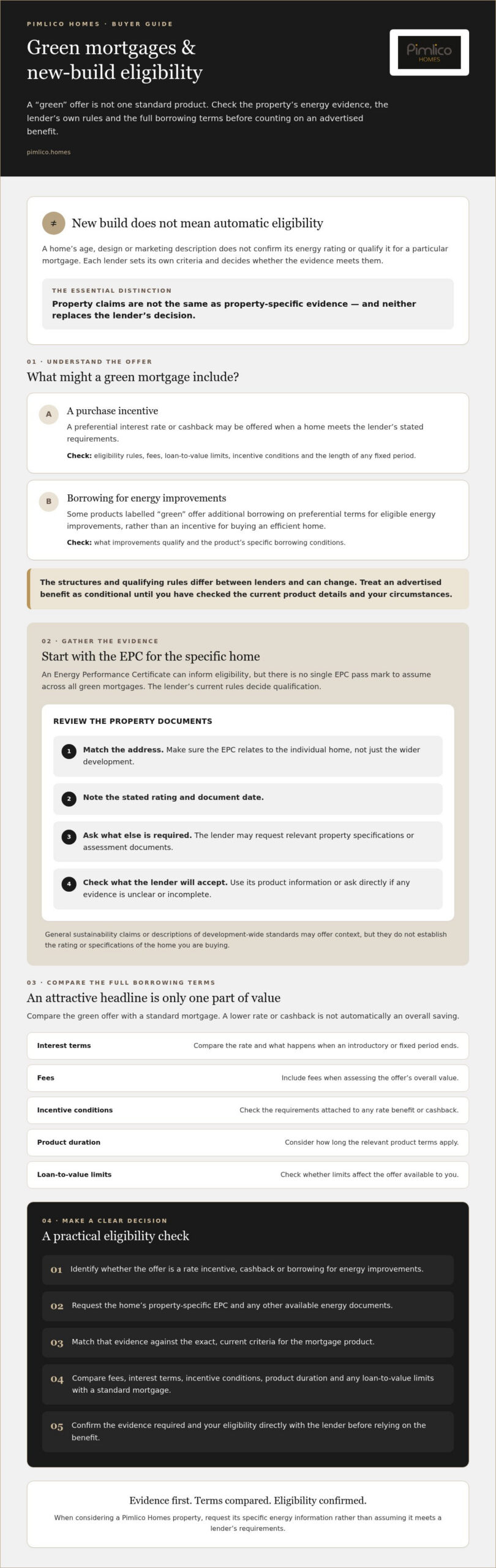
A practical checklist for checking a new build’s green mortgage eligibility
Work through the checks in order. You can review the documents and compare published terms yourself, but only the lender can confirm whether its current product applies to your circumstances and the exact property.
- Identify potential lenders. Find current products that appear relevant and note when you checked their published terms. Offers and criteria can change.
- Check each lender’s criteria. Look for the required EPC rating, accepted evidence and any borrower or borrowing conditions. Don’t assume the same rules apply across lenders.
- Request property-specific evidence. Ask the developer for the home’s EPC and any additional energy-performance documents the lender requests. Check that the address and details match the property you intend to buy.
- Compare the full terms. Review interest terms, fees, incentive conditions and product duration against a suitable alternative, using the same borrowing assumptions.
- Confirm eligibility with the lender. Provide the required details and ask for confirmation before relying on an advertised benefit. Check whether changes to the documents or mortgage offer could affect the decision.
Questions to ask the lender or mortgage adviser
Be precise: which EPC rating or other property evidence does the current product require? Does the offer apply to this exact home and intended borrowing? Ask about any conditions, application timing and what happens if the evidence or borrower doesn’t meet the criteria. If you’re using an adviser, ask them to explain how the options compare for your circumstances.
Questions to ask the developer
Request the individual home’s EPC and relevant energy-performance documentation. Ask which specifications are confirmed for that property and which, if any, are optional. Broad descriptions such as “sustainable” aren’t a substitute for documents or proof of lender eligibility. If a detail isn’t recorded in the information supplied, ask for clarification before making assumptions.
Keep copies of the evidence and the lender’s response. If either the documentation or offer terms change during your purchase, ask the lender whether that affects eligibility. Don’t rely on an earlier indication without checking.
For a wider perspective on selecting a home, explore a luxury new build buying guide alongside this mortgage checklist. If you’re considering a Pimlico Homes property, explore luxury new-build homes and request energy information for the specific home. Its eligibility must still be confirmed by the lender.
Choosing an energy-conscious luxury new build with confidence
A considered purchase brings the home and its financing into the same picture. Review verified, property-specific energy documents alongside the lender’s full mortgage terms, then weigh both against the home’s layout, specification and your household’s longer-term needs. A striking design may shape how a home feels to live in; it doesn’t establish its energy rating or eligibility for a lender’s product.
Likewise, “new build” describes a property’s status, not a guaranteed EPC result or mortgage outcome. Make decisions from evidence for the individual home, rather than assuming that a luxury finish or broad sustainability claim confirms its performance.
What to verify before reserving a property
Before relying on an assumed green mortgage benefit, request the current EPC and any relevant energy-performance documentation for the specific property. Check that the address and details correspond to the home you’re considering. Ask which stated features are included in that home and whether any described elements are optional, rather than treating a general specification as confirmation.
Then give the documents to your chosen lender or mortgage adviser and ask whether they meet the lender’s current criteria for the offer. Confirm this directly: only the lender can decide whether the property and your intended borrowing qualify. If documents, specifications or mortgage terms change before completion, ask whether that affects eligibility.
How Pimlico Homes fits into the research process
Pimlico Homes develops and sells luxury new-build residential properties, including detached homes, executive courtyard homes and bespoke homes. Prospective buyers can ask about the specifications and supporting energy documentation available for the particular property they’re considering. Confirm the rating and any mortgage eligibility using property-specific evidence and the lender’s decision.
Energy performance is one part of a lasting decision. Consider how the rooms, layout and confirmed specification will serve your household over time, as well as the full cost and conditions of borrowing. For a broader perspective on long-term ownership, consult a new-build home resale value guide alongside your mortgage comparison. The aim is to choose a home that suits your life, supported by clear evidence and terms you understand.
Make your next home decision with confidence
A green mortgage is only valuable when the lender’s current criteria, the property’s verified energy documents and the full borrowing terms align. Compare any incentive with a suitable standard mortgage, including fees, conditions and what happens when the offer ends. A new-build label or luxury specification alone can’t confirm an energy rating or guarantee eligibility.
For buyers considering energy efficient luxury homes north east, the next step is to request property-specific energy information and confirm directly with the chosen lender whether it meets the product’s requirements. Pimlico Homes develops luxury detached homes and executive courtyard homes. Ask about the documents available for the specific home you’re considering, then have the lender confirm eligibility.
Explore Pimlico Homes’ luxury new-build homes and review each property’s details alongside your borrowing options. Contact the team to discuss the homes and request information for a property you’re considering.
Frequently Asked Questions
Are there eco-friendly mortgages for new builds?
Yes, some lenders offer mortgage products or incentives connected to a property’s energy performance, but availability and conditions vary. An offer might involve a preferential interest rate or cashback for a qualifying home, while another product could support energy improvements. Check the lender’s current product information rather than relying on the label “green mortgage”, as it doesn’t describe one standardised mortgage type.
Do all new-build homes qualify for a green mortgage?
No. New-build status alone doesn’t guarantee that a property meets a lender’s criteria. The lender may require an EPC rating or other evidence, and its rules can differ from those of another provider. Request documents for the specific home and check them against the chosen product’s current conditions. Only the lender can confirm whether the property and your application qualify.
What EPC rating is needed for an eco-friendly mortgage?
There isn’t one EPC rating that applies to every green mortgage. Each lender sets the qualifying criteria for its own product, which may specify a minimum rating or request other property evidence. Before choosing an offer, check the lender’s current requirements and confirm that the EPC relates to the home you intend to buy. Don’t assume a rating from a general development description applies to an individual property.
Are green mortgages cheaper than standard mortgages?
Not necessarily. A green mortgage may offer a preferential rate or incentive, but fees, conditions and how long the terms apply can affect its overall value. Compare it with a suitable standard mortgage using the same borrowing amount, deposit, repayment type and term. Check what happens when an initial deal ends, and consider discussing personalised options with an appropriately qualified mortgage adviser.
Can I get a green mortgage for a luxury new-build home?
Possibly, if the property meets the chosen lender’s current criteria and your application satisfies its requirements. Luxury design and new-build status don’t establish an EPC rating or mortgage eligibility. Buyers researching energy efficient luxury homes north east should request energy documents for the individual home and ask the lender to confirm whether they meet its conditions. Pimlico Homes sells luxury detached and executive courtyard homes, but the property’s rating and eligibility need to be confirmed from its documents and by the lender.
What documents should I request from a new-build developer?
Ask for the EPC for the specific home, checking that its address and details match the property you’re considering. Request any additional energy-performance assessment or specification documents that your lender requires. Clarify which stated features are included in that home and which are optional. A general sustainability statement or development-wide description isn’t a substitute for property-specific evidence or confirmation from the lender.
Can a mortgage adviser confirm whether a new build qualifies?
A suitably qualified mortgage adviser can help you understand a lender’s published criteria, review the available property evidence and discuss products that may fit your circumstances. However, the lender makes the final decision on eligibility and approval. Ask the adviser what documents to provide, then have the lender confirm whether the evidence relates to the exact property and meets the product’s current rules before relying on an incentive.





