
A high EPC rating may make a home eligible for a green mortgage, but it won’t guarantee a lower rate or determine whether your application is approved. For buyers considering a new build, the EPC ratings of new build homes are an important part of the picture, not the whole decision.
It’s understandable to expect an energy-efficient home to bring financial advantages. However, lenders set their own criteria, and mortgage approval still depends on your circumstances as well as the property. A predicted rating for a home still under construction may also differ from its final EPC, so check what evidence your lender will accept before relying on a particular product.
This guide explains what an EPC tells you, how lenders may consider it, and how energy-efficiency-linked offers compare with standard mortgage options. It also sets out practical questions to ask before reserving a new build, including which EPC documents to request and what to confirm with your lender or broker. A considered purchase starts with clarity about both the home’s performance and the terms of your mortgage.
Key Takeaways
- Understand what EPC ratings of new build homes indicate, and treat the A-to-G band as one part of assessing a property.
- Separate mortgage approval and affordability checks from green mortgage eligibility. A strong EPC rating guarantees neither approval nor a better deal.
- Compare a lender’s green mortgage criteria and full terms with standard options before deciding which suits your circumstances.
- Before reserving, ask for the available EPC evidence and establish whether it is predicted or final. Then confirm with your lender what it will accept.
- Weigh energy performance alongside your finances, mortgage terms and the features that matter to your household.
What EPC ratings of new build homes tell mortgage applicants
Could a strong EPC rating secure mortgage approval or improve the terms offered? It may affect which products a buyer can consider, but it is not a decision in itself. A lender assesses the application against its own criteria, including the buyer’s finances and the property. The EPC is one piece of evidence, not a promise of approval, a particular interest rate or a lower bill.
That distinction matters when comparing EPC ratings of new build homes. A favourable rating may be relevant to a lender’s energy-efficiency-linked products, but qualifying bands and other conditions vary. Check the specific lender’s current requirements rather than assuming a particular rating will change the outcome.
What does an EPC rating measure?
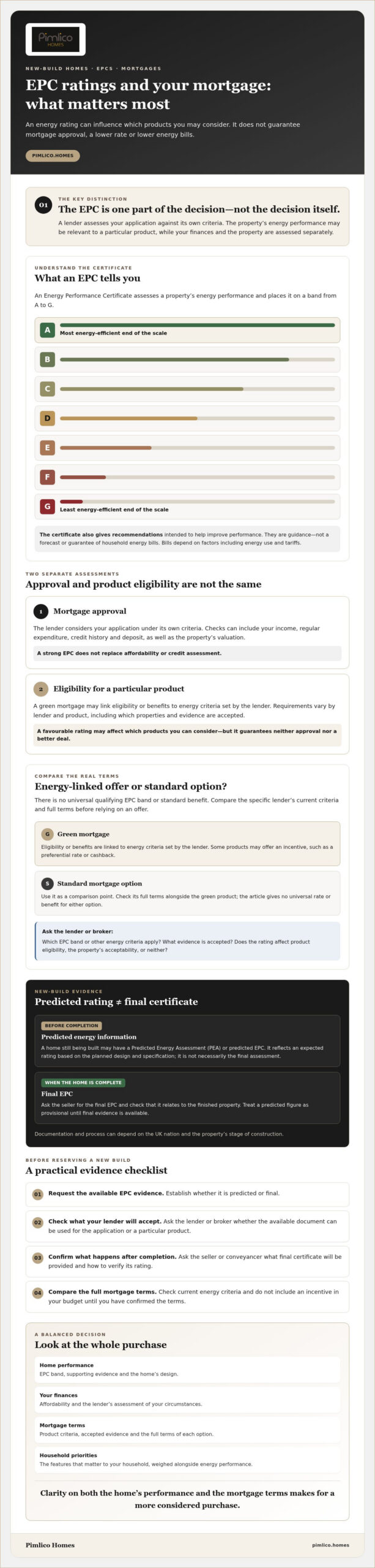
An Energy Performance Certificate assesses a property’s energy performance and gives it a band from A to G. A is the most energy-efficient end of the scale; G is the least. The certificate also includes recommendations intended to help improve performance. These are guidance, not a forecast or guarantee of the energy bills a household will pay. Bills depend on factors such as energy use and tariffs. For a wider overview of the UK system, see this Energy Performance Certificate (EPC) overview.
An EPC describes a home’s assessed energy performance; a lender’s affordability assessment considers whether the applicant can meet the mortgage repayments. The documents address different questions. An efficient home does not, by itself, show that a borrower meets a lender’s financial criteria.
Why can a new build have EPC information before completion?
For a home still being built, buyers may be given design-stage energy information, commonly described as a Predicted Energy Assessment (PEA) or predicted EPC. This indicates an expected rating based on the planned design and specification. It is not necessarily the final assessment of the completed home. The documentation and process can depend on the UK nation and the property’s stage of construction.
Once the home is complete, ask the seller for the final EPC and check that it relates to the finished property. If you’re buying off-plan, request the available predicted documentation and ask your lender or broker whether it can be used for the application or a particular product. Before exchange or completion, check with the seller or conveyancer what final certificate will be provided and how to verify its rating. Treat any predicted figure as provisional until the final evidence is available.
Review the EPC alongside the home’s design and your wider financial plans. Its rating can help you frame useful questions, but confirm the lender’s assessment and product terms directly with the lender or broker.
How an EPC rating may affect your mortgage options
A favourable EPC rating can affect which mortgage products you’re eligible to consider, but it doesn’t replace the lender’s assessment of you or the property. For EPC ratings of new build homes, the practical distinction is between approval, based on the lender’s underwriting criteria, and product eligibility, which may include energy-performance conditions.
Keep the different checks separate. Your income, regular expenditure, credit history, deposit and the property’s valuation can all form part of a mortgage decision. A higher EPC rating does not automatically increase how much you can borrow or secure a lower interest rate. Each lender sets its own criteria, including any requirements relating to the property, so confirm these directly with your lender or broker.
Can an EPC rating change mortgage approval?
An EPC is not a substitute for affordability checks or credit assessment. A buyer might meet a lender’s financial criteria yet not meet the conditions for a particular energy-linked product. Equally, a buyer with an efficient home could still fall short of the lender’s application requirements. Ask whether the rating affects the mortgage product available, the property’s acceptability, or neither. These are distinct questions, and the answer depends on the lender.
What are green mortgages, and who may qualify?
Green mortgages are products whose eligibility or benefits are linked to energy criteria set by the lender. Some may offer an incentive, such as a preferential rate or cashback, but there is no universal qualifying EPC band or standard benefit. Criteria can differ by lender and product, and may specify which properties or evidence are accepted. Check the current terms before including an incentive in your budget.
Before comparing offers, ask your lender or broker:
- Which EPC band or other energy criteria apply to this specific product?
- Will the lender accept the evidence available for the property, particularly if it is still being built?
- Does the incentive apply for the full mortgage term, or are there conditions or time limits?
- How do the rate, fees and overall terms compare with a standard mortgage you could qualify for?
These checks help establish whether an energy-linked offer is suitable, rather than assuming a headline incentive means a better overall deal. For homes in England and Wales, you can check a new-build’s EPC rating through GOV.UK. Ask your lender what documentation it requires and whether it accepts a predicted assessment.
Consider mortgage terms alongside the home itself. As you assess the wider purchase, you can also explore Pimlico Homes’ luxury new-build homes, while discussing personal mortgage options with a lender or broker.
EPC ratings and mortgage deals: compare the real differences
A headline rate can make an offer look compelling, but it doesn’t tell you whether you qualify or whether the product suits your plans. Compare the full terms and the evidence required, not just the EPC band or advertised incentive.
| What you’re comparing | What to check |
|---|---|
| Standard mortgage | Assess the rate, fees, fixed-rate period, early repayment conditions and your eligibility. An EPC-linked incentive may not apply, but the lender’s usual property and applicant criteria still matter. |
| Lender green mortgage | Confirm the qualifying EPC band, eligible property types, accepted evidence and any conditions attached to the incentive. Benefits and requirements are specific to the lender and product. |
| EPC evidence | Check whether the lender needs a final EPC or will accept predicted documentation for a home that is not yet complete. Confirm that the certificate relates to the property you’re buying. |
An EPC rating alone cannot establish which mortgage is best. The right comparison depends on the complete product terms and your circumstances. For background on how EPC ratings affect mortgage deals, the Energy Saving Trust explains the link between energy performance and green mortgage incentives. Your lender’s current offer terms should guide any decision.
What should you compare beyond the advertised rate?
Check the fees, any cashback or other incentive, how long a fixed rate lasts and whether early repayment charges could affect your plans. Consider the costs and conditions over the period you expect to hold the product, rather than treating a lower initial rate as the whole story. A regulated mortgage adviser can provide a personalised recommendation based on your finances and circumstances.
Why can two lenders treat the same EPC differently?
Each lender sets its own eligibility rules, rating thresholds and acceptable evidence. One may assess a product using a particular EPC band, while another may set different criteria or documentation requirements. There is no single qualifying standard that applies to all UK mortgages. Before relying on a green offer, ask the lender to confirm the applicable threshold and whether it accepts the certificate or predicted assessment available for your new build.
How to check a new-build EPC before choosing a mortgage
Before relying on an EPC rating to compare mortgage options, establish exactly what evidence exists and whether your lender will accept it. The EPC ratings of new build homes may be based on information available at different stages of construction, so check the document’s status rather than treating an early estimate as final.
Use this checklist before reserving or proceeding with a mortgage application:
- Request the available EPC evidence. Ask the seller for the certificate or assessment currently available, including any design-stage or predicted document.
- Confirm its status and date. Establish whether it is preliminary or final, when it was issued and whether a later assessment will be provided.
- Check the property details. Match the address and any identifying details on the document to the home you intend to buy. Raise any discrepancy with the seller.
- Verify the applicable process. EPC procedures and requirements can differ across the UK nations. Ask your conveyancer which guidance applies to the property and transaction, and check current official information.
- Ask the lender what it will accept. If you’re considering an energy-linked product, confirm whether the lender accepts the available evidence and what rating or other criteria apply.
- Clarify what happens next. Ask who will provide the completed-home EPC and when, then confirm with your lender or broker how a difference between predicted and final information could affect product eligibility.
Questions to ask your lender, broker and conveyancer
Be specific: “Does this rating affect my eligibility, the rate, or another mortgage term?” “Will you accept this predicted assessment, or do you require a final EPC?” “If the final rating differs, could that change the product I’m offered?” Ask the seller to clarify the document and expected final certificate, and ask your conveyancer which nation’s requirements apply. Keep written responses with your purchase documents.
Careful checking can prevent an assumption from shaping your budget. Treat any early rating as provisional until its status and acceptance are clear, and discuss mortgage terms with your lender or broker. As you consider the property itself, explore Pimlico Homes’ luxury new-build homes as part of your wider purchase research.
Choosing an energy-efficient new build with confidence
An EPC is useful evidence, but it’s only one part of choosing a home and arranging finance. The EPC ratings of new build homes can help you understand assessed energy performance and may be relevant to mortgage product eligibility. They can’t tell you, on their own, whether a property suits your household or which mortgage is right for you.
How should EPC information fit into your home-buying decision?
Consider the certificate alongside the home’s layout, specification, position and long-term suitability for your needs. Review the details provided about the finished property rather than inferring energy performance from marketing descriptions. An EPC’s recommendations may help you understand potential improvements, but the rating doesn’t guarantee a particular energy bill or a specific saving. Actual costs depend on household use, tariffs and other circumstances.
A considered purchase brings these details together. For further guidance on assessing the wider decision, read our luxury new-build buying guide.
What are your next steps as a prospective buyer?
Before making a commitment, request the available EPC evidence and ask the seller or your conveyancer whether it is predicted or final. Check that it relates to the property you intend to purchase, then confirm with your lender or broker which evidence it accepts and whether the rating affects the mortgage product or its terms. If earlier information differs from the final certificate, ask how that could affect eligibility. Compare mortgage options using the lender’s current criteria and seek personalised guidance from a qualified mortgage adviser.
These checks allow you to weigh energy performance in context, alongside the home’s design, your finances and the terms available to you. Clear information at each stage can make a significant decision feel more assured.
To learn more about the homes Pimlico Homes develops and sells, explore Pimlico Homes’ new-build homes.
Make your next move with confidence
The EPC ratings of new build homes can inform your decision, but they don’t determine mortgage approval or guarantee a better deal. Treat the certificate as one part of a broader assessment: confirm whether the evidence is predicted or final, check what your lender accepts, and compare mortgage terms against your finances and plans.
A well-considered purchase looks beyond the rating. Consider the home’s specification, layout and suitability for your household, and ask for clear documentation rather than relying on assumptions. For personalised mortgage guidance, speak with your lender or a qualified adviser.
Pimlico Homes is a specialist developer of luxury new-build homes for private buyers, with a focus on craftsmanship across detached homes, courtyard developments and bespoke homes. Explore Pimlico Homes’ considered collection of new-build homes and take the next step towards finding a home that feels right for the future.
Frequently Asked Questions
Is a high EPC rating required to get a mortgage?
No. There is no single EPC requirement that applies to every UK mortgage. Lenders set their own criteria for properties and for any energy-linked products they offer. They assess your application separately, including affordability and credit history, so a home’s rating can’t replace those checks. Before applying, ask the lender or a regulated mortgage adviser whether the property’s current certificate affects eligibility or any specific mortgage term.
Can an EPC rating get you a cheaper mortgage?
Sometimes, but not automatically. Some lenders offer products or incentives linked to a property’s energy performance, and eligibility depends on their current criteria. A favourable EPC doesn’t guarantee a lower interest rate or lower overall borrowing cost. Compare the full offer, including fees, the rate period, incentive conditions and early repayment terms. Ask the lender to confirm current details, and consider guidance from a qualified mortgage adviser before choosing.
How does an EPC rating affect mortgage affordability?
An EPC rating doesn’t itself determine mortgage affordability. Lenders assess factors such as income, expenditure and credit profile; the home’s rating may instead matter for eligibility for a particular energy-linked product. Actual household running costs can vary with the property and how it’s occupied, so don’t treat an EPC estimate as a personal budget. Ask your lender or adviser whether, and how, the certificate affects your application.
Do new-build homes automatically receive an A-rated EPC?
No. EPC ratings of new build homes are assessed for each individual property, so buyers shouldn’t assume every new home receives an A rating. Request the certificate relating to the property and check whether it’s preliminary, predicted or final. A new-build label or sales description isn’t a substitute for that evidence. Ask the seller or conveyancer to confirm which document is available and verify the current process for the relevant UK nation.
What happens if the final EPC rating differs from the expected rating?
First, confirm which certificate and rating your lender will accept. A difference may matter if the mortgage product has specific energy-performance eligibility criteria, but the effect depends on the lender’s terms and your transaction. Contact the seller, conveyancer and lender promptly to clarify the final evidence and any implications for product eligibility. Don’t assume an earlier predicted rating guarantees access to a particular mortgage offer.
Can a lender refuse a mortgage because of a property’s EPC rating?
A lender’s decision depends on its policies, the property and your circumstances. Some products may have energy-related eligibility criteria, but there’s no single EPC grade that applies as a refusal threshold across all UK lenders. If a lender raises a concern about the property’s rating, ask it or your broker to explain the specific restriction and whether another suitable mortgage product could be considered.
Is an EPC rating the same as a home’s actual energy bills?
No. An EPC assesses a home’s energy performance; it doesn’t promise what a household will pay. Actual bills depend on factors including energy tariffs, occupancy, weather and how residents use heating and appliances. Use the certificate as one source of information alongside property-specific documentation, but don’t treat any estimated figure as a guaranteed bill. Ask the seller or conveyancer to clarify the evidence available for the home you’re buying.





