
A gate can mark the boundary of a home, but it cannot, by itself, create peace of mind. For those exploring gated executive homes, the more useful questions often begin beyond the entrance: who manages access, how security arrangements fit around family life, and where responsibilities end. A considered plan should support both the household’s security needs and its sense of ease.
It is reasonable to want reassurance without making everyday life feel observed or constrained. Security staff can follow agreed routines and access arrangements, but they do not replace residents’ judgement, clear communication or practical planning. The right level of support depends on the property’s layout, household patterns and the responsibilities that need attention.
This guide explains what a residential security team can and cannot contribute, compares staffing approaches, and shows how to set respectful expectations for residents, visitors and staff. It also considers how privacy and the character of a home shape security decisions, helping you choose a proportionate approach. Thoughtful security is not simply a presence at the gate; it is a well-managed part of living well.
Key Takeaways
- Separate the role of security staff from physical access controls and household procedures.
- Turn agreed responsibilities into clear routines, boundaries and incident procedures that work with everyday life.
- Compare continuous staffing, scheduled presence and remote coordination by their effect on privacy, household interaction and operational complexity.
- When considering gated executive homes north east, start with household routines and property access patterns to shape a proportionate approach.
- Assess entrances, sightlines, circulation and private outdoor spaces to understand how a home’s layout may support your preferred level of privacy.
Gated Executive Homes: What a Residential Security Team Can, and Cannot, Do
A residential security team is a group of people assigned to support a household’s security through agreed duties. Depending on the arrangement, this might mean maintaining a visible presence at an entrance, coordinating access for visitors or contractors, or following a plan when an incident occurs. Staff, a gate, an alarm and household procedures have different roles: people provide a human presence, while physical controls and clear routines support the wider plan.
A residential security team can observe, coordinate and follow agreed procedures; it cannot guarantee that an incident will not occur or replace the household’s own decisions. That distinction helps residents define what they need without assuming that a staffed entrance offers complete protection.
What does a residential security team do?
Responsibilities depend on the household’s requirements, the property and the agreed working arrangements. It helps to consider common functions separately:
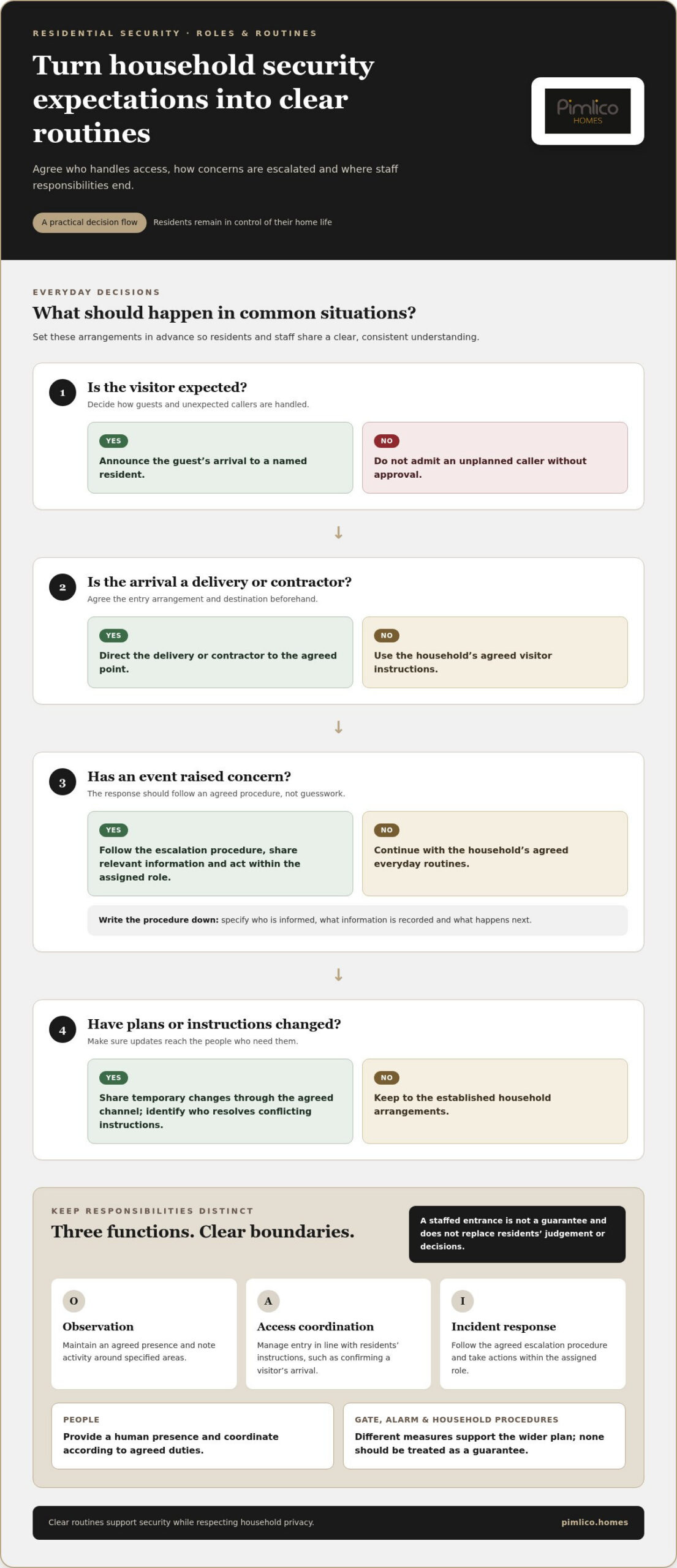
- Observation: Staff may maintain an agreed presence and note activity around specified areas. Observation is not the same as knowing who belongs on the property or determining someone’s intentions.
- Access coordination: A team may manage entry in line with residents’ instructions, such as confirming a visitor’s arrival or directing a delivery to an agreed point. Residents should decide in advance how guests, household staff and unexpected callers are handled.
- Incident response: If an event raises concern, staff may follow the household’s escalation procedure, communicate relevant information and take actions within their assigned role. The plan should say when residents are notified and what happens next.
These functions are not automatic or identical from one home to another. A household that regularly receives visitors may prioritise smooth access coordination; one with quieter routines may value a visible presence at particular times. Clear limits help prevent confusion, protect residents’ privacy and give staff a consistent framework for their work.
Does a gated entrance provide enough security on its own?
No single measure should be treated as a guarantee. A gate can shape how people approach a property and provide a point at which access is managed, but it cannot establish every visitor’s identity, monitor every part of a home or decide how residents want an unusual situation handled. A useful overview of the different forms and security considerations associated with gated communities is Understanding Gated Communities.
Think in layers. Entry controls can sit alongside agreed household routines, clear communication and, where appropriate, staffed support. For example, residents can set out how expected visitors are announced, who may approve access and how changes to plans are shared. Without such arrangements, a gate or staff presence may create uncertainty rather than a dependable routine.
For anyone considering gated executive homes north east, the practical question is not simply whether an entrance is controlled. Consider how the property’s access points, household patterns and assigned responsibilities work together, while preserving the comfort and privacy that make a home feel like one’s own.
How Residential Security Works: Roles, Routines and Boundaries
Security works best when responsibilities are understood before they are needed. A household and its team can agree what a normal day looks like, who makes decisions about access and how relevant information is shared. This turns a general instruction to “keep the household secure” into practical routines, while leaving residents in control of their home life.
Defined responsibilities help protect privacy because everyone knows what needs attention, what should remain private and when information should be shared. The aim is a calm, proportionate presence, not a system that makes ordinary family life feel managed or observed.
Which responsibilities should be agreed in advance?
Begin with the movements that shape a typical week. Consider how residents prefer to receive visitors, where deliveries should be left and how household staff or contractors are expected to enter. A clear arrangement might specify that an expected guest is announced to a named resident, while an unplanned caller is not admitted without approval. The procedure should reflect the household’s preferences.
Agree how updates will be handled. Decide who receives routine information, which channel is suitable for a time-sensitive message and how temporary changes, such as a delayed arrival or rearranged visit, are passed on. If more than one person gives instructions, identify who has authority to resolve a difference. This reduces guesswork for staff and unnecessary interruptions for residents.
Incident procedures also need to be written down. Set out who should be informed, what information should be recorded and how concerns are escalated. These steps do not guarantee a particular outcome; they establish a shared sequence to follow and review. Keep the instructions clear enough to use under pressure, and update them when household routines change.
How can a team respect household privacy?
Make boundaries as specific as duties. Identify private rooms and areas where staff access is limited, explain when entry is permitted, and distinguish household spaces from routes used by deliveries or visitors. Family routines deserve similar consideration: residents may prefer not to receive routine updates during meals, for example, unless a matter has been defined as urgent.
Agree discreet ways to communicate and report. A concise written handover may suit routine matters, whilst a direct message may be preferred for a defined concern. Decide what details are necessary, who should receive them and how records are handled. Avoid collecting or circulating information simply because it might be useful later.
Any use of cameras, monitoring or personal information calls for careful review against current requirements. Consider what is being observed, why it is needed, who can access recordings or reports, and how long information is retained. Make these decisions deliberately rather than leaving them to habit.
For households considering gated executive homes north east, thoughtful routines can help security sit quietly alongside the character of a home. Property choice matters too: explore Pimlico Homes’ executive homes as you consider how layout and daily life align with your priorities.
Residential Security Team Options: Matching Support to Household Needs
There is no single staffing arrangement suited to every household. The choice is less about selecting the most visible option and more about matching support to daily routines, the property’s layout and residents’ expectations of privacy. A model that works well for a home with frequent visitors may feel unnecessarily intrusive in a household with quieter patterns.
How do different staffing arrangements compare?
Consider what each arrangement means in practice, not only how often someone is present. Continuous staffing provides a regular on-site presence, while scheduled support concentrates that presence around agreed periods. Remote coordination can help organise communication, but it is not the same as having someone at the property.
| Arrangement | Presence | Household interaction | Privacy | Operational complexity |
|---|---|---|---|---|
| Continuous on-site staffing | A team member is present on site across agreed shifts. | Regular interaction may be needed for handovers, access and updates. | Requires clear boundaries around staff access and private areas. | Duties, shift changes and handovers need careful coordination. |
| Scheduled presence | Staff attend during defined periods or for particular routines. | Interaction is focused around the agreed attendance window. | Presence is limited to scheduled periods, though expectations still need to be clear. | Residents need a plan for times outside the schedule. |
| Remote coordination | No security staff member is physically present at the home. | Communication takes place at agreed points or when needed. | Less day-to-day staff presence, with privacy still shaped by information-sharing practices. | Residents need to understand who monitors communications and what the arrangement covers. |
Continuous staffing calls for defined responsibilities and reliable handovers so instructions remain consistent between shifts. Scheduled support may suit specific patterns, such as regular visitor periods or times when residents are away. Remote coordination can support agreed communication, but it cannot provide the observation or immediate physical presence of someone on site. Each model has different boundaries, and none is a substitute for household planning.
What should guide the choice of security model?
Start with the household’s actual rhythm. Map how often visitors arrive, when deliveries are expected, whether residents travel regularly and how much staff presence feels comfortable. Then consider the property: the number and position of entrances, routes between shared and private areas, and sightlines from likely points of arrival can all affect how duties are organised.
For people considering gated executive homes north east, status, property value or a gated entrance alone cannot determine the appropriate level of support. A proportionate arrangement should reflect residents’ preferences as well as the home’s practical layout. It should also be reviewed when routines change, without assuming that more staffing automatically means greater reassurance.
How to Set Up and Manage a Residential Security Team
A well-run arrangement starts with the household, not a staffing assumption. First understand how the home is used, where access needs arise and what residents expect from a security presence. Then turn those priorities into clear instructions that can be followed consistently and adjusted as life changes.
- Map household routines and priorities. Note when residents usually come and go, how often visitors and deliveries arrive, and which periods call for particular attention. Include privacy preferences, such as when residents prefer not to be interrupted. This gives you a practical picture of the support required before deciding how it should be provided.
- Walk through the property’s access patterns. Identify each entrance, the routes visitors and household staff use, and any shared spaces. Mark areas where access should be restricted or agreed in advance. Consider how someone arriving at the main entrance moves through the property, and where instructions or communication may be needed.
- Set out duties in writing. Describe what staff are expected to do, what falls outside their role, and who can authorise access or change an instruction. Include procedures for visitors, deliveries, unexpected arrivals and routine reporting. Be specific: explain what “notify the resident” means and which resident should be contacted.
- Choose communication and handover methods. Agree which channel is used for routine updates and how urgent concerns are passed on. Record who receives each type of message, so private information is not shared more widely than necessary. For shifts or changes in attendance, use a consistent handover format covering outstanding matters, temporary instructions and points requiring follow-up.
- Clarify authority and compliance responsibilities. Decide who may approve changes to the plan and how residents will be told about them. Before arrangements begin, check current, authoritative guidance on applicable security licensing and legal obligations, including relevant information-handling requirements. Requirements can depend on the activities involved, so verify them against current official sources rather than relying on assumption.
Review the arrangement as household needs change
A plan should remain useful, not simply sit in a folder. Set a regular review point and ask residents whether duties still match household routines, communications are discreet and clear, and any boundary needs to be restated. A review can also reveal avoidable interruptions or duplicated tasks.
Record each agreed procedural change, including when it takes effect and who has been informed. Revisit the plan after a change in household routines, visitor patterns or the way the property is used. For those considering gated executive homes north east, this resident-led process helps align security planning with the home’s layout and the way people wish to live in it.
Thoughtful property choice can support that planning by bringing circulation and privacy into the wider conversation. Explore Pimlico Homes’ luxury homes as you consider the setting and design that best suit your household.
Choosing an Executive Home With Privacy and Security in Mind
A home’s design shapes how people move through it, welcome visitors and enjoy time away from the main living areas. These details can inform a household’s security plan, but cannot promise a particular outcome. For anyone considering gated executive homes north east, assess how the layout fits daily life rather than relying on a single feature or label.
Which property features can shape a security plan?
As you view a home, consider how its entrances and internal routes work in practice. Is there a clear way to receive visitors without disrupting private areas? Can residents move between principal rooms and outdoor spaces comfortably? Use these questions during a viewing:
- Entrances: Note how many there are and how they relate to household routines, deliveries and visitor arrivals.
- Circulation: Trace the routes from an entrance to shared living areas and private rooms. Think about where residents might want access to be limited.
- Sightlines: Observe what can be seen from key windows and approaches, both into the home and across its grounds. Consider how this affects the feeling of seclusion.
- Outdoor spaces: Assess how private gardens or terraces connect to the home, and whether their layout suits the way your household likes to spend time outside.
These are planning inputs, not security guarantees. A particular arrangement may make visitor movement easier to manage, for example, but it does not establish who is approaching or prevent every unwanted event. The aim is to understand how a home’s features could support the routines you value, whilst recognising that day-to-day arrangements remain a separate consideration.
How does home choice fit into the wider decision?
Weigh property layout alongside the way you expect to live there. Consider household patterns, privacy preferences and how needs may evolve over time. A layout that feels elegant during a viewing should also make sense for everyday arrivals, family life and time spent at home. A luxury new-build purchasing guide can help you consider the wider decisions involved in choosing a home, from priorities to the buying process.
Pimlico Homes develops luxury detached homes, executive courtyard homes, bespoke new builds and luxury barn conversions. Its focus is designing and selling homes for people seeking a considered blend of layout, style and quality craftsmanship. A property’s design can contribute to a resident-led plan, but it should not be taken as evidence of a particular security provision.
Explore Pimlico Homes’ residential homes and development approach as you consider which setting, layout and style best suit your household. The right choice brings together practical needs and the pleasure of a home that feels distinctly your own.
Make Your Next Home Choice With Confidence
Choosing among gated executive homes north east is an opportunity to think beyond the entrance and picture how you want daily life to feel. Let privacy, ease of movement and the rhythms of your household shape the questions you bring to a viewing. A considered choice should feel right not only on arrival, but through the ordinary moments that make a home your own.
Pimlico Homes specialises in luxury detached and executive courtyard homes, bespoke new builds and high-end barn conversions. Each home reflects a wider consideration: how thoughtful design and quality craftsmanship can support the way you want to live, without assuming a property includes gated access or staffed security.
Explore the possibilities and consider which setting and style best reflect your priorities. Explore Pimlico Homes’ luxury residential developments and take the next step towards a home that feels distinctive and truly yours.
Frequently Asked Questions
Does a gated entrance guarantee the security of an executive home?
No. A gate can help manage how people enter, but it cannot guarantee safety or replace the household’s own procedures. Think of security as a combination of measures shaped by the home and the way residents use it. For example, a clear plan for a visitor who arrives earlier than expected can matter as much as the entrance itself. Routines and communication help make the overall arrangement coherent.
Do residential security staff need an SIA licence?
It depends on the duties performed and the current rules that apply to those activities, so it is not safe to assume every residential role has the same licensing requirement. Before making arrangements, check the latest guidance from the Security Industry Authority and verify any relevant legal obligations through authoritative sources. Keep this separate from household preferences, such as whether staff should manage visitors or provide a visible presence.
How can a residential security team protect privacy at home?
Residents can set privacy expectations before regular routines begin. For instance, specify which rooms are private, when staff may enter shared areas and whether routine updates should be written or spoken discreetly. Agree what information belongs in a report and who should receive it. These boundaries help limit unnecessary interruptions, but they cannot guarantee privacy. Revisit them if household arrangements or the use of rooms changes.
Can a household use security support only at certain times?
Yes, a household can consider support aligned with particular routines or periods rather than assuming continuous staffing is necessary. Scheduled attendance might fit a predictable time when visitors are expected, while a permanent on-site model involves a continuing presence and more coordination. The appropriate approach depends on the household’s needs, property and agreed duties. A timetable should also make clear what arrangements apply outside scheduled hours.
How should residents manage visitor and delivery access?
Create a simple procedure that distinguishes expected visitors from unplanned arrivals and explains how deliveries should be handled. For example, residents might nominate who approves a guest’s entry and where a parcel can be left. Decide how a resident can communicate a change, such as a visitor arriving at a different time. Keep instructions practical for the property, and avoid assuming that any particular access system is already in place.
Should residential security teams use CCTV or access-control systems?
They may form part of a wider household plan, but neither replaces clearly assigned responsibilities or agreed procedures. Before using CCTV or access controls, consider what areas are covered, who can view information and how it will be handled. Check applicable privacy and data-protection requirements using current authoritative guidance. The decision should reflect the household’s purpose and preferences, rather than an assumption that technology will prevent incidents.
How often should household security arrangements be reviewed?
Review arrangements periodically and whenever household routines, property use or access needs change. A new regular visitor, altered delivery pattern or room used for a different purpose may make existing instructions less suitable. Invite feedback from residents and staff, record approved changes, and name someone responsible for sharing updates. There is no single review interval that suits every household; choose a cadence that keeps guidance current and understood.





