
Could a family contribution bring a new-build home within reach, yet complicate a mortgage if its terms aren’t clear? Gifting a deposit for a new build home UK buyers are considering involves more than transferring money: the lender will need to understand whether it’s a genuine gift, who provided it and where the funds came from.
Helping a loved one take an important step towards home ownership can be meaningful, but it is important to protect everyone involved. A cash gift towards a deposit is not the same as gifting a property, and describing a loan as a gift can create serious mortgage complications.
This guide explains the difference and what a lender may require, including a signed gift declaration and evidence for identity and source-of-funds checks. It also covers why the terms of the gift and potential Inheritance Tax implications deserve consideration before money changes hands. Use these points to plan the contribution alongside the new-build purchase.
Key Takeaways
- Gifting a deposit for a new build home UK buyers are considering means contributing cash towards the purchase, not transferring ownership of a property.
- Be clear whether the contribution is an outright gift or a repayable loan. The arrangement affects lender questions and the buyer’s financial commitments.
- Agree the gift terms and gather relevant identity and source-of-funds records before the lender asks for them.
- Plan the transfer around the purchase timetable, including any reservation and completion deadlines. New-build purchases do not all follow the same schedule.
- Consider the gift alongside the buyer’s wider budget and any tax implications. A deposit contribution is only one part of deciding whether a home is the right fit.
Gifting a deposit for a new-build home in the UK: how it works
Family support can help a buyer build a deposit or reduce the amount they need to borrow. A gifted deposit is money given towards the purchase, but the mortgage lender must be able to understand the arrangement and decide whether it meets its criteria. A family contribution does not guarantee mortgage approval.
This guide is about giving cash towards a new-build home, not transferring ownership of a home to a family member. The distinction matters because money and property are different assets, and each can raise different questions for lenders and tax authorities.
What counts as a gifted deposit?
A genuine deposit gift is money provided without an expectation that the buyer will repay it. Lenders commonly ask for a signed declaration confirming that the contribution is a gift and that the giver will not acquire a legal interest in the home. They may also request identity documents and evidence showing where the money came from.
A family loan is different. If repayment is expected, the buyer should disclose this to the lender. Repayments may affect affordability and the mortgage assessment. Calling a loan a gift does not change its terms and can create serious complications.
A cash gift is not the same as gifting a property
With a cash gift, the buyer receives funds to put towards a purchase and becomes the property owner after completion. Gifting a property means transferring the asset itself, with different ownership and potential tax consequences. A property transfer or disposal may raise Capital Gains Tax questions, depending on the circumstances, whereas a cash gift has a different tax profile.
Inheritance Tax may also be relevant when someone gives away money or other assets. The treatment depends on the gift, the giver’s circumstances and the applicable rules. For a neutral introduction, see Inheritance Tax in the United Kingdom. It is a starting point, not a substitute for checking current HMRC guidance or obtaining advice for a particular situation.
So, gifting a deposit for a new build home UK buyers are considering is best treated as a carefully documented cash contribution. Agree the terms before transferring funds, disclose the arrangement accurately and factor the lender’s requirements into the purchase timetable.
How a family deposit gift fits into a new-build purchase
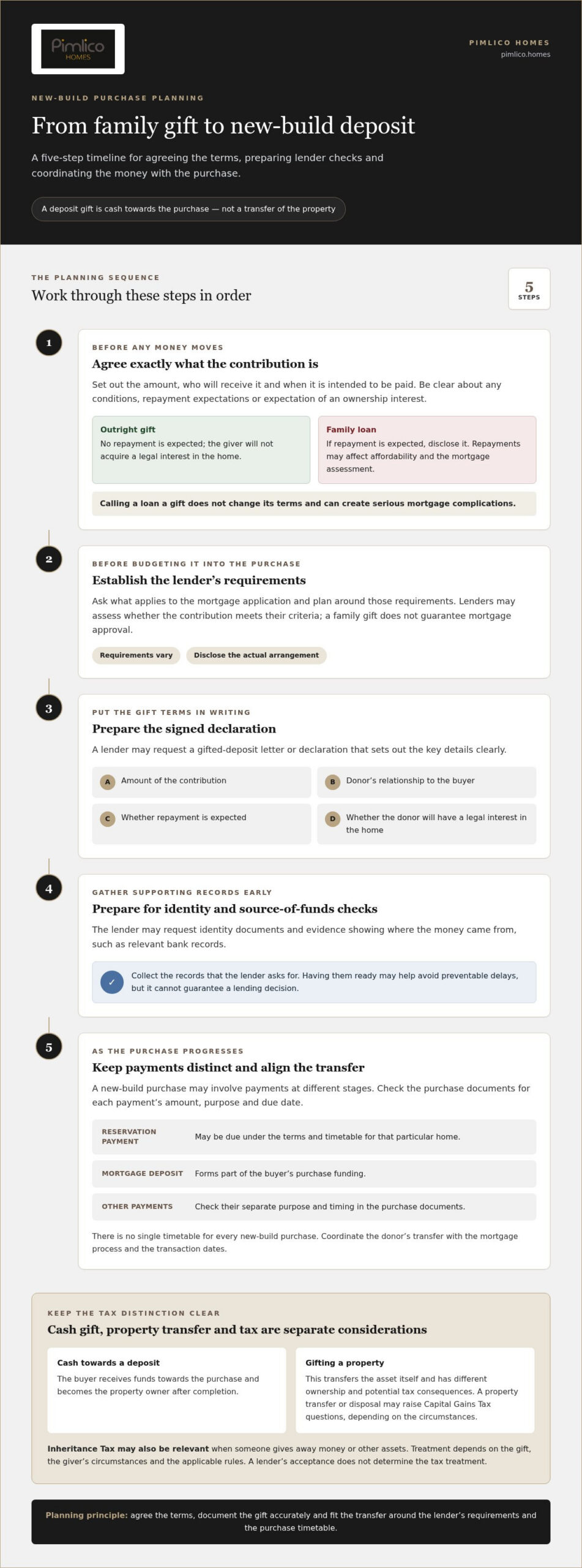
A family contribution is easier to manage when it is planned alongside the purchase rather than treated as a last-minute transfer. For anyone considering gifting a deposit for a new build home UK buyers can follow a practical sequence: agree what the money is for, establish the lender’s requirements, prepare supporting documents and arrange the transfer to fit the transaction timetable.
Agree the gift before funds move
The buyer and donor should agree the amount, who will receive it and when it is intended to be paid. Be explicit about whether the money is an outright gift. Discuss any expectations of repayment, an ownership interest or other conditions. If the donor expects repayment or a stake in the property, the arrangement may not meet the lender’s definition of a gift and could affect its assessment.
Disclose and document a gifted deposit in line with the lender’s requirements. Requirements vary, so establish what applies to the mortgage application before building the funds into the purchase budget.
Prepare for lender checks
A lender may ask for a signed gifted-deposit letter or declaration stating the amount, the donor’s relationship to the buyer, whether repayment is expected and whether the donor will have a legal interest in the property. It may also request identity documents and evidence of the source of the funds, such as relevant bank records, as part of its checks. Gathering these records early can help avoid preventable delays, but it cannot guarantee a lending decision.
Tax is a separate consideration. A lender’s acceptance of a deposit gift does not determine its tax treatment. The donor’s circumstances matter, and the official Inheritance Tax rules are a starting point for understanding how gifts may be considered. This is not personal tax advice; the position depends on the individuals involved.
Keep purchase payments distinct
A new-build purchase can involve a reservation payment, the mortgage deposit and other payments at different stages. These payments are not automatically interchangeable. A reservation payment may be due under the terms and timetable for a particular home, while the deposit forms part of the buyer’s purchase funding. Check the purchase documents to establish the amount, purpose and due date of each payment.
There is no single timetable for every new-build purchase. Reservation and completion arrangements can set their own deadlines, so align the donor’s transfer with the mortgage process and transaction dates. Thoughtful planning supports a more considered purchase, whether you are looking at a detached home, an executive courtyard home or another new-build property. You can also explore new-build homes as part of that decision.
Gifted deposit, family loan, or gifted property: what is the difference?
These arrangements can all involve family support, but they are not interchangeable. The key questions are whether the buyer must repay the money and whether ownership of a property is being transferred. For anyone considering gifting a deposit for a new build home UK lenders will assess the actual terms, not simply the label attached to the funds.
| Arrangement | Ownership and repayment | Questions to consider |
|---|---|---|
| Cash gift | The buyer receives money with no repayment expected; the donor does not gain an ownership interest. | Will the lender accept the gift, and what evidence of the donor and funds will it require? Could Inheritance Tax apply to the gift? |
| Family loan | The buyer is expected to repay the money, under agreed terms. | How will repayments affect the lender’s affordability assessment? What are the loan terms and any tax implications? |
| Gift of property | The property itself, or an interest in it, is transferred; this is not simply deposit funding. | What ownership, tax and transaction consequences arise from the transfer, and how do the rules differ across the UK? |
Gift or loan: does the buyer have to repay the money?
A true gift is not repayable. A loan is repayable, even if it carries no interest or has no formal schedule, and the lender may take the commitment into account when assessing affordability. Criteria vary between lenders. Lloyds Bank’s guide to how a gifted deposit works explains the practical distinction and the information a lender may request.
Be precise about the agreement. If the donor expects the buyer to return the money, describe it as a loan rather than calling it a gift. Misrepresenting the arrangement can undermine the mortgage application and cause problems later. Discuss any expectation of repayment, a share in the home or other conditions before the buyer relies on the funds.
Cash gift or transfer of an existing property?
A cash gift helps fund a purchase; a property gift changes ownership of an existing asset. Transferring property can raise questions about legal ownership, valuation, Inheritance Tax and Capital Gains Tax. A property disposal may have Capital Gains Tax implications, depending on the circumstances, whereas giving cash is a different type of transaction.
Transaction taxes also depend on where the property is situated. SDLT applies in England and Northern Ireland, whilst Scotland and Wales have their own property transaction taxes. The consequences of a transfer depend on its details and current rules, so no single structure suits every family. Establish what is intended, then consider the mortgage and tax implications before funds or ownership change hands.
Practical checklist for gifting a deposit without avoidable delays
A clear paper trail helps the buyer, donor and lender work from the same account of the gift. When gifting a deposit for a new build home UK buyers should distinguish confirmed requirements from assumptions: lender criteria vary, tax outcomes depend on individual circumstances, and new-build payment dates are set by the purchase arrangements.
Before the buyer applies for a mortgage
- Define the arrangement. Record whether the contribution is an outright gift or a loan before describing it to the lender. Note the amount, intended recipient and any conditions.
- Be clear about expectations. Identify whether the donor expects repayment, a share of ownership or another benefit. Conditions may affect how the lender views the funds and the buyer’s application.
- Establish the lender’s requirements. Find out what the application process requires, such as a gift declaration, details about the donor, proof of identity or evidence showing the source of the funds. These are possible requests, not a universal document list.
- Keep information consistent. The gift amount, donor details and terms should match across the declaration, mortgage application and supporting records. If anything changes, update the relevant information rather than relying on an earlier version.
Some requirements are matters of lender policy, not fixed rules for every buyer. A lender may ask for a signed letter confirming that the money is a genuine gift, with no repayment expected and no legal interest for the donor. Do not assume that one lender’s process applies to another.
Before funds are transferred
- Check the timing. Match the expected transfer date to the mortgage process, purchase timetable and any reservation or completion deadlines. New-build arrangements differ, so do not assume there is one standard schedule.
- Keep proof of the transfer. Retain records showing the amount, date, sender and recipient. Store them with the written agreement about the purpose and terms of the funds.
- Separate tax checks from lender checks. Mortgage acceptance does not settle the tax position. Property transaction taxes differ across the UK nations, and Inheritance Tax treatment depends on the circumstances and current rules. Check the relevant jurisdiction and current tax guidance rather than assuming a single UK-wide answer.
Preparation cannot guarantee a mortgage decision or prevent every delay, but it can reduce avoidable uncertainty. Once the funding plan and key dates are clear, consider how they fit into the wider choice of home. Explore Pimlico Homes properties as part of your new-build search.
Planning a gifted deposit around your new-build home purchase
A family contribution is one part of a wider purchase plan. Before committing, bring four elements into focus: the buyer’s overall budget, the terms of the gift, the lender’s process and the expected transaction timetable. This gives the buyer and donor a shared understanding of what the funds are intended to cover and when they may be needed.
For families considering gifting a deposit for a new build home UK buyers should separate what is agreed from what depends on individual circumstances. The lender assesses the contribution as part of the full mortgage application, so the gift alone does not determine approval. Tax treatment can depend on the people, assets and circumstances involved, while the purchase timetable may be shaped by the specific new-build arrangements. Use current requirements rather than relying on assumptions or another buyer’s experience.
A considered purchase begins with clear expectations
Before the buyer commits to a property or the donor transfers money, discuss the purpose and terms of the gift. Is it intended to support the deposit outright, and is there any expectation attached to it? Clear expectations can reduce uncertainty, but they cannot guarantee a smooth transaction or a particular mortgage outcome.
Then consider the home itself. The funding plan should sit alongside practical priorities such as space, design and how the property may suit the buyer’s longer-term plans. A larger contribution does not, by itself, establish whether a home is the right fit. For broader buying considerations, read our luxury new-build purchasing guide.
Explore new-build homes with confidence
Thoughtful planning brings the family gift, mortgage process and purchase dates together as connected parts of a significant decision. Keep the funding arrangement transparent, allow time for the relevant checks and revisit the plan if the terms or timetable change. For tax questions, use current guidance for the relevant UK jurisdiction and circumstances; this overview is not personal tax advice.
With the financial details considered, take time to explore the home that reflects your plans. Explore Pimlico Homes and discover luxury new-build homes, including detached, executive courtyard and bespoke properties.
Make your next move with clarity
A family contribution can support a new-build purchase, but its terms matter. A genuine gift differs from a repayable loan, and neither should be confused with transferring ownership of a property. Agree the arrangement openly, disclose it accurately and organise the evidence your lender may require.
For anyone considering gifting a deposit for a new build home UK rules and lender criteria should be considered alongside the family’s circumstances. Allow for the purchase timetable and treat tax questions with care: the relevant rules can depend on the type of gift and where the property is located. A considered funding plan brings clarity, though it cannot determine mortgage approval or whether a particular home suits your needs.
Pimlico Homes specialises in luxury new-build residential homes, including detached, executive courtyard and bespoke properties. Explore the possibilities at your own pace and consider the home that fits your plans. Explore Pimlico Homes and discover a considered approach to new-build living.
With clear expectations and a thoughtful plan, you can take the next step towards a home designed for the life ahead.
Frequently Asked Questions
Can I gift a deposit for my child’s new-build home in the UK?
Yes, you can give your child money towards a new-build deposit, subject to the mortgage lender’s criteria. If the contribution is presented as a gift, it should be genuine, with no expectation of repayment or ownership in the property. The lender may request a signed declaration, information about you and evidence showing where the funds came from. Consider potential Inheritance Tax implications before transferring a substantial sum.
Does gifting a cash deposit trigger Capital Gains Tax in the UK?
A straightforward gift of cash does not usually create a Capital Gains Tax charge simply because the money is given away. However, selling or disposing of an asset, such as investments or property, to raise that cash may have separate tax consequences. Inheritance Tax can also be relevant to gifts, depending on the circumstances. The tax position is fact-specific, so check current rules rather than treating this as personal tax advice.
Will a gifted deposit affect a mortgage application?
It can affect the application because the lender will want to understand the source and terms of the funds. A genuine, non-repayable gift may be accepted, but lender criteria differ and acceptance does not guarantee mortgage approval. If the buyer must repay the money, the lender may treat it as a financial commitment when assessing affordability. Disclose the arrangement accurately and provide the evidence requested during the application process.
What is a gifted deposit letter?
A gifted deposit letter is a declaration from the person giving the money, confirming key details of the contribution. A lender may require it to state the gift amount, who is giving and receiving the funds, that repayment is not expected and that the donor will not have a legal interest in the home. The lender may also request identity and source-of-funds evidence. Requirements can vary.
Can a family loan be used as a deposit for a new-build home?
Possibly, but the buyer must disclose that the money is a loan rather than describe it as a gift. The lender may take the repayment terms into account when assessing affordability, and its criteria determine whether the arrangement is acceptable. Agree the amount, repayment expectations and any interest clearly, then provide accurate details during the mortgage application. Calling repayable funds a gift can create serious problems and may undermine the application.
Is gifting a property to a child the same as gifting a deposit?
No. A deposit gift transfers money to help fund a purchase, whereas gifting a property transfers ownership of the property itself. That transfer can raise separate legal and tax questions, including possible Capital Gains Tax and Inheritance Tax considerations. Property transaction taxes and rules also differ across the UK nations. The consequences depend on the circumstances and current rules, so do not assume the tax treatment of cash applies to property.
Can a gifted deposit be paid directly towards a new-build home?
It may be possible, but the payment route should fit the lender’s instructions and the purchase arrangements. The lender and the parties handling the transaction may need to trace the funds, verify their source and confirm that they match the declared gift. New-build purchases can have specific reservation and completion deadlines, so establish when the money is needed and how it should be transferred before sending it. Keep records of the payment and its purpose.





