
What if a home’s most enduring value lies not in a forecast, but in how well it serves the people who live there? The idea of “heirloom properties” as a UK asset class can sound compelling, yet the term isn’t a formal legal or financial classification. A family’s intention to pass on a home is no guarantee of its future performance.
It’s understandable to see a long-held home as both a source of belonging and a significant asset. The two are connected, but they aren’t the same. This article explains what may make a property an heirloom in practical terms, and how to assess lasting design, craftsmanship, maintenance and adaptability without confusing emotional legacy with financial certainty. It also considers how a thoughtfully designed new home might support continuity between generations, alongside the responsibilities of ownership. Before making a significant purchase or planning a transfer, independent advice from a solicitor, tax adviser, surveyor and financial adviser can help clarify the implications. The aim is a considered decision, based on both the life a home could hold and the care it may require.
Key Takeaways
- Understand why the phrase ‘heirloom properties’ as a UK asset class needs careful qualification, and what it can mean for a family.
- Learn which features to examine, from build quality and maintenance needs to how a home could adapt as family circumstances change.
- Compare property with other ways of holding family wealth by considering control, liquidity, upkeep, diversification and personal significance.
- Use a considered assessment process, including an independent survey and advice from relevant legal, tax and financial professionals.
- Explore how detached homes, courtyard homes, bespoke new builds and barn conversions might be assessed against your family’s priorities.
What Are Heirloom Properties in the UK, and Is the Term an Asset Class?
An heirloom property is a home intended to support family life and continuity across generations. The idea goes beyond inheritance: it reflects a decision to care for a place, make it useful to those who live there and perhaps pass it on. Its value may be personal, architectural and practical, as well as financial, but these different forms of value should not be confused.
The cultural history of the English country house offers one perspective on how architecture and family identity can become intertwined. Yet a home need not be grand, old or architecturally distinctive to carry meaning. A well-considered new home may also become part of family life over time if it meets changing needs and is cared for responsibly.
What makes a property an heirloom rather than simply an inherited home?
Inheritance describes how a property changes hands; heirloom status is more about the meaning a family gives it. A home inherited by circumstance may be sold or used for a short time, whilst a property deliberately stewarded may be maintained, adapted and kept as a place of connection. Intention, sustained care and shared history can all contribute. Age, purchase price and architectural style alone cannot establish that a home is an heirloom.
Legacy value can be deeply meaningful, but it is never a guarantee of investment returns. A family may prize a home for its familiar rooms, its suitability for different generations or the memories held within it. Those qualities do not establish what it may be worth in future. Financial performance depends on circumstances and factors that can change, so the emotional case for keeping a property deserves separate consideration from any investment assessment.
Is heirloom property a recognised UK asset class?
In the UK, “heirloom property” is best understood as a descriptive concept, not a formally defined legal or financial category. Using the phrase does not, by itself, confer a particular status, return or tax treatment. Describing a home as an heirloom should be a statement of family purpose, not a substitute for checking its ownership or financial implications.
Passing a home between generations can raise questions about ownership, succession and tax. The relevant considerations depend on the people involved and their wider circumstances; a label cannot resolve them. Before buying with a long-term family plan in mind, or arranging a transfer, seek independent advice from appropriately qualified legal, tax and financial professionals. A surveyor can also assess the property itself. Together, this advice can help distinguish a cherished family intention from the practical and financial responsibilities of ownership.
The Qualities That Give Heirloom Properties Lasting Use and Meaning
A home’s long-term potential is shaped by more than its appearance. Construction, maintenance demands, flexibility and setting all influence how comfortably a property can serve its owners over time. Assessing ‘heirloom properties’ as a UK asset class should therefore begin with real-world usefulness, not assumptions based on prestige or presentation.
Consider these practical criteria:
- Construction and condition: Look beyond finishes to the quality of materials, detailing and workmanship. Ask for specifications and maintenance records, and commission an independent survey to check whether the property’s visible appeal is supported by evidence.
- Maintainability: Find out which elements need regular attention, whether materials can be cared for using accessible methods, and what maintenance information is available. A beautifully finished home still requires upkeep.
- Adaptability: Consider whether the layout could accommodate changing household size, privacy needs, working arrangements or mobility. Don’t assume that alterations would be straightforward or affordable.
- Setting: Assess the surroundings in relation to everyday life, access and the needs of the people who may live there in future. A considered setting can support day-to-day use, but circumstances and preferences may change.
Coherent proportions and carefully selected materials may help a home feel considered as tastes evolve. That does not make any particular architectural style timeless, nor does a premium finish guarantee durability. Verify quality through inspection, specifications and a clear understanding of how the property is built and maintained.
How do design and craftsmanship support long-term ownership?
Look closely at how elements meet and function, not just at their surface. Ask what materials have been used, how key details are constructed and what care they require. A surveyor can help identify concerns that are not obvious during a viewing. Maintenance guidance and property documentation can also clarify future responsibilities, although they cannot remove the need for ongoing upkeep.
Can a home adapt as family needs change?
Picture different stages of household life: a room used as a study today might later serve another purpose, whilst separate spaces may become more important as privacy needs change. Check circulation, entrances and everyday comfort, including how easily people can move through the home. These are useful questions, not promises of universal accessibility. Assess any structural changes on their own merits.
A home’s practical longevity depends on how well it can be maintained and adapted, not simply how it looks on the day it is bought. Ownership across generations also calls for separate consideration of succession and tax. For general information, consult the Inheritance Tax rules on GOV.UK and seek advice suited to your circumstances.
For buyers applying these criteria to a new home, Pimlico Homes’ luxury detached homes may be one option to assess against your family’s priorities. Design and craftsmanship can inform that judgement, but cannot promise future value or suitability.
Heirloom Properties Compared with Other Ways to Hold Family Wealth
A home can be both a place to live and a substantial part of family wealth. Comparing it with liquid investments and other family assets helps clarify the trade-offs without assuming one form is right for every household. Considering ‘heirloom properties’ as a UK asset class means looking beyond potential financial performance: control, access to funds, ownership responsibilities and personal meaning all matter.
| Consideration | Residential property | Liquid investments | Other family assets |
|---|---|---|---|
| Control | Owners can occupy or manage a home, subject to its ownership arrangements. | Holdings can generally be adjusted through the relevant provider or platform. | Control depends on the asset, its ownership and any agreements around it. |
| Liquidity | A sale takes time and involves a property transaction; it is not readily converted to cash. | Often more readily accessible, though timing and value depend on the holding. | Varies. Some assets may be difficult to divide or sell. |
| Upkeep | Requires ongoing care, maintenance and decisions about use. | Does not involve maintaining a building, though management or other charges may apply. | Can involve storage, specialist care or administration, depending on the asset. |
| Diversification | A single home can concentrate a substantial share of family wealth in one asset. | A portfolio may hold different investments, depending on how it is arranged. | May add variety, but value and saleability can be uncertain. |
| Emotional significance | Can hold shared memories and support everyday family life. | Usually valued primarily for its financial role. | May carry personal, cultural or family meaning. |
What can a family home offer that liquid assets cannot?
A home can be lived in. Familiar rooms, shared routines and a sense of continuity may give it a place in family life that a readily accessible investment cannot provide. Occupying and caring for a home also bring obligations. Cash or other liquid holdings may offer more flexibility if family needs change or funds are required. Emotional attachment is meaningful, but it cannot replace an assessment of financial suitability or independent advice.
What are the trade-offs of holding property across generations?
Ownership can mean arranging maintenance, agreeing how the property is used and deciding who meets its costs. If beneficiaries have different needs or views, keeping, occupying or selling a home may become a difficult shared decision. Property values and sale outcomes can change, so no future return should be assumed. For older buildings, Historic England’s Owning an Older Home guidance can help owners understand care and repair considerations.
Before making plans, consider how the home fits alongside other family assets and whether its responsibilities are manageable. Ownership, succession and tax questions depend on individual circumstances; seek current, qualified legal, tax and financial advice before acting.
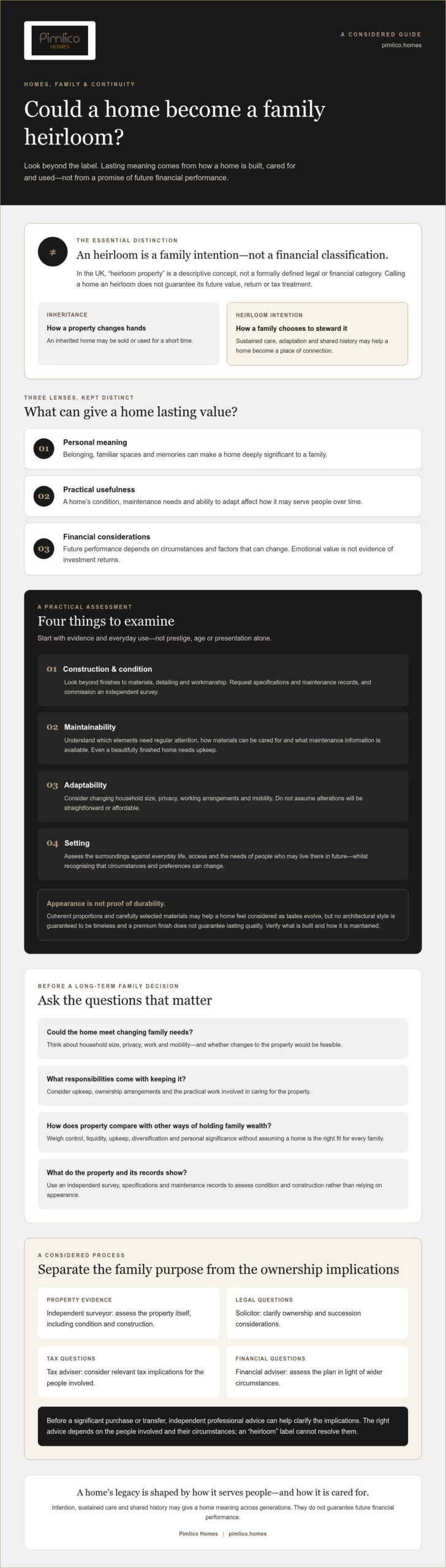
How to Assess a Property’s Potential as a Family Heirloom
A legacy intention is a useful starting point, not a verdict on a home. A structured review can help you test whether the property is sound, practical for the people who may live there and manageable to own over time. This is a more grounded way to assess ‘heirloom properties’ as a UK asset class than relying on appearance or assumptions about future value.
- 1. Define the family purpose. Consider who might live in the home, how it could support family life and whether future occupants would want, and be able, to use it. Be specific about likely needs, but allow for circumstances to change.
- 2. Inspect the property. Arrange an independent survey appropriate to the home and review the specification, available maintenance records and other documentation. Ask what evidence supports claims about materials, construction and workmanship. Don’t rely on finishes or a viewing alone.
- 3. Test its adaptability. Consider whether rooms could serve different purposes, and whether the layout offers the privacy, storage and circulation the household may need. Think about potential accessibility requirements and everyday comfort. Don’t assume alterations will be simple; ask a suitably qualified professional if changes may be needed.
- 4. Review ownership and responsibilities. Understand who would own the property, who would make decisions and how upkeep would be managed. Consider foreseeable maintenance alongside the family’s ability and willingness to meet those responsibilities.
- 5. Seek independent advice. Ask a solicitor about appropriate legal enquiries and ownership arrangements, and consult a qualified tax adviser about possible tax implications. The relevant advice depends on individual circumstances and the rules in force at the time.
Which practical questions should buyers ask before committing?
Ask to see the property’s specifications and available records, and clarify what is known about the condition and maintenance of key elements. During a viewing, consider how daily routines might work: can rooms accommodate changing needs, and are shared and private spaces balanced? The appropriate surveys and legal enquiries will vary by property, so establish their scope with independent professionals before proceeding.
How should families plan for stewardship and succession?
Discuss intended occupation, upkeep, decision-making and the possibility that a future generation may prefer to sell. Early, open conversations can reveal differing expectations before they become difficult choices. Consider ownership structures and succession planning with qualified legal and tax advisers; there is no single arrangement suitable for every family.
For purchase-stage considerations, read this luxury new-build buying guide. Once you have a clear assessment framework, you can also explore Pimlico Homes’ properties as homes to evaluate against your family’s priorities, rather than as a promise of future returns or suitability.
Could a Pimlico Homes Property Become Part of a Family Legacy?
A family legacy is shaped over time, through the way a home is chosen, cared for and used. Pimlico Homes is a residential developer, not an investment, legal or tax adviser. Its luxury detached homes, executive courtyard homes, bespoke new builds and luxury barn conversions can be considered as potential settings for family life, assessed against each buyer’s own priorities.
Thinking about ‘heirloom properties’ as a UK asset class should not mean treating a particular design or finish as proof of future value. Instead, consider how the home could support daily life now, and what might make it practical for future occupants. Look at the layout, the relationship between shared and private spaces, the materials and craftsmanship, and the maintenance information available. These details may inform a careful decision, but they cannot guarantee that a property will suit every generation or retain its financial value.
How might a thoughtfully designed new home support continuity?
A considered layout can help a household live comfortably, whether that means gathering in shared spaces or finding quiet areas for work and rest. Craftsmanship and material choices are also worth examining as part of the home’s overall quality. Look beyond presentation: review the property information and ask questions about specification and care.
Future needs are less certain. Could rooms serve different purposes as family circumstances change? Would the circulation and access work for the people who may live there? Treat adaptability as something to investigate in the particular home, not a feature to assume. A new home may offer a setting for family continuity, but its suitability depends on the property and the people who choose it.
What should buyers explore with Pimlico Homes?
For any home under consideration, review the available property details, specifications and purchase information. Ask about design decisions, materials, craftsmanship and practical ownership considerations. You may also wish to compare the home with the assessment criteria developed earlier in this article, then arrange independent inspections and obtain professional advice where appropriate.
Questions about investment suitability, ownership structures, succession and tax should go to suitably qualified independent financial, legal and tax professionals. These matters depend on individual circumstances, and a residential developer cannot replace specialist advice.
If a family home is part of your longer-term vision, explore Pimlico Homes’ properties and consider whether a detached home, courtyard home, bespoke new build or barn conversion aligns with the way your family hopes to live. The decision is yours, made with care and clear information.
Choose a Home with the Future in Mind
Thinking about ‘heirloom properties’ as a UK asset class begins with a distinction: a family’s intention to keep and pass on a home can give it deep personal meaning, but it doesn’t make future financial performance certain. Lasting usefulness depends on practical qualities too, including construction, maintenance needs and how comfortably the home could serve changing generations.
Assess the property with care. Review its specifications, consider how it might adapt, and understand the responsibilities of ownership. For questions about succession, tax or investment suitability, seek independent advice from appropriately qualified professionals. A considered purchase is grounded in both family purpose and a clear view of the obligations involved.
Pimlico Homes develops luxury detached and executive courtyard homes, bespoke new builds and premium barn conversions, with a focus on craftsmanship. These may offer settings for family continuity, but each home should be assessed against your own priorities, without assuming a particular future outcome.
Explore Pimlico Homes’ properties and consider whether a detached home, courtyard home, bespoke new build or barn conversion could suit the way your family hopes to live. Review the property information and arrange independent advice to help you make a considered decision.
Frequently Asked Questions
Is an heirloom property a recognised UK asset class?
No. An heirloom property is best understood as a descriptive idea for a home a family hopes to retain, use or pass on over time. The phrase ‘heirloom properties’ as a UK asset class shouldn’t be taken to mean it has a formal legal, tax or investment definition. If classification matters to a decision, ask a qualified UK professional to confirm the relevant terminology and implications for your circumstances.
Can a newly built home become an heirloom property?
Yes, a newly built home could become part of a family legacy if its owners value it, care for it and choose to keep it. Age alone doesn’t determine personal significance. Before buying, assess evidence about construction and materials, consider whether the layout could adapt to changing needs, and understand the maintenance involved. A new home doesn’t necessarily retain its value or suit future generations, so don’t treat either outcome as assured.
How much does an heirloom property need to be worth?
There’s no established price threshold that makes a home an heirloom. The term describes family intention or meaning, not a minimum market valuation. A property may be deeply valued by its occupants regardless of its financial worth, and its market value can change. Consider its condition and usefulness alongside your wider financial position, including the responsibilities of ownership. Seek independent advice before making investment, tax or succession decisions.
What happens if family members disagree about keeping an inherited property?
Disagreement can arise over who lives in the home, how upkeep is managed, who meets costs or whether it should be sold. Early discussion can help surface different expectations, but families shouldn’t assume every beneficiary will want to keep the property or that retaining it will be financially suitable. The options depend on ownership and individual circumstances. Seek qualified legal advice about documenting arrangements and resolving decisions fairly.
What makes a property suitable for several generations?
There’s no universal checklist, but buyers can examine construction quality, foreseeable maintenance, flexible room use, privacy and everyday accessibility. For example, consider whether a room might serve a different purpose as household needs change, and whether circulation through the home would work for intended occupants. Treat adaptability as something to investigate, not a guarantee. An independent survey and careful review of specifications can help clarify what a particular property offers.
Can a property guarantee long-term financial security for a family?
No property can guarantee financial security or future returns. Market values, maintenance requirements, ownership needs and family circumstances can all change. A home may offer practical use and personal meaning, but it can also tie up capital and require ongoing expenditure. Consider the property as part of your wider financial position, rather than relying on it alone. For investment, legal or tax questions, consult suitably qualified independent professionals.





