
The most impressive-looking new build isn’t always the one you’ll most enjoy living in. When comparing high end new build homes for sale, considered design, fine craftsmanship and everyday comfort matter just as much as a striking first impression.
That distinction can be difficult to make when listings use similar language to describe very different homes. The choice between a detached home, an executive courtyard home or a bespoke design isn’t simply a matter of appearance. Each offers a different way to live.
This guide explains how to recognise the qualities that set a high-end new build apart and weigh different home styles against your priorities. It also covers what to look for in a listing and during a viewing, from the care behind the design to the practical details that shape daily life.
Pimlico Homes develops luxury detached homes, executive courtyard homes, bespoke new builds and luxury barn conversions. These distinct approaches to high-end living share a focus on considered design and craftsmanship, giving you a useful framework for deciding which home feels right for the life you want to lead.
Key Takeaways
- Look beyond luxury labels. Assess how design, craftsmanship and everyday comfort come together across the whole home.
- Compare detached, courtyard, bespoke and barn-conversion homes against the privacy, character and routines that matter to you.
- When viewing high end new build homes for sale, follow a consistent sequence and compare the property with its floor plan and description.
- Notice how details shape the overall experience, from the sense of arrival to the way rooms connect.
- Explore how Pimlico Homes’ distinct home styles offer different expressions of considered design and craftsmanship.
What Makes High-End New Build Homes for Sale Stand Apart?
A high-end new-build home is not defined by a luxury label or a collection of decorative finishes. It is a home in which considered design, skilled craftsmanship, balanced proportions and practical comfort work together to create a coherent place to live.
In brief: A high-end new-build home brings together thoughtful planning, careful execution and lasting liveability. Its quality should be apparent both in its appearance and in how it supports everyday life.
Polished photography and elevated language can make very different properties sound alike. A dramatic entrance or striking kitchen may catch your eye, but neither tells the whole story. Look for clues that reveal how the home has been designed as a whole: how rooms relate to one another, how natural light reaches the interior and whether the details feel consistent from one space to the next.
Size and grandeur are not the same as quality. The word “mansion” has its own general meaning and historical context, as explored in What defines a mansion?, but a high-end home need not rely on scale alone to feel distinguished. Proportion, clarity of design and ease of use can be just as telling.
Which qualities make a new build feel considered?
Start with the way the floor plan supports daily routines. Does the entrance create a natural sense of arrival? Do shared rooms connect without feeling exposed? Are quieter spaces set apart from the livelier parts of the home? These relationships can shape comfort more than a single standout feature.
Light and transitions matter, too. Notice whether windows bring daylight into the rooms where you expect to spend time, and whether movement between spaces feels intuitive. A hallway, doorway or change in floor finish can guide the experience of a home. When these elements feel deliberate, the overall design is easier to understand and inhabit.
Materials and detailing should reinforce that coherence. Rather than judging a finish in isolation, consider whether its colour, texture and scale sit comfortably alongside surrounding surfaces. Practical use belongs in the same assessment: think about whether a room can accommodate the furniture and activities you have in mind.
How is high-end quality different from a luxury label?
Marketing language gives an impression; a useful description gives you something specific to assess. Look for information about the layout, the relationship between rooms, the design intent and the details that bring the home together. During a viewing, compare those descriptions with what you can see.
Separate visual statements from qualities that affect daily comfort. A striking feature may have little bearing on how well the rooms function, while a clear route through the home or a thoughtfully placed window may be less conspicuous but matter throughout the day. Neither a premium-looking material nor an impressive individual room proves that the entire home has been considered with equal care.
When comparing high end new build homes for sale, look for consistency between the description and your experience of the property. Assess how design, proportion, craftsmanship and practical use come together throughout the home, rather than relying on the label.
How Design and Craftsmanship Shape a High-End New Build
Architecture is experienced in sequence, not as a collection of photographs. A home may have striking individual rooms, yet the way they connect determines whether the whole feels composed. Pay attention to how the plan guides movement from the entrance to shared spaces and more private rooms. Consider whether each space feels suited to its purpose, and whether routes between rooms seem natural rather than awkward or needlessly long.
Considered design makes everyday comfort part of the architecture, shaping how a home feels to move through, use and return to.
Plans and descriptions can help you assess that coherence before a viewing. Check whether the stated room arrangements make clear how spaces relate, and look for information about glazing, orientation and views. These details provide context, but do not guarantee a particular quality of light or outlook. If a listing gives little sense of scale, note what you want to understand in person rather than letting a carefully framed image fill in the gaps.
Read the architecture beyond the listing photographs
Photographs isolate moments. A floor plan helps restore the relationships between them. Trace a likely route through the home: where you enter, how you reach the main living areas and where quieter rooms sit in relation to them. Consider how the arrangement might support your routines, including where people gather and where they can find privacy. Read the plan alongside the description, rather than treating either as a complete account on its own.
Look, too, at how the architecture is described. References to glazing, orientation or a view can help explain design choices, but their practical effect depends on the home and its setting. Use a clear listing as a basis for comparison with what you see. It cannot replace your own judgement of scale, flow and outlook.
Recognise craftsmanship in the details
At a viewing, observe how finishes meet at edges, corners and changes in material. Look for consistency across similar details, such as door frames, fitted elements and the junctions between walls and floors. Use these as prompts to notice whether the execution appears considered throughout, rather than concentrated in one showpiece room.
Read any stated specification in context. Homes differ, and one material or feature cannot establish the quality of an entire design. Consider how the described elements work together and whether the visible finish supports the overall architectural character. Careful detailing can make a home feel more resolved when small decisions reinforce the larger design rather than compete with it.
For broader purchase considerations, Pimlico Homes’ luxury new-build purchasing guide offers a useful companion as you assess plans, descriptions and viewings. You can also explore Pimlico Homes’ high-end homes to see how different residential designs express considered planning and craftsmanship in distinct ways.
Compare High-End New Build Home Styles by the Life You Want
Home styles are not a ladder of prestige. They offer different relationships with privacy, arrival, architectural character and the rhythms of daily life. As you compare high end new build homes for sale, consider which qualities suit your priorities instead of assuming one form is inherently superior.
The table offers a starting point, not a promise about every individual property. Layout, setting and design choices shape how each home feels in practice, so use the listing and floor plan to explore the possibilities.
| Home style | Privacy | Sense of arrival | Architectural character | Routines to consider |
|---|---|---|---|---|
| Detached | Separation from neighbouring homes may appeal. | Often has an independent approach. | Can offer a distinct presence and form. | Consider how you use the space around the home. |
| Executive courtyard | Depends on the layout and relationship with neighbouring homes. | May centre on an arrival shared with a courtyard setting. | Courtyard form can create a distinctive sense of place. | Think about your preferred balance of privacy and community. |
| Bespoke | Shaped by the design and arrangement of spaces. | Can reflect a distinctive approach to entering and moving through the home. | Individual design choices give it a tailored character. | Consider how the design supports your own priorities. |
| Barn conversion | Influenced by the building and its layout. | Existing character can shape the arrival experience. | May bring retained character together with contemporary living. | Weigh the appeal of the architecture against practical needs. |
Detached and courtyard homes: privacy or shared setting?
A detached home can suit buyers who value separation and an independent sense of arrival. A courtyard home offers a different experience, with its design shaped by the relationship between individual homes and shared spaces. Explore executive courtyard homes for a closer look at this form.
Ask yourself what feels most natural: a more independent setting, or a home whose arrangement creates a sense of connection? Consider privacy alongside outlook and how you use outdoor and shared spaces. The plan and setting matter as much as the style name.
Bespoke homes and barn conversions: individual character
A bespoke home is defined by distinctive design choices and a tailored sense of place. A barn conversion, by contrast, draws character from an existing building, bringing its established identity into a contemporary home. Each has a different architectural story, and neither automatically suits every lifestyle.
Consider how the character you admire will serve your everyday priorities, from the way rooms are arranged to the atmosphere you want at home. Modern barn-conversion interiors offer a more focused view of this style. You can also explore Pimlico Homes’ distinctive home styles and consider which form feels most in tune with the life you want to lead.
What to Examine When Viewing High-End New Build Homes for Sale
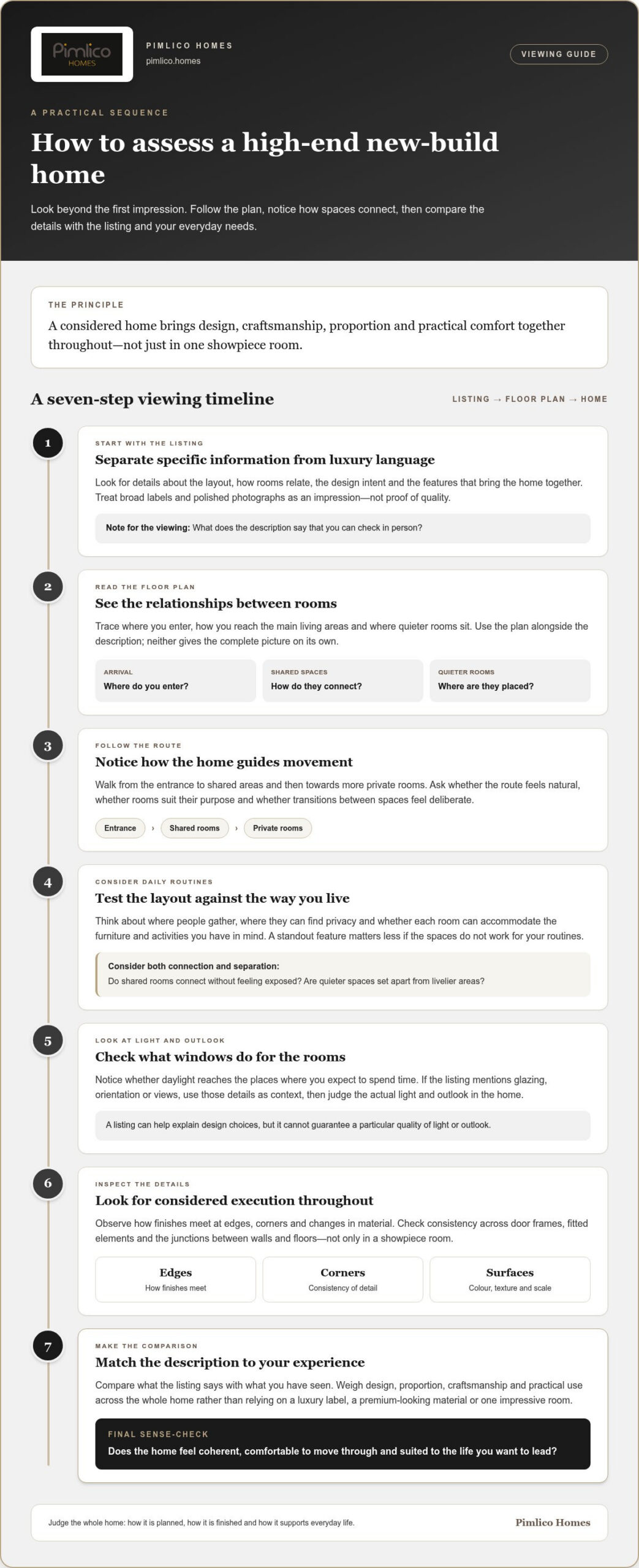
A viewing is more useful when you arrive with a method, not simply an expectation of being impressed. Before visiting, note the rooms, features and materials described in the listing, then bring the floor plan so you can compare the home on paper with the experience in person. For buyers considering high end new build homes for sale, this approach helps separate what you can observe from what needs clarification in the purchase process.
Assess the home as a whole, not feature by feature. Follow this sequence to build a balanced impression.
- Setting. Take in the home’s position and outlook before focusing on the building itself. Notice how its surroundings relate to the description, and consider whether the setting suits the level of privacy and atmosphere you want.
- Arrival. Observe the approach to the entrance and how it feels to step inside. Is the transition welcoming and clear? Compare what you experience with the impression created by the listing, without relying on photographs alone.
- Layout. Use the floor plan to follow your movement between rooms. Consider whether the stated arrangement feels intuitive in person, and whether the proportions support the way you expect to use each space.
- Details. Look at finishes and visible junctions in more than one room. Note consistency, condition and any differences between what the description says and what is present. Record observations rather than drawing conclusions from one isolated detail.
- Listing questions. Revisit the description and note anything that remains unclear, such as a stated feature you cannot identify or a detail whose scope is uncertain. Keep these questions separate from what you have directly observed.
Turn the listing into a useful viewing checklist
Before the appointment, underline specific claims in the description and mark the rooms or features you want to see. At the property, compare them with the floor plan and your route through the home. If an element is not apparent, record it as an open question rather than assuming it is present or absent. This creates a clear distinction between what you saw and what needs explanation in the relevant purchase information.
Assess whether the home fits your everyday life
Picture familiar routines, from quiet time to entertaining. Consider whether the arrangement offers the privacy you prefer, whether storage appears practical for your belongings and whether circulation feels comfortable when rooms are in use. Notice how indoor spaces connect with any outdoor areas described. These are personal judgements, and your priorities will show whether an appealing first impression translates into a home that fits.
After the viewing, compare your notes with the listing once more. Which details matched? Which qualities felt right in person? What remains unresolved? A considered decision comes from weighing the setting, layout and finish together, then addressing outstanding points through the purchase process. To explore homes shaped by design and craftsmanship, view Pimlico Homes’ high-end new-build homes.
Explore High-End New Build Homes from Pimlico Homes
Choosing a home is a personal decision, shaped by the way you want to live as much as by the architecture that first attracts you. Pimlico Homes specialises in high-end residential properties, with a range that brings considered design and craftsmanship into distinct forms of living. Rather than treating every home as an expression of the same idea, the different styles offer their own character and appeal.
As you explore high end new build homes for sale, the principles in this guide can help you look beyond a striking first impression. Consider how a home is planned, how its details contribute to a coherent whole and whether its style fits your everyday priorities. The right choice is not necessarily the grandest or most individual. It is the one whose character and practical qualities feel suited to you.
A considered range of homes for different priorities
Pimlico Homes’ residential range includes detached homes, executive courtyard homes, bespoke new builds and luxury barn conversions. Each is a distinct expression of high-end living. A detached home may appeal if you value an independent sense of arrival; a courtyard home offers a different relationship with its setting. Bespoke design brings individual choices to the fore, whilst a barn conversion may attract those drawn to distinctive architectural character.
Use these differences to refine your shortlist. Which sense of privacy feels right? Do you prefer an individual design expression, or are you drawn to the character of a conversion? Think about how the home’s form, layout and atmosphere could support the routines you value. No single style is the measure of quality; the more useful question is how thoughtfully it meets your priorities.
Take the next step towards a considered choice
As you browse Pimlico Homes’ residential developments and property information, keep your viewing notes and priorities close. Compare each home’s description with its plan and the qualities you experienced in person. Note what feels especially well resolved, which layout best suits your daily life and which questions you want to address as part of the purchase process. This makes it easier to compare homes on meaningful points rather than relying on an overall impression.
The decision also sits within a wider purchase journey. Pimlico Homes’ luxury new-build purchasing guide offers further context as you consider the steps involved in choosing a home. Take time to reflect on what matters most, from architectural character to practical comfort. A considered shortlist can bring clarity to a significant choice.
To see the residential developments and home styles presented by Pimlico Homes, explore Pimlico Homes. Each offers another perspective on high-end living, grounded in considered design and craftsmanship.
Choose a Home That Feels Right for What Comes Next
The right home should feel compelling beyond the first viewing. As you consider high end new build homes for sale, think about how each possibility may suit the life you want to lead, not only how it looks today. A clear sense of your priorities can turn a shortlist into a more confident decision.
Pimlico Homes develops luxury residential properties, including detached, executive courtyard, bespoke and barn-conversion homes. Its new-build projects place high-quality craftsmanship at the heart of considered design, creating a thoughtful foundation for choosing a home with character and purpose.
Explore the homes and residential developments, revisit the details that matter most to you, and let your preferences guide the decision. Explore Pimlico Homes’ high-end residential developments and find the home style that suits your priorities.
Frequently Asked Questions
Are high-end new-build homes energy efficient?
They may be designed with energy efficiency in mind, but the description “new build” alone doesn’t establish how efficient a particular home is. Review its Energy Performance Certificate (EPC), stated features and available information about heating and controls. An EPC offers a useful comparison, but it cannot predict your exact energy use or bills, which depend on factors including how you use the home and the energy tariffs available to you.
Can I personalise a high-end new-build home before moving in?
Possibly, depending on the home’s stage of completion and the choices already incorporated into its design. An unfinished property may allow a different range of decisions from one where finishes are already in place. Treat personalisation as a point to establish through the home’s written information and purchase arrangements. Don’t assume a particular change can be made, or that it will be included, without documented agreement.
What should I compare when viewing two luxury new-build homes?
Compare the details that affect ownership as well as the visual impression: room dimensions, storage, included fixtures and fittings, completion status, EPC information and any applicable warranty documents. Check that each listing describes these items on the same basis, so you aren’t comparing an included feature in one home with an optional extra in another. For high end new build homes for sale, a written side-by-side note can make differences clearer.
Do high-end new-build homes include a warranty?
Some new homes are sold with a warranty, but don’t assume the same cover applies to every property. Read the sale documents to establish whether a warranty is provided, who provides it, when cover begins and what it includes or excludes. Also distinguish warranty cover from a separate process for recording finishing issues. If the documents are unclear, raise the point through the purchase process before making a decision.
Can I reserve a new-build home before it is completed?
It may be possible, depending on the property’s sale stage and the terms offered. Before reserving, read the written reservation terms carefully, including any reservation period, payment arrangements, cancellation provisions and what happens if the anticipated completion timing changes. Keep a copy of the documents and make sure you understand which steps follow reservation. A reservation is not the same as having completed the purchase.
Is a barn conversion considered a new-build home?
A barn conversion creates a home within an existing building, so it isn’t necessarily the same as a newly constructed house, even if it is newly available as a residence. How it is described can depend on the property and the context of the sale. Read the particulars carefully and review the relevant property documents, including the EPC, to understand the home’s nature and the work described.
What does an EPC tell me about a new-build home?
An EPC summarises a property’s energy performance and provides an efficiency rating from A, the most efficient band, to G, the least efficient. It also includes information about energy use and recommendations for improving performance. Use it as one source of evidence, not a promise of future bills: actual consumption varies with occupancy, heating preferences and energy tariffs. Compare EPC details alongside the home’s stated specification.





