
Exclusivity can support a luxury home’s resale appeal, but it cannot guarantee its value. Whether luxury new builds hold their value depends on location, design and construction quality, the supply of comparable homes, and demand when you sell. Premium finishes matter most when they are matched by lasting practicality.
It is understandable to expect a distinctive new home to retain its appeal. But a high purchase price or premium specification does not automatically mean stronger resale prospects. Look closely at the location, the development and the home itself.
This guide explains how to assess those factors before you buy, from local desirability and limited availability to build quality, design choices and wider market conditions. You’ll also see how professional advice can help you weigh the evidence and make a considered decision about a significant investment.
Key Takeaways
- Use financial and property advice to weigh local demand, comparable homes and the development’s distinctiveness before deciding what a home may be worth later.
- Understand how service charges and estate fees affect ongoing ownership costs, buyer appeal and the overall resale proposition.
- Assess warranties, energy efficiency and modern features alongside build quality and practical design, rather than treating luxury specification alone as a measure of lasting value.
- Look closely at location, neighbourhood and potential changes in buyer demand to identify risks that could weaken future resale appeal.
Seeking advice from financial advisers and estate agents
Before buying with resale in mind, compare the location, likely buyer pool, build quality and ongoing ownership costs. Ask a financial adviser to assess affordability and your wider financial position, and ask an estate agent to review local demand and comparable properties.
- Ask an estate agent for a local market assessment. Request examples of comparable homes and discuss what makes each relevant, such as location, plot, condition and specification. Ask which features attract buyers in that area and which are personal choices. A striking aesthetic may appeal to you, but an agent’s view of likely buyer priorities can help distinguish enduring demand from individual taste.
- Have a financial adviser model the commitment. Discuss the purchase alongside your other assets, borrowing and plans for the property. Ask how changes in interest rates could affect affordability and buyer demand. The Bank of England says lower interest rates reduce borrowing costs and can push house prices higher. Treat this as market context, not a forecast for one home or location.
- Test the development’s exclusivity against evidence. Ask the agent how the home differs from nearby properties and whether comparable options are readily available. Consider whether bespoke details, plot privacy or a distinctive setting offer lasting appeal, rather than relying on novelty alone. Limited availability may strengthen a home’s sense of distinction, but local demand still shapes its resale prospects.
- Request a written view of the main assumptions. Ask each professional to explain the evidence behind their assessment, including comparable sales, location and the likely buyer profile. Then compare those assumptions with your intended ownership period and priorities. Financial advisers assess the wider financial picture; estate agents bring local property knowledge. Their separate perspectives help you weigh investment considerations alongside aesthetics and personal use.
Armani jeans in the US are an example of a luxury brand targeting fashion-seeking, price-sensitive young people in urban US cities. This illustrates why the intended audience matters when judging whether an exclusive home may retain appeal beyond a narrow group; local demand still needs to be assessed on its own evidence.
For luxury car ownership, consider used luxury cars, leasing, or setting strict budgets to limit the financial impact. Keeping that impact in view can support a realistic assessment of the wider financial commitment.
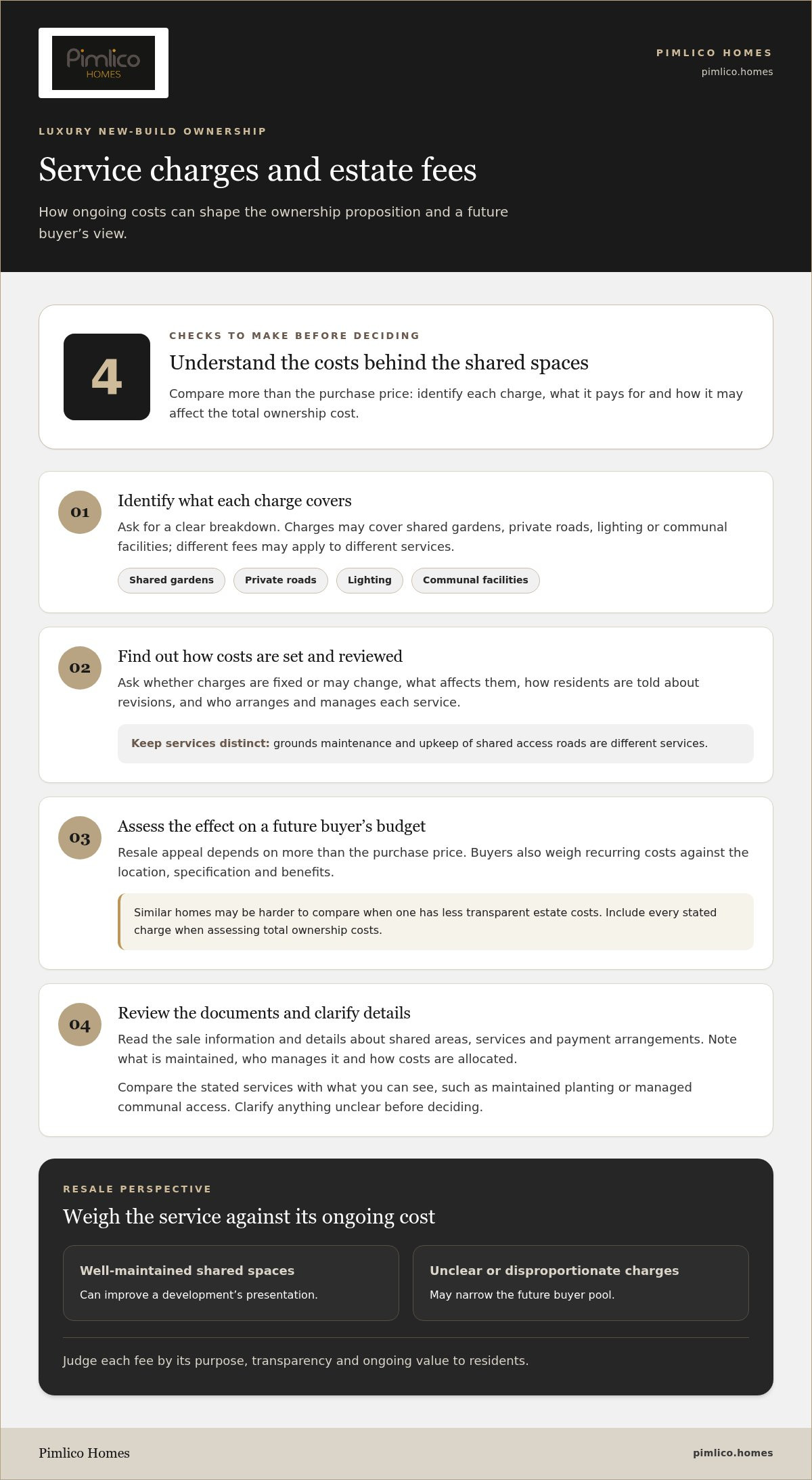
How do service charges and estate fees affect luxury new-build resale values?
- Identify exactly what each charge covers. Ask for a clear breakdown of service charges and estate fees before comparing homes. Charges may cover shared gardens, private roads, lighting or communal facilities, and different fees may apply to different services. Maintained shared grounds can enhance a setting, but understand the costs involved.
- Establish how the charges are calculated and reviewed. Ask whether costs are fixed or may change, what affects them, and how residents are informed of revisions. Find out who arranges and manages each service. Grounds maintenance and upkeep of shared access roads, for example, are different services. Clear information helps you compare ongoing commitments accurately.
- Consider the effect on a future buyer’s budget. Resale appeal depends on more than the purchase price. Buyers also weigh recurring costs against the location, specification and benefits. If two homes offer similar space but one has less transparent estate costs, that uncertainty can complicate comparison. Include every stated charge in your assessment of total ownership costs.
- Review the documents and ask focused questions. Read the sale information and details about shared areas, services and payment arrangements. Note what is maintained, who manages it, and how costs are allocated. Clarify anything unclear before deciding. Compare the stated services with what you can see, such as maintained planting or managed communal access.
Well-maintained shared spaces can improve a development’s presentation, while unclear or disproportionate charges may narrow its future buyer pool. Judge each fee by its purpose, transparency and ongoing value to residents.
Luxury brand differentiation can be built around features such as bespoke products or services and handmade items. These features may distinguish an offering, but they do not remove the need to assess recurring charges against the services provided. Buyers considering resale can weigh distinctive features alongside the clarity and continuing value of estate costs, keeping the overall ownership proposition in view.
Do warranties, energy efficiency and modern features help luxury new builds retain value?
- Read the warranty documents before comparing properties. Check what the warranty covers, its duration, exclusions, claims process and whether it can pass to a future owner. Cover for specified structural defects, for example, differs from cover limited to particular fittings. Keep the documents with the home’s other records. Clear information helps future buyers understand the protection attached to the property.
- Examine the home’s energy information and design. Review the available energy performance documents and ask how insulation, glazing, heating and ventilation work together. Compare the property’s stated performance with other homes you are considering, rather than relying on a single feature such as underfloor heating. Efficient design may appeal to buyers seeking comfort and manageable energy use, while thoughtful orientation and practical controls can support everyday living.
- Assess modern technology for usefulness and integration. Smart-home systems can be planned into a home from the early design stages, so controls feel considered rather than added on. Check what the systems operate, how residents use them and whether instructions are available. Lighting that supports different routines may have broader appeal than an elaborate feature that future occupants find difficult to use or maintain.
- Separate lasting function from short-lived novelty. Consider whether each premium feature improves comfort, flexibility or daily use. A home cinema, for instance, works best when lighting, audio, video, soundproofing and ambience are planned together. Ask how these elements are maintained and whether the room could serve another purpose. Durable materials, adaptable layouts and documented systems may help preserve appeal as tastes and technology change.
Warranties, energy performance and modern features can strengthen a home’s appeal when they are clear, functional and suited to future occupants. Their value depends on the quality of the whole property, not the specification list alone.
What risks can reduce the resale value of a luxury new-build home?
- Assess the location beyond the home’s boundaries. The Scottish Government identifies location and neighbourhood as factors influencing a home’s attractiveness and perceived value. Visit the area at different times and consider access, nearby amenities, outlook and the surrounding street scene. A beautifully appointed property may attract fewer buyers if its setting feels less convenient or appealing than comparable locations. Consider whether the neighbourhood’s character supports the lifestyle future buyers may seek.
- Compare the home with competing properties. Look at nearby new builds and established homes with similar space, layouts and specifications. If many properties share the same design or premium features, yours may stand out less at resale. An estate agent can offer insight into which details local buyers notice. Consider whether the plot, outlook or internal layout offers practical advantages, rather than relying only on a high-end finish.
- Choose personalisation with future appeal in mind. Bespoke choices can make a home feel distinctive, but highly specific colours, finishes or room uses may not suit every buyer. A room designed around one hobby, for example, could limit flexibility. Prioritise enduring materials and adaptable layouts. Keep records of installed systems and finishes so future owners can understand and care for them.
- Keep the property and its records in good order. Neglected finishes, unresolved defects or missing paperwork can create uncertainty during a sale. Keep a clear file of warranties, manuals, service records and completed work. Periodically review the exterior and interior, including rooflines, windows, landscaping and drainage. A well-presented home with organised documentation gives prospective buyers a clearer picture of its condition and care.
Use these checks to identify vulnerabilities before purchase and weigh them against the home’s lasting strengths. Explore a considered approach to your next home as you assess what will matter to future buyers.
Pimlico Homes: Luxury Detached Homes
Pimlico Homes develops Luxury Detached Homes, Executive Courtyard Homes, Bespoke Luxury Homes and Luxury Barn Conversions. If you are weighing a home’s design, setting and long-term appeal, exploring these styles can help you identify what best suits your priorities.
A considered purchase balances personal preferences with practical questions: how the home will serve your daily life, which details feel enduring, and how its character fits its surroundings. Exploring these points early can bring greater clarity to a significant property decision.
Contact Pimlico Homes to explore its homes and discuss what matters most to you.
Make your next move with confidence
Whether luxury new builds hold their value is best considered alongside your own plans for the home. Look beyond resale: which setting, layout and architectural character will suit your life while remaining appealing to others? A property that feels right to live in may be a more considered long-term choice than one selected for prestige alone.
Pimlico Homes develops Luxury Detached Homes, Executive Courtyard Homes and Bespoke Luxury Homes. Exploring these distinct approaches can help you clarify your priorities, from privacy and generous proportions to a home shaped around your preferences. Start by defining what matters to you, then discuss how those priorities could shape your home.
Discuss your plans with Pimlico Homes and take the next step towards a home that reflects your ambitions.
Frequently Asked Questions
Do luxury new-build homes in the UK hold their value over time?
Some do, but luxury status alone does not determine whether a home retains value. The purchase price, future demand and timing of a sale all influence the outcome. A distinctive property may appeal to a more specific group of buyers, affecting how readily it sells. Consider whether your plans allow flexibility over when to sell, rather than relying on a particular resale date.





