A house sale does not necessarily end its building warranty. Transferring a new home warranty to a new owner is usually possible, but the policy terms determine whether cover can be transferred and what steps are required. The buyer generally receives the remaining cover, not a new warranty period.
That distinction matters when you take ownership. A warranty can offer reassurance, but protection depends on what it covers and whether its conditions have been met. Appliance warranties may follow different rules from a building warranty, so identify exactly which cover is included in the sale.
This guide explains how to arrange the transfer, what buyer and sale details a provider may request, and which documents to hand over. It also covers how to understand the policy’s coverage, limitations and maintenance responsibilities, helping you assess the protection attached to your new home.
Key Takeaways
- Read the policy to distinguish a transferable building warranty from separate appliance or system guarantees.
- Ask the warranty provider which transfer documents are required and whether a fee applies; the process may be free or involve a small fee.
- Have the buyer’s contact details and the sale or completion date ready, then retain written confirmation of the policy update.
- Review the cover’s exclusions, maintenance conditions and claims history so you understand what protection remains.
Are Warranties Transferable When Buying a New Home?
UK new-build warranty providers may allow a transfer where their policy terms permit it. A sale does not automatically transfer the warranty; the policy sets out the required process. The Building Safety Act 2022 recognises the ability of a person benefiting from a warranty to transfer that benefit to another person, according to UK Parliament.
-
Check provider transfer rules
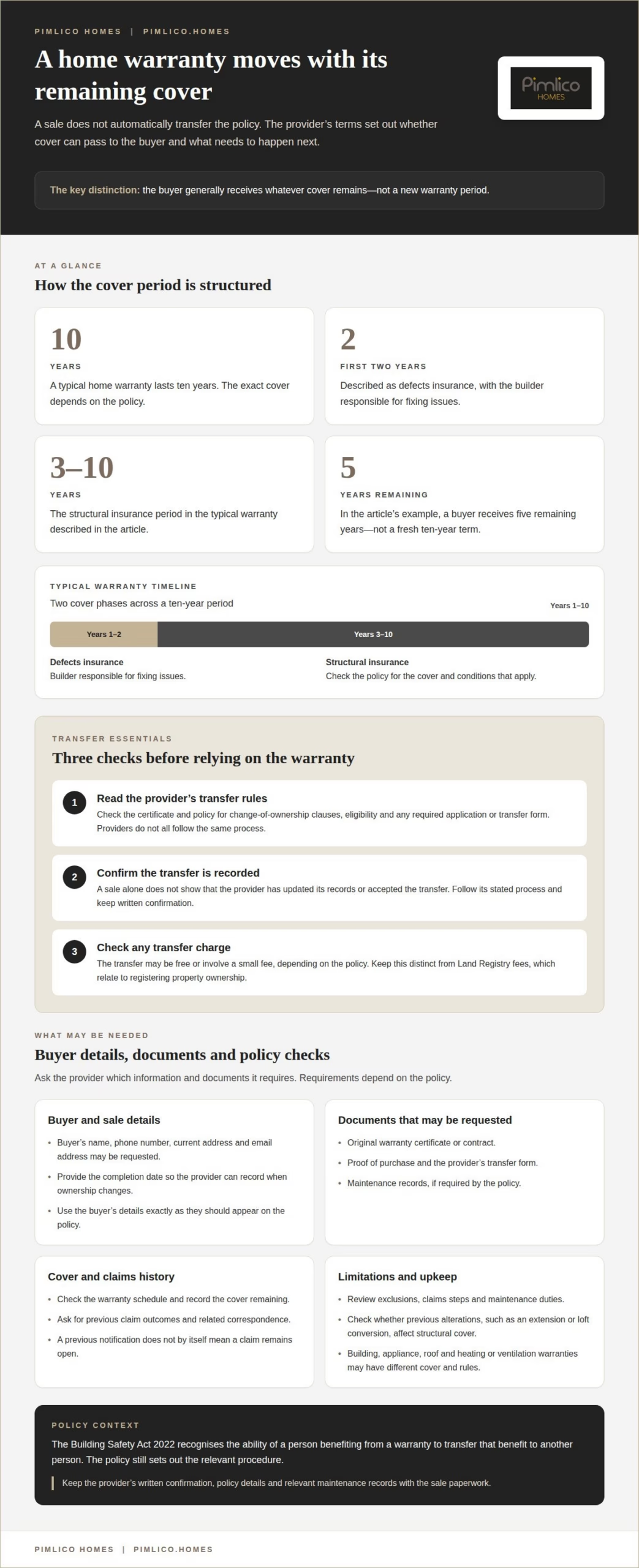
Start by finding the warranty certificate and policy documents. Check for clauses covering a change of ownership, transfer eligibility and any required application. The provider’s terms determine whether the cover can pass to the buyer and what steps apply. UK providers do not all follow the same process. If the documents specify a transfer form, include it in the sale arrangements.
-
Confirm whether transfer is automatic
Read the policy’s ownership-change conditions before relying on the warranty after completion. A property sale alone does not show that the provider has updated its records or accepted a transfer. Some policies require the existing owner to notify the provider and submit documents. The Building Safety Act 2022 refers to transferring the benefit, but the policy still sets out the relevant procedure. Keep written confirmation with the purchase paperwork.
-
Check applicable transfer fees
Ask the provider what charges apply to its warranty transfer process. The transfer may be free or involve a small fee, depending on the policy. Keep this separate from Land Registry fees: they relate to registering property ownership, not transferring warranty cover. For a sale involving a transfer of part or all of a property, the Land Registry fee calculator can identify the registration fee. The two processes may require separate paperwork, so record each cost and confirmation distinctly.
Buyer details and closing date needed for a transfer
Transferring a new home warranty to a new owner starts with providing the information and sale date required by the provider. Documents may include the original warranty certificate or contract, proof of purchase, the provider’s transfer form and maintenance records if the policy requires them.
-
Gather buyer details and closing date
Contact the warranty provider while selling and ask which details it needs. These may include the buyer’s name, phone number, current address and email address. Provide the completion date so the provider can record when ownership changes. Use the buyer’s details exactly as they should appear on the policy, and avoid an estimated date if completion has already taken place.
-
Prepare the required transfer documents
Gather the original warranty certificate or contract, proof of purchase and the provider’s transfer form. Include maintenance records if required by the policy. Together, these documents identify the property, existing cover and incoming owner. In the sale agreement, name each warranty being transferred and state its coverage period. Include relevant conditions or limitations so both parties can see what the agreement covers and which obligations remain.
-
Update the policyholder details
Send the buyer’s information and required paperwork to the provider using its stated process. The sale agreement alone does not update the provider’s policyholder record. Request an update and keep a copy of your submission. Once the transfer is processed, give the buyer the written confirmation, policy details and relevant maintenance records. Keep the provider’s response with the sale documents to create a clear record if questions later arise about the transfer or cover.
Explaining coverage, limitations and maintenance requirements
A new owner can claim for a previously reported defect only if the transferred policy covers it and claim rights remain available. Check the claim’s status, exclusions, maintenance conditions and any building work before relying on the cover.
-
Check the remaining cover and previous claims
Ask for the warranty schedule and claims history, then record the cover remaining. A typical home warranty lasts ten years: the first two years are described as defects insurance, when the builder is responsible for fixing issues, and years three to ten as the structural insurance period. For example, a buyer taking over a ten-year structural warranty with five years remaining receives those five years, not a fresh term. Previous claims can affect the protection remaining, so obtain their outcomes and related correspondence.
During the first two years of cover, the original builder or contractor can be held directly liable for repair work. A previous notification does not, by itself, mean a claim remains open or that the new owner can claim. The policy and recorded claim status determine what can be pursued.
-
Explain coverage and limitations
Set out what each policy covers, its exclusions and the owner’s maintenance duties. A structural building warranty addresses structural defects; separate roof or heating, ventilation and air-conditioning warranties may cover specified materials, workmanship or systems. Read each policy’s claims process and keep maintenance records if required. Poorly documented upkeep can complicate a claim if the policy makes maintenance a condition of cover.
Look for alterations made by a previous owner. An extension or loft conversion may invalidate structural cover, so establish whether building work took place and how the warranty treats it. Also consider lending: mortgage lenders may not accept an application to buy a property less than ten years old without a building warranty. The buyer should understand any gap in cover before proceeding with the purchase.
Whether building warranties transfer when a home is sold
Building warranties can transfer to a buyer, subject to the policy terms. NHBC, LABC and Premier Guarantee each set their own requirements, so follow the named provider’s process rather than assuming a sale transfers cover automatically.
-
Compare provider transfer procedures
Read the policy issued by NHBC, LABC or Premier Guarantee and identify its transfer instructions. Compare the required notice, forms, documents, fee conditions and confirmation process. These details determine how the transfer is completed; the provider names alone do not mean the procedures are identical. The property’s certificate and policy terms govern its cover, so do not rely only on a general description of building warranties.
Ask the seller to include the warranty details in the sale paperwork. Record the provider’s name, policy reference, stated coverage period and any relevant limitations. This gives the buyer a clear starting point for following the correct process and helps distinguish building cover from separate product guarantees.
-
Complete the warranty transfer when selling
Start the transfer with the warranty provider once the property is being sold. Follow its instructions for notifying it of the ownership change, submitting any transfer form and supplying the buyer information requested. Include the sale completion date so the provider can identify when the change takes effect under its process.
Keep copies of the application, supporting documents and provider correspondence. Give the buyer the policy documents and written confirmation once the transfer has been processed. That confirmation offers useful peace of mind, but the policy still defines the cover and its remaining term. For a new purchase, explore new-build homes with the warranty documentation considered alongside the property details.
Do not treat the Land Registry ownership update as the warranty transfer. They are separate processes: the property register records ownership, while the warranty provider administers the policy. A completed sale does not replace the provider’s transfer procedure or written confirmation.
Pimlico Homes
Pimlico Homes creates new homes for buyers considering a significant property purchase, including Luxury Detached Homes, Executive Courtyard Homes, Bespoke Luxury Homes and Luxury Barn Conversions. If you are comparing a completed home with a new-build purchase, the warranty documents remain important for understanding the protection attached to the property.
For any home you are considering, make the warranty certificate, policy terms and transfer process part of your purchase discussions. Pimlico Homes’ homes offer a considered starting point for buyers seeking a distinctive residence, while warranty transfer arrangements depend on the specific policy and its provider.
Contact Pimlico Homes to discuss finding a home that suits your plans.
Make your next home decision with clarity
A considered purchase involves more than the property itself. When transferring a new home warranty to a new owner, understanding the home’s documentation can help you take a confident next step. Keep the warranty information alongside the other details that matter to your decision, including how the home suits your plans and the setting you want to call home.
Pimlico Homes offers Luxury Detached Homes, Executive Courtyard Homes and Bespoke Luxury Homes. Each offers a distinct approach to modern living, with the choice guided by your priorities rather than the warranty alone. The right home should feel well judged in every respect, from its design to the practical details that accompany ownership.
If you are considering your next move, contact Pimlico Homes to discuss your plans. Take the next step with a clear sense of what matters to you, and find a home that feels right for the life ahead.
Frequently Asked Questions
Can a building warranty be transferred to a new owner?
Yes, a building warranty can pass to a new owner if its policy allows the transfer. The Building Safety Act 2022 recognises the ability of a person who benefits from a warranty to transfer that benefit to another person, according to UK Parliament. This does not mean every policy transfers automatically. The buyer should establish that the provider has recorded the change before relying on the cover.
Can a new-build home warranty be transferred to a new owner in the UK?
Yes, a new-build warranty may transfer to a buyer in the UK, subject to the provider’s policy terms and process. A buyer should establish which building warranty applies and whether the provider has accepted the change of owner. The warranty protects only the property and risks described in its policy, so separate appliance guarantees may need their own ownership updates.
Is there a fee or deadline for transferring a new home warranty in the UK?
A transfer may be free or involve a small fee; the policy provider sets the process. There is no single deadline for every warranty. A seller should start the transfer as soon as they decide to sell, allowing time to assemble documents and meet the provider’s requirements. Ask for the process and any charge in writing, then retain the provider’s response with the sale records.
What coverage and remaining warranty period does the new owner receive?
The buyer receives the protection that the policy transfers, for the remaining term, subject to its limits and exclusions. For example, if a ten-year structural warranty has five years remaining, the buyer receives those five years, not a new ten-year term. A prior claim, unmet maintenance condition or alteration may affect what can be claimed, so consider the policy schedule and claim records together.
Which UK new-build warranty providers allow transfer to a new owner?
NHBC, LABC and Premier Guarantee may allow a transfer, subject to their policy terms and individual procedures. Check the property’s warranty documents and follow the named provider’s instructions.