
Could a prenuptial agreement protect your share of a home if the title says something different? It’s an important question when considering joint ownership of luxury property UK buyers may arrange around unequal deposits, future plans and a shared vision of home. A prenup and the property title are not interchangeable: each addresses a different part of the arrangement.
If you’re unsure whether a prenup determines who legally owns a property, or how to recognise unequal contributions without inviting disputes later, look beyond the purchase price. The way ownership is recorded, the agreement between you and your partner, and what happens if you separate, sell or one of you dies all deserve careful consideration.
This article explains the distinction between registered title and beneficial ownership, and outlines how joint tenants and tenants in common differ in England and Wales. It also explores how a prenuptial agreement may sit alongside those arrangements, which documents can help record your intentions, and why legal outcomes depend on the circumstances. Considering the right questions before completion can help you begin a significant home purchase with clearer expectations.
Key Takeaways
- For joint ownership of luxury property UK buyers should consider how the registered title and beneficial interests will reflect their intentions.
- A prenuptial agreement can record a couple’s intentions, but it does not automatically determine the property’s title or shares.
- Compare joint tenants and tenants in common carefully, particularly where contributions differ or inheritance plans matter.
- Before committing to a purchase, discuss deposits, mortgage payments, ongoing costs and the shares each person intends to hold.
- Coordinate property documents and relationship agreements with appropriate legal advice, recognising that outcomes depend on jurisdiction and circumstances.
Joint ownership of luxury property in the UK: why the structure matters
Choosing a home together also means choosing how to own it. Couples considering joint ownership of luxury property UK buyers may arrange need to decide whose names appear on the title and how their respective interests should be understood if circumstances change. A substantial purchase can bring different expectations about deposits, future payments and what should happen on separation or death. Discussing these points before buying helps make those expectations explicit.
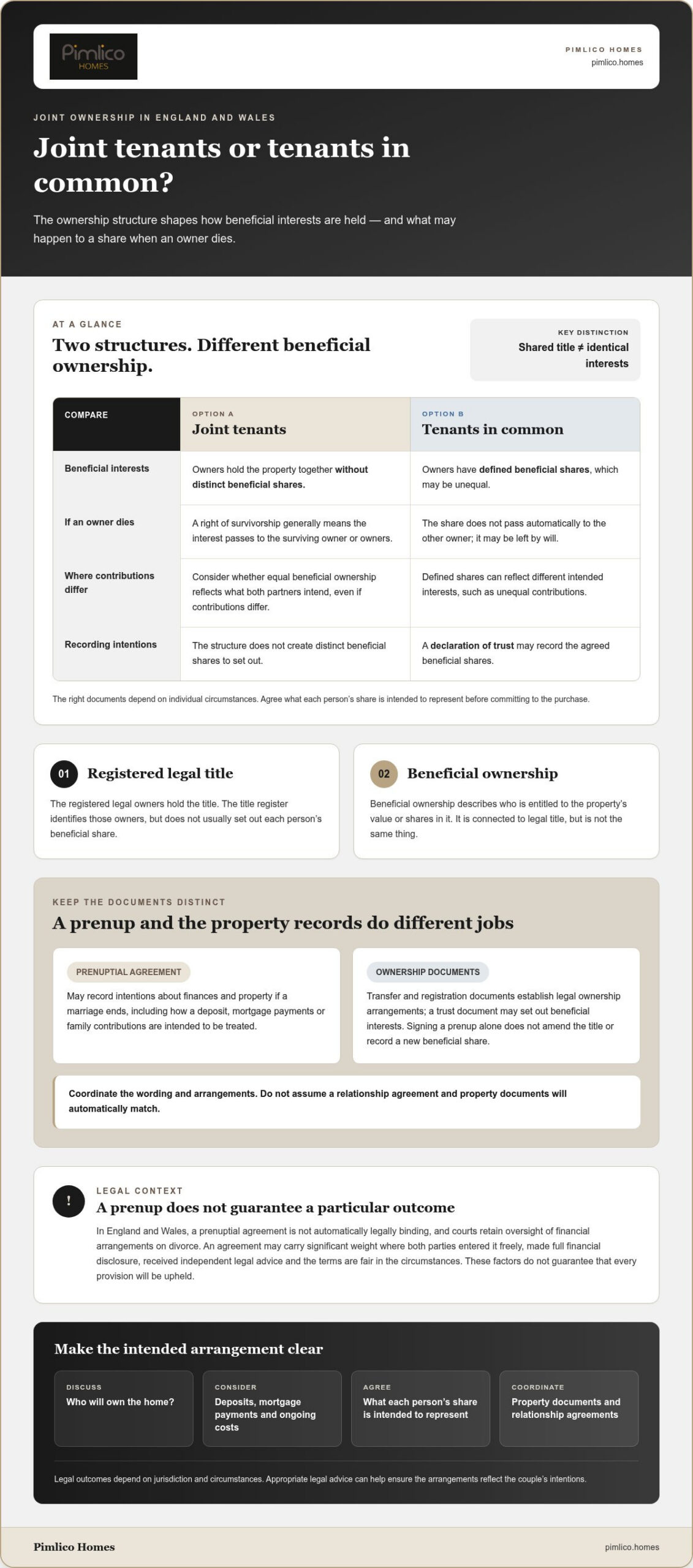
Joint ownership means more than one person has an interest in a home. In England and Wales, the registered legal owners hold the title, while beneficial ownership describes who is entitled to the property’s value or shares in it. The two are connected, but not identical: the title register identifies the registered owners, but does not usually set out each person’s beneficial share.
In brief: joint tenants own a property together without distinct beneficial shares, while tenants in common hold defined beneficial shares, which may be unequal. Joint tenants generally have a right of survivorship, so an owner’s interest passes to the surviving owner or owners on death. A tenant in common’s share does not pass automatically this way and may be left by will.
What does joint ownership mean for a home purchase?
Buying together involves deciding how beneficial ownership will be held, not simply whose names appear as legal owners. For example, one partner might contribute more towards the deposit while both contribute to the mortgage. The couple should decide whether they intend to share the property equally or reflect those different contributions in their beneficial interests. A declaration of trust may record agreed shares. The right documents depend on individual circumstances.
Why does a luxury property make early planning significant?
A valuable home may involve a substantial deposit, continuing mortgage payments and family funds. Each can shape what the buyers consider fair. If expectations differ, leaving them unspoken can create room for disagreement later. Agreeing how contributions and beneficial interests are intended to relate before committing to the purchase gives both partners a clearer starting point.
A prenuptial agreement can record a couple’s intentions about finances and property. A general Prenuptial Agreement overview explains its broad purpose. However, a prenup does not replace the documents used to register ownership or record beneficial shares. Ownership records and relationship agreements serve different purposes: each should reflect the couple’s intentions, and neither should be assumed to do the work of the other.
Before buying, discuss who will own the home, how you will handle the deposit and ongoing costs, and what each person expects their share to represent. These decisions are easier to address before assumptions become entrenched. The distinction matters whether the home is a luxury new build, a bespoke residence or a carefully converted barn. The property may be designed to endure, but its ownership arrangements should be clear from the beginning.
How prenuptial agreements interact with property ownership and title
A prenuptial agreement can help a couple set out how they intend to treat assets and contributions if their marriage ends. For buyers planning joint ownership of luxury property UK-wide, however, it is one part of a wider legal picture. Consider the agreement alongside the documents that transfer and register the home, and any document recording beneficial interests.
In England and Wales, a prenup is not automatically legally binding. Courts retain oversight when deciding financial arrangements on divorce. Under the approach associated with Radmacher v Granatino, an agreement may carry significant weight where both parties entered it freely, made full financial disclosure, received independent legal advice and the terms are fair in the circumstances. These factors do not guarantee that a court will uphold every provision or reach a particular outcome.
What a prenuptial agreement can address
Couples may use a prenup to record their intentions for a home acquired before or during marriage, including how they want a deposit, mortgage payments or family contributions to be treated if they separate. It can also set out the broader financial context in which they expect the property to be considered. Each person should have the opportunity to understand the terms, supported by full disclosure and independent legal advice. Circumstances and fairness matter, and no clause can promise a specific result.
For example, if one partner contributes more towards the deposit, the agreement might record what both intend that contribution to mean. The couple should also consider whether the intended beneficial shares are clearly reflected in the property documents. A prenup and a declaration of trust may serve different roles, so coordinate their wording and arrangements rather than assuming they will match.
What a prenup does not automatically change
Signing a prenup does not, by itself, transfer ownership, amend the registered title or record a new beneficial share. The transfer documentation establishes the legal ownership arrangements, while Land Registry records show registered proprietorship. A trust document may set out beneficial interests where relevant. Consider the documents together, particularly if their wording or apparent effect differs.
A prenup records contractual intentions; registered title records legal ownership, and neither should be treated as a substitute for the other. That distinction is central to sound planning. An agreement may describe what a couple intends, but the property documents must also be considered and made consistent with those intentions.
This explanation relates to England and Wales. Scotland and Northern Ireland have distinct legal frameworks, so the effect of an agreement and the relevant property arrangements require jurisdiction-specific guidance. The law and a couple’s circumstances can both shape the outcome.
Once the legal planning is under way, consider how the home itself and its design suit your shared plans. Explore luxury new-build homes as part of a considered purchase.
Joint tenants or tenants in common: compare the consequences before choosing
For couples considering joint ownership of luxury property UK arrangements, the choice between joint tenants and tenants in common affects more than how the purchase is recorded. It determines whether beneficial interests are distinct and what may happen to an owner’s interest on death. Neither structure is universally preferable. The right fit depends on the couple’s intentions, contributions and wider plans.
| Consideration | Joint tenants | Tenants in common |
|---|---|---|
| Beneficial shares | Owners hold the property together, without distinct individual shares. | Each owner has a defined share, which may be equal or unequal. |
| If an owner dies | The right of survivorship generally means the interest passes automatically to the surviving owner or owners. | The deceased owner’s share does not pass automatically to the other owner; it may pass under their will. |
| Role of a will | An owner cannot leave a distinct share of the property by will. | An owner may leave their share by will, subject to their circumstances and estate planning. |
| Unequal contributions | May not reflect an intention for owners to hold different beneficial shares. | Can accommodate unequal shares when they are properly agreed and documented. |
When might joint tenancy align with a couple’s intentions?
Joint tenancy may suit couples who intend to own the home together without separating their beneficial interests and who want survivorship to apply. When one owner dies, the survivor generally becomes entitled to the property automatically rather than inheriting a defined share under a will. Shared commitment does not always mean equal intended contributions, so consider whether this structure matches your plans.
When might tenants in common merit consideration?
Tenants in common may be worth considering where partners intend to hold defined shares, perhaps because one contributes more to the deposit or family funds are involved. A share can form part of an owner’s estate and may be dealt with through their will. The intended proportions and supporting documents need careful legal drafting and review. A difference in contributions alone should not be treated as proof of an agreed share.
Look beyond the labels. Consider the deposit, mortgage payments, future costs, inheritance intentions and what a prenuptial agreement says about the home. The ownership structure and any written agreements should express compatible intentions, rather than leaving important questions to assumption. If plans change, legal procedures may also be required to alter the form of ownership, so give the decision attention before completion.
A considered choice starts with an honest conversation: do you intend to own the home as one shared whole, or to hold identifiable interests? Your answer can help frame the documents and advice needed for your circumstances. For a high-value purchase, clarity is an important part of planning, alongside choosing a home whose design and craftsmanship suit the life you intend to build together.
A practical checklist for planning joint ownership of a luxury home
Good planning begins before exchange, while the purchase structure and each person’s expectations can still be considered together. For joint ownership of luxury property UK buyers should work through the practical questions in sequence, rather than relying on assumptions about what a partner’s contribution or a prenup will mean.
What should couples discuss before exchange?
Start with the details of the proposed purchase. Write down what each person expects to contribute and how you intend to share ownership. This checklist can help organise the discussion. It is not a substitute for advice on your own arrangements.
- Establish the jurisdiction. Identify where the property is located and which legal framework applies. Property and family law differ across the UK.
- Confirm the intended owners. Decide who is to be named as a legal owner and whether anyone else is contributing funds without becoming an owner.
- Map the proposed purchase. Set out the deposit, mortgage arrangements and expected completion costs, noting each person’s contribution.
- Discuss ongoing payments. Consider mortgage contributions, bills, maintenance and any future improvements. Agree how you intend these payments to relate to beneficial shares, rather than assuming every payment changes ownership.
- Consider possible changes. Discuss what you would expect if you separated, sold the home, refinanced or one of you died. For example, you might agree to review how a sale would be handled if one person funded a later improvement. This is a discussion point, not a determination of the legal result.
- Record the shared intentions. Make sure the proposed arrangements are clear enough to inform the legal documents, rather than leaving important decisions to a later date.
Which documents and decisions may need coordinated review?
Each document has a distinct role. The transfer records the transaction and legal ownership being registered. The title register records the registered proprietors. A declaration of trust may set out beneficial shares. A will deals with an individual’s estate, while a prenup records the couple’s intentions about financial arrangements if their marriage ends. Review these documents together for consistency, rather than treating them as interchangeable.
A qualified property solicitor can advise on conveyancing and ownership documentation, including how intended shares should be recorded. Mortgage obligations are a separate question: borrowers’ responsibilities to a lender do not, by themselves, define each person’s beneficial share. Discuss both points as part of the same purchase plan, and ensure the documents reflect the decisions reached.
For wider purchase context, consider the practical stages of choosing and buying a home alongside this ownership checklist. Explore luxury new-build homes as you shape a purchase that suits your shared plans.
Buying a luxury property together: turn shared intentions into clear next steps
A considered purchase brings two plans together: the home you want to build a life in, and the arrangements that explain how you intend to own it. Property title and relationship agreements address different matters, so plan them together rather than treating them as interchangeable. A clear understanding at the outset can help prevent mismatched expectations, although it cannot guarantee a particular outcome if circumstances change.
The legal position depends on where the property is located, the couple’s circumstances and the law that applies at the relevant time. Scotland and Northern Ireland have distinct legal frameworks from England and Wales. Even within one jurisdiction, a court’s approach to a prenuptial agreement or property interests may depend on the specific facts. Treat this as a framework for discussion, not a prediction of how a future dispute would be resolved.
How to move from discussion to a considered purchase
Give the decisions a deliberate order. First, agree who is intended to own the home and how you expect contributions to relate to beneficial interests. Next, obtain legal advice on the proposed ownership structure and any relationship agreement, including the documents needed to record your intentions. Then progress the purchase with those arrangements in view. This helps keep the legal plan connected to the transaction, rather than trying to reconcile documents after decisions have been made.
Revisit the arrangements if your intentions or circumstances change. A new financial contribution, a change in mortgage arrangements, marriage, separation or a decision to sell may prompt questions about whether existing documents still reflect what you both intend. Changes to ownership or agreements can have legal consequences, so do not assume an informal conversation updates the formal arrangements.
Choosing a home with a shared vision
Once the ownership discussions are under way, consider the qualities you want in the home itself. Think about how its space, layout and setting will support your shared priorities over time. Pimlico Homes develops luxury detached homes, executive courtyard homes and luxury barn conversions, with a focus on high-quality craftsmanship. These are property-selection considerations, not assurances about legal arrangements or future outcomes.
Agree what matters most to each of you: perhaps a more private setting, a particular balance of indoor and outdoor living, or a home suited to changing needs. Compare those priorities with the character and design of the properties you consider. The aim is not simply to choose a prestigious address, but to find a home that feels considered and enduring for both owners.
With your intentions discussed and independent legal advice in place, you can approach the purchase with a clearer sense of what the ownership documents need to reflect. Explore Pimlico Homes’ luxury homes as you consider the setting and craftsmanship that could suit your shared plans.
Shape a home purchase around your shared future
Bring your plans for ownership and your vision for home into focus together. Consider not only how you want to hold the property, but how its design, setting and everyday spaces could support the life you intend to build. Take time to obtain advice suited to your circumstances before committing to legal or financial arrangements.
With thoughtful preparation, the joint ownership of luxury property UK couples choose can reflect more than a purchase decision. It can be part of a considered foundation for the years ahead. Pimlico Homes specialises in luxury new-build residential properties, including luxury detached homes, executive courtyard homes, bespoke homes and luxury barn conversions, shaped around quality and considered design.
Explore the possibilities and discover a home that suits your shared priorities. Explore Pimlico Homes’ luxury properties and take the next step towards a home you can make your own.
Frequently Asked Questions
Is a prenuptial agreement legally binding in the UK?
Not automatically, and the answer depends on which UK jurisdiction applies. In England and Wales, courts retain oversight of financial orders on divorce. An agreement made freely, with full financial disclosure and independent legal advice, may carry significant weight if its terms are fair in the circumstances. It cannot guarantee that a court will follow every provision. Scotland and Northern Ireland have distinct legal frameworks, so advice should reflect the relevant jurisdiction.
Can a prenuptial agreement change who owns a property?
No. A prenup does not itself transfer a home, alter the registered title or create a new beneficial share. For example, if a couple agrees that one partner should receive a defined share, they should consider how that intention is recorded in the property documents as well as in the agreement. The wording and effect of each document depend on the circumstances, so legal advice can help identify any mismatch.
Can unmarried couples use an agreement to protect property contributions?
Yes, unmarried partners can document their intentions about contributions and property interests. For a joint ownership of luxury property UK purchase, they might record how a larger deposit is intended to relate to each person’s share, or how they plan to divide sale proceeds. A declaration of trust may be relevant to beneficial interests, while a cohabitation agreement can address broader arrangements. The documents should be drafted for the couple’s circumstances.
Does joint tenancy mean a property automatically passes to the other owner?
Generally, yes. With a joint tenancy, the right of survivorship means that when one owner dies, their interest passes to the surviving owner or owners rather than under their will. This can matter if an owner intended to leave an interest to someone else. Couples should consider this consequence alongside their estate plans, since a will cannot usually redirect a joint tenant’s interest while the joint tenancy remains in place.
Can a prenup protect a property bought before marriage?
A prenup can set out how a couple intends a home owned before marriage to be treated if the marriage ends, but it cannot guarantee that the property will be excluded from a financial settlement. The court’s approach can depend on factors such as fairness and the couple’s circumstances at the time. Keeping a clear record of the property’s ownership and any later contributions may help explain the parties’ intentions, but legal advice is important.
Does a mortgage make both owners equally responsible for a jointly owned home?
Not necessarily. Ownership and responsibility for mortgage payments are related but separate questions. The mortgage contract identifies who is liable to the lender and on what terms; the title and any trust documentation concern ownership interests. For instance, two people might own a home but only one be named as a borrower, depending on the arrangements. Review the lending documents and ownership records together before agreeing how costs will be shared.
Does a UK prenuptial agreement work the same way in Scotland?
No. Scotland has a distinct legal framework, so the treatment and effect of a prenuptial agreement may differ from England and Wales. A couple buying property in Scotland should seek advice that addresses Scottish law and the specific agreement, property and financial circumstances involved. Do not assume that an agreement prepared for another UK jurisdiction will have the same effect. If the couple or their assets have connections across jurisdictions, explain those details when seeking advice.





