
What if the finest countryside view is not the widest one, but the one that feels right from the rooms you use every day? For buyers considering luxury homes with countryside views, the landscape is only part of the picture. A beautiful outlook should feel enduring and enjoyable, without compromising privacy, comfort or the rhythms of daily life.
It is natural to be drawn to rolling fields, open skies and a sense of space. Yet the quality of that experience depends on more than what you can see from the garden. The home’s position, the way its architecture frames the landscape, and how light and privacy change through the day all shape whether a view becomes a lasting pleasure.
This guide explains how to assess a setting, consider the relationship between design and outlook, and picture everyday routines in a countryside home. Use these practical priorities to distinguish a striking first impression from a setting that genuinely suits you. With craftsmanship and timeless design in mind, you can approach your search with greater clarity and confidence.
Key Takeaways
- Understand what makes a countryside outlook meaningful beyond its first visual impression.
- See how room placement, sightlines and glazing can bring the landscape into everyday living.
- Compare open, enclosed and elevated settings by their character, privacy and relationship to neighbouring homes.
- Use a considered viewing sequence to assess the outlook from key rooms and outdoor spaces.
- Consider how craftsmanship and timeless design shape luxury homes with countryside views, alongside The Pimlico Pledge’s customer service from reservation through handover of keys.
Luxury homes with countryside views: what makes the outlook meaningful?
A countryside view is a visible connection between a home and the rural landscape around it. It might take in open fields, wooded slopes, waterways, orchards or cultivated land. For buyers considering luxury homes with countryside views, the distinction lies not only in what appears beyond the glass, but in how the outlook relates to the home and its setting.
A view can be a decorative extra, admired briefly before daily life moves elsewhere. A more integrated outlook has a continuing presence, from the rooms where people gather to the quieter spaces used for reading or reflection. Look for a home where the landscape feels considered in the layout, rather than incidental to it.
A meaningful view enriches the way you experience home, not simply the way it photographs.
What counts as a countryside view?
There is no single landscape that defines a rural outlook. One buyer may value a broad horizon and far-reaching skies; another may prefer the layered detail of trees, fields and hedgerows. Water, grazing land and distant hills can each create a distinctive sense of place.
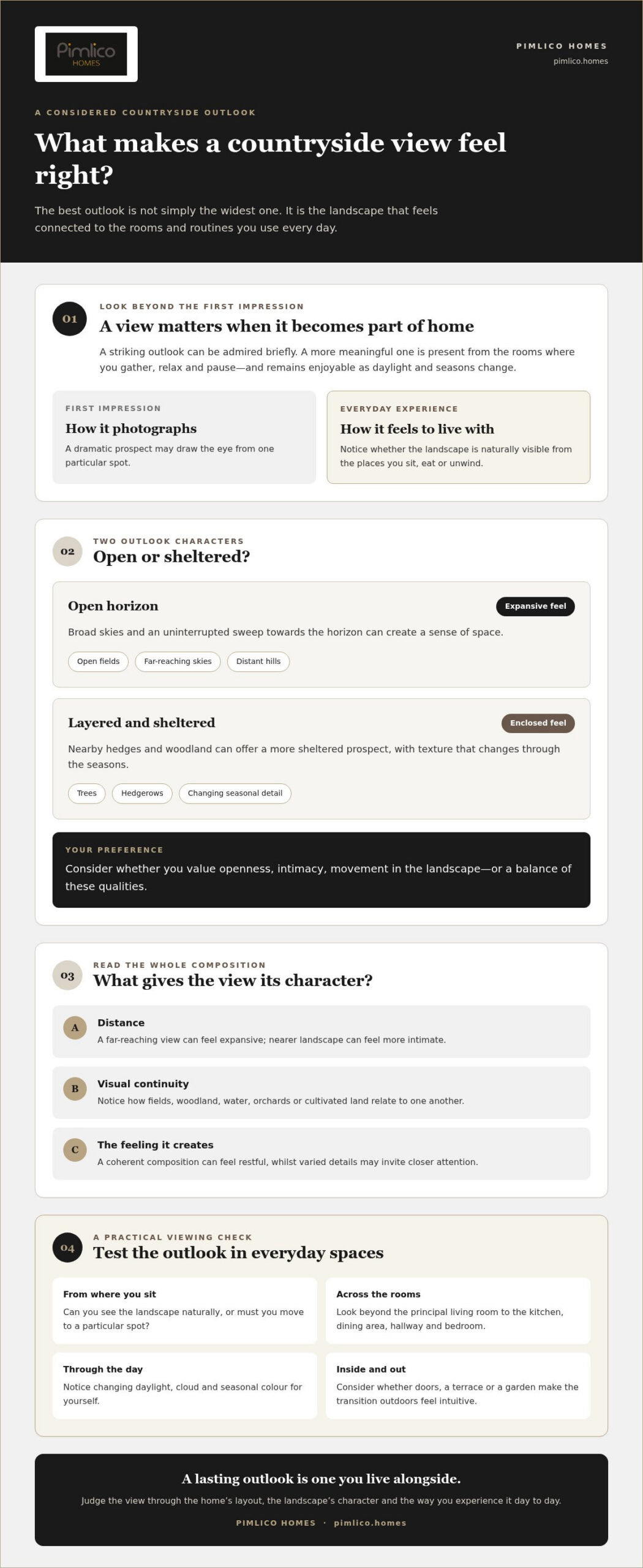
Distance and visual continuity shape the impression. An uninterrupted sweep towards the horizon can feel expansive, whilst nearer hedges and woodland may offer a more sheltered prospect with changing texture through the seasons. Look at how the elements relate: a coherent composition can feel restful, while a view with varied details may invite closer attention. Consider whether you prefer openness, intimacy, movement in the landscape or a balance of these qualities.
The word “villa” has often been associated with country living, though its meaning has evolved across periods and places. For a brief historical perspective, see History and definition of villas. The label alone cannot tell you how a home meets its landscape. Judge that through the outlook itself and the way the property is arranged around it.
Why the outlook matters beyond first impressions
A view can influence a room’s atmosphere over an ordinary day. Changing daylight, cloud and seasonal colour bring subtle variation; a glimpse of trees or open land can also make a room feel more connected to its surroundings. Experience these qualities for yourself rather than relying on a photograph or description.
Consider the room’s purpose as well as its prospect. A wide view might feel especially welcome in a shared living space, whilst a more enclosed outlook could suit a room intended for quiet. Notice whether you naturally turn towards the windows, whether the landscape is visible from where you sit, and whether the outlook remains part of the room during everyday routines. A setting becomes more than a backdrop when you encounter it from spaces you use and at different moments of the day.
How luxury home design can frame countryside views
A countryside outlook becomes part of a home when the architecture gives it a natural place in daily life. Room position, window placement, doorways and the route between inside and out all shape how readily the landscape is noticed. For buyers exploring luxury homes with countryside views, the question is not simply whether a view is visible, but whether the design connects it to the way the home is lived in.
There is no single plan that suits every property or household. A thoughtfully composed home responds to its site, balancing the outlook with practical needs such as comfortable room arrangements, privacy and useful circulation. Consider whether the design gives the landscape a considered presence without making every room dependent on it.
Sightlines, rooms and the view
Look beyond the principal living room. A view may shape the experience of a kitchen or dining area, provide a focal point from a hallway, or be glimpsed from a bedroom. Each connection can feel different: a direct prospect may draw the eye, whilst a framed view through an opening or across another part of the home can create a quieter sense of discovery.
Notice what you can see from the places where you might sit, eat or pause. Does the outlook appear naturally from the room, or must you move to a particular spot? A window’s position and proportions influence how the view is read, while the arrangement of walls and openings can guide attention from one space to another. Look for design choices that suit your routines, rather than assuming that a dramatic view from one position will work equally well throughout the home.
A considered relationship between interior and landscape
Doors leading to a terrace or garden can make the transition outdoors feel intuitive, while garden-facing rooms may establish a visual connection even when you remain inside. Look at how you reach the threshold and whether the outdoor space feels like a continuation of the home or a separate destination. Practical considerations can include privacy, amenities and how the setting fits your way of life. Read more about considerations for countryside living.
Materials and proportions also influence how a building sits within its surroundings. Timber, stone or carefully chosen finishes may echo the textures of a rural setting, while a restrained palette can let the landscape hold attention. These details work best when they feel coherent with the architecture rather than applied as decoration. Pay attention to the points where elements meet: the way a doorway, window or change in floor level is finished affects the character and ease of moving through the home.
Considered design turns a view from something you look at into something you live alongside. To explore how design and craftsmanship come together in bespoke homes, visit Pimlico Homes’ bespoke luxury homes.
Comparing countryside settings: outlook, privacy and everyday character
A rural setting can feel expansive, sheltered or lifted above the surrounding landscape. None is inherently better. Each creates a different relationship between the home, the countryside and nearby properties, so the right choice depends on what you want from day to day. When comparing luxury homes with countryside views, consider openness and privacy as separate qualities rather than assuming one guarantees the other.
Open horizons or a more sheltered rural outlook?
A broad horizon can give a room or garden a strong sense of space, with distant fields or sky drawing the eye outwards. By contrast, a sheltered outlook framed by trees, hedgerows or land contours may feel more intimate, with details close at hand. An elevated position can reveal a wider sweep of scenery, though its character depends on what lies around and below the home. Consider which atmosphere you would enjoy returning to, rather than judging a setting by its first impression alone.
The comparison below is a starting point, not a ranking. Actual sightlines depend on the property’s position and surroundings.
| Outlook | Openness | Sense of enclosure | Relationship to neighbouring homes |
|---|---|---|---|
| Open | Often broad, with long views across fields or sky | May feel less enclosed where the view extends far | Neighbours may be visible or screened, depending on orientation and distance |
| Enclosed | Views may be more contained by trees, hedges or landform | Can feel more sheltered and intimate | Planting or the lie of the land may affect visibility, but does not determine privacy alone |
| Elevated | May offer a wider prospect across the surrounding landscape | Can feel open, with enclosure shaped by the position and terrain | Higher sightlines may include neighbouring land or homes, depending on direction |
Balancing scenery with privacy
Privacy is not simply the absence of nearby homes. It also depends on where sightlines fall and how exposed particular spaces feel. A property may look across open land yet have a neighbouring window facing a terrace; another may have a more enclosed view but feel private in the rooms and outdoor areas you use most. Consider the outlook from living spaces, bedrooms and garden seating, and whether views into or out of those areas suit your preferences.
Think about the balance you want. You might welcome an expansive prospect from a principal room whilst preferring a more sheltered corner outdoors. You may value uninterrupted views even if neighbouring homes are occasionally visible in the distance. Neither preference is universal, so assess privacy in context rather than assuming it from a listing description.
When comparing homes, note what you can see from the windows and outdoor spaces that matter to you. Look across the landscape, then consider the reverse: which parts of the home are visible from nearby properties? This change in perspective can help you judge whether scenery, enclosure and privacy combine in a way that feels right for everyday living.
How to assess a luxury home with countryside views when viewing
Photographs can suggest the character of a setting, but a viewing shows how the landscape relates to the home itself. Take a deliberate route through the property, pausing in the rooms you expect to use most and spending time outdoors where accessible. Compare sightlines, room arrangements and the qualities you personally want from a rural outlook, rather than judging the property from one viewpoint.
A simple viewing sequence for assessing the outlook
Begin with the principal living spaces. Stand where you might sit or prepare a meal, not only beside the window, and notice what appears naturally in your view. Then move through the home and outside, comparing how the outlook changes between rooms, thresholds and garden areas.
- Start inside. From the main living areas, note the landscape in view and whether the room’s layout makes that outlook easy to enjoy during ordinary routines.
- Look from other key rooms. Consider bedrooms, dining spaces or a study. Notice whether views feel varied and connected, or concentrated in one part of the home.
- Step outdoors. Where the viewing allows, compare the outlook from a terrace, garden or other outdoor space. Notice how the home meets the landscape and which areas feel comfortable to spend time in.
- Record your priorities. Write down the features that matter most, such as distant views, a sheltered aspect, visible wildlife or a sense of separation from nearby homes.
Questions that clarify how the home will feel to live in
Pause before moving on. Ask yourself whether the outlook would still appeal during familiar routines, such as breakfast, reading or spending time with family. Consider whether you prefer a broad prospect, a more enclosed setting or different qualities in different rooms. Think about how much privacy you want and how readily you expect to use the outdoor space. These are personal judgements that a photograph cannot settle for you.
- Which room would I most want to spend time in, and what can I see from it?
- Does the outlook feel connected to everyday life, or is it mainly a striking first impression?
- How open or sheltered would I like the rooms and outdoor spaces to feel?
- What would I want to remember about the setting after leaving the viewing?
At each viewing, ask what you can see, how the home connects to it, and whether that relationship suits your everyday life. Brief notes make it easier to compare homes against your priorities rather than relying on memory alone. For broader guidance on selecting a luxury new build, read the luxury new build buying guide.
As you refine your search, explore Pimlico Homes’ luxury homes and consider the design qualities that matter most to you.
Choosing a luxury home with countryside views: craftsmanship and care
A compelling outlook can draw you towards a property, but a lasting choice rests on the home as a whole. The setting, architecture and quality of workmanship should feel considered together, so that the landscape complements everyday living rather than carrying the entire appeal. As you compare luxury homes with countryside views, look for a balance between visual character and the qualities that will matter after the first viewing.
Pimlico Homes develops luxury detached, bespoke and executive courtyard homes, alongside luxury barn conversions. Its residential work is guided by exceptional craftsmanship, innovation and timeless design. These are useful priorities for any buyer: careful workmanship can help a home feel coherent, while thoughtful design brings character without relying on passing trends.
Craftsmanship and timeless design as lasting priorities
Notice how a home’s details work together. The proportions of a room, the treatment of openings and the relationship between interior finishes can all contribute to a sense of cohesion. Innovation has a place when it supports considered design; timelessness comes from choices that feel measured and suited to the home’s character. No single feature guarantees that a property will suit you, but looking at the whole can help you judge whether its design feels enduring rather than built around one striking feature.
For buyers drawn to rural architecture, a barn conversion offers a distinctive point of reference. The modern barn conversion interiors guide explores how interior design can respect a building’s character whilst creating a refined place to live. It is one way to consider how heritage and contemporary sensibility can sit together.
A considered experience from reservation to handover
The quality of a significant home purchase is also shaped by the experience of moving through it. The Pimlico Pledge sets out Pimlico Homes’ customer-service commitment from reservation through handover of keys. It reflects the company’s focus on customer care throughout the journey from choosing a home to receiving the keys.
As you weigh up your priorities, reflect on what makes a property feel right: its architectural character, the care evident in its finish, and how its setting fits the life you want to lead. The landscape may be the first thing that captures your attention. Craftsmanship, design and a thoughtful customer experience complete the picture.
To explore Pimlico Homes’ approach to luxury residential design, craftsmanship and customer care, visit Pimlico Homes.
Let your priorities shape the next step
The right home should feel considered not only in its architecture, but in the way it supports the life you want to lead. As you continue exploring luxury homes with countryside views, use your priorities as a guide: the atmosphere you want to come home to, the spaces you value most and the relationship with the landscape that feels right to you.
Keep those priorities close as you explore. A clear sense of what matters can help you recognise a home whose setting and character resonate beyond the viewing, and give you confidence to take the next step at your own pace.
Explore Pimlico Homes’ luxury homes and discover a considered approach to luxury living. Begin with the view, then find its meaning in a home that feels suited to you.
Frequently Asked Questions
Do countryside views change throughout the year?
Yes. A countryside view can shift with the seasons and the land around a home. Crops may be planted or harvested, trees can gain or lose foliage, and daylight changes across the year. If a particular sightline matters to you, consider what might vary and what is likely to remain, such as the contours of the land or distant buildings. A view is a living part of its setting, not a fixed picture.
Can I enjoy countryside views without living in a remote home?
Yes. A home can have a rural outlook without being isolated; countryside scenery may be found near a village or amongst settled surroundings. The view and the degree of remoteness are separate considerations. As you look at luxury homes with countryside views, think about how you want to balance landscape with day-to-day connections, such as access to shops, services and social life. The ideal balance depends on how you expect to use your home and its surroundings.
Do countryside views have to be farmland?
No. A countryside outlook can include woodland, open grassland, orchards, waterways, heath or a varied mix of rural features. What matters is whether the setting appeals to you, not whether it fits one particular image of the countryside. Consider the character of the landscape and how it changes across the view. A patchwork of different elements may be just as compelling as a broad sweep of fields.
Can outdoor spaces make countryside views more enjoyable?
Yes. A garden, balcony or terrace can give you another vantage point and make it easier to spend time with the landscape outside the home. Consider where you might sit, whether there is room for dining or quiet relaxation, and whether you would value both a sheltered spot and a more open one. Picture how you would use the space on an ordinary afternoon, not only for a special occasion.
Are countryside-view homes suitable for contemporary interiors?
Yes. Contemporary interiors can sit comfortably within a rural setting when the design feels coherent with the home’s architecture. Clean-lined furniture, considered lighting and a restrained palette can provide a calm counterpoint to a landscape with changing colours and textures. Carefully chosen details can bring character without making the interior feel themed. During a viewing, imagine your own furnishings in the rooms and consider whether they would support the atmosphere you want.
What should I notice about a countryside view in poor weather?
Notice how the outlook reads when visibility is reduced or the light is subdued. Distant features may become less distinct, whilst nearer details in the landscape can remain prominent. Ask yourself whether the view still has interest without a bright sky or far-reaching panorama. You might also notice reflections in the windows and whether the prospect is enjoyable from several positions in the room. Poor weather offers a useful perspective, not a verdict on the home.





