Reserving a home can make it feel secured, but it is not the same as buying it. The luxury new build reservation process UK buyers encounter is a conditional milestone: it may hold a property for a set period while important decisions and checks still lie ahead.
It is natural to want clarity before paying a fee or committing to a deadline. Reservation terms can differ between developments, so do not assume a fee is refundable, every detail is settled or a reservation gives you the same protection as exchanging contracts.
This guide explains what a reservation agreement does, which terms to inspect and what to clarify before signing, including the fee, withdrawal provisions and timeframe for exchange. It also shows how reservation fits into the wider purchase, so you can keep conveyancing moving without rushing decisions or giving up useful flexibility. A 28-day reservation period is common, but check the written terms for the home you are considering. An independent solicitor experienced in new-build purchases can help you understand each step and what you are agreeing to.
Key Takeaways
- Use this luxury new build reservation process UK guide to identify what the paperwork records, including the property, fee, timescales and next steps.
- Compare the written terms rather than relying on assumptions about what a reservation agreement usually includes.
- Ask for clear answers about withdrawal and any extension process, and keep the responses with your records.
- Gather the relevant documents, note key dates and involve an independent conveyancing solicitor or licensed conveyancer early.
- Keep reservation paperwork accessible as you progress your checks, and make sure you understand each document before moving forward.
Luxury new-build reservation process UK: what reservation means before you commit
Reservation paperwork can feel decisive, particularly when you have found a home that suits your plans but have not yet exchanged contracts. The luxury new build reservation process UK buyers encounter starts with an initial written arrangement. What that arrangement does and how long it applies depend on its wording and the applicable law. It may record an intention to proceed and set out agreed next steps, but it is not, by itself, a guarantee that the purchase will complete.
Think of reservation as an early milestone, not the finish line. It is separate from exchanging contracts and from legal completion. Before signing or paying a fee, read the actual terms and ask for clarification where anything is unclear. Do not rely on what another developer, buyer or online guide says the process should be. The documents for the home you are considering are the relevant starting point.
What does reserving a new-build home usually involve?
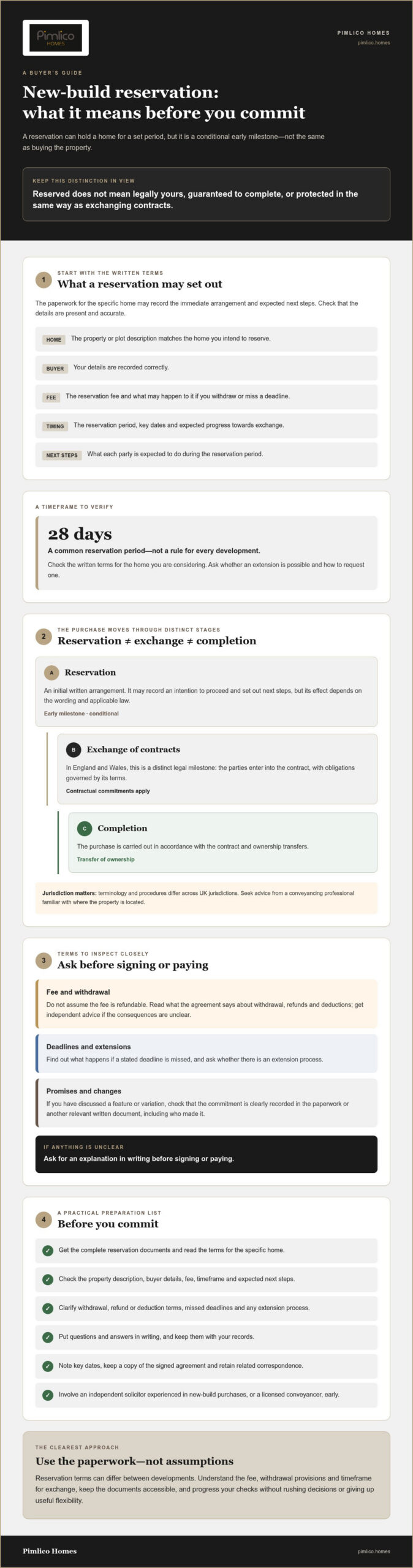
The developer’s written reservation terms may identify the home or plot, the prospective buyer, any reservation fee, the period for progressing the purchase and the next steps expected of each party. Check that these details are present and accurate. Pay particular attention to how the agreement describes the fee and what happens if you withdraw or miss a stated deadline.
There is no single process that applies to every development. The paperwork may set out specific conditions or timeframes, so ask for the complete documents and have any uncertainty addressed in writing. Keep a copy of the signed agreement and related correspondence.
Reservation, exchange and completion: how the stages differ
Reservation comes earlier in the transaction. It may set out arrangements while you and the developer progress towards a contract, but its effect depends on the terms and applicable law. It does not necessarily create the same commitments as a contract for sale.
In England and Wales, exchange of contracts is a distinct legal milestone: the parties enter into the contract, with their obligations governed by its terms. Completion comes later, when the purchase is carried out in accordance with that contract and ownership transfers. The legal process of transferring property ownership is often described as the UK conveyancing process. Terminology and procedures differ across UK jurisdictions, so seek advice from a conveyancing professional familiar with the jurisdiction where the property is located.
Until you understand the contract and reach the relevant legal milestones, treat reservation as conditional. It may give you a defined route towards purchase, but it does not, on its own, ensure that the sale will proceed or complete.
How a new-build reservation agreement works and what it does not settle
A reservation agreement puts an early stage of the purchase in writing, but its scope is not universal. Terms can vary between developers, properties and UK jurisdictions. In the luxury new build reservation process UK buyers should read the documents for the specific home, rather than assume a familiar-looking form carries standard conditions.
The agreement may identify the property and buyer, state any reservation fee and set out a period for progressing the transaction. It may also record what happens next. These details can clarify the immediate arrangements, but they do not settle every part of the purchase.
What may appear in the reservation paperwork?
Check that the property description matches the home you intend to reserve and that the buyer details are correct. Locate the stated fee and reservation period, then read the provisions on withdrawal, refunds, deductions and requests to extend the period. If a term is unclear, ask for an explanation in writing before signing or paying.
Review any promises or agreed changes carefully. For example, if you have discussed a particular feature or variation, check that the paperwork or another relevant written document records it clearly and identifies who made the commitment. A conversation alone may not give you the clarity you need later.
What a reservation does not automatically guarantee
Do not assume that paying a fee means it will be returned if you withdraw. The agreement’s wording and the law applicable to your circumstances matter, so obtain independent advice if you are unsure about the consequences. Reservation is not proof that the home is legally yours or that the purchase is bound to complete.
Planning matters, conveyancing, mortgage arrangements and exchange of contracts are separate parts of the wider transaction. A reservation does not, by itself, complete those checks or confirm that finance is in place. The details and timing depend on the property, transaction and relevant jurisdiction. Ask your conveyancing solicitor or licensed conveyancer how the terms apply to your circumstances.
Reservation terms are not a substitute for reviewing the purchase contract. Before proceeding, make sure you understand both the early agreement and the contract that may later govern the sale. To see the types of homes Pimlico Homes develops, explore its luxury new-build homes while reviewing the documents for any property you are considering.
New-build reservation agreement review: compare the terms, not assumptions
A careful review turns vague assurances into questions you can resolve before committing. In the luxury new build reservation process UK buyers should compare what the agreement actually says with what they have been told, rather than assume a fee, deadline or cancellation right works the same way across developments. Use the table as a prompt, then check each answer against the written terms.
| Clause | Question to ask | Point to verify |
|---|---|---|
| Reservation fee | How and when is it paid, and what does the agreement say happens to it? | Exact amount, payment timing, refund eligibility and any permitted deductions. |
| Reservation period | When does the period begin and end, and what steps are expected before it expires? | Dates, required actions and which party is responsible for each. |
| Withdrawal | What happens if I withdraw, the developer withdraws or a deadline is missed? | The written consequences and any conditions affecting repayment or release of the property. |
| Extension | Can the period be extended, and who must agree? | Whether an extension is possible, how to request one and how confirmation must be recorded. |
| Consumer-code coverage | Which code or scheme applies to this purchase? | The developer’s stated coverage, its scope and the process or remedies it describes. |
Reservation fee and withdrawal: what should buyers check?
Read the fee clause closely. Find the exact wording on payment, refund eligibility, deductions and timing, rather than relying on a verbal summary or a fee policy from another development. Check what the agreement says if you withdraw, the developer withdraws or a deadline passes. If the answer is unclear, request clarification in writing and seek independent conveyancing advice before deciding. Do not assume a particular refund outcome without checking the terms and applicable law.
Deadlines, changes and written commitments
Enter each stated date in your calendar and note who must act by then. If the paperwork allows an extension, establish how to request it and make sure any approval is documented. Treat changes to the specification or other agreed points with the same care: check which document records them and who has confirmed them. Your conveyancer can compare the reservation paperwork with later contract papers and flag inconsistencies for you to resolve.
Consumer-code coverage and any available remedies depend on the developer, the applicable scheme and the relevant jurisdiction. Confirm which applies to your purchase and read its terms. A general reference to a code is not a substitute for checking the agreement itself.
Before signing a UK new-build reservation agreement: a buyer’s checklist
A considered purchase begins with clear documents and enough time to understand them. In the luxury new build reservation process UK buyers should weigh any stated reservation deadline against the practical steps ahead, including mortgage arrangements, valuation and legal checks. Use this sequence to organise your review before signing or paying.
- Obtain the documents. Request the complete reservation agreement and every term or document it refers to. Ask for the relevant property details and written information about the next steps.
- Check the terms. Read the clauses on the fee, payment, withdrawal, refunds, deductions, deadlines, extensions and variations. Confirm the property and buyer details are accurate.
- Ask questions. Seek written clarification of any ambiguous wording. Establish who to contact about the reservation and how payment and documents will be acknowledged.
- Take independent advice. Where possible, ask an independent conveyancing solicitor or licensed conveyancer to review the agreement before you sign. Share the paperwork and related correspondence.
- Retain records. Keep the signed documents, payment acknowledgement and written answers together. Record deadlines, who must act and any agreed changes.
Questions to ask the developer before paying a reservation fee
Ask for the full agreement before deciding whether to proceed. If provisions on refunds, withdrawal, deadlines or variations are unclear, request an explanation in writing and check that it matches the wording in the documents. Confirm how the reservation payment will be acknowledged and who can answer practical questions. A clear written record helps distinguish a confirmed term from an assumption.
When to ask your conveyancer to review the agreement
Involve your conveyancer early, especially if a clause could affect your decision or the fee. Provide the reservation paperwork, sales correspondence and any written assurances, then ask how the relevant UK jurisdiction affects the agreement and later contract process. Allow time for mortgage arrangements, valuation and legal checks alongside the stated deadline. Do not assume each step will be completed within it.
For context beyond the reservation stage, read our luxury new-build buying guide, which sets out the wider purchase journey. You can also explore Pimlico Homes’ luxury new-build homes while considering the paperwork and advice you need.
After reserving a luxury new-build home: clear next steps with Pimlico Homes
Reservation is a point in the purchase journey, not a reason to set the paperwork aside. Keep the process moving by recording what has been agreed, when the next steps are due and which questions still need answers. In the luxury new build reservation process UK buyers should confirm property-specific details with the developer and ask an independent conveyancer about legal or contractual concerns.
Keep the purchase moving without overlooking the detail
Bring the documents together in one place, whether in a secure digital folder or a physical file. Keep the signed agreement, payment records, correspondence and written clarifications so you can refer to the exact wording as the transaction progresses.
Diary every date stated in the agreement and note who is expected to act. If a milestone, response or change is unclear, ask promptly and keep the reply. Continue with independent legal checks, and refer contract questions to your conveyancing solicitor or licensed conveyancer. A reservation does not replace the need to understand the purchase contract before proceeding.
Explore a luxury new-build purchase with confidence
Alongside the legal process, confirm practical details about the specific home directly with the developer. Make sure information you rely on is current and recorded in writing where appropriate. Your independent adviser is the right person to consult about how the agreement or contract affects your circumstances. Pimlico Homes does not provide legal advice.
Pimlico Homes develops luxury detached homes, executive courtyard homes and bespoke homes, with a focus on craftsmanship and considered residential design. To learn more about its residential developments and enquire about homes that may suit your plans, Explore Pimlico Homes. Take the next step at your own pace, with the documents understood and the right advice in place.
Take your next step with clarity
A reservation can mark meaningful progress towards a new home, but the written terms deserve careful attention. The luxury new build reservation process UK buyers follow is not a substitute for understanding the purchase contract or taking independent conveyancing advice. Check the fee, deadlines and withdrawal provisions in the documents for the home you are considering, and keep written records of any clarifications.
With those details in hand, you can move forward with a clearer understanding of what the reservation does and what remains to be confirmed before exchange and completion. The right home is a significant investment. It merits a measured decision, supported by clear information and advice tailored to your circumstances.
Pimlico Homes develops luxury residential properties, including detached, courtyard and bespoke new-build homes, with a focus on high-quality craftsmanship. Explore Pimlico Homes’ residential developments and enquire about homes that may suit your plans.
Frequently Asked Questions
Is a new-build reservation agreement legally binding in the UK?
It may create obligations, but its legal effect depends on the agreement’s wording, the circumstances and the relevant UK jurisdiction. A reservation agreement is distinct from the contract for sale and does not necessarily commit both parties to complete the purchase. Check what it says about the fee, reservation period and withdrawal, and ask an independent conveyancing solicitor or licensed conveyancer to explain any clauses you are unsure about.
Can I get my reservation fee back if I change my mind?
It depends on the written terms and the law that applies, so do not assume the fee is refundable. Look for clauses covering withdrawal, refund eligibility, deductions and any conditions or deadlines. If the agreement is unclear, request written clarification before paying and get independent advice about your circumstances. Also check what the documents say if the developer withdraws or the transaction cannot proceed for another reason.
What should I check in a new-build reservation agreement?
Confirm the property and buyer details, the fee and when it must be paid, the reservation period and what each party is expected to do next. Read the terms for withdrawal, refunds, deductions, missed deadlines and extensions. Check how agreed variations or promises are recorded, and ask which consumer code or scheme applies. The luxury new build reservation process UK buyers follow can differ, so rely on the documents for the specific property.
Does reserving a new-build home mean I own it?
No. Reservation is an early stage and does not, by itself, transfer ownership or guarantee that the purchase will complete. The sale proceeds through separate legal steps, including exchange of contracts and completion, with the precise process depending on the jurisdiction and transaction. Keep progressing your conveyancing checks, and ask your independent adviser what the reservation means for your purchase before treating the home as legally yours.
How long does a new-build reservation last?
The period is set out in the agreement and can vary by developer and property. A 28-day reservation period is common, but it is not a universal rule or a substitute for checking your own paperwork. Confirm when the period starts and ends, what actions are expected before expiry and whether an extension can be requested. Record the dates and get any agreed extension confirmed in writing.
Can a developer change the terms after I reserve a new-build home?
Do not assume either that terms can be changed freely or that they can never change. The answer depends on the agreement, the nature of the proposed change and applicable law. Ask the developer to explain any change in writing, identify the relevant clause and provide an updated document if appropriate. Have your conveyancer compare it with the original reservation terms and later contract papers before you agree or proceed.
Should a solicitor review a new-build reservation agreement before I sign?
Independent legal advice before signing can help you understand the fee, deadlines, withdrawal terms and any clauses that may affect your purchase. Choose a conveyancing solicitor or licensed conveyancer with relevant new-build experience, and share the full agreement, referenced documents and related correspondence. They can advise on how the terms apply to your circumstances and jurisdiction. Pimlico Homes can provide property information, but it does not provide legal advice.