
When investing in luxury property, the strongest case for a home may not be the promise of growth, but how well it serves your plans over time. A substantial commitment can offer quality, comfort and a sense of permanence, yet future appeal depends on more than an impressive finish.
It’s reasonable to ask what supports lasting value, how different property types compare and whether a premium home could prove difficult to resell. No home can guarantee an investment return, so a considered decision starts with clear-eyed scrutiny of its strengths, costs and trade-offs.
This guide offers a practical framework for assessing design, specification, usability and the risks that come with a significant commitment. It compares detached homes, courtyard homes, bespoke new builds and barn conversions, helping you judge whether a particular property aligns with your priorities. The aim is not to predict performance, but to help you make a decision with care and confidence.
Key Takeaways
- Assess a luxury property against your personal aims, ownership responsibilities and possible future value, not its prestige alone.
- Use completed-sale evidence alongside asking prices to build a more grounded view of a property’s position in the market.
- Compare detached homes, courtyard homes, contemporary new builds and barn conversions by privacy, upkeep, flexibility, character and buyer appeal.
- Test affordability and possible exit options, recognising that market shifts, financing and selling conditions can affect the outcome.
- Use a clear shortlist of objectives, evidence and practical fit to decide whether a luxury home, including Pimlico Homes’ residential options, suits your plans.
What does investing in luxury property mean in 2026?
Luxury property can carry two kinds of significance: it is a place to live and a substantial asset with costs, responsibilities and an uncertain future value. Investing in a premium home means assessing it against your aims, the demands of ownership and the possibility that its value may change. It is not simply a matter of choosing the most impressive address or specification.
The distinction matters. A carefully considered interior, quality craftsmanship and a practical layout may strengthen a home’s appeal to you and to future buyers. They cannot guarantee capital growth or a particular resale price. A high-quality home may be a pleasure to own, but it is never a guaranteed high-performing investment.
For a broad introduction to what sits within this distinctive property category, Understanding Luxury Real Estate offers useful context. For a purchase decision, however, the essential question is more personal: what do you need this property to do?
Which investment objective are you trying to achieve?
Rank your priorities before comparing homes. Capital preservation, potential appreciation, lifestyle value and future flexibility can all matter, but they are not interchangeable. A home chosen for daily comfort may justify features that have personal value, while an income-focused asset would be assessed against different measures, such as costs and potential income. Be clear about which aims are essential and which are secondary.
This helps separate a considered preference from an assumption about returns. A generous kitchen or secluded garden may be central to how you want to live, but neither is evidence of future performance. Write down your financial and personal priorities, then use that list to judge whether a property’s character and practical qualities fit your plans.
Why does a premium property need a longer view?
Purchase timing, the length of ownership and conditions at the point of sale can all shape the eventual outcome. Property is illiquid: unlike an asset that can be sold quickly on a market, a home may take time to find a suitable buyer and complete a sale. If your circumstances require a swift exit, account for that before committing.
There is no universal holding period that makes a premium home a sound investment. Consider whether you could remain comfortable with ownership if selling took longer than hoped or market conditions were less favourable. Include the ongoing responsibilities of maintaining the property in your assessment, not only the initial appeal of its design.
A measured decision brings these strands together. Look beyond finish and prestige to the home’s enduring usability, the demands it places on you and how it fits your priorities. That perspective doesn’t remove uncertainty, but it gives you a more disciplined basis for deciding whether the commitment feels right.
How to assess the investment fundamentals of a luxury property
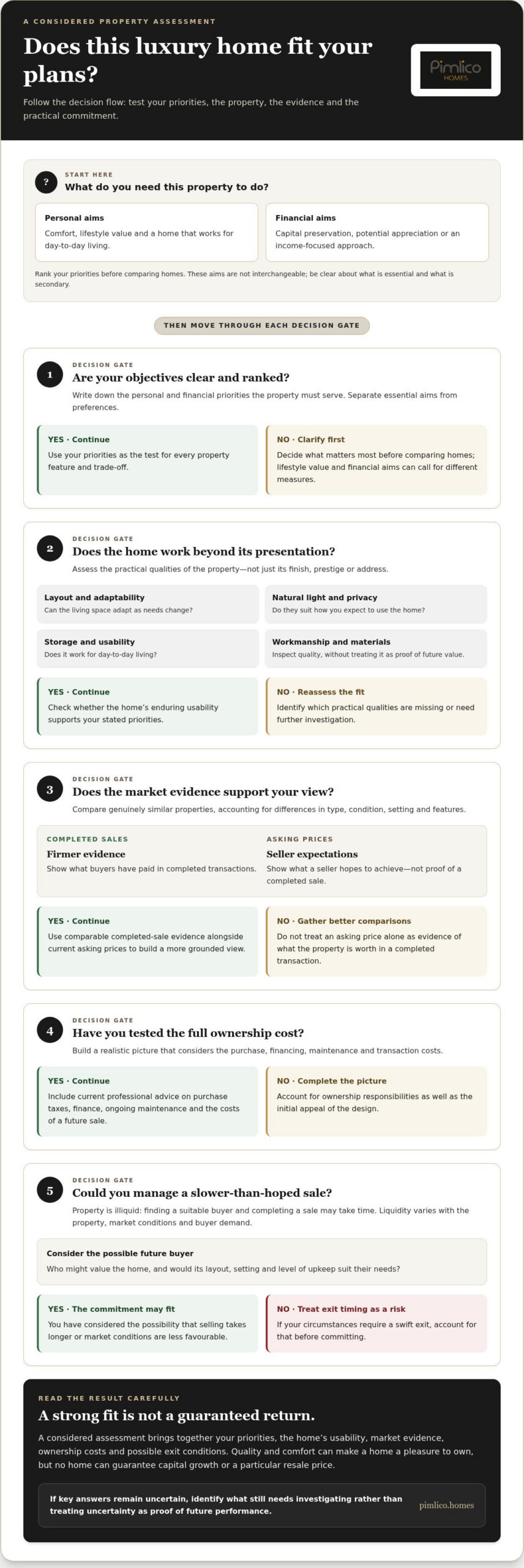
A disciplined assessment turns an appealing viewing into a decision grounded in evidence. Establish what you want the home to achieve, examine its qualities and costs, then consider how readily it might suit someone else in future. This sequence keeps the key questions in view without treating any feature as a promise of growth.
- Define your objectives. Set out the financial and personal priorities the property must serve, and rank them before viewing.
- Assess the home. Look beyond presentation to layout, natural light, privacy, storage, adaptability and the quality of the workmanship.
- Examine market evidence. Compare genuinely similar properties, paying attention to completed transactions as well as current asking prices.
- Test affordability. Build a full ownership picture that includes the purchase, financing, maintenance and transaction costs.
- Consider an exit. Think about who might value the home in future and whether you could accommodate a sale taking time.
Comparisons are most useful when they account for meaningful differences in property type, condition, setting and features. An asking price records what a seller hopes to achieve; it is not proof of what a buyer has paid. Comparable completed sales offer firmer evidence of market behaviour than asking prices alone, which show only the seller’s ambition. A wider perspective on the decisions involved in property investment is available in Forbes’ Real Estate Investment Strategies.
What makes a luxury home resilient to changing buyer preferences?
Consider how the home works day to day. Is there useful storage, good natural light, privacy and living space that can adapt as needs change? Inspect craftsmanship and materials carefully, but treat them as factors to assess, not automatic evidence of future value. Enduring usability may matter beyond a fashionable finish or short-lived design trend.
How should you test affordability and a future exit?
Build a realistic ownership budget with current professional advice on purchase taxes, finance, ongoing maintenance and the costs involved in a future sale. Then consider the likely future buyer: what needs might the layout, setting and level of upkeep suit? This is not a prediction of when you will sell. Liquidity varies with the property, market conditions and buyer demand.
Use the exercise to identify what you still need to investigate, rather than to manufacture certainty. A carefully specified home may offer quality and comfort, yet it remains one part of a wider financial picture. If thoughtful craftsmanship and enduring usability are central to your criteria, explore Pimlico Homes’ luxury homes as part of your comparison.
Luxury detached homes, courtyard homes and conversions: compare the investment trade-offs
Property type shapes the experience of ownership, but it cannot establish future performance or resale demand on its own. Compare how a home’s privacy, upkeep, flexibility and character match your priorities. The same feature can be an advantage to one household and a compromise to another.
| Home type | Privacy | Maintenance considerations | Layout flexibility | Character and potential buyer appeal |
|---|---|---|---|---|
| Luxury detached home | Often offers greater separation from neighbouring homes. | Outdoor areas and the wider property may require more attention. | May suit households seeking distinct living and private spaces. | Can appeal to buyers prioritising space and independence. |
| Executive courtyard home | May offer a more enclosed outdoor setting, with the degree of privacy depending on the design. | A more contained exterior may mean different upkeep demands. | Consider whether the arrangement supports daily routines and changing needs. | May attract buyers who value a considered, lower-sprawl layout. |
| Contemporary new build | Depends on the site plan, orientation and relationship to neighbouring homes. | Review materials, specification and ongoing care requirements. | Modern planning may offer practical, adaptable spaces. | May suit buyers drawn to contemporary design and a cohesive specification. |
| Barn conversion | Varies with its setting and the arrangement of surrounding buildings. | Assess the condition and care needs of the converted structure and its materials. | Existing architectural features can shape how rooms are arranged or adapted. | Distinctive character may appeal to buyers seeking an individual home. |
What might distinguish a luxury detached home from a courtyard home?
A detached home may suit those who prize separation, generous outdoor areas or room for different household activities. That space can also bring more exterior upkeep. A courtyard home may offer a more contained setting and a closer relationship between indoor and outdoor living. Consider how much privacy, garden space and day-to-day maintenance you actually want, rather than assuming either format is inherently more desirable.
How should you weigh a new build against a barn conversion?
A contemporary new build may offer a coherent modern layout and specification, while a barn conversion can centre on retained architectural character. Neither is automatically easier to maintain or adapt. Look closely at how the spaces function, the materials and workmanship, and whether distinctive features support practical living. A considered specification matters most when it serves lasting usability, not simply a current design preference.
Use the comparison as a prompt for questions, not a league table. Picture ordinary routines: where you work, how you host, what outdoor space you will use and how your needs could change. Then weigh those answers against the property’s upkeep and the qualities likely to matter to a future buyer. A new-build purchasing guide and an article on barn-conversion interiors can offer further design context as you refine your preferences.
What risks and assumptions should luxury property buyers challenge?
A premium finish can make a home feel exceptional, but it cannot promise capital growth. A luxury property purchase still exposes a buyer to changing market conditions, finance costs, maintenance demands and the circumstances in which a future sale takes place. The purchase price alone does not reveal how resilient an investment may be.
Be cautious of confident projections built on asking prices, selected past performance or promotional language. Asking prices show what sellers hope to achieve, not necessarily what buyers have paid. Past transactions provide context, but cannot guarantee future demand. Treat any forecast as an assumption to test, not a result to rely on.
Before committing, consider how the purchase might feel under three scenarios: optimistic, expected and downside. What if the property takes longer to sell, borrowing costs change, or maintenance is higher than anticipated? If a calculation depends on a single favourable outcome, it may not reflect the full risk. Check any numerical market example against current, reliable evidence before allowing it to influence a decision.
Which assumptions can distort an investment decision?
Luxury buyers can mistake exclusivity for immunity from market shifts. A distinctive home may appeal strongly to some buyers and less readily to others; neither its finish nor its past performance settles its future value. Challenge projections by asking what evidence supports each assumption, whether comparisons are genuinely similar, and how the conclusion changes if demand or sale timing is less favourable than expected.
- Market conditions: Buyer demand and achievable sale terms can change.
- Financing: Review how borrowing costs and terms affect affordability over time.
- Ownership: Allow for continuing maintenance and the care required by the property.
- Resale: A narrower pool of prospective buyers may affect how long a sale takes.
What due diligence can reduce avoidable uncertainty?
Before exchange, review the title, relevant planning information, survey findings and contract terms with appropriately qualified independent advisers. A solicitor can advise on legal matters; a surveyor can interpret the property’s condition; and financial or tax advice can be tailored to your circumstances. Review relevant warranties and supporting documentation, without treating their presence as proof of investment performance.
Due diligence is a form of risk management, not a guarantee against loss or an assurance of future value. Its purpose is to help you understand what you are buying, identify issues that may affect ownership and make a decision with fewer unanswered questions. The right checks depend on the property and your plans, so seek advice suited to the particular purchase.
Once your priorities and risk tolerance are clear, explore Pimlico Homes’ luxury residential developments as options to consider alongside your assessment. A measured decision brings the home’s design and craftsmanship into view without mistaking them for a promise of financial return.
Choosing a luxury home that fits your investment goals
A considered purchase brings personal priorities, evidence and financial comfort into the same frame. The aim is not to identify a home that guarantees a particular outcome. It is to find a property whose qualities and ownership demands make sense for your plans, while remaining clear-eyed about uncertainty.
Before comparing individual homes, write down your objectives and separate essential requirements from attractive extras. A beautiful architectural detail may capture the imagination, but it should not obscure practical questions about space, upkeep, adaptability or affordability. The shortlist below can help turn broad intentions into consistent criteria.
How can you turn your priorities into a practical shortlist?
Rank the qualities that matter most to you, such as privacy, space, character, manageable upkeep and adaptable rooms. Record essentials separately from preferences, then assess each prospective home against the same criteria. This makes trade-offs visible: a more distinctive setting, for example, may matter more to you than a particular finish, or vice versa.
- Objectives: Be clear about the personal and financial purpose of the purchase.
- Evidence: Note what supports your view of the property, including comparable completed sales and relevant documentation.
- Affordability: Consider the full purchase and ownership picture with advice appropriate to your circumstances.
- Fit: Judge the home’s layout, specification and care needs against your essential requirements.
Apply the same questions to every property. A consistent comparison helps prevent an impressive first viewing or persuasive presentation from shifting the criteria halfway through your search. It also gives you a clearer basis for identifying which compromises are acceptable and which would undermine the purpose of the purchase.
What should a considered next step look like?
Review the homes and development information available, then compare their design, specification and practical qualities with your shortlist. Pimlico Homes develops luxury detached homes, executive courtyard homes, bespoke new builds and high-end barn conversions, with a focus on residential homes and high-quality craftsmanship. These different forms may suit different priorities; none should be treated as a promise of financial performance.
Before making legal or financial commitments, arrange independent advice that reflects the property and your circumstances. Legal, financial, survey and tax advice can help you understand the matters relevant to your decision. Prepare focused questions about the home, its documentation and the details that matter most to your intended use.
A measured enquiry begins with your requirements: what kind of home you are seeking, which qualities are essential and what information would help you assess its fit. Take time to compare, revisit your assumptions and decide only when the property and the commitment feel aligned.
Explore Pimlico Homes and consider which home best fits your priorities.
Take your next step with confidence
A significant property decision deserves more than an appealing first impression. Give yourself space to reflect on what you want ownership to bring to your life, as well as what you’re prepared to commit. The right choice is personal: it should feel compelling today and remain aligned with your priorities as they evolve.
Let your next step be a focused one. Revisit the qualities that matter most, note any questions still unanswered and use those questions to guide your exploration. There’s no need to force a decision before the detail feels clear. A measured pace can help you distinguish genuine fit from initial excitement.
Explore homes with care, taking time to consider how their design, setting and craftsmanship would shape everyday living. Explore Pimlico Homes’ luxury residential developments and discover which possibilities resonate with your plans. With clear priorities and thoughtful consideration, you can move towards a choice that feels both distinctive and right for you.
Frequently Asked Questions
Does luxury property always increase in value?
No, a luxury property can fall in value as well as rise. Premium features may attract particular buyers, but market conditions, affordability and ownership costs also shape what a buyer may ultimately pay. Consider whether the property remains worthwhile to you if its value stays unchanged or falls, and account for how maintenance and selling expenses could affect the amount you receive.
Is a luxury new build a good investment?
It can suit your objectives, but a new build is not automatically a good investment. Assess whether its layout, specification and energy performance align with your intended use, and review its Energy Performance Certificate and relevant warranty documents. Check any ongoing charges associated with the property or development, where applicable. Compare the home with suitable completed sales, then consider whether its qualities justify the commitment for your circumstances.
How long should you hold a luxury property investment?
There is no fixed holding period that suits every buyer. Set a horizon that reflects your finances and likely life plans, rather than relying on a general rule about how long property should be owned. Consider whether you could continue to meet ownership costs if circumstances delayed a sale, and whether your borrowing arrangements remain suitable over that time. Review the plan if your needs or financial position change.
What should I check before buying a luxury home as an investment?
Check that the property’s legal and practical details match what you believe you are buying. Alongside a survey and legal review, examine boundaries, access arrangements, restrictions affecting use and any documentation relating to alterations or building work. Confirm what is included in the sale and understand the property’s energy information. A solicitor and other qualified advisers can explain which checks matter for the specific home and your circumstances.
Can a home’s design affect its resale appeal?
Yes, design can influence which future buyers find a home attractive, although it cannot guarantee demand or a sale price. Flexible rooms, clear circulation, useful storage and a considered relationship between indoor and outdoor spaces can support everyday use across different household needs. Highly individual features may be a strong point for some buyers and less relevant to others, so assess distinctive design alongside practical function.
Should I buy a luxury property for rental income or capital growth?
Neither objective is universally preferable; the right emphasis depends on your finances, responsibilities and tolerance for uncertainty. For a rental strategy, assess likely income against periods without a tenant, upkeep, tax and relevant landlord obligations, taking current professional advice. A capital-growth aim depends on future market conditions and is not assured. If the home is primarily for your own use, weigh its personal value separately from either financial objective.





